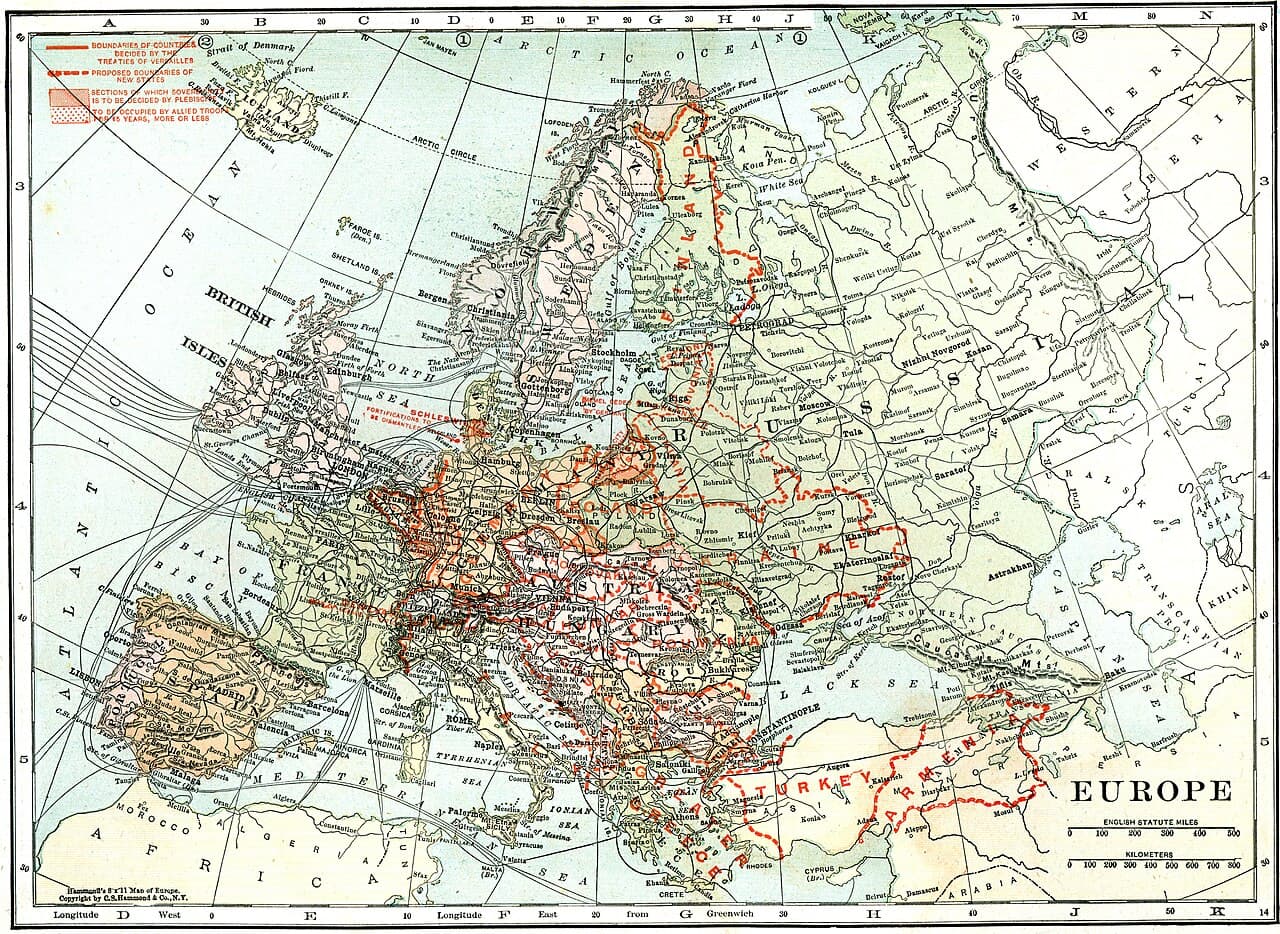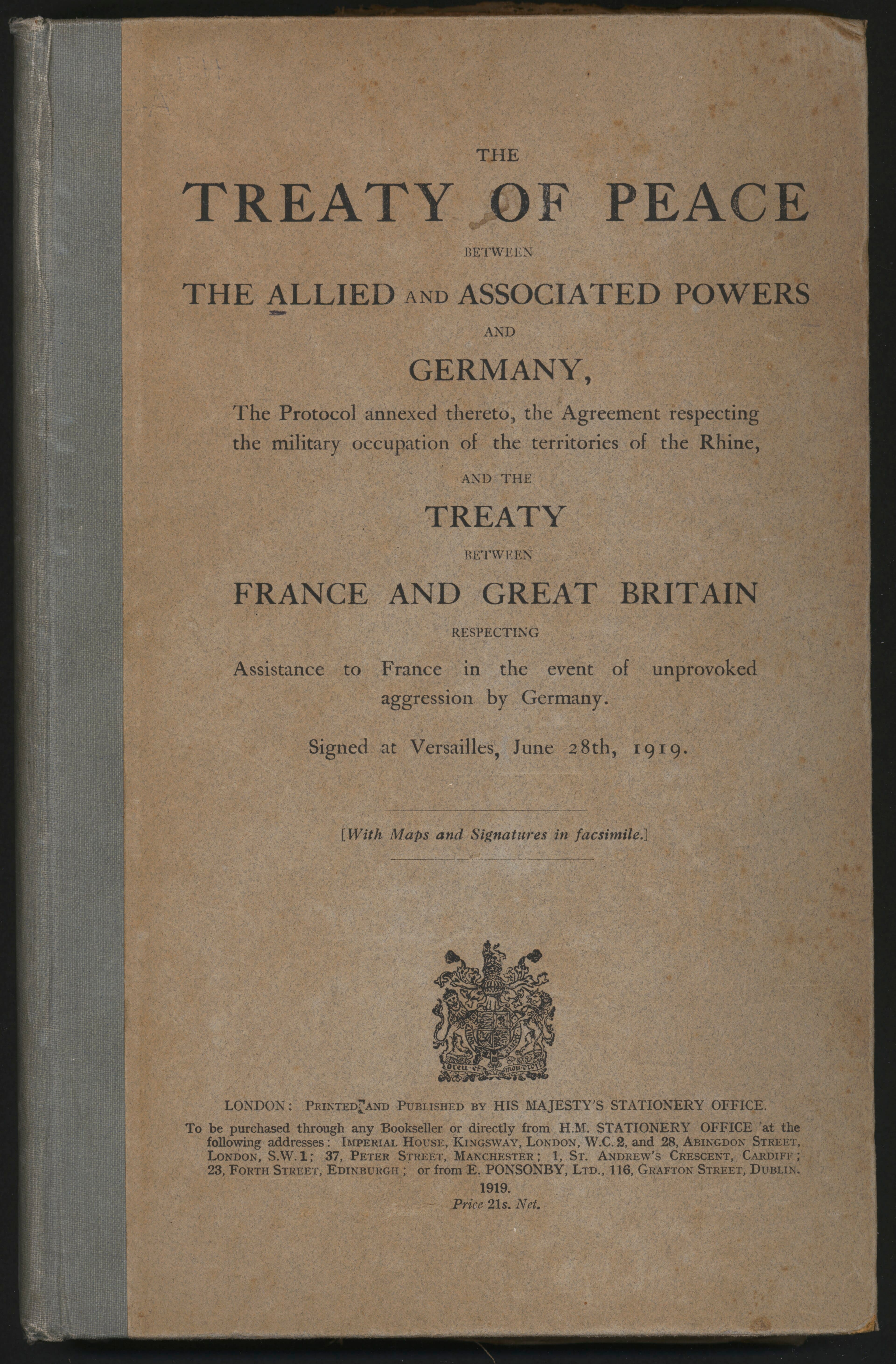
The Treaty of Versailles, signed on June 28, 1919, was the peace agreement that formally ended World War I between Germany and the Allied Powers. It imposed sweeping territorial losses, a crippling $33 billion reparations bill (roughly $500 billion in today's money), strict military limitations, and the notorious 'War Guilt Clause' that forced Germany to accept sole responsibility for the war. Historians widely regard it as one of the most consequential — and most contested — diplomatic documents in modern history, because its punitive terms fuelled the economic devastation, nationalist resentment, and political extremism that brought Adolf Hitler to power and ignited World War II just two decades later.
What Was the Historical Background to the Treaty of Versailles?
World War I, which began in August 1914 and ended with the Armistice of November 11, 1918, killed an estimated 20 million people and left Europe economically shattered. The Allied Powers — principally France, Britain, the United States, and Italy — convened the Paris Peace Conference in January 1919 to negotiate the postwar settlement. The chief architects of the treaty were the 'Big Four': U.S. President Woodrow Wilson, British Prime Minister David Lloyd George, French Premier Georges Clemenceau, and Italian Prime Minister Vittorio Orlando. Germany, crucially, was not invited to participate in the negotiations. German delegates were summoned to Versailles only to receive the final draft and sign it — a humiliation that would echo through the Weimar Republic's short, turbulent life. The treaty was signed in the Hall of Mirrors at the Palace of Versailles — the same room where, in 1871, the German Empire had been proclaimed after defeating France in the Franco-Prussian War. That symbolic choice was deliberate and was not lost on Germany.
What Were the Main Terms of the Treaty of Versailles?
The treaty contained 440 articles spanning territorial changes, military restrictions, reparations, and the creation of new international institutions. The most politically explosive provision was Article 231, universally known as the 'War Guilt Clause,' which assigned Germany and its allies full moral and legal responsibility for all losses and damages caused by the war. This provided the legal foundation for the reparations demand. Territorially, Germany lost approximately 13 percent of its prewar territory and 10 percent of its population — about 7 million people. Alsace-Lorraine, seized from France in 1871, was returned. The Rhineland was demilitarised and placed under Allied occupation for 15 years. Germany lost the Saar coalfields to League of Nations administration, Eupen and Malmedy to Belgium, North Schleswig to Denmark (following a plebiscite), Memel to Lithuania, and large portions of Prussia and Silesia to the newly created Poland, severing East Prussia from the German mainland via the 'Polish Corridor.' Germany also surrendered all overseas colonies, which were redistributed as 'mandates' to Britain, France, Japan, and other Allied states. Militarily, the German army was capped at 100,000 men, the navy was limited to 15,000 sailors and no submarines, and Germany was forbidden to possess an air force, tanks, or heavy artillery. The General Staff — the brain of the German military machine — was dissolved. On the international institutional side, the treaty's Part I established the League of Nations, Woodrow Wilson's cherished project for collective security. With bitter irony, the U.S. Senate refused to ratify the treaty, and America never joined the very organization its president had championed.
| Provision | Specific Requirement | Impact on Germany |
|---|---|---|
| War Guilt Clause (Art. 231) | Germany accepts full blame for WWI | Legal basis for reparations; national humiliation |
| Reparations | $33 billion (£6.6 billion) to be paid over decades | Economic collapse, hyperinflation by 1923 |
| Territorial Loss | 13% of territory, including Alsace-Lorraine, Polish Corridor | 7 million Germans placed under foreign rule |
| Military Limits | Army capped at 100,000; no air force, submarines, or tanks | Stripped great-power military status |
| Rhineland | Demilitarised zone; Allied occupation for 15 years | Germany unable to defend its western border |
| Colonies | All overseas colonies surrendered | Loss of prestige and resources |
| League of Nations | Germany excluded from joining until 1926 | Diplomatic isolation reinforced |
Why Was the War Guilt Clause So Controversial?
Article 231 was arguably the single most inflammatory clause in the entire treaty. German politicians across the political spectrum — from Social Democrats to nationalists — united in condemning it as a 'lie.' Modern historians, including Christopher Clark in his 2012 work 'The Sleepwalkers,' argue that responsibility for World War I was genuinely shared among all the major powers, and that Germany was not uniquely or solely guilty. At the time, German Foreign Minister Count Brockdorff-Rantzau protested vigorously before being forced to sign under threat of resumed military operations. The clause fed directly into the 'stab-in-the-back myth' (Dolchstoßlegende) — the toxic conspiracy theory promoted by German nationalists, including Hitler, which claimed that Germany had not lost the war militarily but had been betrayed from within by Jews, socialists, and democrats. This narrative became one of the most dangerous political weapons of the 20th century.
How Did the Reparations Demand Destabilise the Weimar Republic?
The Reparations Commission set Germany's total liability at 132 billion gold marks (approximately $33 billion) in May 1921, divided into tranches. The figure was staggering for a country already devastated by four years of total war. Germany made its first reparations payment in 1921 but quickly fell behind. When Germany defaulted on timber deliveries in January 1923, France and Belgium occupied the Ruhr — Germany's industrial heartland — to extract payment in kind. The German government responded with 'passive resistance,' ordering workers to strike and printing money to pay them. The result was the catastrophic hyperinflation of 1923, in which the exchange rate collapsed from 4.2 marks per U.S. dollar in 1914 to 4.2 trillion marks per dollar by November 1923. Middle-class savings were wiped out overnight, radicalising millions of Germans. Economist John Maynard Keynes had warned this would happen in his prescient 1919 book 'The Economic Consequences of the Peace,' in which he argued the reparations were economically irrational and morally unjust. The Dawes Plan (1924) and Young Plan (1929) later restructured payments, but the Great Depression after 1929 made even the reduced schedule impossible to meet. Germany made its final reparations payment — €94 million in interest on the original bonds — on October 3, 2010, nearly 92 years after the war ended.
How Did Different Nations React to the Treaty of Versailles?
Reactions to Versailles split sharply along national lines. In Germany, the treaty was universally reviled as the 'Diktat' — a dictated peace — and its signatories were labelled 'November criminals.' The first Weimar government that signed it fell within months. In France, Clemenceau was criticised from the opposite direction: many French politicians felt the treaty was not harsh enough and had not delivered the permanent security France needed after losing 1.4 million soldiers. Marshal Ferdinand Foch famously remarked, 'This is not a peace. It is an armistice for twenty years' — a prediction that proved accurate to within seven months. In Britain, initial public approval quickly gave way to guilt and revisionism; the 'appeasement' policies of the 1930s were partly driven by genuine British belief that Germany had been treated too harshly. Italy, which had entered the war on the Allied side expecting significant territorial gains, received far less than promised — fuelling what Italian nationalists called the 'mutilated victory' and boosting Mussolini's fascist movement. In the United States, Senators Henry Cabot Lodge and his Republican majority rejected the treaty over concerns about the League of Nations and America's sovereignty, leaving Woodrow Wilson's legacy in ruins.
What Role Did Woodrow Wilson's Fourteen Points Play?
In January 1918, President Wilson had outlined his vision for a just peace in his 'Fourteen Points' speech, which included self-determination for peoples, freedom of the seas, open diplomacy, arms reduction, and the creation of a League of Nations. Germany agreed to the Armistice partly on the understanding that the final peace would be based on Wilson's principles. The contrast between those promises and the actual treaty terms was stark. Self-determination, for instance, applied to Poles, Czechs, and Slovaks but explicitly not to Germans: the 3.5 million ethnic Germans in the Sudetenland (in the new Czechoslovakia) and the 6–7 million Germans in Austria were forbidden from uniting with Germany. Wilson himself compromised several of his own points under pressure from Clemenceau and Lloyd George, and returned to America politically broken. He suffered a severe stroke in October 1919 while touring the country to build public support for the treaty and the League, and never fully recovered. The Senate voted against ratification twice, in November 1919 and March 1920.
Why Did the Treaty of Versailles Help Cause World War II?
The causal link between Versailles and World War II is one of the most discussed questions in modern historiography. The treaty created conditions that were, as historian Margaret MacMillan has argued, 'neither a peace of reconciliation nor a peace of absolute destruction' — it was punitive enough to enrage Germany but not thorough enough to permanently weaken it. Hitler's entire political programme was built on reversing Versailles: remilitarising the Rhineland (March 1936), annexing Austria in the Anschluss (March 1938), seizing the Sudetenland at Munich (September 1938), and ultimately occupying all of Czechoslovakia (March 1939). Each step was rhetorically framed as correcting the injustices of 1919, and each step was met with appeasement by Britain and France — nations whose leaders genuinely doubted the moral legitimacy of the treaty they were defending. The reparations-driven economic devastation of the Weimar Republic, the political violence it enabled, and the psychological wound of the War Guilt Clause created the conditions in which Hitler could rise from failed artist to German Chancellor between 1919 and 1933.
What Was the Long-Term Legacy of the Treaty of Versailles?
The Treaty of Versailles reshaped the map of Europe and the world in ways still visible today. It created or enlarged at least nine new European states — including Poland, Czechoslovakia, Yugoslavia, and Finland — and dissolved the Ottoman, Austro-Hungarian, and Russian empires. Its colonial provisions set in motion the process that eventually led to decolonisation in Africa and Asia, though not in the way its architects intended. The failure of the League of Nations, fatally weakened by American absence and the exclusion of Germany and the Soviet Union, became the central lesson that drove the creation of the more inclusive United Nations in 1945. The contrast between the punitive Versailles settlement and the generous Marshall Plan (1948) — which deliberately avoided repeating Versailles's economic mistakes after World War II — is one of the most instructive case studies in the entire history of international relations. The treaty was formally superseded by the Treaty on the Final Settlement with Respect to Germany, signed on September 12, 1990, as part of German reunification — effectively closing the last legal chapter opened in the Hall of Mirrors in 1919.