The Iranian Revolution of 1979 was a popular uprising that overthrew Shah Mohammad Reza Pahlavi and replaced Iran's monarchy with an Islamic republic led by Ayatollah Ruhollah Khomeini. Between January and February 1979, decades of political repression, economic inequality, and cultural resentment converged to produce one of the twentieth century's most consequential revolutions. The revolution fundamentally transformed Iran's government, society, and foreign policy, and its shockwaves continue to shape geopolitics across the entire Middle East today.
What Were the Deep Causes of the Iranian Revolution?
The roots of the revolution stretched back decades before 1979. Mohammad Reza Shah, who had ruled Iran since 1941, accelerated a sweeping modernisation programme in 1963 known as the White Revolution. This series of reforms — land redistribution, women's suffrage, literacy campaigns, and the sale of state-owned enterprises — was designed to secularise and Westernise Iranian society. However, the programme alienated the powerful Shia clerical establishment, displaced millions of rural peasants without delivering promised prosperity, and enriched a narrow urban elite while leaving the working class and bazaar merchants behind. The Shah's secret police, SAVAK, founded in 1957 with CIA and Mossad assistance, ruthlessly suppressed political opposition, torturing and killing thousands of dissidents. By the mid-1970s, Iran's oil windfall — revenues jumped from $4 billion in 1973 to $20 billion by 1975 — fuelled rampant inflation and corruption rather than broad-based development, deepening public anger. Intellectuals on the left, Islamist activists, and liberal nationalists all found common cause in opposing the Shah's autocratic rule.
Who Was Ayatollah Khomeini and Why Did He Matter?
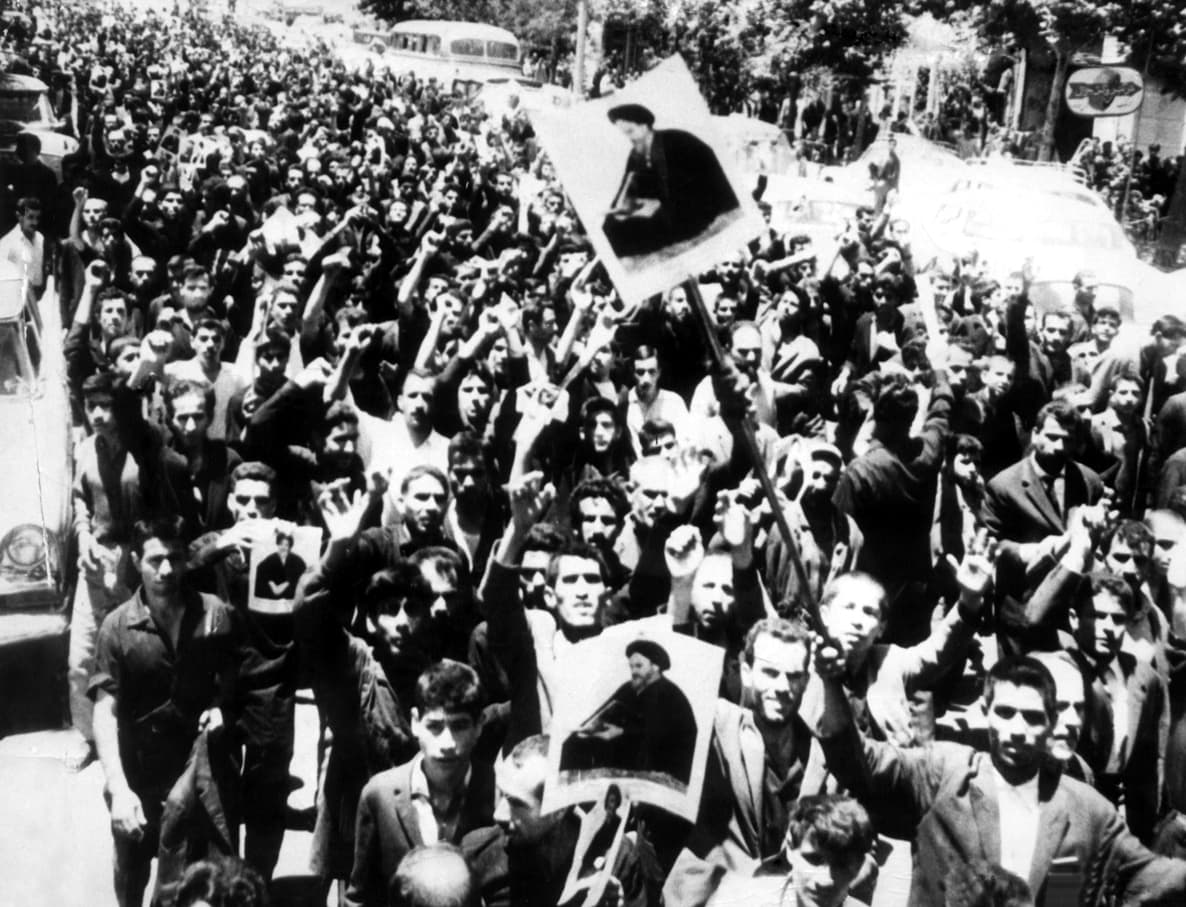
Ruhollah Musavi Khomeini, born in 1902 in the town of Khomein, was a senior Shia cleric who had publicly opposed the Shah since the early 1960s. After leading protests against the White Revolution, he was arrested in 1963, triggering the bloody June 1963 uprising in which hundreds of demonstrators were killed by security forces. He was exiled in 1964, first to Turkey, then to the Shia holy city of Najaf in Iraq, and finally — after Iraqi pressure in late 1978 — to Neauphle-le-Château near Paris, France. From exile, Khomeini distributed revolutionary sermons on cassette tapes that were smuggled into Iran and played in mosques throughout the country, reaching millions of listeners. He articulated a radical political theory called Velayat-e Faqih — the Guardianship of the Islamic Jurist — which held that a senior cleric should govern an Islamic state until the return of the Hidden Imam. This ideology gave the revolution its distinctive theocratic character and set it apart from every other major revolution of the twentieth century. Khomeini's austere image, combined with his uncompromising opposition to both American imperialism and Soviet communism, gave him near-universal appeal among opposition groups who would later discover they had very different visions of post-revolutionary Iran.
How Did the Revolution Unfold: A Timeline of Key Events in 1978–1979
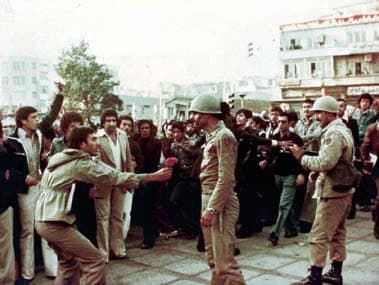
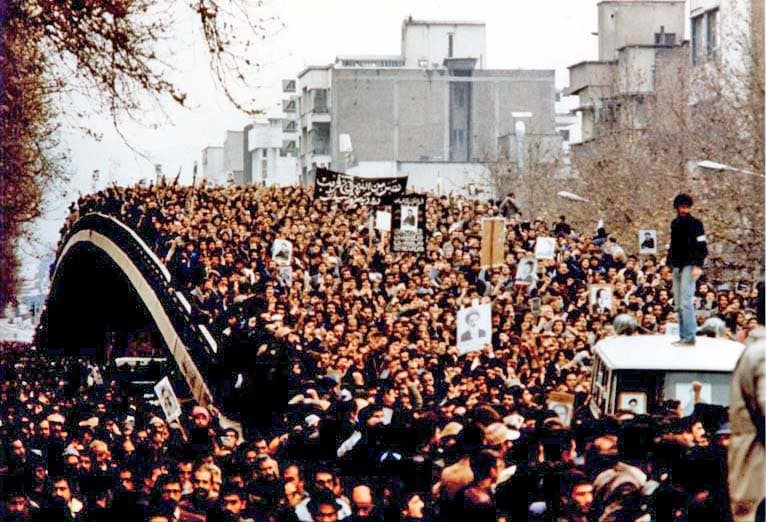
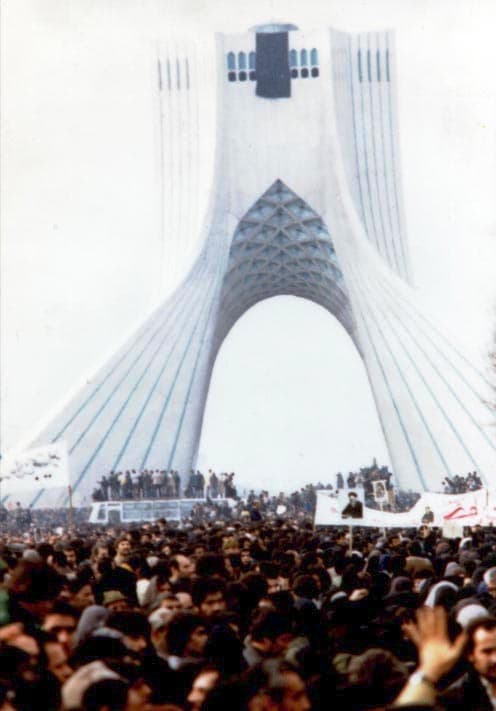
The revolution gathered momentum through a series of escalating crises in 1978. On 7 January 1978, a government-planted newspaper article slandered Khomeini, triggering protests in the holy city of Qom that were violently suppressed, killing several seminarians. Shia mourning customs dictated memorial protests every 40 days, creating a self-reinforcing cycle of demonstrations and crackdowns throughout the year. On 8 September 1978 — a day remembered as Black Friday — security forces opened fire on protesters in Jaleh Square in Tehran, killing between 84 and hundreds of demonstrators depending on the source. The massacre radicalised millions of moderates. By October and November 1978, a general strike paralysed oil production, cutting Iran's output from 6 million barrels per day to barely 1 million. The Shah declared martial law, appointed a military government under General Gholam Reza Azhari in November, but could not restore order. On 16 January 1979, Mohammad Reza Shah left Iran, never to return; he died in exile in Cairo, Egypt, on 27 July 1980. Khomeini flew back to Tehran on 1 February 1979, greeted by an estimated crowd of between 3 million and 5 million people — one of the largest public gatherings in recorded history. On 11 February 1979, the imperial army declared neutrality, the last pillars of the old state collapsed, and the revolution was complete. A national referendum held on 30–31 March 1979 approved the establishment of an Islamic republic by 98.2 percent of voters.
What Happened During the US Hostage Crisis of 1979–1981?
The revolution's most internationally explosive episode began on 4 November 1979, when a group of Islamist students calling themselves 'Students Following the Imam's Line' seized the United States Embassy in Tehran and took 66 American diplomats and staff hostage. The students were outraged that President Jimmy Carter had allowed the ailing Shah to enter the United States for medical treatment. Khomeini endorsed the takeover, transforming what began as a student action into a state-sanctioned crisis. The 444-day standoff — the longest hostage crisis in modern American history — paralysed the Carter administration. A military rescue attempt, Operation Eagle Claw, ended disastrously on 24 April 1980 when eight US servicemen died in a helicopter collision in the Iranian desert. The crisis contributed decisively to Carter's defeat by Ronald Reagan in the November 1980 presidential election. The 52 remaining hostages were finally released on 20 January 1981 — minutes after Reagan was inaugurated — as part of the Algiers Accords, which unfroze $7.9 billion in Iranian assets frozen by the United States.
How Did the Revolution Change Iranian Society?
The establishment of the Islamic Republic brought sweeping social transformation. The new constitution, ratified in December 1979, created a dual governmental structure: elected institutions such as the presidency and parliament coexisted with powerful unelected theocratic bodies, most importantly the Supreme Leader and the Guardian Council. Sharia law was codified; alcohol was banned, women were required to wear the hijab in public, and mixed-gender socialisation in public spaces was restricted. Tens of thousands of political opponents — leftists, liberals, monarchists, and ethnic minorities including Kurds and Arabs — were imprisoned or executed in the years following the revolution. Amnesty International documented at least 2,000 executions in 1981 alone, and estimates for political killings during 1981–1988 range from 7,000 to over 30,000. Simultaneously, the new government invested heavily in rural infrastructure, literacy, and healthcare: the adult literacy rate rose from roughly 50 percent in 1979 to over 85 percent by the early 2000s. University enrolment expanded dramatically, and paradoxically Iran today has one of the highest rates of female university graduates in the region.
Why Did the Iran-Iraq War Follow So Closely After the Revolution?
On 22 September 1980, Iraqi President Saddam Hussein launched a full-scale invasion of Iran, initiating one of the bloodiest conflicts of the late twentieth century. Saddam calculated that the revolutionary chaos had left Iran's military vulnerable, and he sought to seize the oil-rich Khuzestan province and establish Iraqi dominance in the Persian Gulf. He also feared that Khomeini's Shia revolutionary ideology would inspire Iraq's own Shia majority to revolt. The war lasted eight years, ending in an August 1988 ceasefire that the UN brokered. Estimates of total casualties range from 500,000 to over 1 million dead on both sides. The war hardened the Islamic Republic's revolutionary ideology, eliminated most internal opposition under the guise of wartime necessity, and cemented the Revolutionary Guards Corps (IRGC) as a dominant political and economic institution in Iran. The conflict also introduced chemical weapons on a large scale — Iraq used mustard gas and nerve agents against both Iranian troops and Kurdish civilians — a war crime that received little Western condemnation at the time.
| Factor | Pre-Revolution Iran (1978) | Post-Revolution Iran (1980s) |
|---|---|---|
| Government type | Constitutional monarchy | Islamic republic (theocracy) |
| Head of state | Shah Mohammad Reza Pahlavi | Supreme Leader Ayatollah Khomeini |
| Legal system | Civil / secular law | Sharia-based law |
| Women's dress code | No state mandate | Mandatory hijab law (1983) |
| US relations | Close ally; $10bn+ in arms sales | Hostile; embassy seized; sanctions |
| Oil output (barrels/day) | ~6 million (1978) | ~1.5 million (1981, wartime low) |
| Political parties | Restricted but present | Most banned; IRP dominant until 1987 |
| Adult literacy rate | ~50% (1979) | ~70% by 1990, rising to 85% by 2000 |
What Is the Lasting Geopolitical Legacy of the Iranian Revolution?
The 1979 revolution reshaped the Middle East in ways that remain visible today. Iran became the primary state sponsor of Shia militant organisations across the region: Hezbollah in Lebanon, founded with Iranian support in 1982, Hamas in Gaza, and various Shia militias in Iraq and Yemen. This 'Axis of Resistance' network has been a persistent source of regional instability and confrontation with Israel, Saudi Arabia, and the United States. The revolution also triggered a broader Sunni-Shia rivalry, with Saudi Arabia dramatically increasing funding for Wahhabi institutions worldwide in a bid to counterbalance Iranian ideological influence. Iran's nuclear programme, which became a major international crisis from the early 2000s onward, is a direct legacy of revolutionary self-reliance ideology and the traumatic experience of fighting Iraq with limited outside support. The 2015 Joint Comprehensive Plan of Action (JCPOA), the 2018 US withdrawal under President Trump, and ongoing negotiations reflect how the revolution's geopolitical consequences remain unresolved more than four decades later. Domestically, the Islamic Republic has faced persistent challenges: the 1999 student protests, the 2009 Green Movement following disputed elections, the 2019 fuel-price protests in which security forces killed an estimated 1,500 people, and the 2022 Woman, Life, Freedom uprising sparked by the death of 22-year-old Mahsa Amini in morality police custody. Each wave of protest demonstrates that the tensions the revolution unleashed have never been fully contained.
How Has the Iranian Revolution Influenced Global Politics and Islam?
Beyond the Middle East, the Iranian Revolution demonstrated that a mass popular movement could topple a well-armed, Western-backed government through sustained civil disobedience and strikes — a lesson studied by revolutionary movements worldwide. It proved that political Islam could be a governing ideology, not merely an opposition movement, influencing Islamist parties from Egypt's Muslim Brotherhood to groups in Southeast Asia. The revolution also provoked a sharp reassessment of US foreign policy: Washington's failure to foresee the Shah's collapse despite deep intelligence investment led to institutional reforms in how the CIA analysed political risk. The revolution's anti-imperialist rhetoric resonated in Cold War contexts across Africa, Latin America, and Asia, even among non-Muslim liberation movements. Scholars including Nikki Keddie, Ervand Abrahamian, and Hamid Dabashi have debated whether the revolution was primarily Islamist, nationalist, or a populist revolt against modernisation gone wrong. The most persuasive consensus is that it was all three simultaneously — a collision of class, culture, and geopolitics that no single ideology can fully explain.