
The Industrial Revolution, sometimes called the First Industrial Revolution in contrast to the subsequent Second Industrial Revolution, was a transitional period of the global economy toward more widespread, efficient and stable manufacturing processes, succeeding the Second Agricultural Revolution. Beginning in Great Britain around 1760, the Industrial Revolution had spread to continental Europe and the United States by about 1840. Economic historians agree that the onset of the Industrial Revolution is the most important event in human history, comparable only to the adoption of agriculture with respect to material advancement.
This transition included going from hand production methods to machines; new chemical manufacturing and iron production processes; the increasing use of water power and steam power; the development of machine tools; and rise of the mechanised factory system. Output greatly increased, and the result was an unprecedented rise in population and population growth. Many technological and architectural innovations were British. By the mid-18th century, Britain was the leading commercial nation, with GDP per capita considerably over the world average. The textile industry was the first to use modern production methods, and textiles became the dominant industry in terms of employment, value of output, and capital invested.
The precise start and end of the Industrial Revolution is debated among historians, as is the pace of economic and social changes. Rapid adoption of mechanized textiles spinning occurred in Britain in the 1780s, and high rates of growth in steam power and iron production occurred after 1800. Mechanised textile production spread from Britain to continental Europe and the US in the early 19th century.

A recession occurred from the late 1830s when the adoption of the Industrial Revolution's early innovations, such as mechanised spinning and weaving, slowed as markets matured despite increased adoption of locomotives, steamships, and hot blast iron smelting. New technologies such as the electrical telegraph, widely introduced in the 1840s in the UK and US, were not sufficient to drive high rates of growth. Rapid growth reoccurred after 1870, springing from new innovations in the Second Industrial Revolution. These included steel-making processes, mass production, assembly lines, electrical grid systems, large-scale manufacture of machine tools, and use of advanced machinery in steam-powered factories.
The Industrial Revolution influenced almost every aspect of life. In particular, average income and population began to exhibit unprecedented sustained growth, with the standard of living improving for most in the Western world, though others have said it did not begin to improve meaningfully until the 20th century. Prior to the Industrial Revolution, most manufacturing occurred in China and India; after the Industrial Revolution, most manufacturing took place in North America and Western Europe.
Etymology
The earliest recorded use of "Industrial Revolution" was in 1799 by French envoy Louis-Guillaume Otto, announcing that France had entered the race to industrialise. Raymond Williams states: "The idea of a new social order based on major industrial change was clear in Southey and Owen, between 1811–18, and was implicit as early as Blake in the early 1790s and Wordsworth at the turn of the [19th] century." The term Industrial Revolution applied to technological change became more common by the 1830s, as in Jérôme-Adolphe Blanqui's description in 1837 of la révolution industrielle. Friedrich Engels in The Condition of the Working Class in England in 1844 spoke of "an industrial revolution, a revolution which...changed the whole of civil society". His book was not translated into English until the late 19th century, and the expression did not enter everyday language till then. Credit for its popularisation is given to Arnold Toynbee, whose 1881 lectures gave a detailed account of the term.

Economic historians such as Mendels, Pomeranz, and Kridte argue proto-industrialisation in parts of Europe, the Islamic world, Mughal India, and China created the social and economic conditions that led to the Industrial Revolution, thus causing the Great Divergence. Some historians, such as John Clapham and Nicholas Crafts, have argued that the economic and social changes occurred gradually and that revolution is a misnomer.
Requirements
Several key factors enabled industrialisation. High agricultural productivity—exemplified by the British Agricultural Revolution—freed up labor and ensured food surpluses. The presence of skilled managers and entrepreneurs, an extensive network of ports, rivers, canals, and roads for efficient transport, and abundant natural resources such as coal, iron, and water power further supported industrial growth. Political stability, a legal system favorable to business, and access to financial capital also played crucial roles. Once industrialisation began in Britain in the 18th century, its spread was facilitated by the eagerness of British entrepreneurs to export industrial methods and the willingness of other nations to adopt them. By the early 19th century, industrialisation had reached Western Europe and the United States, and by the late 19th century, Japan.
Important technological developments
The commencement of the Industrial Revolution is closely linked to a small number of innovations, beginning in the second half of the 18th century. By the 1830s, the following gains had been made in important technologies:
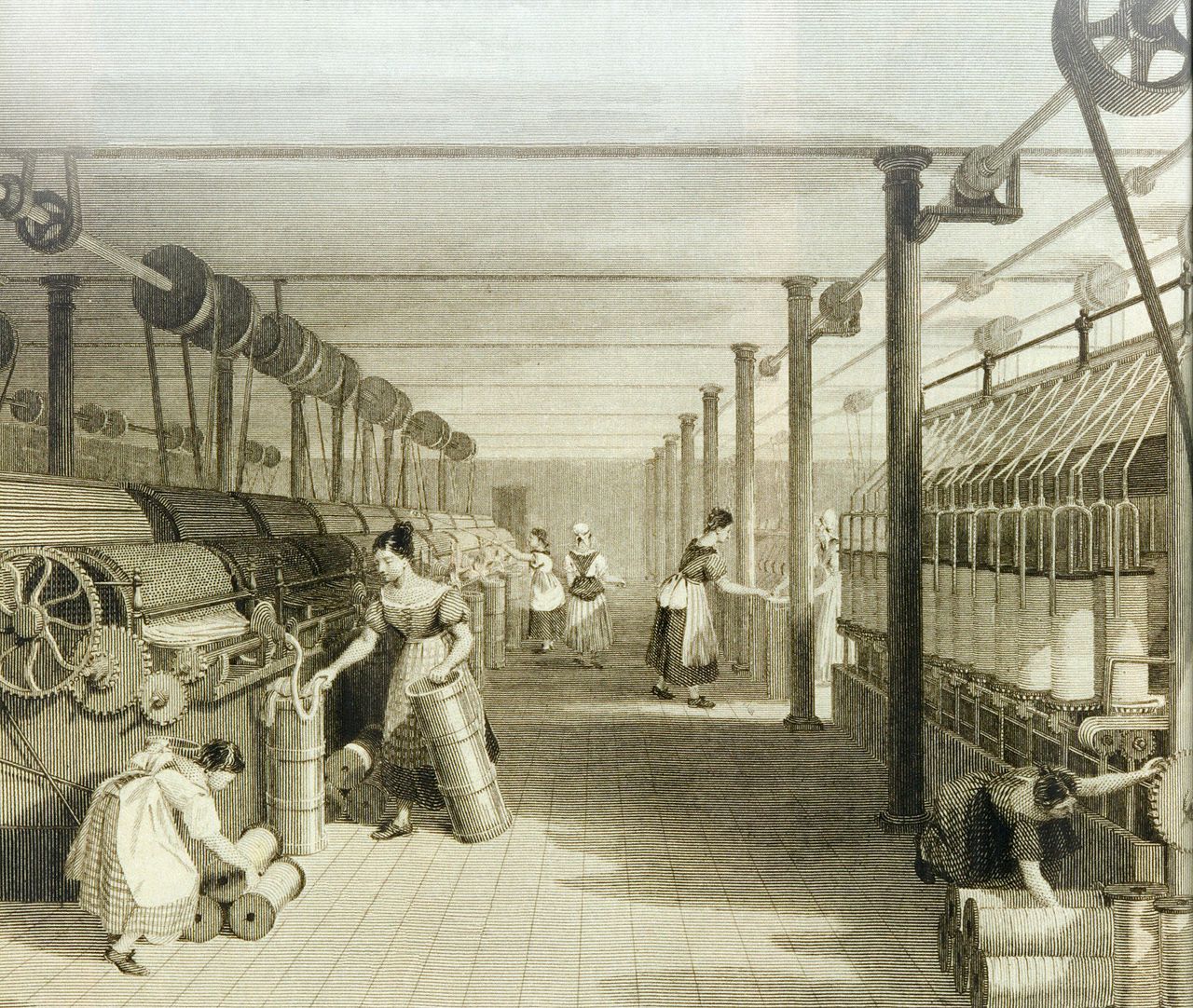
Textiles – mechanised cotton spinning powered by water, and later steam, increased output per worker by a factor of around 500. The power loom increased output by a factor of 40. The cotton gin increased productivity of removing seed from cotton by a factor of 50. Large gains in productivity occurred in spinning and weaving of wool and linen, but were not as great as in cotton.
Steam power – the efficiency of steam engines increased so they used between one-fifth and one-tenth as much fuel. The adaptation of stationary steam engines to rotary motion made them suitable for industrial uses. The high-pressure engine had a high power-to-weight ratio, making it suitable for transportation. Steam power underwent a rapid expansion after 1800.
Iron-making – the substitution of coke for charcoal greatly lowered the fuel cost of pig iron and wrought iron production. Using coke also allowed larger blast furnaces, resulting in economies of scale. The steam engine began being used to power blast air in the 1750s, enabling a large increase in iron production by overcoming the limitation of water power. The cast iron blowing cylinder was first used in 1760. It was improved by making it double acting, which allowed higher blast furnace temperatures. The puddling process produced structural grade iron at lower cost than the finery forge. The rolling mill was fifteen times faster than hammering wrought iron. Developed in 1828, hot blast greatly increased fuel efficiency in iron production.

Invention of machine tools – the first machine tools were the screw-cutting lathe, the cylinder boring machine, and the milling machine. Machine tools made the economical manufacture of precision metal parts possible, although it took decades to develop effective techniques for making interchangeable parts.
Textile manufacture
British textile industry
In 1750, Britain imported 2.5 million pounds of raw cotton, most of which was spun and woven by the cottage industry in Lancashire. The work was done by hand in workers' homes or master weavers' shops. Wages were six times those in India in 1770 when productivity in Britain was three times higher. In 1787, raw cotton consumption was 22 million pounds, most of which was cleaned, carded, and spun on machines. The British textile industry used 52 million pounds of cotton in 1800, and 588 million pounds in 1850.
The share of value added by the cotton industry in Britain was 2.6% in 1760, 17% in 1801, and 22% in 1831. Value added by the woollen industry was 14% in 1801. Cotton factories numbered about 900 in 1797. In 1760, approximately one-third of cotton cloth manufactured was exported, rising to two-thirds by 1800. In 1781, cotton spun amounted to 5 million pounds, which increased to 56 million pounds by 1800. In 1800, less than 0.1% of world cotton cloth was produced on machinery invented in Britain. In 1788, there were 50,000 spindles in Britain, rising to 7 million over the next 30 years.

Wool
The earliest European attempts at mechanised spinning were with wool; however, wool spinning proved more difficult to mechanise than cotton. Productivity improvement in wool spinning during the Industrial Revolution was significant, but less than cotton.
Silk
Arguably the first highly mechanised factory was John Lombe's water-powered silk mill at Derby, operational by 1721. Lombe learned silk thread manufacturing by taking a job in Italy and acting as an industrial spy; however, because the Italian silk industry guarded its secrets, the state of the industry at that time is unknown. Although Lombe's factory was technically successful, the supply of raw silk from Italy was cut off to eliminate competition. To promote manufacturing, the Crown paid for models of Lombe's machinery which were exhibited in the Tower of London.
Cotton
Parts of India, China, Central America, South America, and the Middle East have a history of hand-manufacturing cotton textiles, which became a major industry after 1000 AD. Most cotton was grown by small farmers alongside food and spun in households for domestic consumption. In the 1400s, China began to require households to pay part of their taxes in cotton cloth. By the 17th century, almost all Chinese wore cotton clothing, and it could be used as a medium of exchange. In India, cotton textiles were manufactured for distant markets, often produced by professional weavers.

Cotton was a difficult raw material for Europe to obtain before it was grown on colonial plantations. Spanish explorers found Native Americans growing sea island (Gossypium barbadense) and upland cotton (Gossypium hirsutum). Sea island cotton was exported from Barbados from the 1650s. Upland cotton was uneconomical because of the difficulty of removing seed, a problem solved by the cotton gin. A strain of cotton seed brought from Mexico to Natchez, Mississippi, in 1806 became the parent genetic material for 90% of world production today; it produced bolls three to four times faster to pick.
Trade and textiles
The Age of Discovery was followed by colonialism beginning around the 16th century. Following the discovery of a trade route to India around southern Africa by the Portuguese, the British founded the East India Company, and other countries founded companies, which established trading posts throughout the Indian Ocean region.
A large segment of this trade was in cotton textiles, which were purchased in India and sold in Southeast Asia, including the Indonesian archipelago where spices were purchased for sale to Southeast Asia and Europe. By the 1760s, cloth was over three-quarters of the East India Company's exports. Indian textiles were in demand in Europe, where previously only wool and linen were available; however, cotton goods consumed in Europe was minor until the early 19th century.
Pre-mechanized European textile production
By 1600, Flemish refugees began weaving cotton in English towns where cottage spinning and weaving of wool and linen was established. They were left alone by the guilds who did not consider cotton a threat. Earlier European attempts at cotton spinning and weaving were in 12th-century Italy and 15th-century southern Germany, but these ended when the supply of cotton was cut off.
British cloth could not compete with Indian cloth because India's labour cost was approximately one-fifth that of Britain's. In 1700 and 1721, the British government passed Calico Acts to protect domestic woollen and linen industries from cotton fabric imported from India. The demand for heavier fabric was met by a domestic industry based around Lancashire that produced fustian, a cloth with flax warp and cotton weft. Flax was used for the warp because wheel-spun cotton had insufficient strength, the resulting blend was not as soft as 100% cotton and more difficult to sew.
On the eve of the Industrial Revolution, spinning and weaving were done in households, for domestic consumption, and as a cottage industry under the putting-out system. Under the putting-out system, home-based workers produced under contract to merchant sellers, who often supplied the raw materials. In the off-season, the women, typically farmers' wives, did the spinning and the men did the weaving. Using the spinning wheel, it took 4–8 spinners to supply one handloom weaver.
Invention of textile machinery
The flying shuttle, patented in 1733 by John Kay, doubled the output of a weaver, worsening the imbalance between spinning and weaving. It became widely used around Lancashire after 1760 when John's son, Robert, invented the dropbox, which facilitated changing thread colors.
Lewis Paul patented the roller spinning frame and the flyer-and-bobbin system for drawing wool to a more even thickness. The technology was developed with John Wyatt of Birmingham. In 1743, a factory opened in Northampton with 50 spindles on each of five of Paul and Wyatt's machines. A similar mill was built by Daniel Bourn. Paul and Bourn patented carding machines in 1748. Based on two sets of rollers that travelled at different speeds, it was later used in the first cotton spinning mill.
In 1764, in Oswaldtwistle, Lancashire, James Hargreaves invented the spinning jenny. It was the first practical spinning frame with multiple spindles. The jenny worked similarly to the spinning wheel, by first clamping down on the fibres, then drawing them out, followed by twisting. It was a simple, wooden-framed machine that only cost £6 for a 40-spindle model in 1792 and was used mainly by home spinners.
The water frame, was developed by Richard Arkwright, who patented it in 1769. The design was partly based on a spinning machine built by Kay, hired by Arkwright. The water frame could produce a hard, medium-count thread suitable for warp, finally allowing 100% cotton cloth to be made in Britain. Arkwright used water power at a factory in Cromford, Derbyshire in 1771, giving the invention its name. Samuel Crompton invented the spinning mule in 1779, so called because it is a hybrid of Arkwright's water frame and James Hargreaves's spinning jenny. Crompton's mule could produce finer thread than hand spinning, at lower cost. Mule-spun thread was of suitable strength to be used as a warp and allowed Britain to produce highly competitive yarn in large quantities.
Realising expiration of the Arkwright patent would greatly increase the supply of spun cotton and lead to a shortage of weavers, Edmund Cartwright developed a vertical power loom which he patented in 1785. Samuel Horrocks patented a loom in 1813, which was improved by Richard Roberts in 1822, and these were produced in large numbers by Roberts, Hill & Co. Roberts was a maker of high-quality machine tools and pioneer in the use of jigs and gauges for precision workshop measurement.
The demand for cotton presented an opportunity to planters in the US, who thought upland cotton would be profitable if a better way could be found to remove the seed. Eli Whitney responded by inventing the inexpensive cotton gin. A man using a cotton gin could remove seed in one day, which previously took two months.
These advances were capitalised on by entrepreneurs, of whom the best known is Arkwright. He is credited with a list of inventions, but these were developed by such people as Kay and Thomas Highs. Arkwright nurtured the inventors, patented the ideas, financed the initiatives, and protected the machines. He created the cotton mill which brought the production processes together in a factory, and developed the use of power, which made cotton manufacture a mechanised industry. Other inventors increased the efficiency of spinning, so the supply of yarn increased greatly. Steam power was then applied to drive textile machinery. Manchester acquired the nickname Cottonopolis during the early 19th century owing to its sprawl of textile factories.
Though mechanisation dramatically decreased the cost of cotton cloth, by the mid-19th century machine-woven cloth still could not equal the quality of hand-woven Indian cloth. However, the high productivity of British textile manufacturing allowed coarser grades of British cloth to undersell hand-spun and woven fabric in low-wage India, destroying the Indian industry.
Metallurgy
British iron production
In the UK in 1720, there were 20,500 tons of charcoal iron and 400 tons with coke. In 1806, charcoal iron production had dropped to 7,800 tons and coke cast iron was 250,000 tons. In 1750, the UK imported 31,000 tons of bar iron and either refined from cast iron or directly produced 18,800 tons of bar iron, using charcoal and 100 tons using coke. In 1796, the UK was making 125,000 tons of bar iron with coke and 6,400 tons with charcoal; imports were 38,000 tons and exports were 24,600 tons. In 1806 the UK did not import bar iron but exported 31,500 tons.
Iron process innovations
A major change in the iron industries, during the Industrial Revolution, was the replacement of wood and other bio-fuels with coal. For a given amount of heat, mining coal required much less labour than cutting wood and converting it to charcoal, and coal was more abundant than wood, supplies of which were becoming scarce before the enormous increase in iron production that took place in the late 18th century.
In 1709, Abraham Darby made progress using coke to fuel his blast furnaces at Coalbrookdale. However, the coke pig iron made was not suitable for making wrought iron and was used mostly for the production of cast iron goods. He had the advantage over his rivals in that his pots, cast by his patented process, were thinner and cheaper.
In 1750, coke had replaced charcoal in the smelting of copper and lead and was in widespread use in glass production. In the smelting and refining of iron, coal and coke produced inferior iron to that made with charcoal because of the coal's sulfur content. Low sulfur coals were known, but they still contained harmful amounts. Another factor limiting the iron industry was the scarcity of water power to power blast bellows. This limitation was overcome by the steam engine.
Use of coal in iron smelting started before the Industrial Revolution, based on innovations by Clement Clerke and others from 1678, using coal reverberatory furnaces known as cupolas. These were operated by the flames playing on the ore and charcoal or coke mixture, reducing the oxide to metal. This has the advantage that impurities in the coal do not migrate into the metal. This technology was applied to lead in 1678, copper in 1687, and iron foundries in the 1690s, but in this case the reverberatory furnace was known as an air furnace.
Coke pig iron was hardly used to produce wrought iron until 1755, when Darby's son Abraham Darby II built furnaces at Horsehay and Ketley where low sulfur coal was available, and not far from Coalbrookdale. These furnaces were equipped with water-powered bellows, the water being pumped by Newcomen atmospheric engines. Abraham Darby III installed similar steam-pumped, water-powered blowing cylinders at the Dale Company when he took control in 1768. The Dale Company used Newcomen engines to drain its mines and made parts for engines which it sold throughout the country.
Steam engines made the use of higher-pressure and volume blast practical; however, the leather used in bellows was expensive to replace. In 1757, ironmaster John Wilkinson patented a hydraulic powered blowing engine for blast furnaces. The blowing cylinder for blast furnaces was introduced in 1760 and the first blowing cylinder made of cast iron is believed to be the one used at Carrington in 1768, designed by John Smeaton.
Cast iron cylinders for use with a piston were difficult to manufacture. James Watt had difficulty trying to have a cylinder made for his first steam engine. In 1774 Wilkinson invented a machine for boring cylinders. After Wilkinson bored the first successful cylinder for a Boulton and Watt steam engine in 1776, he was given an exclusive contract for providing cylinders. Watt developed a rotary steam engine in 1782, they were widely applied to blowing, hammering, rolling and slitting.
In addition to lower cost and greater availability, coke had other advantages over charcoal in that it was harder and made the column of materials flowing down the blast furnace more porous and did not crush in the much taller furnaces of the late 19th century.
As cast iron became cheaper and widely available, it began being a structural material for bridges and buildings. A famous early example is The Iron Bridge built in 1778 with cast iron produced by Abraham Darby III. However, most cast iron was converted to wrought iron. Conversion of cast iron had long been done in a finery forge. An improved refining process known as potting and stamping was developed, but this was superseded by Henry Cort's puddling process. Cort developed significant iron manufacturing processes: rolling in 1783 and puddling in 1784. Puddling produced a structural grade iron at a relatively low cost. Puddling was backbreaking and extremely hot work. Few puddlers lived to be 40. Puddling became widely used after 1800. British iron manufacturers had used considerable amounts of iron imported from Sweden and Russia to supplement domestic supplies. Because of the increased British production, by the 1790s Britain eliminated imports and became a net exporter of bar iron.
Hot blast, patented by the Scottish inventor James Beaumont Neilson in 1828, was the most important development of the 19th century for saving energy in making pig iron. The amount of fuel to make a unit of pig iron was reduced at first by between one-third using coke or two-thirds using coal; the efficiency gains continued as the technology improved. Hot blast raised the operating temperature of furnaces, increasing their capacity. Using less coal or coke meant introducing fewer impurities into the pig iron. This meant that lower quality coal could be used in areas where coking coal was unavailable or too expensive; however, by the end of the 19th century transportation costs fell considerably.
Shortly before the Industrial Revolution, an improvement was made in the production of steel, which was an expensive commodity and used only where iron would not do, such as for cutting edge tools and springs. Benjamin Huntsman developed his crucible steel technique in the 1740s. The supply of cheaper iron and steel aided a number of industries, such as those making nails, hinges, wire, and other hardware items. The development of machine tools allowed better working of iron, causing it to be increasingly used in the rapidly growing machinery and engine industries.
Copper smelting
Smelting of copper in reverberatory furnaces using coal was pioneered in Bristol in the 1680s. Swansea in Britain developed in the 19th century into the World's prime hub of copper smelting importing ore from places like Chile, Cuba and Australia.