
The Great Depression was a severe global economic downturn from 1929 to 1939. The period was characterized by high rates of unemployment and poverty, drastic reductions in industrial production and international trade, and widespread bank and business failures around the world. The economic contagion began in 1929 in the United States, the largest economy in the world, with the devastating Wall Street crash of 1929 often considered the beginning of the Depression. Among the countries with the most unemployed were the U.S., the United Kingdom, and Germany.
The Depression was preceded by a period of industrial growth and social development known as the "Roaring Twenties". Much of the profit generated by the boom was invested in speculation, such as in the stock market, contributing to growing wealth inequality. Banks were subject to minimal regulation, resulting in loose lending and widespread debt. By 1929, declining spending had led to reductions in manufacturing output and rising unemployment. Share values continued to rise until the October 1929 crash, after which the slide continued until July 1932, accompanied by a loss of confidence in the financial system. By 1933, the U.S. unemployment rate had risen to 25%, about one-third of farmers had lost their land, and 9,000 of its 25,000 banks had gone out of business. President Herbert Hoover was unwilling to intervene heavily in the economy, and in 1930 he signed the Smoot–Hawley Tariff Act, which inadvertently worsened the Depression. In the 1932 presidential election, Hoover was defeated by Franklin D. Roosevelt, who from 1933 pursued a set of expansive New Deal programs in order to provide relief and create jobs. In Germany, which depended heavily on U.S. loans, the crisis caused unemployment to rise to nearly 30% and fueled political extremism, paving the way for Adolf Hitler's Nazi Party to rise to power in 1933.
Between 1929 and 1932, worldwide gross domestic product (GDP) fell by an estimated 15%; in the U.S., the Depression resulted in a 30% contraction in GDP. Recovery varied greatly around the world. Some economies, such as the U.S., Germany, and Japan, started to recover by the mid-1930s; others, such as France, did not return to pre-shock growth rates until later in the decade. The Depression had devastating economic effects on both wealthy and poor countries: all experienced drops in personal income, prices (deflation), tax revenues, and profits. International trade fell by more than 50%, and unemployment in some countries rose as high as 33%. Cities around the world, especially those dependent on heavy industry, were heavily affected. Construction virtually halted in many countries, and farming communities and rural areas suffered as crop prices fell by up to 60%. Faced with plummeting demand and few job alternatives, areas dependent on primary sector industries suffered the most. The outbreak of World War II in 1939 ended the Depression, as it stimulated factory production, providing jobs for women as militaries absorbed large numbers of young, unemployed men.

The precise causes for the Great Depression are disputed. One set of historians, for example, focuses on non-monetary economic causes. Among these, some regard the Wall Street crash itself as the main cause; others consider that the crash was a mere symptom of more general economic trends of the time, which had already been underway in the late 1920s. A contrasting set of views, which rose to prominence in the later part of the 20th century, ascribes a more prominent role to failures of monetary policy. According to those authors, while general economic trends can explain the emergence of the downturn, they fail to account for its severity and longevity; they argue that these were caused by the lack of an adequate response to the crises of liquidity that followed the initial economic shock of 1929 and the subsequent bank failures accompanied by a general collapse of the financial markets.
Overview
The economic picture at the beginning of the crisis
After the Wall Street crash of 1929, when the Dow Jones Industrial Average dropped from 381 to 198 over the course of two months, optimism persisted for some time. The stock market rose in early 1930, with the Dow returning to 294 (pre-depression levels) in April 1930, before steadily declining for years, to a low of 41 in 1932.
At the beginning, governments and businesses spent more in the first half of 1930 than in the corresponding period of the previous year. On the other hand, consumers, many of whom suffered severe losses in the stock market the previous year, cut expenditures by 10%. In addition, beginning in the mid-1930s, a severe drought ravaged the agricultural heartland of the U.S.

Interest rates dropped to low levels by mid-1930, but expected deflation and the continuing reluctance of people to borrow meant that consumer spending and investment remained low. By May 1930, automobile sales had declined to below the levels of 1928. Prices, in general, began to decline, although wages held steady in 1930. Then a deflationary spiral started in 1931. Farmers faced a worse outlook; declining crop prices and a Great Plains drought crippled their economic outlook. At its peak, the Great Depression saw nearly 10% of all Great Plains farms change hands despite federal assistance.
Beyond the United States
At first, the decline in the U.S. economy was the factor that triggered economic downturns in most other countries due to a decline in trade, capital movement, and global business confidence. Then, internal weaknesses or strengths in each country made conditions worse or better. For example, the U.K. economy, which experienced an economic downturn throughout most of the late 1920s, was less severely impacted by the shock of the depression than the U.S. By contrast, the German economy saw a similar decline in industrial output as that observed in the U.S. Some economic historians attribute the differences in the rates of recovery and relative severity of the economic decline to whether particular countries had been able to effectively devaluate their currencies or not. This is supported by the contrast in how the crisis progressed in, e.g., Britain, Argentina, and Brazil, all of which devalued their currencies early and returned to normal patterns of growth faster than countries that stuck to the gold standard, such as France or Belgium.
Attempts by individual countries to shore up their economies through protectionist policies—such as the 1930 U.S. Smoot–Hawley Tariff Act and retaliatory tariffs in other countries—led to a collapse in global trade, contributing to the depression. By 1933, the economic decline had pushed world trade to one-third of its level compared to four years earlier.

Course
Origins
While the precise causes for the occurrence of the Great Depression are disputed and can be traced to both global and national phenomena, its immediate origins are most conveniently examined in the context of the U.S. economy, from which the initial crisis spread to the rest of the world.
In the aftermath of World War I, the Roaring Twenties brought considerable wealth to the United States and Western Europe. Initially, the year 1929 dawned with good economic prospects: despite a minor crash on 25 March 1929, the market seemed to gradually improve through September. Stock prices began to slump in September and were volatile at the end of the month. A large sell-off of stocks began in mid-October. Finally, on 24 October, Black Thursday, the American stock market crashed 11% at the opening bell. Actions to stabilize the market failed, and on 28 October, Black Monday, the market crashed another 12%. The panic peaked the next day on Black Tuesday, when the market saw another 11% drop.
Thousands of investors were ruined, and billions of dollars had been lost; many stocks could not be sold at any price. The market recovered 12% on Wednesday, but by then significant damage had been done. Though the market entered a period of recovery from 14 November until 17 April 1930, the general situation had been a prolonged slump. From September 1929 to 8 July 1932, the market lost 85% of its value.
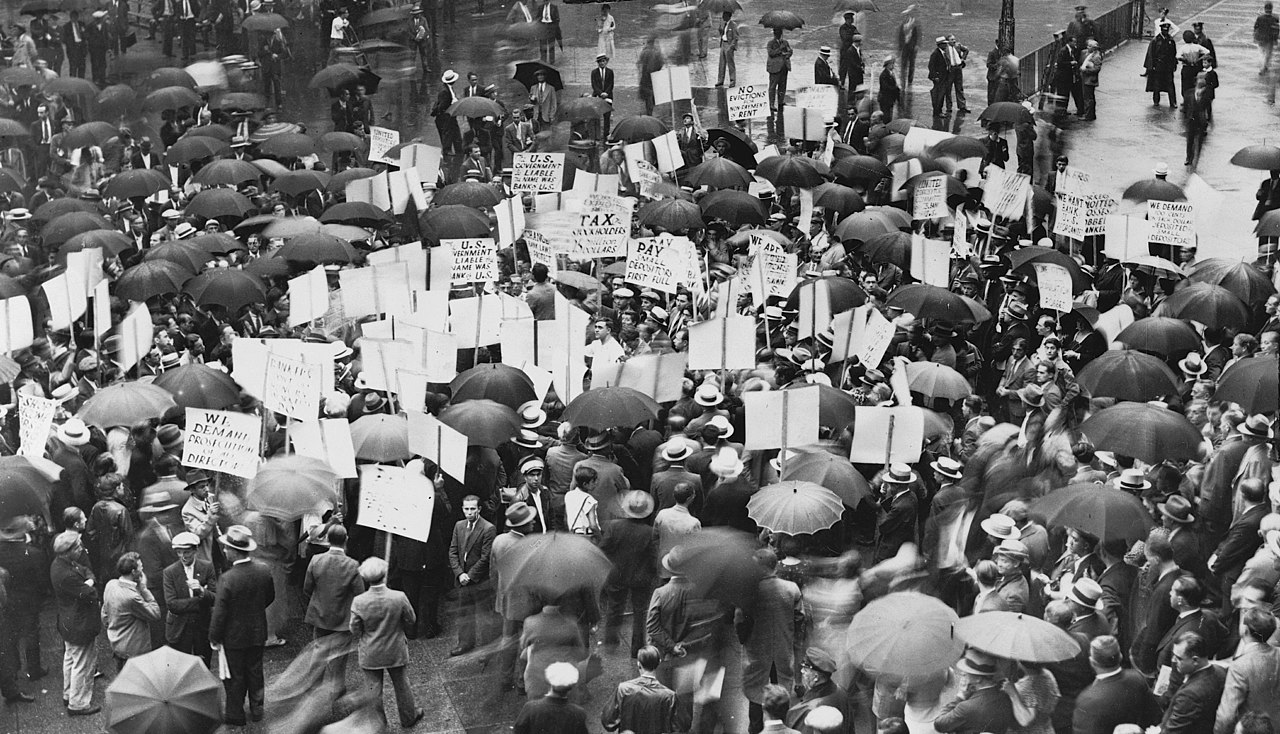
Despite the crash, the worst of the crisis did not reverberate around the world until after 1929. The crisis hit panic levels again in December 1930, with a bank run on the Bank of United States, a former privately run bank bearing no relation to the U.S. government (not to be confused with the Federal Reserve). Unable to pay out to all of its creditors, the bank failed.
Among the 608 American banks that closed in November and December 1930, the Bank of United States accounted for a third of the total $550 million deposits lost, and with its closure, bank failures reached a critical mass.
The Smoot–Hawley Act and the Breakdown of International Trade
In an initial response to the crisis, the U.S. Congress passed the Smoot–Hawley Tariff Act on 17 June 1930. The act was ostensibly aimed at protecting the American economy from foreign competition by imposing high tariffs on foreign imports. The consensus view among economists and economic historians (including Keynesians, Monetarists, and Austrian economists) is that the passage of the Smoot–Hawley Tariff had, in fact, achieved an opposite effect to what was intended. It exacerbated the Great Depression by preventing economic recovery after domestic production recovered, hampering the volume of trade; still, there is disagreement as to the precise extent of the Act's influence.

In a 1995 survey of American economic historians, two-thirds agreed that the Smoot–Hawley Tariff Act at least worsened the Great Depression. According to the U.S. Senate website, the Smoot–Hawley Tariff Act is among the most catastrophic acts in congressional history.
Many economists have argued that the sharp decline in international trade after 1930 helped to worsen the depression, especially for countries significantly dependent on foreign trade. Most historians and economists blame the act for worsening the depression by seriously reducing international trade and causing retaliatory tariffs in other countries. While foreign trade was a small part of overall economic activity in the U.S. and was concentrated in a few businesses such as farming, it was a much larger factor in many other countries. The average ad valorem (value-based) rate of duties on dutiable imports for 1921–1925 was 25.9%, but under the new tariff it jumped to 50% during 1931–1935. In dollar terms, American exports declined over the next four years from about $5.2 billion in 1929 to $1.7 billion in 1933. Hardest hit were farm commodities such as wheat, cotton, tobacco, and lumber.
Governments around the world took various steps into spending less money on foreign goods, such as "imposing tariffs, import quotas, and exchange controls". These restrictions triggered much tension among countries that had large amounts of bilateral trade, causing major export-import reductions during the depression. Not all governments enforced the same measures of protectionism. Some countries raised tariffs drastically and enforced severe restrictions on foreign exchange transactions, while other countries reduced "trade and exchange restrictions only marginally":

"Countries that remained on the gold standard, keeping currencies fixed, were more likely to restrict foreign trade." These countries "resorted to protectionist policies to strengthen the balance of payments and limit gold losses." They hoped that these restrictions and depletions would hold the economic decline.
Countries that abandoned the gold standard allowed their currencies to depreciate which caused their balance of payments to strengthen. It also freed up monetary policy so that central banks could lower interest rates and act as lenders of last resort. They possessed the best policy instruments to fight the Depression and did not need protectionism.
"The length and depth of a country's economic downturn and the timing and vigor of its recovery are related to how long it remained on the gold standard. Countries abandoning the gold standard relatively early experienced relatively mild recessions and early recoveries. In contrast, countries remaining on the gold standard experienced prolonged slumps."
The gold standard and the spreading of global depression
The gold standard was the primary transmission mechanism of the Great Depression. Even countries that did not face bank failures and a monetary contraction firsthand were forced to join the deflationary policy since higher interest rates in countries that performed a deflationary policy led to a gold outflow in countries with lower interest rates. Under the gold standard's price–specie flow mechanism, countries that lost gold but nevertheless wanted to maintain the gold standard had to permit their money supply to decrease and the domestic price level to decline (deflation).
Gold standard
Some economic studies have indicated that the rigidities of the gold standard not only spread the downturn worldwide but also suspended gold convertibility (devaluing the currency in gold terms) that did the most to make recovery possible.
Every major currency left the gold standard during the Great Depression. The UK was the first to do so. Facing speculative attacks on the pound and depleting gold reserves, in September 1931 the Bank of England ceased exchanging pound notes for gold and the pound was floated on foreign exchange markets. Japan and the Scandinavian countries followed in 1931. Other countries, such as Italy and the United States, remained on the gold standard into 1932 or 1933, while a few countries in the so-called "gold bloc", led by France and including Poland, Belgium, and Switzerland, stayed on the standard until 1935–36.
According to later analysis, the earliness with which a country left the gold standard reliably predicted its economic recovery. For example, The UK and Scandinavia, which left the gold standard in 1931, recovered much earlier than France and Belgium, which remained on gold much longer. Countries such as China, which had a silver standard, almost avoided the depression entirely. The connection between leaving the gold standard as a strong predictor of that country's severity of its depression and the length of time of its recovery has been shown to be consistent for dozens of countries, including developing countries. This partly explains why the experience and length of the depression differed between regions and states around the world.
German banking crisis of 1931 and British crisis
The financial crisis escalated out of control in mid-1931, starting with the collapse of the Creditanstalt in Vienna in May. This put heavy pressure on Germany, which was already in political turmoil. With the rise in violence of National Socialist ('Nazi') and Communist movements, as well as investor nervousness at harsh government financial policies, investors withdrew their short-term money from Germany as confidence spiraled downward. The Reichsbank lost 150 million marks in the first week of June, 540 million in the second, and 150 million in two days, 19–20 June. Collapse was at hand. U.S. President Herbert Hoover called for a moratorium on payment of war reparations. This angered Paris, which depended on a steady flow of German payments, but it slowed the crisis down, and the moratorium was agreed to in July 1931. An international conference in London later in July produced no agreements, but on 19 August a standstill agreement froze Germany's foreign liabilities for six months. Germany received emergency funding from private banks in New York as well as the Bank of International Settlements and the Bank of England. The funding only slowed the process. Industrial failures began in Germany; a major bank closed in July, and a two-day holiday for all German banks was declared. Business failures were more frequent in July and spread to Romania and Hungary. The crisis continued to get worse in Germany, bringing political upheaval that finally led to the coming to power of Hitler's Nazi regime in January 1933.
The world financial crisis now began to overwhelm Britain; investors around the world started withdrawing their gold from London at the rate of £2.5 million per day. Credits of £25 million each from the Bank of France and the Federal Reserve Bank of New York and an issue of £15 million fiduciary notes slowed, but did not reverse, the British crisis. The financial crisis now caused a major political crisis in Britain in August 1931. With deficits mounting, the bankers demanded a balanced budget; the divided cabinet of Prime Minister Ramsay MacDonald agreed; it proposed to raise taxes, cut spending, and most controversially, cut unemployment benefits by 20%. The attack on welfare was unacceptable to the Labour movement. MacDonald wanted to resign, but King George V insisted he remain and form an all-party coalition "National Government". The Conservative and Liberal parties signed on, along with a small cadre of Labour, but the vast majority of Labour leaders denounced MacDonald as a traitor for leading the new government. Britain went off the gold standard, and suffered relatively less than other major countries in the Great Depression. In the 1931 British election, the Labour Party was virtually destroyed, leaving MacDonald as prime minister for a largely Conservative coalition.
Turning point and recovery
In most countries of the world, recovery from the Great Depression began in 1933. In the U.S., recovery began in early 1933, but the U.S. did not return to 1929 GNP for over a decade and still had an unemployment rate of about 15% in 1940, albeit down from the high of 25% in 1933.
There is no consensus among economists regarding the motive force for the U.S. economic expansion that continued through most of the Roosevelt years (and the 1937 recession that interrupted it). The common view among most economists is that Roosevelt's New Deal policies either caused or accelerated the recovery, although his policies were never aggressive enough to bring the economy completely out of recession. Some economists have also called attention to the positive effects from expectations of reflation and rising nominal interest rates that Roosevelt's words and actions portended. It was the rollback of those same reflationary policies that led to the interruption of a recession beginning in late 1937. One contributing policy that reversed reflation was the Banking Act of 1935, which effectively raised reserve requirements, causing a monetary contraction that helped to thwart the recovery. GDP returned to its upward trend in 1938. A revisionist view among some economists holds that the New Deal prolonged the Great Depression, as they argue that National Industrial Recovery Act of 1933 and the National Labor Relations Act of 1935 restricted competition and established price fixing. John Maynard Keynes did not think that the New Deal under Roosevelt single-handedly ended the Great Depression: "It is, it seems, politically impossible for a capitalistic democracy to organize expenditure on the scale necessary to make the grand experiments which would prove my case—except in war conditions."
According to Christina Romer, the money supply growth caused by huge international gold inflows was a crucial source of the recovery of the United States economy, and the economy showed little sign of self-correction. The gold inflows were partly due to the devaluation of the U.S. dollar and partly due to the deterioration of the political situation in Europe. In their book, A Monetary History of the United States, Milton Friedman and Anna J. Schwartz also attributed the recovery to monetary factors and contended that it was much slowed by poor management of money by the Federal Reserve System. Chairman of the Federal Reserve (2006–2014) Ben Bernanke agreed that monetary factors played important roles both in the worldwide economic decline and eventual recovery. Bernanke also saw a strong role for institutional factors, particularly the rebuilding and restructuring of the financial system, and pointed out that the Depression should be examined from an international perspective.
Role of women and household economics
Women's primary role was as housewives; without a steady flow of family income, their work became much harder in dealing with food, clothing and medical care. Birthrates fell everywhere, as children were postponed until families could financially support them. The average birthrate for 14 major countries fell 12% from 19.3 births per thousand population in 1930 to 17.0 in 1935. In Canada, half of Roman Catholic women defied Church teachings and used contraception to postpone births.
Among the few women in the labor force, layoffs were less common in the white-collar jobs, and they were typically found in light manufacturing work. However, there was a widespread demand to limit families to one paid job so that wives might lose employment if their husband was employed. Across Britain, there was a tendency for married women to join the labor force, competing for part-time jobs especially.
In France, very slow population growth, especially in comparison to Germany, continued to be a serious issue in the 1930s. Support for increasing welfare programs during the depression included a focus on women in the family. The Conseil Supérieur de la Natalité campaigned for provisions enacted in the Code de la Famille (1939) that increased state assistance to families with children and required employers to protect the jobs of fathers, even if they were immigrants.
In rural and small-town areas, women expanded their operation of vegetable gardens to include as much food production as possible. In the United States, agricultural organizations sponsored programs to teach housewives how to optimize their gardens and to raise poultry for meat and eggs. Rural women made feed sack dresses and other items for themselves and their families and homes from feed sacks. In American cities, African American women quiltmakers enlarged their activities, promoted collaboration, and trained neophytes. Quilts were created for practical use from various inexpensive materials and increased social interaction for women and promoted camaraderie and personal fulfillment.
Oral history provides evidence for how housewives in a modern industrial city handled shortages of money and resources. Often they updated strategies their mothers used when they were growing up in poor families. Cheap foods were used, such as soups, beans, and noodles. They purchased the cheapest cuts of meat—sometimes even horse meat—and recycled the Sunday roast into sandwiches and soups. They sewed and patched clothing, traded with their neighbors for outgrown items, and made do with colder homes. New furniture and appliances were postponed until better days. Many women also worked outside the home, or took boarders, did laundry for trade or cash, and did sewing for neighbors in exchange for something they could offer. Extended families used mutual aid—extra food, spare rooms, repair work, cash loans—to help cousins and in-laws.
In Japan, official government policy was deflationary and the opposite of Keynesian spending. Consequently, the government launched a campaign across the country to induce households to reduce their consumption, focusing attention on spending by housewives.
In Germany, the government tried to reshape private household consumption under the Four-Year Plan of 1936 to achieve German economic self-sufficiency. The Nazi women's organizations, other propaganda agencies, and the authorities all attempted to shape such consumption, as economic self-sufficiency was needed to prepare for and to sustain the coming war. The organizations, propaganda agencies, and authorities employed slogans that called up traditional values of thrift and healthy living. However, these efforts were only partly successful in changing the behavior of housewives.
World War II and recovery
The common view among economic historians is that the Great Depression ended with the advent of World War II. Many economists believe that government spending on the war caused or at least accelerated recovery from the Great Depression, though some consider that it did not play a very large role in the recovery, though it did help in reducing unemployment.
The rearmament policies leading up to World War II helped stimulate the economies of Europe in 1937–1939. By 1937, unemployment in Britain had fallen to 1.5 million. The mobilization of manpower following the outbreak of war in 1939 ended unemployment.
The American mobilization for World War II at the end of 1941 moved approximately 10 million people out of the civilian labor force and into the war. This eliminated the last effects from the Great Depression and brought the U.S. unemployment rate down to below 10%.
World War II had a dramatic effect on many parts of the American economy. Government-financed capital spending accounted for only 5% of the annual U.S. investment in industrial capital in 1940; by 1943, the government accounted for 67% of U.S. capital investment. The massive war spending doubled economic growth rates, either masking the effects of the Depression or essentially ending the Depression. Businessmen ignored the mounting national debt and heavy new taxes, redoubling their efforts for greater output to take advantage of generous government contracts.
Causes
Attempts to return to the gold standard
During World War I, many countries suspended their gold standard in varying ways. There was high inflation from WWI and in the 1920s in the Weimar Republic, Austria, and throughout Europe. In the late 1920s there was a scramble to deflate prices to get the gold standard's conversation rates back on track to pre-WWI levels by causing deflation and high unemployment through monetary policy. In 1933 FDR signed Executive Order 6102 and in 1934 signed the Gold Reserve Act.
Keynesian vs Monetarist view
The two classic competing economic theories of the Great Depression are the Keynesian (demand-driven) and the Monetarist explanation. There are also various heterodox theories that downplay or reject the explanations of the Keynesians and monetarists. The consensus among demand-driven theories is that a large-scale loss of confidence led to a sudden reduction in consumption and investment spending. Once panic and deflation set in, many people believed they could avoid further losses by keeping clear of the markets. Holding money became profitable as prices dropped lower and a given amount of money bought ever more goods, exacerbating the drop in demand. Monetarists believe that the Great Depression started as an ordinary recession, but the shrinking of the money supply greatly exacerbated the economic situation, causing a recession to descend into the Great Depression.
Economists and economic historians are almost evenly split as to whether the traditional monetary explanation that monetary forces were the primary cause of the Great Depression is right or the traditional Keynesian explanation that a fall in autonomous spending, particularly investment, is the primary explanation for the onset of the Great Depression. Today there is also significant academic support for the debt deflation theory and the expectations hypothesis that—building on the monetary explanation of Milton Friedman and Anna Schwartz—add non-monetary explanations.
There is a consensus that the Federal Reserve System should have cut short the process of monetary deflation and banking collapse by expanding the money supply and acting as lender of last resort. If they had done this, the economic downturn would have been far less severe and much shorter.