The Boxer Rebellion was a violent anti-foreign, anti-Christian uprising in China that lasted from 1899 to 1901, during which a secret society called the Society of Righteous and Harmonious Fists — nicknamed 'Boxers' by Western observers — besieged foreign legations in Beijing and massacred thousands of Chinese Christians. The crisis ended when an Eight-Nation Alliance of approximately 45,000 troops captured Beijing in August 1900, forcing China to sign the humiliating Boxer Protocol of 1901. The rebellion marked a turning point in Chinese history, accelerating the collapse of the Qing Dynasty and fuelling the nationalist movements that would transform the country in the twentieth century.
What Was the Society of Righteous and Harmonious Fists?
The Boxers — known in Chinese as the Yihetuan — emerged from rural Shandong Province in the late 1890s. They were primarily poor peasants, many of whom practiced a blend of Chinese martial arts, folk religion, and ritual magic. Members believed that rigorous physical training and spiritual rituals made them invulnerable to foreign bullets, a conviction that proved tragically false on the battlefield. The movement drew on older secret-society traditions and millenarian beliefs, presenting itself as a defender of Chinese culture, Confucian values, and the Qing imperial order against the encroachments of Christianity and Western imperialism. By 1899, membership had swelled into the tens of thousands across Shandong and Zhili (modern Hebei) provinces, making the Yihetuan a formidable popular force that the Qing court found increasingly difficult to suppress or ignore.
What Caused the Boxer Rebellion?
The rebellion grew from a confluence of long-standing grievances that had been building since the mid-nineteenth century. China's defeat in the First Sino-Japanese War of 1894–95 had exposed the weakness of the Qing state and led to the Treaty of Shimonoseki, which ceded Taiwan and Korea to Japanese control. This defeat emboldened European powers to demand further territorial concessions: Germany seized Jiaozhou Bay in 1897, Russia took Port Arthur in 1898, France gained Guangzhouwan, and Britain extended its hold over Weihaiwei and the New Territories of Hong Kong. These 'scramble for concessions' left many Chinese feeling that their country was being carved up by predatory outsiders. Simultaneously, Christian missionaries, backed by extraterritorial legal privileges, were expanding deep into the Chinese countryside. By 1900 there were roughly 800 Catholic missionaries and over 3,000 Protestant missionaries operating in China, with their converts — estimated at around one million Catholics and 85,000 Protestants — often exempt from Chinese law and sometimes weaponising that immunity in local disputes. Severe droughts and flooding in Shandong between 1897 and 1900 compounded popular misery, creating a large pool of desperate, landless men who blamed foreign influence and Chinese Christians for upsetting the cosmic and agricultural order. When Governor-General Yuxian of Shandong actively encouraged Boxer activity rather than suppressing it in 1899, the movement gained crucial state protection and rapidly metastasised.
How Did the Boxer Rebellion Escalate to a Siege of Beijing?
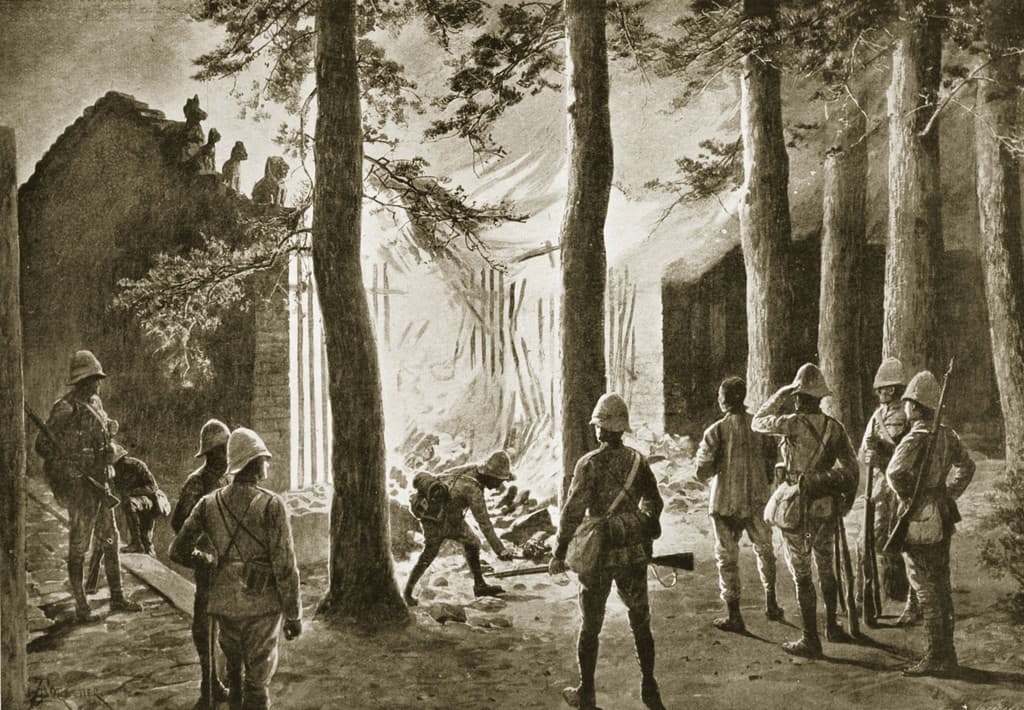
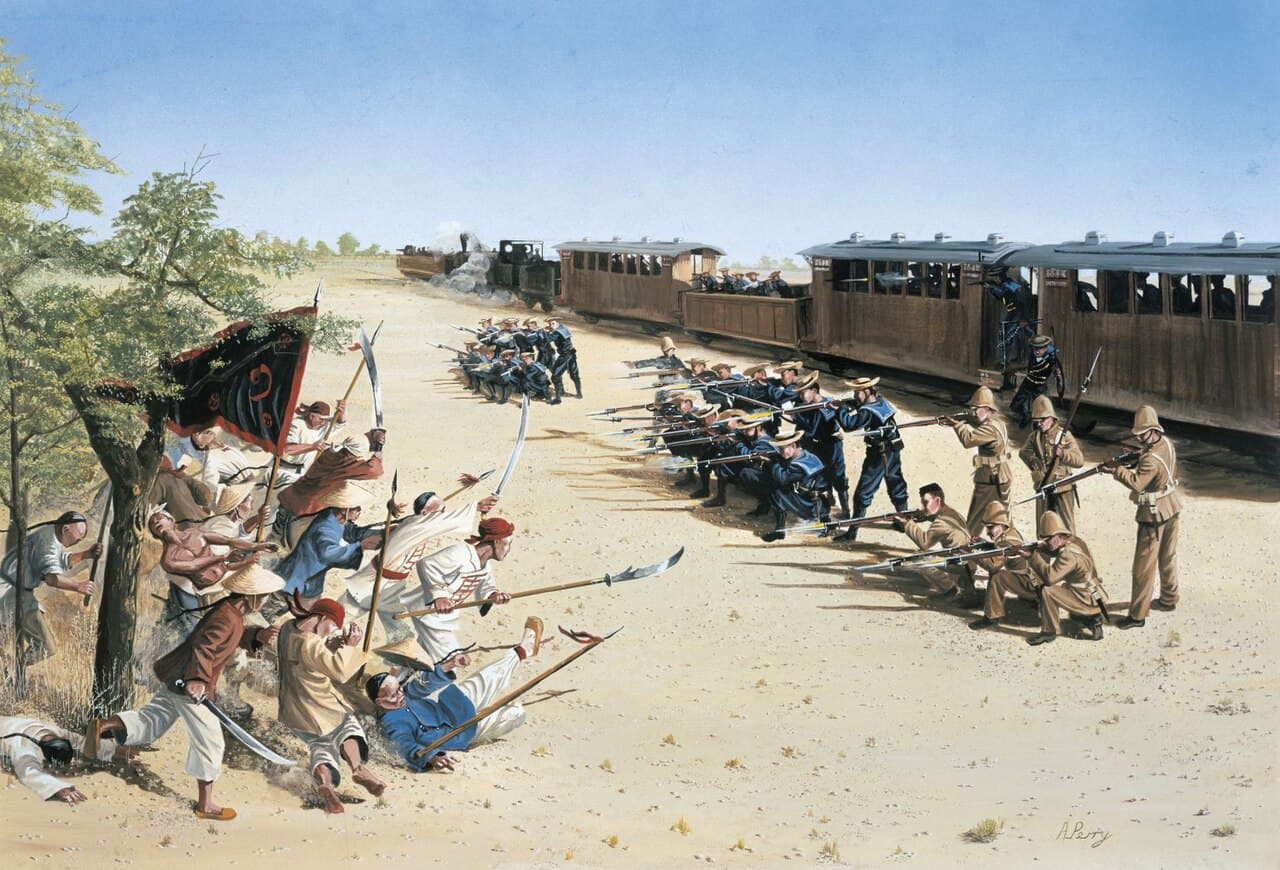
Throughout the spring of 1900, Boxer bands moved northward from Shandong into the capital region, burning churches, destroying railway lines, and killing Chinese Christians by the hundreds. On 31 May 1900, foreign ministers in Beijing requested emergency guard detachments; 435 troops from eight nations arrived at the legation quarter. The crisis dramatically intensified when the Qing court, dominated by the conservative Empress Dowager Cixi, made the fateful decision to side with the Boxers. On 17 June, Allied naval forces seized the Dagu Forts near Tianjin. Interpreting this as an act of war, on 21 June 1900 Empress Dowager Cixi issued an imperial edict declaring war on all foreign powers simultaneously — one of the most audacious diplomatic gambles in Chinese history. Boxer forces and imperial troops then laid siege to the Beijing Legation Quarter, a walled complex of roughly one square kilometre housing approximately 900 civilian foreigners, 400 soldiers, and 2,700 Chinese Christian refugees. The siege lasted 55 days, from 20 June to 14 August 1900. A 2,100-man international relief force under British Admiral Edward Seymour had set out from Tianjin on 10 June but was driven back by combined Boxer and imperial resistance, suffering 62 dead and nearly 230 wounded before retreating. A second, much larger Allied force of around 20,000 troops finally fought its way to Beijing, lifting the siege on 14 August 1900 after fierce urban combat. Simultaneously, a separate Japanese-led force of about 5,000 men relieved the besieged Northern Cathedral (Beitang), where Bishop Alphonse Favier and over 3,000 Chinese Catholics had held out for two months.
Which Nations Formed the Eight-Nation Alliance?
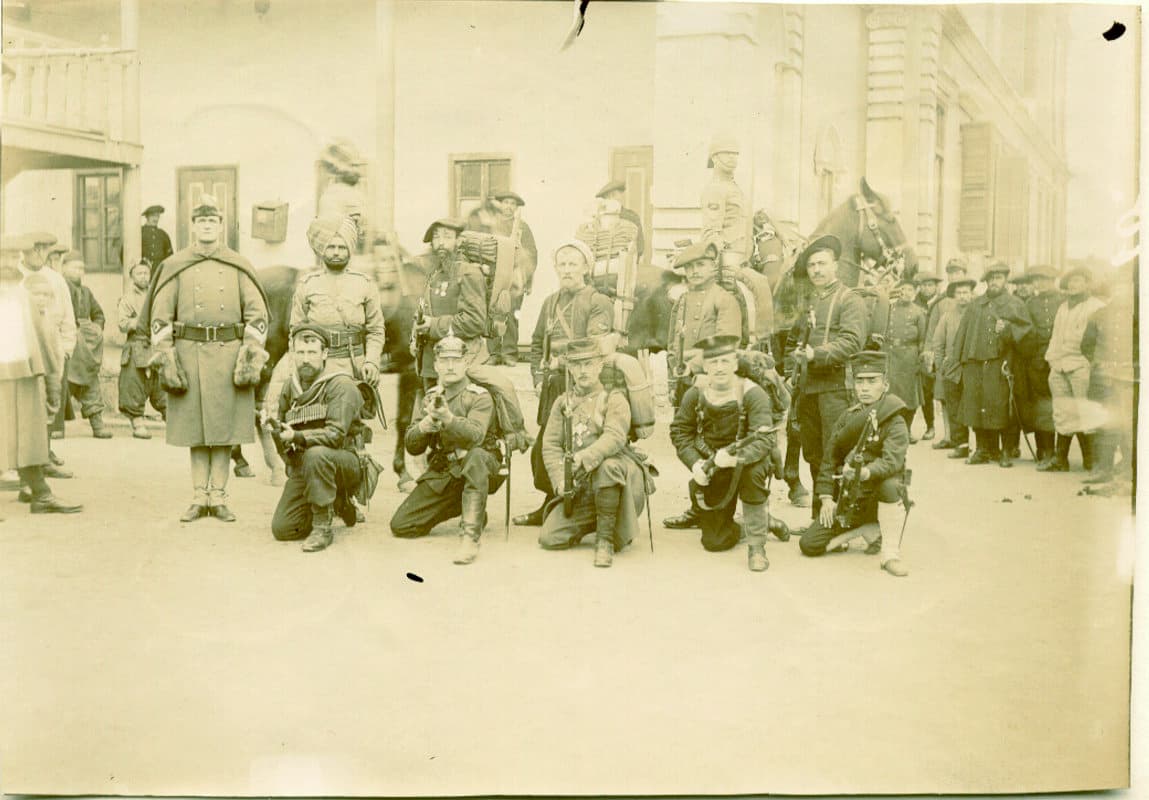
The multinational coalition that suppressed the Boxer Rebellion was unprecedented in its geographic and imperial scope, drawing together powers that were often rivals in other theatres of global competition. Japan contributed the largest single national contingent, some 20,840 troops — a figure that underscored its growing military power just five years after the Sino-Japanese War. Britain deployed 10,000 soldiers largely from India. Russia sent 13,150 men. France contributed 3,130 troops, the United States 3,125, Germany 900 (with a larger contingent of 8,000 following for the punitive phase), Austria-Hungary 296, and Italy 83. The sheer scale of the allied deployment — eventually totalling over 45,000 combat troops — demonstrated how thoroughly Western and Japanese imperial interests had penetrated China and how seriously the powers took the threat to their nationals and treaty privileges.
| Nation | Troops Deployed | Key Motivation |
|---|---|---|
| Japan | 20,840 | Expand regional influence; protect nationals |
| Russia | 13,150 | Secure Manchurian railway concessions |
| Britain | 10,000 | Protect trade routes and Hong Kong |
| Germany | 8,000 (later phase) | Avenge murder of minister Clemens von Ketteler |
| France | 3,130 | Protect Catholic missionaries |
| United States | 3,125 | Protect legation; uphold Open Door Policy |
| Austria-Hungary | 296 | Protect nationals; alliance obligations |
| Italy | 83 | Protect nationals; prestige |
What Atrocities Were Committed During the Rebellion?
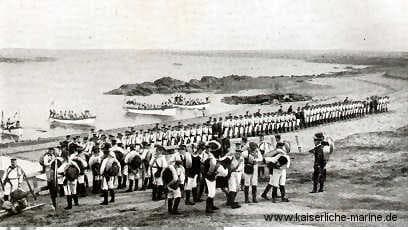
The Boxer Rebellion was marked by extreme brutality on all sides. Boxer forces and imperial troops killed an estimated 32,000 Chinese Christian civilians and between 200 and 250 foreign missionaries and their family members across northern China. The murder of German Minister Clemens von Ketteler on 20 June 1900 — the highest-ranking foreigner killed — gave the Western powers a potent propaganda symbol and a casus belli for military escalation. The capture of Beijing unleashed a period of looting and reprisal by Allied troops that lasted weeks. Soldiers from every coalition nation participated in pillaging the imperial palaces, private homes, and temples, carting off priceless artworks, manuscripts, and treasures. Russian forces occupied Manchuria and massacred thousands of Chinese civilians at Blagoveshchensk in July 1900, driving an estimated 5,000 to 7,000 people into the Amur River where most drowned. German troops under Field Marshal Alfred von Waldersee — appointed supreme commander of the Alliance forces — conducted brutal punitive expeditions into the countryside well into 1901, burning villages and executing suspected Boxer sympathisers. Kaiser Wilhelm II had infamously instructed departing German soldiers on 27 July 1900 to act like 'Huns' and give no quarter, a speech that would haunt Germany's reputation for decades.
What Were the Terms of the Boxer Protocol of 1901?
Signed on 7 September 1901 between the Qing government and eleven foreign powers, the Boxer Protocol was among the most punishing treaties in Chinese history. China was required to pay an indemnity of 450 million taels of silver — equivalent to approximately £67 million or $333 million at the time — to be paid over 39 years at four percent interest, bringing the total to 982 million taels. This figure was deliberately set to equal one tael for every Chinese person alive at the time, a symbolic humiliation. The Legation Quarter in Beijing was expanded and fortified, with foreign troops permanently stationed between the capital and the sea at points including Tianjin, Langfang, and the Dagu Forts. China was prohibited from importing arms for two years, senior officials who had supported the Boxers were executed or exiled, and the Zongli Yamen — China's foreign affairs office — was replaced by a full Ministry of Foreign Affairs. The indemnity crippled Chinese state finances for a generation. The United States eventually returned its portion — approximately $11 million — as the Boxer Indemnity Scholarship Fund, which financed the education of Chinese students in America, including many who later shaped modern China.
How Did the Boxer Rebellion Lead to the Fall of the Qing Dynasty?
The crushing defeat and the terms of the Boxer Protocol fatally undermined the legitimacy of the Qing Dynasty. Empress Dowager Cixi, who had fled Beijing in disguise during the Allied advance — travelling 1,500 kilometres to Xi'an — returned chastened in January 1902 and belatedly launched the 'New Policies' (Xinzheng) reforms, including abolishing the civil service examination in 1905 and drafting a constitution. But these reforms came too late and too tentatively to save the dynasty. The indemnity drained resources that might have funded modernisation. The military humiliation discredited the Manchu ruling class in the eyes of reformers and revolutionaries alike. Sun Yat-sen's Revolutionary Alliance (Tongmenghui), founded in 1905, gained momentum by pointing to Qing helplessness in the face of foreign aggression. When the Wuchang Uprising broke out on 10 October 1911, the dynasty had no credible basis on which to rally public support. The last Qing emperor, the six-year-old Puyi, abdicated on 12 February 1912, ending over 2,000 years of imperial rule in China. Many historians trace a direct line from the humiliation of 1901 to the 1911 Revolution and beyond to the establishment of the People's Republic in 1949.
What Is the Legacy of the Boxer Rebellion Today?
The Boxer Rebellion left a layered and contested legacy that continues to shape Chinese national identity and foreign policy. In China, the period from the First Opium War (1839) through the Boxer Protocol is officially framed as the 'Century of Humiliation' (百年屈辱), a narrative that portrays China as a victim of predatory imperialism and is used by the Chinese Communist Party to legitimise its authority as the restorer of national dignity. The rebellion is remembered ambivalently: the Boxers themselves are sometimes portrayed as misguided but patriotically motivated, while the Qing court's incompetence and the Allied powers' brutality are emphasised. In the West, the siege of the Beijing Legation Quarter became a celebrated adventure story — romanticised in novels, films, and memoirs — that largely obscured the tens of thousands of Chinese Christians killed. The 1963 film '55 Days at Peking' starring Charlton Heston exemplified this distorted popular memory. More recent scholarship has worked to recover Chinese perspectives and to examine the role of imperialism in generating the crisis. The Boxer Indemnity scholarships had an enduring positive legacy: Tsinghua University, one of China's premier research institutions, was founded in 1911 specifically to prepare students for study in the United States using returned indemnity funds. The rebellion also accelerated the development of modern Chinese nationalism, the professionalization of the Chinese military, and ultimately the revolutionary politics that defined the twentieth century.