
The Dutch (Dutch: ) are an ethnic group native to the Netherlands. They share a common ancestry and culture and speak the Dutch language. Dutch people and their descendants are found in migrant communities worldwide, notably in Argentina, Aruba, Australia, Brazil, Canada, Caribbean Netherlands, Curaçao, Germany, Guyana, Indonesia, New Zealand, Sint Maarten, South Africa, Suriname, and the United States. The Low Countries were situated around the border of France and the Holy Roman Empire, forming a part of their respective peripheries and the various territories of which they consisted had become virtually autonomous by the 13th century. Under the Habsburgs, the Netherlands were organised into a single administrative unit, and in the 16th and 17th centuries the Northern Netherlands gained independence from Spain as the Dutch Republic. The high degree of urbanisation characteristic of Dutch society was attained at a relatively early date. During the Republic the first series of large-scale Dutch migrations outside of Europe took place.
The traditional arts and culture of the Dutch encompasses various forms of traditional music, dances, architectural styles and clothing, some of which are globally recognisable. Internationally, Dutch painters such as Rembrandt, Vermeer and Van Gogh are held in high regard. The predominant religion among the Dutch is Christianity, encompassing both Latin Catholicism and Calvinist Protestantism. However, in contemporary times, the majority no longer adhere to a particular Christian denomination. Significant percentages of the Dutch are adherents of humanism, agnosticism, atheism or individual spirituality (including ietsism).
History
Emergence
The general situation described above is applicable to most if not all modern European ethnic groups with origins among the Germanic tribes, such as the Frisians, Germans, English and the Nordic (Scandinavian) peoples. In the Low Countries, this phase began when the Franks, themselves a union of multiple smaller tribes (many of them, such as the Batavi, Chauci, Chamavi and Chattuarii, were already living in the Low Countries prior to the forming of the Frankish confederation), began to incur the northwestern provinces of the Roman Empire. Eventually, in 358, the Salian Franks, one of the three main subdivisions among the Frankish alliance, settled the area's Southern lands as foederati; Roman allies in charge of border defense.

Linguistically Old Frankish gradually evolved into Old Dutch, which was first attested in the 6th century, whereas religiously the Franks (beginning with the upper class) converted to Christianity from around 500 to 700. On a political level, the Frankish warlords abandoned tribalism and founded a number of kingdoms, eventually culminating in the Frankish Empire of Charlemagne.
However, the population make-up of the Frankish Empire, or even early Frankish kingdoms such as Neustria and Austrasia, was not dominated by Franks. Though the Frankish leaders controlled most of Western Europe, the Franks themselves were confined to the Northwestern part (i.e. the Rhineland, the Low Countries and Northern France) of the Empire. Eventually, the Franks in Northern France were assimilated by the general Gallo-Roman population, and took over their dialects (which became French), whereas the Franks in the Low Countries retained their language, which would evolve into Dutch. The current Dutch-French language border has (with the exception of the Nord-Pas-de-Calais in France and Brussels and the surrounding municipalities in Belgium) remained virtually identical ever since, and could be seen as marking the furthest pale of gallicisation among the Franks. A dialect continuum remaining with more eastern Germanic populations, a distinct identity in relation to these only gradually developed, largely based on socio-economic and political factors.
Convergence
The medieval cities of the Low Countries, especially those of Flanders, Brabant and Holland, which experienced major growth during the 11th and 12th centuries, were instrumental in breaking down the already relatively loose local form of feudalism. As they became increasingly powerful, they used their economic strength to influence the politics of their nobility. During the early 14th century, beginning in and inspired by the County of Flanders, the cities in the Low Countries gained huge autonomy and generally dominated or greatly influenced the various political affairs of the fief, including marriage succession.
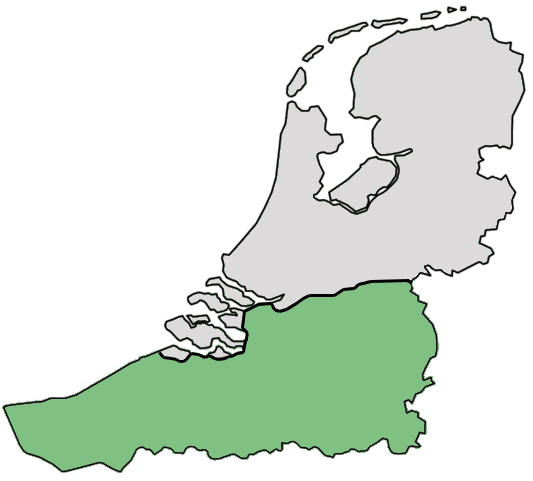
While the cities were of great political importance, they also formed catalysts for medieval Dutch culture. Trade flourished, population numbers increased dramatically, and (advanced) education was no longer limited to the clergy. Flanders, Brabant and Holland began to develop a common Dutch standard language. Dutch epic literature such as Elegast (1150), the Roelantslied and Van den vos Reynaerde (1200) were widely enjoyed. The various city guilds as well as the necessity of water boards (in charge of dikes, canals, etc.) in the Dutch delta and coastal regions resulted in an exceptionally high degree of communal organisation. It is also around this time, that ethnonyms such as Diets and Nederlands emerge.
In the second half of the 14th century, the dukes of Burgundy gained a foothold in the Low Countries through the marriage in 1369 of Philip the Bold of Burgundy to the heiress of the Count of Flanders. This was followed by a series of marriages, wars, and inheritances among the other Dutch fiefs and around 1450 the most important fiefs were under Burgundian rule, while complete control was achieved after the end of the Guelders Wars in 1543, thereby unifying the fiefs of the Low Countries under one ruler. This process marked a new episode in the development of the Dutch ethnic group, as now political unity started to emerge, consolidating the strengthened cultural and linguistic unity.
Consolidation
Despite their growing linguistic and cultural unity, and (in the case of Flanders, Brabant and Holland) economic similarities, there was still little sense of political unity among the Dutch people.

However, the centralist policies of Burgundy in the 14th and 15th centuries, at first violently opposed by the cities of the Low Countries, had a profound impact and changed this. During Charles the Bold's many wars, which were a major economic burden for the Burgundian Netherlands, tensions slowly increased. In 1477, the year of Charles' sudden death at Nancy, the Low Countries rebelled against their new liege, Mary of Burgundy, and presented her with a set of demands.
The subsequently issued Great Privilege met many of these demands, which included that Dutch, not French, should be the administrative language in the Dutch-speaking provinces under Burgundian rule (i.e. Flanders, Brabant and Holland) and that the States-General had the right to hold meetings without the monarch's permission or presence. The overall tenor of the document (which was declared void by Mary's son and successor, Philip IV) aimed for more autonomy for the counties and duchies, but nevertheless all the fiefs presented their demands together, rather than separately. This is evidence that by this time a sense of common interest was emerging among the provinces of the Netherlands. The document itself clearly distinguishes between the Dutch speaking and French speaking provinces.
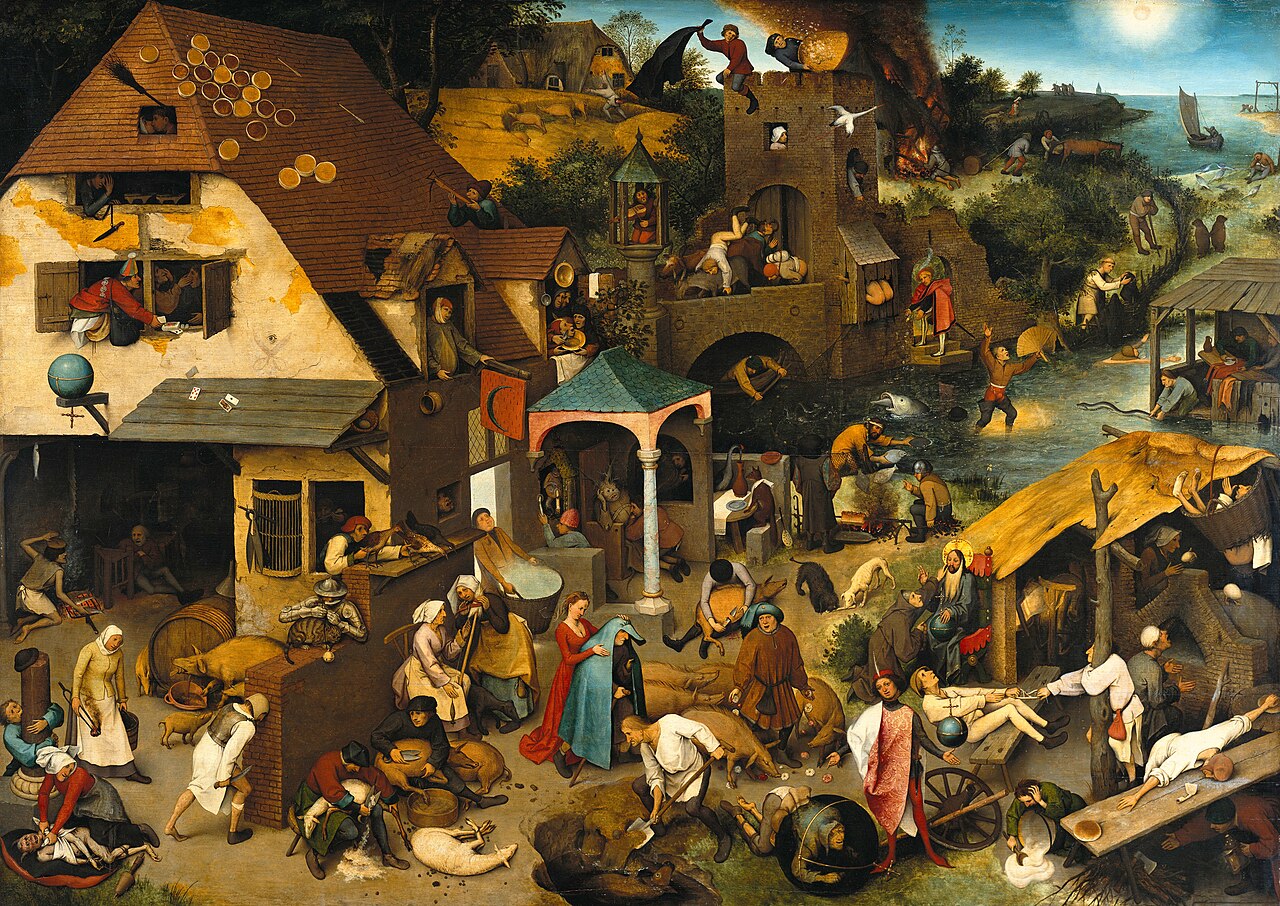
Following Mary's marriage to Maximilian I, Holy Roman Emperor, the Netherlands were now part of the Habsburg lands. Further centralised policies of the Habsburgs (like their Burgundian predecessors) again met with resistance, but, peaking with the formation of the collateral councils of 1531 and the Pragmatic Sanction of 1549 creating the Seventeen Provinces, were still implemented. The rule of Philip II of Spain sought even further centralist reforms, which, accompanied by religious dictates and excessive taxation, resulted in the Dutch Revolt. The Dutch provinces, though fighting alone now, for the first time in their history found themselves fighting a common enemy. This, together with the growing number of Dutch intelligentsia and the Dutch Golden Age in which Dutch culture, as a whole, gained international prestige, consolidated the Dutch as an ethnic group.
National identity
By the middle of the 16th century, an overarching, 'national' (rather than 'ethnic') identity seemed in development in the Habsburg Netherlands, when inhabitants began to refer to it as their 'fatherland' and were beginning to be seen as a collective entity abroad; however, the persistence of language barriers, traditional strife between towns, and provincial particularism continued to form an impediment to more thorough unification. Following excessive taxation together with attempts at diminishing the traditional autonomy of the cities and estates in the Low Countries, followed by the religious oppression after being transferred to Habsburg Spain, the Dutch revolted, in what would become the Eighty Years' War. For the first time in their history, the Dutch established their independence from foreign rule. However, during the war it became apparent that the goal of liberating all the provinces and cities that had signed the Union of Utrecht, which roughly corresponded to the Dutch-speaking part of the Spanish Netherlands, was unreachable. The Northern provinces were free, but during the 1580s the South was recaptured by Spain, and, despite various attempts, the armies of the Republic were unable to expel them. In 1648, the Peace of Münster, ending the Eighty Years' War, acknowledged the independence of the Dutch Republic, but maintained Spanish control of the Southern Netherlands. Apart from a brief reunification from 1815 until 1830, within the United Kingdom of the Netherlands (which included the Francophones/Walloons) the Dutch have been separated from the "Flemings" to this day. The border between the Netherlands and Belgium is purely contingent, simply reflecting the 1648 cease-fire line. There is a perfect dialect continuum.
Dutch Empire
The Dutch colonial empire (Dutch: Het Nederlandse Koloniale Rijk) comprised the overseas territories and trading posts controlled and administered by Dutch chartered companies (mainly the Dutch West India Company and the Dutch United East India Company) and subsequently by the Dutch Republic (1581–1795), and by the modern Kingdom of the Netherlands after 1815.
Ethnic identity
Hollander vs. Nederlander
Many Dutch people (Nederlanders) will object to being called Hollanders as a national denominator on much the same grounds as many Welsh or Scots would object to being called English instead of British, as the Holland region only comprises two of the twelve provinces, and 40% of the Dutch citizens. The same holds for the country being referred to as Holland instead of The Netherlands. In January 2020, the Dutch government officially dropped its support of the word Holland for the whole country.

(Multi)cultural identity
The ideologies associated with (Romantic) Nationalism of the 19th and 20th centuries never really caught on in the Netherlands. The (re)definition of Dutch cultural identity has become a subject of public debate following the increasing influence of the European Union and the influx of non-Western immigrants in the post-World War II period. In this debate typically Dutch traditions have been put to the foreground.
In sociological studies and governmental reports, ethnicity is often referred to with the terms autochtoon and allochtoon. These legal concepts refer to place of birth and citizenship rather than cultural background and do not coincide with the more fluid concepts of ethnicity used by cultural anthropologists.
Greater Netherlands
As did many European ethnicities during the 19th century, the Dutch also saw the emerging of various Greater Netherlands- and pan-movements seeking to unite the Dutch-speaking peoples across the continent, while trying to counteract Pan-Germanic tendencies. During the first half of the 20th century, there was a prolific surge in writings concerning the subject. One of its most active proponents was the historian Pieter Geyl, who wrote De Geschiedenis van de Nederlandsche stam ('The History of the Dutch tribe/people') as well as numerous essays on the subject.

During World War II, when both Belgium and the Netherlands fell to German occupation, fascist elements (such as the NSB and Verdinaso) tried to convince the Nazis into combining the Netherlands and Flanders. The Germans however refused to do so, as this conflicted with their ultimate goal, the Neuordnung ('New Order') of creating a single pan-Germanic racial state. During the entire Nazi occupation, the Germans denied any assistance to Greater Dutch ethnic nationalism, and, by decree of Hitler himself, actively opposed it.
The 1970s marked the beginning of formal cultural and linguistic cooperation between Belgium (Flanders) and the Netherlands on an international scale.
Statistics
The total number of Dutch can be defined in roughly two ways. By taking the total of all people with full Dutch ancestry, according to the current CBS definition (both parents born in the Netherlands), resulting in an estimated 16,000,000 Dutch people, or by the sum of all people worldwide with both full and partial Dutch ancestry, which would result in a number around 33,000,000.
Linguistics
Language
Dutch is the main language spoken by most Dutch people. It is a West Germanic language spoken by around 29 million people. Old Frankish, a precursor of the Dutch standard language, was first attested around 500, in a Frankish legal text, the Lex salica, and has a written record of more than 1500 years, although the material before around 1200 is fragmentary and discontinuous.
As a West Germanic language, Dutch is related to other languages in that group such as West Frisian, English and German. Many West Germanic dialects underwent a series of sound shifts. The Anglo-Frisian nasal spirant law and Anglo-Frisian brightening resulted in certain early Germanic languages evolving into what are now English and West Frisian, while the Second Germanic sound shift resulted in what would become (High) German. Dutch underwent none of these sound changes and thus occupies a central position in the West Germanic languages group.
Standard Dutch has a sound inventory of thirteen vowels, six diphthongs and twenty-three consonants, of which the voiceless velar fricative (hard ch) is considered a well known sound, perceived as typical for the language. Other relatively well known features of the Dutch language and usage are the frequent use of digraphs like Oo, Ee, Uu and Aa, the ability to form long compounds and the use of slang, including profanity.
The Dutch language has many dialects. These dialects are usually grouped into six main categories; Hollandic, West-Flemish/Zeelandic, East Flemish, Brabantic and Limburgish, although Limburgish is recognized as a regional language under part 2 of the European Charter for Regional or Minority Languages. The Dutch part of Low Saxon is sometimes also viewed as a dialect of Dutch as it falls in the area of the Dutch standard language, although it is recognized as a regional language. Of these dialects, Hollandic and Dutch Low Saxon are solely spoken by Northerners. Brabantic, East Flemish, West-Flemish/Zeelandic and Limburgish are cross border dialects in this respect. Lastly, the dialectal situation is characterised by the major distinction between 'Hard G' and 'Soft G' speaking areas (see also Dutch phonology). Some linguists subdivide these into approximately 28 distinct dialects.
Dutch immigrants also exported the Dutch language. Dutch was spoken by some settlers in the United States as a native language from the arrival of the first permanent Dutch settlers in 1615, surviving in isolated ethnic pockets until about 1900, when it ceased to be spoken except by first generation Dutch immigrants. The Dutch language nevertheless had a significant impact on the region around New York. For example, the first language of U.S. president Martin Van Buren was Dutch. Most of the Dutch immigrants of the 20th century quickly began to speak the language of their new country. For example, of the inhabitants of New Zealand, 0.7% say their home language is Dutch, despite the percentage of Dutch heritage being considerably higher.
Dutch is currently an official language of the Kingdom of the Netherlands (Netherlands, Aruba, Sint Maarten, and Curaçao), Belgium, Suriname, the European Union, and the Union of South American Nations (due to Suriname being a member). In South Africa and Namibia, Afrikaans is spoken, a daughter language of Dutch, which itself was an official language of South Africa until 1983. The Dutch, Flemish and Surinamese governments coordinate their language activities in the Nederlandse Taalunie ('Dutch Language Union'), an institution also responsible for governing the Dutch Standard language, for example in matters of orthography.
Etymology of autonym and exonym
The origins of the word Dutch go back to Proto-Germanic, the ancestor of all Germanic languages, *theudo (meaning "national/popular"); akin to Old Dutch dietsc, Old High German diutsch, Old English þeodisc and Gothic þiuda all meaning "(of) the common (Germanic) people". As the tribes among the Germanic peoples began to differentiate its meaning began to change. The Anglo-Saxons of England for example gradually stopped referring to themselves as þeodisc and instead started to use Englisc, after their tribe. On the continent *theudo evolved into two meanings: Diets or Duuts meaning "Dutch (people)" (archaic) and Deutsch (German, meaning "German (people)"). At first the English language used (the contemporary form of) Dutch to refer to any or all of the Germanic speakers on the European mainland (e.g. the Dutch, the Frisians and the Germans). Gradually its meaning shifted to the Germanic people they had most contact with, both because of their geographical proximity, but also because of the rivalry in trade and overseas territories: the people from the Republic of the Netherlands, the Dutch.
In the Dutch language, the Dutch refer to themselves as Nederlanders. Nederlanders derives from the Dutch word Neder, a cognate of English Nether both meaning "low", and "near the sea" (same meaning in both English and Dutch), a reference to the geographical texture of the Dutch homeland; the western portion of the North European Plain. Although not as old as Diets, the term Nederlands has been in continuous use since 1250.
Names
Tussenvoegsels
Dutch surnames (and surnames of Dutch origin) are generally easily recognisable. Many Dutch surnames feature a tussenvoegsel (lit. 'between-joiner'), which is a family name affix positioned between a person's given name and the main part of their family name. The most common tussenvoegsels are van (e.g. A. van Gogh "from/of"), de / der / den / te / ter / ten (e.g. A. de Vries, "the"), het / ’t (e.g. A. ’t Hart, "the"), and van de / van der / van den (e.g. A. van den Berg, "from/of the"). These affixes are not merged, nor capitalised by default. The second affix in a Dutch surname is never capitalised (e.g. Van den Berg). The first affix in a Dutch surname is only capitalised if it is not preceded by a first name, initial or other surname. For example Vincent van Gogh, V. van Gogh, mr. Van Gogh, Van Gogh and V. van Gogh-van den Berg are all correct, but Vincent Van Gogh is wrong.
Many surnames of Dutch diaspora (mainly in the English-speaking world and Francophonie) are adapted, not only in pronunciation but also in spelling. For example, by merging and capitalising the affixes and main parts of the surnames (e.g. A. van der Bilt becomes A. Vanderbilt).
Spelling
Dutch names can differ greatly in spelling. The surname Baks, for example is also recorded as Backs, Bacxs, Bax, Bakx, Baxs, Bacx, Backx, Bakxs and Baxcs. Though written differently, pronunciation remains identical. Dialectal variety also commonly occurs, with De Smet and De Smit both meaning Smith for example.
Main types of surnames
There are several main types of surnames in Dutch:
Patronymic surnames; the name is based on the personal name of the father of the bearer. Historically this has been by far the most dominant form. These type of names fluctuated in form as the surname was not constant. If a man called Willem Janssen (William, John's son) had a son named Jacob, he would be known as Jacob Willemsen (Jacob, Williams' son). Following civil registry, the form at time of registry became permanent. Hence today many Dutch people are named after ancestors living in the early 19th century when civil registry was introduced to the Low Countries. These names rarely feature tussenvoegsels. Similar to English names like Johnson.
Toponymic surnames; the name is based on the location on which the bearer lives or lived. In Dutch this form of surname nearly always includes one or several tussenvoegsels, mainly van, van de and variants where van is translated as from. Many emigrants removed the spacing and capitalised these words, leading to derived names for well-known people like Cornelius Vanderbilt. Van translated as of (Dutch language does not distinguish between "of" and "from" both indicated by "van"), Dutch surnames can sometimes refer to upper class or aristocratic titles (e.g. William, Prince of Orange). However, in Dutch van mostly reflects the place of origin of the family and not any aristocratic claim to a holding (Van der Bilt – one who comes from De Bilt).
Occupational surnames; the name is based on the occupation of the bearer. Well known examples include Molenaar, Visser and Smit. This practice is similar to English surnames (the example names translate perfectly to Miller, Fisher and Smith).
Cognominal surnames; based on nicknames relating to physical appearance or other features, on the appearance or character of the bearer (at least at the time of registration). For example De Lange ('the tall one'), De Groot ('the big one'), De Dappere ('the brave').
Other surnames may relate to animals. For example; De Leeuw ('The Lion'), Vogels ('Birds'), Koekkoek ('Cuckoo') and Devalck ('The Falcon'); to a desired social status; e.g., Prins ('Prince'), De Koninck/Koning ('King'), De Keyzer/Keizer ('Emperor'); or to colour; e.g. Rood ('red'), Blauw/Blaauw ('blue'), De Wit ('the white'). There is also a set of made up or descriptive names; e.g. Naaktgeboren ('born naked').
Culture
Religion
Prior to the arrival of Christianity, the ancestors of the Dutch adhered to a form of Germanic paganism augmented with various Celtic elements. At the start of the 6th century, the first (Hiberno-Scottish) missionaries arrived. They were later replaced by Anglo-Saxon missionaries, who eventually succeeded in converting most of the inhabitants by the 8th century. Since then, Christianity has been the dominant religion in the region.
In the early 16th century, the Protestant Reformation began to form and soon spread in the Westhoek and the County of Flanders, where secret open-air sermons were held, called hagenpreken ('hedgerow orations') in Dutch. The ruler of the Dutch regions, Philip II of Spain, felt it was his duty to fight Protestantism and, after the wave of iconoclasm, sent troops to crush the rebellion and make the Low Countries a Catholic region once more. The Protestants in the southern Low Countries fled North en masse. Most of the Dutch Protestants were now concentrated in the free Dutch provinces north of the river Rhine, while the Catholic Dutch were situated in the Spanish-occupied or -dominated South. After the Peace of Westphalia in 1648, Protestantism did not spread South, resulting in a difference in religious situations.