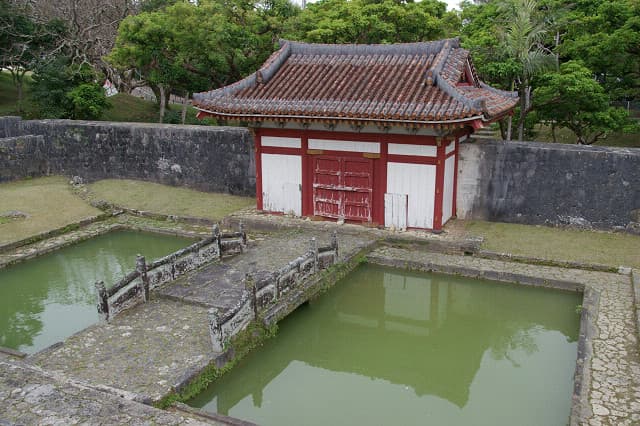
Okinawa Prefecture (Japanese: 沖縄県, Hepburn: Okinawa-ken; pronounced [o.kʲi.na.wa(ꜜ.keɴ)]; Okinawan: ウチナーチン, romanized: Uchinaachin) is the southernmost and westernmost prefecture of Japan. It consists of three main island groups—the Okinawa Islands, the Sakishima Islands, and the Daitō Islands—spread across a maritime zone approximately 1,000 kilometers east to west and 400 kilometers north to south. Despite a modest land area of 2,281 km2 (880 sq mi), Okinawa's territorial extent over surrounding seas makes its total area nearly half the combined size of Honshu, Shikoku, and Kyushu. Of its 160 islands, 49 are inhabited. The largest and most populous island is Okinawa Island, which hosts the capital city, Naha, as well as major urban centers such as Okinawa, Uruma, and Urasoe. The prefecture has a subtropical climate, characterized by warm temperatures and high rainfall throughout the year. People from the Nansei Islands, including Okinawa, the Sakishima Islands, and parts of Kagoshima Prefecture, are often collectively referred to as Ryukyuans. However, there are significant cultural and customary differences between individual islands and even between local communities.
Historically the center of the Ryukyu Kingdom, Okinawa long served as a maritime trading hub and cultural gateway; the kingdom participated in the Chinese tributary system—maintaining formal tribute relations with the Ming and Qing—and retained distinct statehood until it was incorporated into Japan as Okinawa Prefecture in 1879 following the Ryukyu Disposition. After the Battle of Okinawa (1945), the islands were under U.S. administration until reversion to Japan in 1972, and today host a large share of U.S. military facilities in Japan (around 70% by area of land exclusively used by U.S. forces), a continuing source of local and national debate. A small but persistent independence movement exists, reflecting Okinawa's distinct historical trajectory and identity.
Over time, Okinawa developed its own distinctive traditions, cuisine, and performing arts. Today, Okinawan music, characterized by the distinctive sanshin instrument, and festivals such as Eisa have gained popularity across the country. The islands are also the birthplace of karate, later popularized on the Japanese mainland and worldwide. The prefectural economy is predominantly service-based, with tourism and related services as major drivers, while manufacturing plays a comparatively small role.
Reading level
Audio Summary
Played with your browser's voice. Studio-quality audio can be added with a text-to-speech service.
Ask about this article
📝 Quick Quiz1 / 4
What is "Okinawa Prefecture" primarily known for?
Vocix Daily — In Your Inbox
Top stories, deep-dive articles, and "On This Day" history — one crisp digest delivered every morning.
Sources & references
Reference material for this entry is drawn from the open encyclopedic record, including Wikipedia , available under the CC BY-SA 4.0 license. Images are credited individually beside each photo.
The prehistoric history of Okinawa differs significantly from that of mainland Japan. Prior to written records, it is generally divided into two periods: the Paleolithic era and the Shellmidden period (Kaizuka period). The earliest evidence of human activity in Okinawa includes the Yamashita Cave Man, dating back approximately 32,000 years, and the Minatogawa Man from around 18,000 years ago. In 2012, the world's oldest known fishhook was discovered in the Sakitari Cave site in Nanjo City, Okinawa Prefecture.
The Shellmidden Period in Okinawa roughly corresponds to the Jōmon through Heian periods of mainland Japan, with a chronological gap of about 10,000 years from the Paleolithic era.
At the Kogachibaru Shell Mound, archaeological findings include pottery styles such as Sobata and Ichiki, which originate from the Kyushu region, obsidian from Koshidake in Saga Prefecture, and jade from Itoigawa in Niigata Prefecture used for ornamental pendants. These discoveries indicate that close exchanges with Kyushu were already taking place during this time.
However, by the middle of the Shellmidden Period, Okinawan pottery began to exhibit clearly localized characteristics. Examples include the Iha and Ogido pottery styles, which are distinct to the region.
In contrast to the Shellmidden culture of Okinawa Island, which was influenced primarily by mainland Japan, the prehistoric cultures of the Miyako and Yaeyama Islands were shaped more significantly by southern cultures, including those from the Philippines.
Gusuku and Sanzan periods
From the 12th century onward, Okinawa entered the Gusuku period, characterized by the development of an agrarian society. During this time, populations moved from coastal dunes to more fertile limestone plateaus, leading to significant population growth and the beginnings of international trade. Local chieftains, known as Aji, constructed fortified residences called Gusuku to protect their territories and expand their influence through foreign trade. Gusuku sites are found throughout the Ryukyu Islands, from the Amami Islands in the north to the Yaeyama Islands in the south, with estimates ranging from 300 to 400 sites in total. Early Gusuku were generally small, covering about 1,000 square meters, but larger fortresses appeared in later periods.
By the 14th century, Okinawa Island was divided into three polities, marking the beginning of the Sanzan period. These were the Kingdom of Hokuzan, centered at Nakijin Castle in the north; the Kingdom of Chūzan, centered at Urasoe Castle in the central region; and the Kingdom of Nanzan, centered at Ōzato Castle in the south.
According to official histories compiled by the royal government in Shuri—such as the Chūzan Seikan, Chūzan Seifu, and Kyūyō—the first royal lineage of Ryukyu was the legendary Tenson dynasty. After internal conflict during its 25th generation, a local Aji named Shunten from Urasoe was supported by the people, quelled the unrest, and was crowned as the first king of the Ryukyu Kingdom. However, these early historical accounts are heavily mythologized, and even if Shunten was a real historical figure, he likely ruled only the Urasoe area as an Aji. The Shunten dynasty lasted for three generations before being overthrown by the Eiso dynasty, which in turn was replaced by the Satto dynasty after four generations. By this time, Okinawa Island had effectively split into the three kingdoms of Hokuzan, Chūzan, and Nanzan.
In 1372, the Ming dynasty of China dispatched an envoy, Yang Zai, to the Kingdom of Chūzan, requesting the king, Satto, to enter into a tributary relationship. Satto agreed, and soon after, the kings of Nanzan (Chōsatto) and Hokuzan (Hanishi) also began paying tribute to the Ming court, bringing all three kingdoms into the Chinese tributary system.
In 1406, the Aji of Sashiki, Shō Hashi, overthrew King Bunei of the Satto dynasty and installed his father, Shō Shishō, as king, establishing the First Shō Dynasty. In 1416, Shō Hashi capitalized on dissatisfaction among the Aji of Hokuzan with their king, Hananchi, and conquered the kingdom. The Kingdom of Nanzan, plagued by internal conflict under the rule of Tarumoi, was defeated by Shō Hashi in 1429, completing the unification of Okinawa Island under the Chūzan Kingdom.
Ryukyu Kingdom period
The First Shō Dynasty experienced political instability due to the early deaths of several kings. After the death of the fifth king, Shō Kinpuku, a succession dispute known as the Shirii-Tumui rebellion broke out. Order was eventually restored when Shō Taikyū ascended as the sixth king. During his reign, another major conflict, the Gosamaru–Amawari rebellion, occurred, but Shō Taikyū was able to suppress it. His successor, King Shō Toku, was known as a tyrant. After his death, a coup led by royal officials installed the high-ranking bureaucrat Kanemaru as king. Kanemaru took the royal name Shō En, founding the Second Shō Dynasty.
Under the rule of the third king of the dynasty, Shō Shin, a centralized administration was firmly established. Shō Shin relocated powerful regional chieftains (Aji) to the capital of Shuri and appointed state officials to govern the provinces directly. The territorial extent of the Ryukyu Kingdom also expanded, covering the area from the Amami Islands in the north to the Yaeyama Islands in the south. Culturally, this era was a golden age for the kingdom, with significant development in the arts, religion, and architecture.
By actively participating in the tribute system with the Ming dynasty, the Ryukyu Kingdom received preferential treatment and became a key intermediary trading hub in East Asia. Many of the tribute goods presented to China originated from Japan, while Chinese goods were exported to Japan through Ryukyu. Southeast Asia, China, and Japan were Ryukyu's primary trade partners, and the kingdom also maintained trade with the Korean Peninsula. However, Ryukyu's significance as a trade hub declined in the 16th century with the Age of Discovery, as Portuguese and Spanish merchants entered East Asia, and China gradually relaxed its maritime prohibition policies.
The Miyako Islands and Yaeyama Islands had long been politically fragmented. In 1474, local strongman Nakasone Toyomiya of Miyako Island submitted to the Ryukyu Kingdom, bringing the island under centralized control. In 1500, Ryukyuan forces defeated Oyake Akahachi, the ruler of Ishigaki Island. In 1522, Nakasone Toyomiya conquered Yonaguni Island, completing the unification of the Yaeyama Islands under Ryukyuan rule. The Amami Islands in the north also came under Ryukyuan control by 1466.
In 1609, the Shimazu clan of the Satsuma Domain invaded the Ryukyu Kingdom in what is known as the Invasion of Ryukyu. King Shō Nei surrendered, and the kingdom became a vassal state under Satsuma's control. The Amami Islands were ceded to Satsuma as part of the settlement. While Ryukyu was partially integrated into Japan's feudal han system, it continued to function as a nominally independent kingdom and maintained its tributary relationship with China.Ryukyuan sovereignty was maintained since complete annexation would have created a conflict with China. The Satsuma clan earned considerable profits from trade with China during a period in which foreign trade was heavily restricted by the shogunate. Although Satsuma maintained strong influence over the islands, the Ryukyu Kingdom maintained a considerable degree of domestic political freedom for over two hundred years.
In the mid-17th century, the Ryukyuan reformer Haneji Chōshū implemented significant political and social reforms promoting pro-Japanese policies. In the mid-18th century, Sai On, a statesman and scholar, continued these reforms and greatly improved the internal administration of the kingdom.
In 1816, two British ships visited Ryukyu but made no demands for trade or missionary activity. In 1844, France became the first European country to officially request trade with Ryukyu. In 1853, Commodore Matthew Perry of the United States East India Squadron stopped in Ryukyu prior to his negotiations with the Tokugawa shogunate in Japan.
First Okinawa Prefecture period
Following the Meiji Restoration, Japan began its modernization process by abolishing the han system and establishing prefectures in 1871. That same year, the Mudan Incident occurred when a Ryukyuan ship drifted to Taiwan and its crew was killed by local indigenous people. This event became a pretext for Japan to assert control over the Ryukyu Kingdom. In 1872, Japan reclassified the kingdom as the Ryukyu Domain, a move known as the Ryukyu Disposition. To avoid backlash from the Qing dynasty and Ryukyuan royalty, the Meiji government initially designated Ryukyu as a "domain" rather than a "prefecture", a designation that had already been abolished in mainland Japan.
In 1874, another Ryukyuan shipwreck incident led to the Taiwan Expedition of 1874 (the Botan War), in which Japan dispatched troops to Taiwan. During post-conflict negotiations, the Qing acknowledged Japan's actions as "a righteous act of protecting its people." Japan interpreted this as de facto recognition of Ryukyu as Japanese territory and subsequently ordered the Ryukyu Domain to cease its tribute missions to China. This triggered internal division within the Ryukyuan court between pro-Japan and pro-China factions.
In March 1879, the Japanese government officially abolished the Ryukyu Domain and established Okinawa Prefecture, relocating King Shō Tai to Tokyo. Some Ryukyuan nobles and civilians fled to China and appealed to the Qing government to restore the Ryukyu Kingdom. Resistance in the Miyako and Yaeyama Islands was especially strong, culminating in the Kōchi Incident, in which locals killed a Japanese interpreter. However, the rebellion was eventually suppressed.
The Qing dynasty invited former U.S. President Ulysses S. Grant to mediate the dispute. Grant proposed a compromise in which the Okinawa Islands would go to Japan, while the Miyako and Yaeyama Islands would be ceded to China. The Qing countered with a plan that would return the Ryukyu Kingdom to the Okinawa Islands, assign the Amami Islands to Japan, and annex the Miyako and Yaeyama Islands to China. Ultimately, the negotiations failed. After the First Sino-Japanese War (1894–1895), the Qing ceded Taiwan to Japan and lost influence in the region, silencing calls for the restoration of Ryukyu.
In the early years of direct Japanese rule, a policy known as the Old Customs Preservation Policy (旧慣温存政策, Kyūkan Onzon Seisaku) was implemented, maintaining Ryukyuan land and tax systems, which slowed Okinawa's modernization. After the First Sino-Japanese War, Japan replaced this policy with an assimilation strategy, accelerating Okinawa's Japanization. However, Okinawa's strategic and economic importance declined, particularly after Taiwan became Japan's new southern frontier and sugar-producing center.
In the 20th century, Japan undertook major land reforms and prioritized sugar production in Okinawa, though economic development remained far behind mainland Japan. Transportation infrastructure also modernized, with new roads, railways, and ferry routes to the Japanese mainland established in the early 1900s. During the early Taishō era, Okinawa briefly prospered as sugar prices soared due to World War I. However, by the late Taishō and early Shōwa era, the Great Depression struck, causing widespread famine. Many impoverished farmers resorted to eating the toxic cycad plant to survive, in what became known as the "Cycad Hell" (Sotetsu Jigoku (蘇鉄地獄)). Many Okinawans migrated to mainland Japan or abroad. Between 1923 and 1930, Okinawans accounted for 10% of all Japanese emigrants. Remittances from overseas workers contributed 40% to 65% of the prefecture's annual budget.
In the 1930s, Japan increasingly pursued a path of militarism. By the 1940s, Okinawa Prefecture was integrated into the wartime regime. The government enforced standard Japanese language use and replaced traditional Ryukyuan name pronunciations with Japanese ones as part of a broader imperial assimilation policy.
In 1943, the Japanese military began seizing land in Okinawa to build airbases. In 1944, the 32nd Army was stationed in Okinawa, requisitioning resources from civilians and initiating evacuations to mainland Japan and Taiwan. In August 1944, the evacuation ship Tsushima Maru, carrying about 1,700 evacuees, was sunk by an American submarine, resulting in 1,476 deaths. In October that same year, Naha was bombed in the 10-10 air raids, destroying 90% of the city.
In 1945, Okinawa became the site of the largest ground battle on Japanese soil during the Pacific War. The Battle of Okinawa resulted in the deaths of approximately 12,520 American soldiers and an estimated 200,000 Japanese personnel, including military and civilians.
The United States military landed on the coast of Yomitan Village, Okinawa Island, on April 1 and quickly secured control over the northern half of the island. The Japanese forces, facing overwhelming American attacks, retreated to the southern part of the island. Shuri Castle, which served as the headquarters of the Japanese command, was destroyed, and on June 23, organized resistance ended with the suicide of Lieutenant General Mitsuru Ushijima, the commanding officer of the Okinawan defense forces, and other high-ranking staff at Mabuni.
Over approximately three months of intense fighting, a large number of civilians were killed as a result of American naval bombardment that affected residential areas, extensive aerial bombing, and the use of flamethrowers against natural caves (gama) and civilian air-raid shelters. Additionally, there were numerous instances of group suicides among civilians, driven in part by fear of American capture. It is estimated that one in four residents of Okinawa perished, and the island was left devastated.
Postwar disposition disputes
During World War II, the Allied powers engaged in multiple rounds of discussions regarding the postwar status of the Ryukyu Islands. At the Cairo Conference in 1943, U.S. President Franklin D. Roosevelt proactively raised the issue of Ryukyu's sovereignty, suggesting that China might administer the islands after the war. However, Chinese leader Chiang Kai-shek responded only cautiously, proposing instead a joint occupation and international trusteeship. As a result, the Cairo Declaration made no explicit reference to the Ryukyus, instead stating that territories such as Taiwan and the Pescadores—seized by Japan—should be returned to China. Historians believe Chiang hesitated because he was unsure whether Roosevelt's offer was sincere or a diplomatic probe, and because the wartime Nationalist government relied heavily on American support and wished to avoid a territorial dispute.
As the Pacific War progressed, the U.S. military increasingly emphasized the strategic importance of the Ryukyus. In 1944, some U.S. officials proposed exclusive control of the islands to serve as a bulwark against Soviet expansion and threats from the Asian mainland. Roosevelt reportedly expressed to Joseph Stalin his support for returning the Ryukyus to China, but no formal agreements emerged from the Cairo, Yalta, or Potsdam meetings. The Potsdam Declaration stated only that Japanese sovereignty would be limited to the islands of Honshu, Kyushu, Shikoku, and Hokkaido, while other territories—including the Ryukyus—would be subject to future decisions by the Allied powers.
After the war, the Nationalist government of China recognized the strategic value of the Ryukyu Islands and proposed a joint trusteeship with the United States for a period of five to ten years. Later proposals included allowing the U.S. to establish bases on some islands, indicating a willingness to compromise and an understanding that the U.S. would not readily transfer sovereignty to China. Chinese domestic opinion was divided: some called for an independent Ryukyuan state, others demanded the full incorporation of the Ryukyus into Chinese territory. Most emphasized the islands' strategic importance as a buffer zone and argued they should not fall into the hands of another power.
In 1946, the United States Department of State advocated for the return of the Ryukyus to Japan, citing anti-expansion principles and concerns over economic burdens. In contrast, the U.S. military proposed that the islands be designated as a "strategic trust territory," with Okinawa Island declared a "strategic area." Military leaders argued that the high cost of American lives during the Battle of Okinawa justified permanent military governance as compensation for their sacrifice. After internal debate, the plan was formalized in SWNCC 59 / 1, which proposed placing Okinawa under U.S. military administration rather than returning it to Japan, using trusteeship arrangements to sidestep sovereignty issues. The directives SCAPIN-677 and SCAPIN-841 established the legal and administrative basis for U.S. jurisdiction south of the 29th parallel north, forming the framework for postwar American control.
U.S. administration (1945–1972)
On April 1, 1945, the U.S. Army and Marine Corps launched an invasion of Okinawa with approximately 185,000 troops. They encountered determined and intense resistance from the Japanese defenders, but the U.S. emerged victorious on June 22. During the fighting, approximately one-third of Okinawa's civilian population lost their lives. The dead, of all nationalities, are commemorated at the Cornerstone of Peace.
During the battle of Okinawa, U.S. fleet admiral Chester Nimitz had issued an order on 5 April 1945, declaring the suspension of the Japanese administration in Okinawa and the establishment of the United States Military Government of the Ryukyu Islands (USMGR). The United States Civil Administration of the Ryukyu Islands was later established in 1950 to replace the USMGR, and the U.S. administration of Okinawa was later formalized in 1952, when the Treaty of San Francisco came into effect.
Continued U.S. military buildup
During the Korean War, B-29 Superfortresses flew bombing missions over Korea from Kadena Air Base on Okinawa. The military buildup on the island during the Cold War increased a division between local inhabitants and the American military. Under the 1952 Treaty of Mutual Cooperation and Security between the United States and Japan, United States Forces Japan (USFJ) have maintained a large military presence.
During the mid-1950s, the U.S. seized land from Okinawans to build new bases or expand currently existing ones. According to the Melvin Price Report, by 1955, the military had displaced 250,000 residents.
Secret U.S. deployment of nuclear weapons
Since 1960, the U.S. and Japan have maintained an agreement that allows the U.S. to secretly bring nuclear weapons into Japanese ports. The Japanese people tended to oppose the introduction of nuclear arms into Japanese territory; the Japanese government's assertion of Japan's non-nuclear policy and a statement of the Three Non-Nuclear Principles reflected this popular opposition. Most of the weapons were alleged to be stored in ammunition bunkers at Kadena Air Base. Between 1954 and 1972, 19 different types of nuclear weapons were deployed in Okinawa, but with fewer than around 1,000 warheads at any one time. In fall 1960, U.S. commandos in Green Light Teams secret training missions carried small nuclear weapons on the east coast of Okinawa Island.
Vietnam War
Between 1965 and 1972, Okinawa was a key staging point for United States in its military operations directed towards North Vietnam. Along with Guam, it presented a geographically strategic launch pad for covert bombing missions over Cambodia and Laos. Anti-Vietnam War sentiment became linked politically to the movement for reversion of Okinawa to Japan. In 1965, the U.S. military bases, earlier viewed as paternal post war protection, were increasingly seen as aggressive. The Vietnam War highlighted the differences between United States and Okinawa but showed a commonality between the islands and mainland Japan.
As controversy grew regarding the alleged placement of nuclear weapons on Okinawa, fears intensified over the escalation of the Vietnam War. Okinawa was perceived by some inside Japan as a potential target for China, should the communist government feel threatened by United States. American military secrecy blocked any local reporting on what was actually occurring at bases such as Kadena Air Base. As information leaked out, and images of air strikes were published, the local population began to fear the potential for retaliation.
Political leaders such as Makoto Oda, a major figure in the Beheiren movement (Foundation of Citizens for Peace in Vietnam), believed that the return of Okinawa to Japan would lead to the removal of U.S. forces, ending Japan's involvement in Vietnam. In a speech delivered in 1967, Oda was critical of Prime Minister Eisaku Satō's unilateral support of America's war in Vietnam, claiming "Realistically we are all guilty of complicity in the Vietnam War". The Beheiren became a more visible anti-war movement on Okinawa as the American involvement in Vietnam intensified. The movement employed tactics ranging from demonstrations to handing leaflets to soldiers, sailors, airmen and Marines directly, warning of the implications for a third World War.
The U.S. military bases on Okinawa became a focal point for anti-Vietnam War sentiment. By 1969, over 50,000 American military personnel were stationed on Okinawa. United States Department of Defense began referring to Okinawa as the "Keystone of the Pacific". This slogan was imprinted on local U.S. military license plates.
In 1969, chemicals leaked from the U.S. storage depot at Chibana in central Okinawa, under Operation Red Hat. Evacuations of residents took place over a wide area for two months. Even two years later, government investigators found that Okinawans and the environment near the leak were still suffering because of the depot.
On May 15, 1972, the U.S. government returned the islands to Japan following the signing of the 1971 Okinawa Reversion Agreement.
Post-reversion history (1972–present)
The U.S. Marine Corps buried a massive stockpile of Agent Orange at the Futenma air station in Okinawa, seriously sickening the base's former head of maintenance and potentially contaminating nearby residents and the ground beneath the base. The barrels were abandoned in Okinawa at the end of the Vietnam War – when the U.S. government banned the dioxin-laden defoliant for health reasons — and were buried at the installation in the city of Ginowan after the Pentagon ignored repeated requests to safely dispose of them, according to the veterans who served at the installation in the 1970s and 1980s. The 1995 kidnaping, beating, and rape of a 12-year-old girl by three U.S. servicemen triggered widespread protests in Okinawa. Reports by the local media of accidents and crimes committed by U.S. servicemen have reduced the local population's support for the U.S. military bases. A strong emotional response has emerged from certain incidents.
Documents declassified in 1997 proved that both tactical and strategic weapons have been maintained in Okinawa. In 1999 and 2002, the Japan Times and the Okinawa Times reported speculation that not all weapons were removed from Okinawa. On October 25, 2005, after a decade of negotiations, the governments of the U.S. and Japan officially agreed to move Marine Corps Air Station Futenma from its location in the densely populated city of Ginowan to the more northerly and remote Camp Schwab in Nago by building a heliport with a shorter runway, partly on Camp Schwab land and partly running into the sea. The move is partly an attempt to relieve tensions between the people of Okinawa and the Marine Corps.
Despite Okinawa prefecture constituting only 0.6% of Japan's land surface, in 2006 75% of all USFJ bases were located on Okinawa, occupying 18% of the main island.