
The Korean War (25 June 1950 – 27 July 1953) was an armed conflict fought on the Korean Peninsula between North Korea (Democratic People's Republic of Korea; DPRK) and South Korea (Republic of Korea; ROK) and their allies. North Korea was supported by China and the Soviet Union, while South Korea was supported by the United Nations led by the United States under the auspices of the United Nations Command (UNC).
After the end of World War II in 1945, Korea, which had been a Japanese colony for 35 years, was divided by the Soviet Union and the United States into two occupation zones at the 38th parallel, with plans for a future independent state. The zones formed their own governments in 1948 due to political disagreements. North Korea was led by Kim Il Sung in Pyongyang, and South Korea by Syngman Rhee in Seoul; both claimed to be the sole legitimate government of all of Korea.
Rhee's government suppressed socialist uprisings at Jeju and Yeosu-Suncheon, and both sides engaged in extensive border clashes. On 25 June 1950, North Korea's Korean People's Army (KPA) launched an invasion of the south. In the absence of the Soviet Union's representative, the UN Security Council denounced the attack and called on member nations to provide military assistance to repel the invasion. UN forces under the unified command comprised 21 countries, with the US providing around 90% of military personnel. On 27 June 1950 President Harry S. Truman ordered US air and sea forces to aid South Korea.
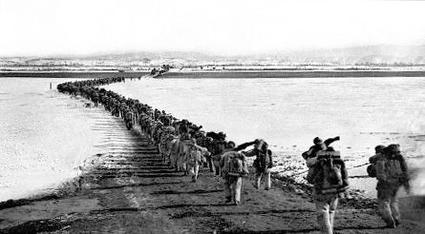
Seoul was captured by the KPA on 28 June, and by early August, the Republic of Korea Army (ROKA) and its allies were nearly defeated, holding onto only the Pusan Perimeter in the peninsula's southeast. On 15 September, UN forces landed at Inchon near Seoul, cutting off KPA troops and supply lines. UN forces broke out from the perimeter on 18 September, recaptured Seoul, and invaded North Korea in October, capturing Pyongyang and advancing towards the Yalu River (border with China). On 19 October, the Chinese People's Volunteer Army (PVA) crossed the Yalu and entered the war on the side of the North. UN forces retreated from North Korea in December, following the PVA's first and second offensive. Communist forces captured Seoul again in January 1951 before losing it to a UN counter-offensive two months later. After an abortive Chinese spring offensive, UN forces retook territory roughly up to the 38th parallel. Armistice negotiations began in July 1951, but dragged on as the fighting became a war of attrition and the North suffered devastating damage from UN bombing, destroying virtually all of North Korea's major cities.
Combat ended on 27 July 1953 with the signing of the Korean Armistice Agreement, which allowed the exchange of prisoners and created a 4-kilometre wide (2.5 mile) Demilitarized Zone (DMZ) along the frontline, with a Joint Security Area at Panmunjom. The industrial warfare was defined by armored offensives, with the North's initial invasion and later by UN forces, tunnel warfare by Chinese forces, and the first large jet aircraft battles. The conflict caused around one million military deaths and an estimated 1.5 million to 3 million civilian deaths. Alleged war crimes include the mass killing of alleged communists by South Korea, the Seoul National University Hospital massacre by North Korea, and the carpet bombing of North Korea by the UNC. North Korea became one of the most heavily bombed countries in history. No peace treaty has been signed; the Korean conflict remains a frozen conflict, which has occasionally flared, such as in the 1966–1969 DMZ Conflict.
Names
In South Korea, the war is usually referred to as the "625 War" (6·25 전쟁; 六二五戰爭), the "625 Upheaval" (6·25 동란; 六二五動亂; yugio dongnan), or simply "625", reflecting the date of its commencement on 25 June.

In North Korea, the war is officially referred to as the Fatherland Liberation War (Choguk haebang chŏnjaeng) or the Chosŏn [Korean] War (조선전쟁; Chosŏn chŏnjaeng).
In the United States, the war was initially described by President Harry S. Truman as a "police action" as the US never formally declared war and its military actions in Korea conducted under the auspices of the UN flag. It has sometimes been referred to in the English-speaking world as "The Forgotten War" or "The Unknown War" because of the lack of public attention it received relative to World War II and the Vietnam War.
In mainland China, the segment of the war after the intervention of the People's Volunteer Army is commonly and officially known as the "War to Resist America and Assist Korea" (Chinese: 抗美援朝战争; pinyin: Kàngměi Yuáncháo Zhànzhēng), while the segment preceding that is officially called the "Korean Civil War" (simplified Chinese: 朝鲜内战; traditional Chinese: 朝鮮內戰; pinyin: Cháoxiǎn Nèizhàn). The term "Chosŏn War" (simplified Chinese: 朝鲜战争; traditional Chinese: 朝鮮戰爭; pinyin: Cháoxiǎn Zhànzhēng) is sometimes used unofficially. The term "Hán (Korean) War" (Chinese: 韓戰; pinyin: Hán Zhàn) is most used in Taiwan (Republic of China), Hong Kong and Macau.

Background
Japanese colonization (1910–1945)
Korea was a colony ruled by the Empire of Japan from 1910 to 1945. The Empire of Japan diminished China's influence over Korea in the First Sino-Japanese War (1894–95). A decade later, after defeating Imperial Russia in the Russo-Japanese War, Japan made the Korean Empire its protectorate with the Eulsa Treaty in 1905, and then annexed it with the Japan–Korea Treaty of 1910.
Many Korean nationalists fled the country. The Provisional Government of the Republic of Korea was founded in 1919 in the Beiyang government. It failed to achieve international recognition, failed to unite the nationalist groups, and had a fractious relationship with its US-based founding president, Syngman Rhee.
The Chinese nationalist National Revolutionary Army and the communist People's Liberation Army (PLA) helped organize Korean refugees against the Japanese military, which had also occupied parts of China. The nationalist-backed Koreans, led by Yi Pom-Sok, fought in the Burma campaign (1941–45). The communists, led by Kim Il Sung, among others, fought the Japanese in Korea and Manchuria.
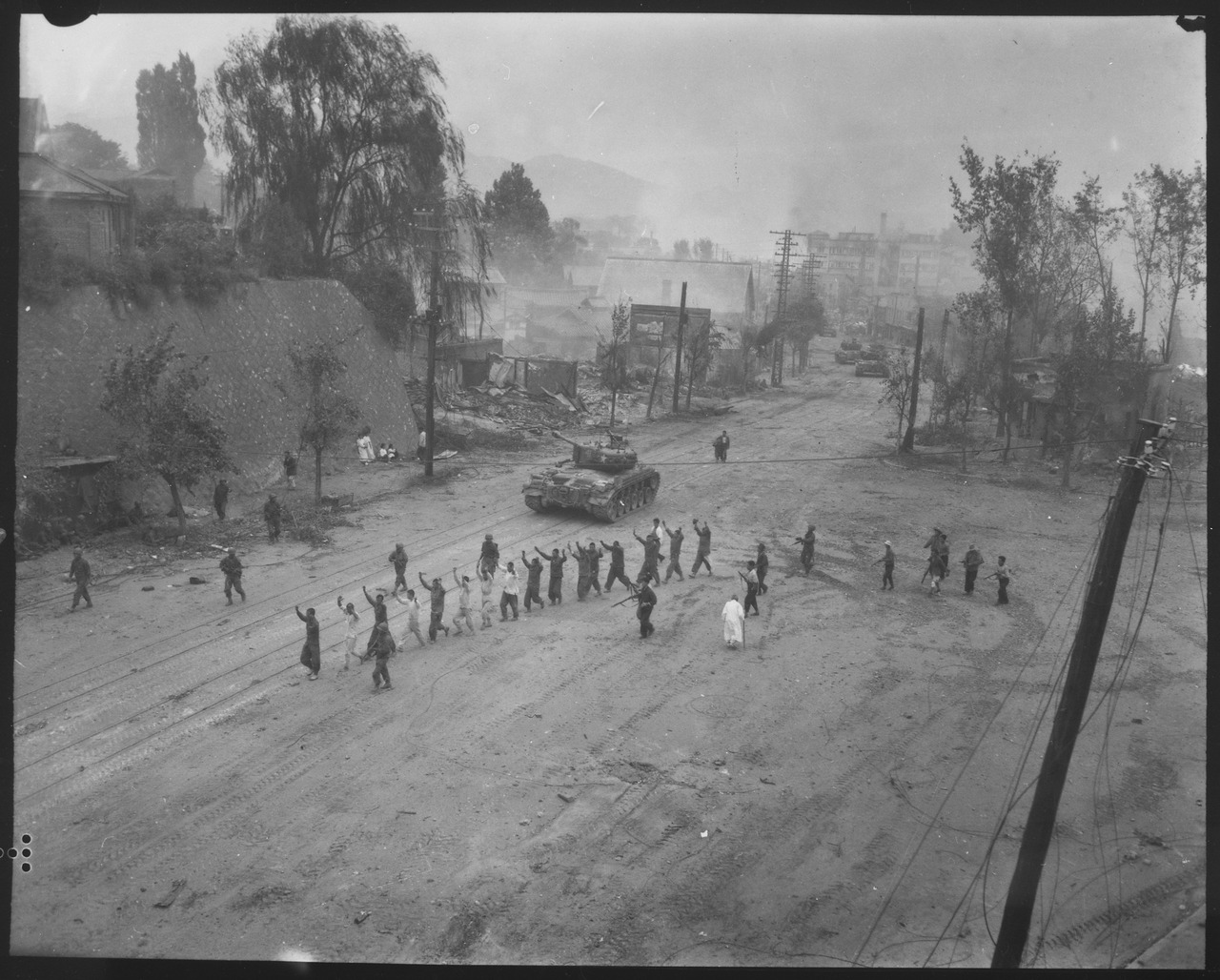
At the Tehran Conference in 1943 and the Yalta Conference in February 1945, the Soviet Union promised to join the Allies in the Pacific War within three months of the victory in Europe. On 8 August 1945, the USSR declared war on Japan and invaded Manchuria. On 10 August, Soviet forces entered northern Korea and had secured most major cities in the north by 24 August, as Japanese resistance was light. Having fought Japan on Korean soil, the Soviet forces were well received by Koreans. Imperial Japanese rule of Korea officially ended when Japan surrendered to the Allies on 15 August 1945, following the atomic bombings of Hiroshima and Nagasaki.
Division of Korea (1945)
At the Cairo Conference in 1943, China, the UK, and the US decided that "in due course, Korea shall become free and independent".
As World War II drew to a close, on 11 August 1945 two American military officials in Washington — US Colonels Dean Rusk and Charles H. Bonesteel III — chose an invisible line across the former Japanese colony, the 38th Parallel, for the division of Korea into two occupation zones, north and south, Soviet and American.

This was incorporated into US General Order No. 1, which responded to the Japanese surrender on 15 August. Joseph Stalin, however, maintained his wartime policy of cooperation, and on 16 August, the Red Army halted at the 38th parallel for three weeks to await the arrival of US forces. In explaining the choice of the 38th parallel, US Colonel Dean Rusk observed that, "Even though it was further north than could be realistically reached by US forces in the event of Soviet disagreement ... we felt it important to include the capital of Korea in the area of responsibility of American troops".
Joint US-Soviet occupation (1945–1948)
On 7 September 1945, General Douglas MacArthur issued Proclamation No. 1 to the people of Korea, announcing US military control over Korea south of the 38th parallel and establishing English as the official language during military control. On 8 September, US Lieutenant General John R. Hodge arrived in Incheon to accept the Japanese surrender south of the 38th parallel. Appointed as military governor, Hodge directly controlled South Korea as head of the US Army Military Government in Korea (USAMGIK 1945–48).
In December 1945, Korea was administered by the US–Soviet Union Joint Commission, as agreed at the Moscow Conference, to grant independence after a five-year trusteeship. Waiting five years for independence was unpopular among Koreans, and riots broke out. The Communist Party supported the trusteeship, while Kim Ku and Syngman Rhee led the anti-trusteeship movement against both the US Army Military Government in Korea and the Soviet military administration. To contain them, the USAMGIK banned strikes on 8 December and outlawed the PRK Revolutionary Government and People's Committees on 12 December. Following further civilian unrest, the USAMGIK declared martial law.

Citing the inability of the Joint Commission to make progress, the United Nations (UN) decided to hold an election under UN auspices to create an independent Korea, as stated in UN General Assembly Resolution 112. The Soviet authorities and Korean communists refused to participate in the election. The final attempt to establish a unified government was thwarted by North Korea's refusal. Due to concerns about division caused by an election without North Korea's participation, many South Korean politicians boycotted it. The 1948 South Korean general election was held in May. The resultant South Korean government promulgated a national political constitution on 17 July and elected Syngman Rhee as president on 20 July. The Republic of Korea (South Korea) was established on 15 August 1948.
In the Soviet-Korean Zone of Occupation, the Soviets agreed to the establishment of a communist government led by Kim Il Sung. The Democratic People's Republic of Korea (North Korea) was established on 10 July 1948. The 1948 North Korean parliamentary elections took place in August. The Soviet Union withdrew its forces in 1948 and the US in 1949.
Chinese Civil War (1945–1949)
With the end of the war with Japan, the Chinese Civil War resumed in earnest between the Communists and the Nationalist-led government. While the Communists were struggling for supremacy in Manchuria, they were supported by the North Korean government with matériel and manpower.
According to Chinese sources, the North Koreans donated 2,000 railway cars worth of supplies while thousands of Koreans served in the Chinese PLA during the war. North Korea also provided the Chinese Communists in Manchuria with a safe refuge for non-combatants and communications with the rest of China. As a token of gratitude, between 50,000 and 70,000 Korean veterans who served in the PLA were sent back along with their weapons, and they later played a significant role in the initial invasion of South Korea. China promised to support the North Koreans in the event of a war against South Korea.
Communist insurgency in South Korea (1948–1950)
By 1948, a North Korea-backed insurgency had broken out in the southern half of the peninsula. This was exacerbated by the undeclared border war between the Koreas, which saw division-level engagements and thousands of deaths on both sides. The ROK was almost entirely trained and focused on counterinsurgency, rather than conventional warfare. They were equipped and advised by a force of a few hundred American officers, who were successful in helping the ROKA to subdue guerrillas and hold its own against North Korean military (Korean People's Army, KPA) forces along the 38th parallel. Approximately 8,000 South Korean soldiers and police officers died in the insurgent war and border clashes.
The first socialist uprising occurred without direct North Korean participation, though the guerrillas still professed support for the northern government. Beginning in April 1948 on Jeju Island, the campaign saw arrests and repression by the South Korean government in the fight against the South Korean Labor Party, resulting in 30,000 violent deaths, among them 14,373 civilians, of whom 2,000 were killed by rebels and 12,000 by ROK security forces. The Yeosu–Suncheon rebellion overlapped with it, as several thousand army defectors waving red flags massacred right-leaning families. This resulted in another brutal suppression by the government and between 2,976 and 3,392 deaths. By May 1949, both uprisings had been crushed.
Insurgency reignited in the spring of 1949 when attacks by guerrillas in the mountainous regions (buttressed by army defectors and North Korean agents) increased. Insurgent activity peaked in late 1949 as the ROKA engaged so-called People's Guerrilla Units. Organized and armed by the North Korean government, and backed by 2,400 KPA commandos who had infiltrated through the border, these guerrillas launched an offensive in September aimed at undermining the South Korean government and preparing the country for the KPA's arrival in force. This offensive failed. However, the guerrillas were now entrenched in the Taebaek-san region of the North Gyeongsang Province and the border areas of the Gangwon Province. While the insurgency was ongoing, the ROKA and KPA engaged in battalion-sized battles along the border, starting in May 1949. Border clashes between South and North continued on 4 August 1949, when thousands of North Korean troops attacked South Korean troops occupying territory north of the 38th parallel. The 2nd and 18th ROK Infantry Regiments repulsed attacks in Kuksa-bong, and KPA troops were "completely routed". Border incidents decreased by the start of 1950.
Meanwhile, counterinsurgencies in the South Korean interior intensified; persistent operations, paired with worsening weather, denied the guerrillas sanctuary and wore away their fighting strength. North Korea responded by sending more troops to link up with insurgents and build more partisan cadres; North Korean infiltrators had reached 3,000 soldiers in 12 units by the start of 1950, but all were destroyed or scattered by the ROKA.
On 1 October 1949, the ROKA launched a three-pronged assault on the insurgents in South Cholla and Taegu. By March 1950, the ROKA claimed 5,621 guerrillas killed or captured and 1,066 small arms seized. This operation crippled the insurgency. Soon after, North Korea made final attempts to keep the uprising active, sending battalion-sized units of infiltrators under the commands of Kim Sang-ho and Kim Moo-hyon. The first battalion was reduced to a single man over the course of engagements by the ROKA 8th Division. The second was annihilated by a two-battalion hammer-and-anvil maneuver by units of the ROKA 6th Division, resulting in a toll of 584 KPA guerrillas (480 killed, 104 captured) and 69 ROKA troops killed, plus 184 wounded. By the spring of 1950, guerrilla activity had mostly subsided; the border, too, was calm.
Prelude to war (1950)
By 1949, South Korean and US military actions had reduced indigenous communist guerrillas in the South from 5,000 to 1,000. However, Kim Il Sung believed widespread uprisings had weakened the South Korean military and that a North Korean invasion would be welcomed by much of the South Korean population. Kim began seeking Stalin's support for an invasion in March 1949, traveling to Moscow to persuade him. Kim and second-in-command Pak Hon-yong tried to enlist Soviet ambassador Terentii Shtykov. Kim met with the ambassador on 12 August 1949; Shtykov said that an outright invasion was out of the question unless South Korea attacked first and that he only willing to consider a limited operation targeting the Ongjin peninsula. Mun Il visited Soviet chargé d'affaires Grigory Tunkin on 3 September 1949. Tunkin's report to the Soviet government was more neutral than previous Soviet diplomats, who were more skeptical.
Stalin initially did not think the time was right for a war in Korea. PLA forces were still embroiled in the Chinese Civil War, while US forces remained stationed in South Korea. After learning about Kim and Pak's plans, he told Tunkin to talk to Kim to produce an assessment of the South Korean and North Korean armed forces. After assessing both sides, Tunkin suggested against an invasion, to which Stalin agreed to and also banned the limited strike on the Ongjin peninsula. Kim continued his insistence on an invasion. On 17 January 1950, he told Soviet diplomats that South Korea needed to be liberated. By 1950, Stalin was more open to suggestions and believed that the strategic situation had changed: PLA forces under Mao Zedong had secured final victory, US forces had withdrawn from Korea, and the Soviets had detonated their first nuclear bomb, breaking the US monopoly. As the US had not directly intervened to stop the communists in China, Stalin calculated they would be even less willing to fight in Korea, which had less strategic significance. The Soviets had cracked the codes used by the US to communicate with their embassy in Moscow, and reading dispatches convinced Stalin that Korea did not have the importance to the US that would warrant a nuclear confrontation.
On 30 January 1950, Stalin telegraphed Shtykov, saying that any invasion "would need extensive preparations" and that "it should be organized without taking too big a risk", effectively giving the greenlight for preparations. Stalin began a more aggressive strategy in Asia based on these developments, including promising economic and military aid to China through the Sino-Soviet Treaty of Friendship, Alliance and Mutual Assistance. Kim spent almost a month in the Soviet Union from 30 March to 25 April, during which invasion plans were finalized. In April 1950, Stalin permitted Kim to attack the government in the South, under the condition that Mao would agree to send reinforcements if needed. For Kim, this was the fulfillment of his goal to unite Korea. Stalin made it clear Soviet forces would not openly engage in combat, to avoid a direct war with the United States.
Kim met with Mao in May 1950 and differing historical interpretations of the meeting have been put forward. According to Barbara Barnouin and Yu Changgeng, Mao agreed to support Kim despite concerns of American intervention, as China desperately needed the economic and military aid promised by the Soviets. Kathryn Weathersby cites Soviet documents which said Kim secured Mao's support. According to Park, Mao told Kim that "if the Americans would enter the war, China will help North Korea with troops". Along with Mark O'Neill, she says this accelerated Kim's war preparations. Chen Jian argues Mao never seriously challenged Kim's plans and Kim had every reason to inform Stalin that he had obtained Mao's support. Citing more recent scholarship, Zhao Suisheng contends Mao did not approve of Kim's war proposal and requested verification from Stalin, who did so via a telegram. Mao accepted the decision made by Kim and Stalin to unify Korea but cautioned Kim over possible US intervention. The coming Korean War was one of three wars that the Soviet and Chinese leaders had planned across East Asia in 1950. The first was a North Korean invasion of South Korea, which was to be backed by Chinese forces if necessary; they also planned a Chinese invasion of Taiwan later that year, and a Viet Minh revolution in Vietnam, which was to be backed by Chinese advisors and weaponry.
Kim told his inner circle about the preparations, including Pak Hon-yong, Aleksei Hegay, Supreme People's Assembly Presidium President Kim Tu-bong, Minister of Defense Choe Yong-gon and Minister of Justice Lee Sung-yop. Soviet generals with extensive combat experience from World War II were sent to North Korea as the Soviet Advisory Group. They completed plans for attack by May and called for a skirmish to be initiated in the Ongjin Peninsula on the west coast of Korea. Kim suggested the invasion start in late June. Soviets thought the North Koreans needed more time to prepare, but as the rain season was about to begin in July, which could make North Korean advances harder, they ultimately accepted Kim's proposal. The North Koreans would then launch an attack to capture Seoul and encircle and destroy the ROK. The final stage would involve destroying South Korean government remnants and capturing the rest of South Korea, including the ports.
On 7 June 1950, Kim called for a Korea-wide election on 5–8 August 1950 and a consultative conference in Haeju on 15–17 June. On 11 June, the North sent three diplomats to the South as a peace overture, which Rhee rejected outright. On 15 June, the invasion date was set to 25 June. On 21 June, Kim revised his war plan to involve a general attack across the 38th parallel, rather than a limited operation in Ongjin. Kim was concerned that South Korean agents had learned about the plans and that South Korean forces were strengthening their defenses. Stalin agreed to this change. On 24 June, division commanders received their invasion orders. The KPA planned defeating the South Koreans in twenty-two to twenty-seven days.
While these preparations were underway in the North, there were clashes along the 38th parallel, especially at Kaesong and Ongjin, many initiated by the South. The ROK was being trained by the US Korean Military Advisory Group (KMAG). On the eve of the war, KMAG commander General William Lynn Roberts voiced utmost confidence in the ROK and boasted that any North Korean invasion would merely provide "target practice". For his part, Syngman Rhee repeatedly expressed his desire to conquer the North, including when US diplomat John Foster Dulles visited Korea on 18 June.
Though some South Korean and US intelligence officers predicted an attack, similar predictions had been made before and nothing had happened. The Central Intelligence Agency noted the southward movement by the KPA but assessed this as a "defensive measure" and concluded an invasion was "unlikely". On 23 June, UN observers inspected the border and did not detect that war was imminent.
Comparison of forces
Chinese involvement was extensive from the beginning, building on previous collaboration between the Chinese and Korean communists during the Chinese Civil War. Throughout 1949 and 1950, the Soviets continued arming North Korea. After the communist victory in the Chinese Civil War, ethnic Korean units in the PLA were sent to North Korea.
In the fall of 1949, two PLA divisions composed mainly of Korean-Chinese troops (164th and 166th) entered North Korea, followed by smaller units throughout the rest of 1949. The reinforcement of the KPA with PLA veterans continued into 1950, with the 156th Division and several other units of the former Fourth Field Army arriving in February; the PLA 156th Division was reorganized as the KPA 7th Division. By mid-1950 between 50,000 and 70,000 former PLA troops had entered North Korea, forming a significant part of the KPA's strength on the eve of the war's beginning. The combat veterans and equipment from China, the tanks, artillery and aircraft supplied by the Soviets, and rigorous training increased North Korea's military superiority over the South, armed by the US military with mostly small arms, but no heavy weaponry.
Several generals, such as Lee Kwon-mu, were PLA veterans born to ethnic Koreans in China. While older histories of the conflict often referred to these ethnic Korean PLA veterans as being sent from northern Korea to fight in the Chinese Civil War before being sent back, recent Chinese archival sources studied by Kim Donggill indicate that this was not the case. Rather, the soldiers were indigenous to China, as part of China's longstanding ethnic Korean community, and were recruited to the PLA in the same way as any other Chinese citizen.
According to the first official census in 1949, the population of North Korea numbered 9,620,000. By mid-1950, North Korean forces numbered between 150,000 and 200,000 troops, organized into 10 infantry divisions, one tank division, and one air force division, with 210 fighter planes and 280 tanks that captured scheduled objectives and territory, among them Kaesong, Chuncheon, Uijeongbu, and Ongjin. Their forces included 274 T-34-85 tanks, 200 artillery pieces, 110 attack bombers, 150 Yak fighter planes, and 35 reconnaissance aircraft. In addition to the invasion force, the North had 114 fighters, 78 bombers, 105 T-34-85 tanks, and some 30,000 soldiers stationed in reserve in North Korea. Although each navy consisted of only several small warships, the North and South Korean navies fought in the war as seaborne artillery for their armies.
In contrast, the South Korean population was estimated at 20 million, over twice that of the North, but its army was unprepared and ill-equipped. As of 25 June 1950, the ROK had 98,000 soldiers (65,000 combat, 33,000 support), no tanks (they had been requested from the US military, but requests were denied), and a 22-plane air force comprising twelve liaison-type and ten AT-6 advanced-trainer airplanes. Large US garrisons and air forces were in Japan, but only 200 to 300 US troops were in Korea.
Course of the war
North Korean invasion (June 1950)
At 4:40 a.m. on 25 June 1950, the KPA crossed the 38th parallel behind artillery fire. The DPRK did not declare war before the invasion (called Operation Pokpung) and rushed to encircle and eventually capture Seoul, the capital of South Korea, from the ROK within a week. KPA forces swarmed South Korea and attacked all along the 38th parallel within an hour, and individual KPA units had advanced 3 to 5 kilometers into South Korean territory within the first three hours. The KPA had a combined arms force including tanks supported by heavy artillery supplied by the Soviet Union. The ROK had no tanks, anti-tank weapons, or heavy artillery. The South Koreans committed their forces in a piecemeal fashion, and these were routed in a few days.
North Korea justified its assault with the claim ROK troops attacked first and that the KPA were aiming to arrest and execute the "bandit traitor Syngman Rhee." Fighting began on the strategic Ongjin Peninsula in the west. There were initial South Korean claims that the 17th Regiment had counterattacked at Haeju; some scholars argue the claimed counterattack was instead the instigating attack, and therefore that the South Koreans may have fired first. However, the report that contained the Haeju claim contained errors and outright falsehoods.
On 27 June, Rhee evacuated Seoul with some of the government. On 28 June, the ROK blew up the Hangang Bridge across the Han River in an attempt to stop the KPA. The bridge was detonated while 4,000 refugees were crossing it and hundreds were killed. Destroying the bridge trapped many ROK units north of the river. In spite of such desperate measures, Seoul fell that same day. Some South Korean National Assemblymen remained in Seoul when it fell, and 48 subsequently pledged allegiance to the North.
Within days of the invasion, masses of ROK soldiers, of dubious loyalty to the Syngman Rhee regime, were retreating southwards or defecting en masse to the northern side, the KPA. On 28 June, Rhee ordered the massacre of suspected political opponents in his own country. In five days, the ROK, which had 95,000 troops on 25 June, was down to less than 22,000 troops. In early July, when US forces arrived, what was left of the ROK was placed under US operational command of the UN Command.
UN Security Council resolutions
On 25 June 1950, the United Nations Security Council (UNSC) adopted Resolution 83 finding that the North Korean invasion of the Republic of Korea was a breach of the peace in violation of Chapter VII of the UN Charter. The Soviet Union, a veto-wielding power, had been boycotting the UN Security Council since January 1950 in protest of Taiwan's occupation of China's permanent seat. Due to this, the Soviet Union's representative was not present at the meeting and was unable to vote against the resolution.
On 27 June, the Security Council adopted Resolution 83 recommending its member states provide military assistance to South Korea to restore international peace, resulting in a coalition led by the United States.
On 4 July, the Soviet Union's deputy foreign minister accused the US of starting an armed intervention on behalf of South Korea. The Soviet Union challenged the legitimacy of the war for several reasons. The ROK intelligence upon which UN Security Council Resolution 83 was based on came from US Intelligence; North Korea was not invited as a sitting temporary member of the UN, which violated Article 32 of the UN Charter; and the fighting was beyond the UN Charter's scope, because the initial North–South border fighting was classed as a civil war. Because the Soviet Union was boycotting the UN Security Council, some legal scholars posited that deciding upon this type of action required the unanimous vote of all five permanent members.
On 7 July, the Security Council adopted Resolution 84, which set up under the sponsorship of the British and French sides a Unified Command structure which was authorized to fly the blue flag of the UN but was not subject in any way to UN orders.