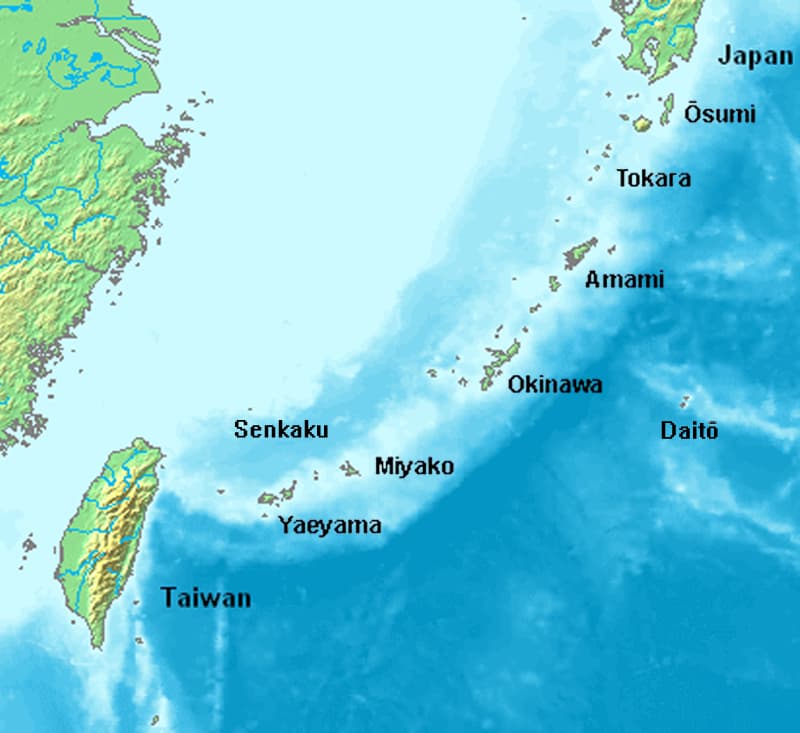
The Ryukyu Islands (Japanese: 琉球列島, Hepburn: Ryūkyū Rettō), also known as the Nansei Islands (南西諸島, Nansei Shotō; lit. 'Southwest Islands') or the Ryukyu Arc (琉球弧, Ryūkyū-ko), are a chain of Japanese islands that stretch southwest from Kyushu to Taiwan. Administratively, they are divided between Kagoshima Prefecture (the Satsunan Islands, further divided into the Ōsumi, Tokara, and Amami Islands) and Okinawa Prefecture (further divided into the Okinawa, Miyako, Yaeyama, Daitō, and Senkaku Islands). The larger ones are mostly volcanic islands and the smaller mostly coral. The largest is Okinawa Island.
The climate of the islands ranges from humid subtropical climate (Köppen climate classification Cfa) in the north to tropical rainforest climate (Köppen climate classification Af) in the south. Precipitation is very high and is affected by the rainy season and typhoons. Except the outlying Daitō Islands, the island chain has two major geologic boundaries, the Tokara Strait (between the Tokara and Amami Islands) and the Kerama Gap (between the Okinawa and Miyako Islands). The islands beyond the Tokara Strait are characterized by their coral reefs.
The Ōsumi and Tokara Islands, the northernmost of the islands, fall under the cultural sphere of the Kyushu region of Japan; local inhabitants speak a variation of the Kagoshima dialect of Japanese. The Amami, Okinawa, Miyako, and Yaeyama Islands have a native population collectively called the Ryukyuan people, named for the former Ryukyu Kingdom (1429–1875) that ruled them. The varied Ryukyuan languages are traditionally spoken on these islands, and the major islands have their own distinct languages. In modern times, the Japanese language has been the primary language of the islands, with the Okinawan Japanese dialect prevalently spoken. The outlying Daitō Islands were uninhabited until the Meiji period, when their development was started mainly by people from the Izu Islands south of Tokyo, with the people there speaking the Hachijō language.
The islands were held by the United States after the 1951 Treaty of San Francisco concluded the Pacific War. They were returned to Japan under the 1971 Okinawa reversion agreement, with China disputing the Senkaku Islands.
Administratively, the islands are divided between two prefectures: the northern islands, collectively called the Satsunan Islands, are part of Kagoshima Prefecture (specifically Kagoshima District, Kumage Subprefecture/District, and Ōshima Subprefecture/District), while the southern part of the chain makes up Okinawa Prefecture. The divide is between the Amami and Okinawa Islands, with the Daitō Islands part of Okinawa Prefecture.
Reading level
Audio Summary
Played with your browser's voice. Studio-quality audio can be added with a text-to-speech service.
Ask about this article
📝 Quick Quiz1 / 3
What is "Ryukyu Islands" primarily known for?
Vocix Daily — In Your Inbox
Top stories, deep-dive articles, and "On This Day" history — one crisp digest delivered every morning.
Sources & references
Reference material for this entry is drawn from the open encyclopedic record, including Wikipedia , available under the CC BY-SA 4.0 license. Images are credited individually beside each photo.
Geography
Island subgroups
The Ryukyu islands are commonly divided into two or three primary groups:
either administratively, with the Northern Ryukyus being the islands in Kagoshima Prefecture (known in Japanese as the "Satsunan Islands") and the Southern Ryukyus being the islands in Okinawa Prefecture (known in Japanese as the "Ryukyu Islands"),
or geographically, with the islands north of the Tokara Strait (Ōsumi and Tokara) being the Northern Ryukyus, those between the Tokara Strait and Kerama Gap (Amami and Okinawa) being the Central Ryukyus, and those south of the Kerama Gap (Miyako and Yaeyama) being the Southern Ryukyus.
The following are the grouping and names used by the Hydrographic and Oceanographic Department of the Japan Coast Guard. The islands are listed from north to south where possible.
Senkaku Islands (尖閣諸島, Senkaku-shotō; claimed by China and Taiwan): Uotsurijima, Kuba Jima, Taisho Jima, Kita Kojima, Minami Kojima
Daitō Islands (大東諸島, Daitō-shotō): Kita Daitō, Minami Daitō, Oki Daitō
The Geospatial Information Authority of Japan, another government organization that is responsible for standardization of place names, disagrees with the Japan Coast Guard over some names and their extent, but the two are working on standardization. They agreed on 15 February 2010, to use Amami-guntō (奄美群島) for the Amami Islands; prior to that, Amami-shotō (奄美諸島) had also been used.
Climate
The climate of the Ryukyu islands is sub-tropical. It is significantly warmer than the main islands Kyushu, Shikoku and Honshu. There are occasional typhoons during the summer. Winter temperature is mild with optimal clearness of the ocean water.
Names and extents
The English and Japanese uses of the term "Ryukyu" differ. In English, the term Ryukyu may apply to the entire chain of islands, while in Japanese Ryukyu usually refers only to the islands that were previously part of the Ryūkyū Kingdom after 1624.
Nansei Islands
Nansei-shotō (南西諸島) is the official name for the whole island chain in Japanese. Japan has used the name on nautical charts since 1907. Based on the Japanese charts, the international chart series uses Nansei Shoto.
Nansei literally means "southwest", the direction of the island chain relative to mainland Japan. Some humanities scholars prefer the uncommon term Ryūkyū-ko (琉球弧, "Ryukyu Arc") for the entire island chain. In geology, however, the Ryukyu Arc includes subsurface structures such as the Okinawa Trough and extends to Kyushu.
During the American occupation of Amami, the Japanese government objected to the islands being included under the name "Ryukyu" in English because they worried that this might mean that the return of the Amami Islands to Japanese control would be delayed until the return of Okinawa. However, the American occupational government on Amami continued to be called the "Provisional Government for the Northern Ryukyu Islands" in English, though it was translated as Rinji Hokubu Nansei-shotō Seichō (臨時北部南西諸島政庁, Provisional Government for the Northern Nansei Islands) in Japanese.
Ryukyu
The name of Ryūkyū (琉球) is strongly associated with the Ryukyu Kingdom, a kingdom that originated from the Okinawa Islands and subjugated the Sakishima and Amami Islands. The name is generally considered outdated in Japanese although some entities of Okinawa still bear the name, such as the local national university. FC Ryukyu is the maximum football representative of the prefecture in the Japanese football league system and has played as high as the second-tier J2 League.
In Japanese, the "Ryukyu Islands" (琉球諸島, Ryūkyū-shotō) cover only the Okinawa, Miyako, and Yaeyama Islands, while in English it includes the Amami and Daitō Islands. The northern half of the island chain is referred to as the Satsunan ("South of Satsuma") Islands in Japanese, as opposed to Northern Ryukyu Islands in English.
Humanities scholars generally agree that the Amami, Okinawa, Miyako, and Yaeyama Islands share much cultural heritage, though they are characterized by a great degree of internal diversity as well. There is, however, no good name for the group. The native population do not have their own name, since they do not recognize themselves as a group this size. Ryukyu is the principal candidate because it roughly corresponds to the maximum extent of the Ryūkyū Kingdom. However, it is not necessarily considered neutral by the people of Amami, Miyako, and Yaeyama, who were marginalized under the Okinawa-centered kingdom. The Ōsumi Islands are not included because they are culturally part of Kyushu. There is a high degree of confusion in use of Ryukyu in English literature. For example, Encyclopædia Britannica equates the Ryukyu Islands with Japanese Ryūkyū-shotō or Nansei-shotō in the definition but limits its scope to the Amami, Okinawa and Sakishima (Miyako and Yaeyama) in the content.
Historical usage
"Ryūkyū" is an exonym and is not a self-designation. The word first appeared in the Book of Sui (636). Its obscure description of Liuqiu (流求) is the source of a never-ending scholarly debate about whether the name referred to Taiwan, Okinawa or both. Nevertheless, the Book of Sui shaped perceptions of Ryūkyū for a long time. Ryūkyū was considered a land of cannibals and aroused a feeling of dread among surrounding people, from Buddhist monk Enchin who traveled to Tang China in 858 to an informant of the Hyōtō Ryūkyū-koku ki who traveled to Song China in 1243. Later, some Chinese sources used "Great Ryukyu" (Chinese: 大琉球; pinyin: Dà Liúqiú) for Okinawa and "Lesser Ryukyu" (Chinese: 小琉球; pinyin: Xiǎo Liúqiú) for Taiwan. Okinawan forms of "Ryūkyū" are Ruuchuu (ルーチュー) or Duuchuu (ドゥーチュー) in Okinawan and Ruuchuu (ルーチュー) in the Kunigami language. An Okinawan man was recorded as having referred to himself as a "Doo Choo man" during Commodore Matthew C. Perry's visit to the Ryūkyū Kingdom in 1852.
From about 1829 until the mid-20th century, the islands' English name was spelled Luchu, Loochoo, Loo-choo, or Lewchew, all pronounced . These spellings were based on the Okinawan form Ruuchuu (ルーチュー), as well as the Chinese pronunciation of the characters "琉球", which in Mandarin is Liúqiú.
Okinawa
Uchinaa (沖縄), Okinawa in Okinawan, is originally a native name for the largest island in the island chain. The island was referred to as Okinawa (阿児奈波) in the 8th century biography of Jianzhen (唐大和上東征傳). It is also specified as Okinawa (おきなわ) in hiragana in the collection of Umuru U Sōshi (おもろさうし), known as Ryukyu's official poetry book. It was not until the 18th century that Okinawa was specified in its own script as 沖縄.
The Japanese map series known as the Ryukyu Kuniezu lists the island as Wokinaha Shima (悪鬼納嶋) in 1644 and Okinawa Shima (沖縄嶋) after 1702. The name Okinawa Shima was chosen by the Meiji government for the new prefecture when they annexed the Ryukyu Kingdom in 1879.
Outside of Okinawa Prefecture, the word "Okinawa" is used to refer to Okinawa Prefecture and does not include Kagoshima Prefecture. (People from the Amami Islands, Kagoshima Prefecture object to being included in "Okinawa".) Inside Okinawa Prefecture, "Okinawa" is used to refer to Okinawa Island, and does not include the Miyako and Yaeyama Islands. People in the Yaeyama Islands use the expression "go to Okinawa" when they visit Okinawa Island.
Some scholars group the Amami and Okinawa Islands together because in some respects (e.g. from a linguistic point of view) Amami is closer to Okinawa than to Miyako and Yaeyama, but there is no established single-word term for the group since the native population had not felt the need for such a concept. Japanese scholars use "Amami–Okinawa" while American and European scholars use "Northern Ryukyuan".
Southern Islands
The folklorist Kunio Yanagita and his followers used Nantō (南島, "Southern Islands"). This term was originally used by the imperial court of Ancient Japan. Yanagita hypothesized that the southern islands were the origin of the Japanese people and preserved many elements that were subsequently lost in Japan. The term is outdated today.
History
Eastern Islands of Liuqiu
The first mention of the islands in Chinese literature occur in the Records of the Grand Historian. Qin Shi Huang heard of "happy immortals" living on the Eastern Islands, so he sent expeditions there to find the source of immortality, to no avail. Based on Ryukyuan folklore on Kudaka Island, some scholars believe that these expeditions succeeded in reaching Japan and launched a social and agricultural revolution there. The Eastern Islands are again mentioned as the land of immortals in the Annals of the Han dynasty.
In 601, the Chinese sent an expedition to the "Country of Liuqiu" (流求國). They noted that the people were small but pugnacious. The Chinese could not understand the local language and returned to China. In 607, they sent another expedition to trade and brought back one of the islanders. A Japanese embassy was in Luoyang when the expedition returned, and one of the Japanese exclaimed that the islander wore the dress and spoke the language of Yaku Island.
Ancient Japan's Southern Islands
The island chain appeared in Japanese written history as Southern Islands (南島, Nantō). The first record of the Southern Islands is an article of 618 in the Nihonshoki (720) which states that people of Yaku (掖玖,夜勾) followed the Chinese emperor's virtue. In 629, the imperial court dispatched an expedition to Yaku. Yaku in historical sources was not limited to modern-day Yakushima but seems to have covered a broader area of the island chain. In 657, several persons from Tokara (都貨邏; possibly Dvaravati) arrived at Kyushu, reporting that they had first drifted to Amami Island (海見島, Amamijima), which is the first attested use of Amami.
Articles of the late 7th century give a closer look at the southern islands. In 677, the imperial court gave a banquet to people from Tane Island (多禰島, Tanejima). In 679, the imperial court sent a mission to Tane Island. The mission carried some people from the southern islands who were described as the peoples of Tane, Yaku, and Amami (阿麻彌) in the article of 682. According to the Shoku Nihongi (797), the imperial court dispatched armed officers in 698 to explore the southern islands. As a result, people of Tane, Yaku, Amami and Dokan visited the capital (then Fujiwara-kyō) to pay tribute in the next year. Historians identify Dokan as Tokunoshima of the Amami Islands. An article of 714 reports that an investigative team returned to the capital, together with people of Amami, Shigaki (信覺), and Kumi (球美) among others. Shigaki should be Ishigaki Island of the Yaeyama Islands. Some identify Kumi as Iriomote Island of the Yaeyama Islands because Komi is an older name for Iriomote. Others consider that Kumi corresponded to Kume Island of the Okinawa Islands. Around this time "Southern Islands" replaced Yaku as a collective name for the southern islands.
In the early 8th century, the northern end of the island chain was formally incorporated into the Japanese administrative system. After a rebellion was crushed, Tane Province was established around 702. Tane Province consisted of four districts and covered Tanegashima and Yakushima. Although the tiny province faced financial difficulties from the very beginning, it was maintained until 824 when it was merged into Ōsumi Province.
Ancient Japan's commitment to the southern islands is attributed to ideological and strategic factors. Japan applied to herself the Chinese ideology of emperorship that required "barbarian people" who longed for the great virtue of the emperor. Thus Japan treated people on its periphery, i.e., the Emishi to the east and the Hayato and the Southern Islanders to the south, as "barbarians". The imperial court brought some of them to the capital to serve the emperor. The New Book of Tang (1060) states at the end of the chapter of Japan that there were three little princes of Yaku (邪古), Haya (波邪), and Tane (多尼). This statement should have been based on a report by Japanese envoys in the early 8th century who would have claimed the Japanese emperor's virtue. At the site of Dazaifu, the administrative center of Kyushu, two wooden tags dated in the early 8th century were unearthed in 1984, which read "Amami Island" (㭺美嶋, Amamijima) and "Iran Island" (伊藍嶋, Iran no Shima) respectively. The latter seems to correspond to Okinoerabu Island. These tags might have been attached to "red woods", which, according to the Engishiki (927), Dazaifu was to offer when they were obtained from the southern islands.
The southern islands had strategic importance for Japan because they were on one of the three major routes used by Japanese missions to Tang China (630–840). The 702 mission seems to have been the first to successfully switch from the earlier route via Korea to the southern island route. The missions of 714, 733 and 752 probably took the same route. In 754, the Chinese monk Jianzhen managed to reach Japan. His biography Tō Daiwajō Tōseiden (779) makes reference to Akonaha (阿兒奈波) on the route, which may refer to modern-day Okinawa Island. An article of 754 states that the government repaired mileposts that had originally been set in the southern islands in 735. However, the missions from 777 onward chose another route that directly connected Kyūshū to China. Thereafter the central government lost its interest in the southern islands.
Kikaigashima and Iōgashima
The southern islands reappeared in written history at the end of the 10th century. According to the Nihongi ryaku (c. 11th–12th centuries), Dazaifu, the administrative center of Kyushu, reported that the Nanban (southern barbarians) pirates, who were identified as Amami islanders by the Shōyūki (982–1032 for the extant portion), pillaged a wide area of Kyūshū in 997. In response, Dazaifu ordered "Kika Island" (貴駕島, Kikashima) to arrest the Nanban. This is the first attested use of Kikaigashima, which is often used in subsequent sources.