
Colorado State University (Colorado State or CSU) is a public land-grant research university in Fort Collins, Colorado, United States. It is the flagship university of the Colorado State University System. It was founded in 1870 as Colorado Agricultural College and assumed its current name in 1957. In 2024, enrollment was approximately 34,000 students, including resident and non-resident instruction students. The university has approximately 1,500 faculty in 8 colleges and 55 academic departments.
Bachelor's degrees are offered in 65 fields of study and master's degrees are offered in 55 fields. Colorado State confers doctoral degrees in 40 fields of study, in addition to a professional degree in veterinary medicine. In fiscal year 2023, CSU spent $498.1 million on research and development. It is classified among "R1: Doctoral Universities – Very high research activity".
CSU's campus includes the Engines and Energy Conversion Laboratory (EECL), the University Center for the Arts, which houses the Avenir Museum of Design and Merchandising and the Gregory Allicar Museum of Art, the James L. Voss Veterinary Teaching Hospital, and the Cooperative Institute for Research in the Atmosphere (CIRA).

The Colorado State Rams compete in the NCAA Division I Pac-12 Conference. Swimmer and six-time Olympic gold medalist Amy Van Dyken is one of CSU's most notable athletes. Other CSU alumni are Nobel Prize winners, Pulitzer Prize winners, astronauts, CEOs, Marshall Scholars and two former governors of Colorado. CSU faculty includes Fulbright Program American Scholars, members of National Academy of Sciences, National Academy of Engineering, American Academy of Arts and Sciences, and the Guggenheim fellowship.
History
Early years
CSU was known at its founding as the Colorado Agricultural College. Arising from the Morrill Act of 1862, the act to create the university was signed by the Colorado Territory governor Edward M. McCook in 1870. While a board of 12 trustees was formed to "purchase and manage property, erect buildings, establish basic rules for governing the institutions and employ buildings," the near complete lack of funding by the territorial legislature for this mission severely hampered progress.
The first 30-acre (12 ha) parcel of land for the campus was deeded in 1871 by Robert Dazell. In 1872, the Larimer County Land Improvement Company contributed a second 80-acre (32 ha) parcel. The first $1000 to erect buildings was finally allocated by the territorial legislature in 1874. The funds were not, however, and trustees were required to find a matching amount, which they eventually obtained from local citizens and businesses.

Among the institutions which donated matching funds was the local Grange, which was heavily involved in the early establishment of the university. As part of this effort, in the spring of 1874, Grange No. 6 held a picnic and planting event at the corner of College Avenue and West Laurel Street, and later plowed and seeded 20 acres (80,000 m2) of wheat on a nearby field. Within several months, the university's first building, a 16-foot (4.9 m)-by-24-foot red brick building nicknamed the "Claim Shanty" was finished, providing the first tangible presence of the institution in Fort Collins.
After Colorado achieved statehood in 1876, the territorial law establishing the college was required to be reauthorized. In 1877, the state legislature created the eight-member State Board of Agriculture to govern the school. Early in the 21st century, the governing board was renamed the Board of Governors of the Colorado State University System. The legislature also authorized a railroad right-of-way across the campus and a mill levy to raise money for construction of the campus' first main building, Old Main, which was completed in December 1878. Despite wall cracks and other structural problems suffered during its first year, the building was opened in time for the welcoming of the first five students on September 1, 1879, by university president Elijah Evan Edwards. Enrollment grew to 25 by 1880.
During the first term at Colorado Agricultural College in fall 1879, the school functioned more as a college-prep school than a college because of the lack of trained students. Consequently, the first course offerings were arithmetic, English, U.S. history, natural philosophy, horticulture and farm economy. Students also labored on the college farm and attended daily chapel services. The spring term provided the first true college-level instruction. Despite his accomplishments, Edwards resigned in spring 1882 because of conflicts with the State Board of Agriculture, a young faculty member, and with students. The board's next appointee as president was Charles Ingersoll, a graduate and former faculty member at Michigan State Agricultural College, who began his nine years of service at CAC with just two full-time faculty members and 67 students, 24 of whom were women.

President Charles Ingersoll
Agricultural research grew rapidly under Ingersoll. The Hatch Act of 1887 provided federal funds to establish and maintain experiment stations at land-grant colleges. Ainsworth Blount, CAC's first professor of practical agriculture and manager of the College Farm, had become known as a "one man experiment station", and the Hatch Act expanded his original station to five Colorado locations. The curriculum expanded as well, introducing coursework in engineering, animal science, and liberal arts. New faculty members brought expertise in botany, horticulture, entomology, and irrigation engineering. CAC made its first attempts at animal science during 1883–84, when it hired veterinary surgeon George Faville. Faville conducted free weekly clinics for student instruction and treatment of local citizens' diseased or injured animals. Veterinary science at the college languished for many years following Faville's departure in 1886.
President Ingersoll believed the school neglected special programs for women. Despite the reluctance of the institution's governing board, CAC began opening the door to liberal arts in 1885, and by Ingersoll's last year at CAC the college had instituted a "Ladies Course" that offered junior and senior women classes in drawing, stenography and typewriting, foreign languages, landscape gardening and psychology. Ingersoll's belief in liberal yet practical education conflicted with the narrower focus of the State Board of Agriculture, and a final clash in April 1891 led to his resignation. In 1884, CAC would celebrate the commencement of its first three graduates.
Professor Louis G. Carpenter
One of the early notable professors was Louis George Carpenter (March 28, 1861 – September 12, 1935), who was happy to be called "Professor Carp." He was a college professor and later the Dean of Engineering & Physics at Colorado State University formerly known as the Colorado Agricultural College. He was also an engineer, mathematician, and irrigation and consulting engineer.

Carpenter began teaching mathematics at Michigan State Agricultural College, and did so from 1883 to 1888.
Carpenter was recruited by President Charles Ingersoll and accepted the chair of the Engineering & Physics Department of the then Colorado Agricultural College. There, he began the first organized and systematic college program for irrigation engineering. Those completing such instruction were awarded a Bachelor of Science degree in Irrigation Engineering. Carpenter was a strong advocate for expanding education opportunities to minorities and women. He helped promote and organize newly accredited degree programs despite opposition from those unwilling to change.
Carpenter declined the Presidency of that college (later university) in 1891 and several times during his tenure. Despite difficulty to enact change, he was significant in being able to help transform the farm focused college into a university of higher learning.

In 1889, he became the director of the Colorado Agricultural Experiment Station.
Carpenter was one of the foremost leading experts on irrigation systems. He investigated irrigation systems not only in North America but also in Canada and Europe. This led to his engineering consulting and water law. He became Colorado's State Engineer, a post he held for several years while still teaching.
In 1911, Carpenter left academics and established an engineering consulting firm in Denver. This covered not only included irrigation engineering, but also consulting on hydraulic construction projects and the problems associated with such projects. He did this traveling around Canada, the United States and Western Europe with his brother running the office until his retirement in 1922. He left many papers to the university and was given an honorary doctorate before his death in 1935.
Turn of the 20th century
Alston Ellis encountered limited funding and decided in 1895 to reduce the number of Experiment Stations. Female students grew in number from 44 in 1892 to 112 in 1896, and by fall 1895, the college's new domestic-economy program was in place. Football had a one-year stint at CAC in 1893, but Ellis was not a supporter of extracurricular activities and was especially hostile towards football.
Barton Aylesworth became the school's fourth president in 1899, and the combination of his non-confrontational style with the presence of the vocal Colorado Cattle and Horse Growers Association on the governing board allowed ranching and farming interests to take the college's agricultural programs to new heights, greatly influencing the development of the entire school. Initially, the influence of ranching interests brought tremendous progress to CAC's agricultural programs. Enrollment quadrupled, studies in veterinary medicine were re-established, and CAC's Experiment Station benefited from lobbying that finally secured state appropriations. Eventually, conflicts with agricultural interests may have prompted Aylesworth to begin promoting a more balanced curriculum at CAC, which he then fought hard to defend. The conflict also led him to tire and negotiate his resignation.
Aylesworth was a big supporter of extracurricular activities. Football returned to the college in fall 1899, but baseball was the school's most popular sport. In 1903, the women's basketball team won CAC's first unofficial athletic championship, culminating with a victory over the University of Colorado. New clubs, fraternities, and sororities also emerged. By 1905, the school had a fledgling music department, which two years later became the Conservatory of Music.
President Charles Lory
Taking office in 1909, CAC President Charles Lory oversaw the school's maturation and reconciled longstanding conflicts between supporters of a broad or specialized curriculum. He embarked on a demanding schedule of personal appearances to make Colorado Agricultural College known as an institution that served the state's needs. Another of Lory's notable achievements was putting the school on solid fiscal ground, meeting rising construction costs and freeing the institution of debt.
The onset of World War I influenced all aspects of CAC, but nowhere was the impact more apparent than in the institution's programs for farmers. World War I created demands for American agricultural products, and CAC established new food production committees, information services and cultivation projects to help improve food production and conservation in Colorado. World War I also drew men from campus to Europe's battlefields. In June 1916, the National Defense Act created the Reserve Officers Training Corps. A few months later CAC applied to establish an ROTC unit in Fort Collins and resurrected a defunct National Guard unit on campus.
During the early 1930s, CAC's community-wide activities were greatly influenced by the Great Depression and the Dust Bowl. The Extension Service organized relief programs for inhabitants of Eastern Colorado, of whom a survey found 20,000 to be urgently in need of food and helped sustain cropland threatened by pests and drought. President Lory sought to help Colorado farmers by pushing for major tax reforms to relieve them of high tax burdens and played a significant role in a 1930s project that supplied irrigation water for agricultural development in Eastern Colorado.
Lory and the State Board had challenges of their own back on campus. In response to claims that the university was falling behind national standards, the board retired or demoted several senior professors and administrators deemed past the peak of their proficiency and hired new doctorate-holding personnel while consolidating sections of lecture courses. A student petition led to the governing-board to change the college's name to more accurately reflect the diversity of its academic programs, and in 1935 the school became the Colorado State College of Agriculture and Mechanic Arts, or Colorado A&M for short. After 31 years of leadership, President Lory announced his retirement in 1938.
From World War II into the modern era
Soon after Pearl Harbor, Colorado A&M began to look like a military post, with the college serving as many as 1,500 servicemen. New President Roy Green tried to prepare for the sudden departure of students and arrival of servicemen by improving ROTC facilities and introducing military-training programs. Although servicemen filed onto campus, student enrollment at Colorado A&M, 1,637 in fall 1942, dropped to 701 by fall 1943, and female students outnumbered their male counterparts for the first time. When the war ceased in 1945, soldiers returning from Europe and the Pacific filled U.S. higher-education institutions. Nearly 1,040 students attended the college in fall 1946, and about 1,600 students enrolled by spring 1946. Close to 80 former "Aggies" died in World War II including football talent Lewis "Dude" Dent.
Colorado A&M becomes a university under Bill Morgan
Colorado A&M shed its image as a narrow technical college and became a university in appearance and title during the 1950s under President Bill Morgan. Providing adequate student housing for an increasing number of youth approaching college age and improving cramped instructional facilities were among the first tests of Morgan's leadership. He responded, and five new residence halls were completed between 1953 and 1957.
Academic offerings grew to include advanced degrees. The State Board of Agriculture approved a doctoral degree in civil engineering in 1951, and three years later allowed other qualified departments to offer doctorates. Morgan believed students earning this advanced degree should hold it from a university, and so began a campaign to upgrade Colorado A&M to university status. In 1957, the Colorado General Assembly approved the new name of Colorado State University.
1960s: Student activism
Colorado State became a scene of intense student activism during the 1960s and early 1970s. The reduction of strict campus regulations for women was among the early targets of student activists, coming to the forefront in 1964 when a 21-year-old female student moved into unapproved off-campus housing to accommodate her late hours as editor of the student newspaper.
The civil-rights movement on campus also picked up momentum and visibility. In spring 1969, shortly before Morgan's retirement, Mexican American and African American student organizations presented a list of demands to university officials primarily urging increased recruitment of minority students and employees. The demonstrators' occupation of the Administration Building continued to the front lawn of Morgan's home. Students and university representatives took their concerns to state officials, but Colorado legislators rejected a subsequent university request for funds to support minority recruitment.
Anti-military protest took place in dramatic form at Colorado State from 1968 to 1970. On March 5, 1968, several hundred students and faculty with anti-war sentiments marched to Fort Collins' downtown War Memorial and wiped blood on a placard tied to the memorial. Hecklers and blockaders created such a disturbance that police had to disperse the non-marchers. In May 1970, as campus peace activists held the second day of a student strike in the gymnasium in response to the U.S. invasion of Cambodia and the student deaths at Kent State University, one or more arsonists set Old Main ablaze, destroying the 92-year-old cornerstone of Colorado State.
2000s: CSU under President Penley
In his welcoming address for the fall 2007 semester, former CSU President Larry Edward Penley called for CSU to set the standard for the 21st century public land-grant research university. He identified as the heart of this ideal the contribution to the prosperity and quality of life of the local and international community, in part through fostering relationships and collaborations with federal research partners, the business community and key industries. A part of this approach was Colorado State's Supercluster research model, designed to utilize interdisciplinary, issue-based research on pressing global issues in which the university has particular expertise and connect research results to the marketplace. Initial Superclusters in infectious disease and in cancer research were launched. As well, new residence halls were constructed according to national green building standards, and a sustainability advisory committee was charged to coordinate green activities at Colorado State.
While maintaining historic ties to local agriculture, administration officials also emphasized the desire to better connect with the local community. As such, CSU became party to UniverCity, a multi-organization initiative that links the school with city government, community and business associations to expand and synchronize working relationships. Another goal set by the university was to improve undergraduate education. Penley stated that essential tasks were access and graduation rates, particularly for qualified low-income and minority students, and an education international in scope suited to a global economy.
Penley resigned in 2008.
Later 2000s: After President Penley
While a statistics professor at CSU, Mary Meyer declared that a study of salaries by CSU created salary goals for women faculty that were "substantially smaller than for men". This led CSU to start studying pay equity in 2015, which in turn led later that year to a quarter of female full professors receiving higher pay.
Joyce E. McConnell became the first female president of CSU in 2019. On June 9, 2022, the CSU Board of Governors and President McConnell announced she would be leaving her position as of June 30, 2022. Former Provost Rick Miranda was chosen to serve in an interim role while a new president is identified. In December 2022, the CSU Board announced the appointment of Amy Parsons, once its vice president of operations, then executive vice chancellor, as its 16th president effective Feb. 1, 2023.
Campus
Colorado State University is located in Fort Collins, Colorado, a mid-size city of approximately 170,000 residents at the base of the Front Range of the southern Rocky Mountains. The university's 583-acre (2.4 km2) main campus is located in central Fort Collins and includes a 101-acre (0.41 km2) veterinary teaching hospital. CSU is also home to a 1,438-acre (5.8 km2) Foothills Campus, a 1,575-acre (6.4 km2) agricultural campus, and the 1,177-acre (4.8 km2) Pingree Park mountain campus. CSU uses 4,043 acres (16.4 km2) for research centers and Colorado State Forest Service stations outside of Larimer County.
Main campus
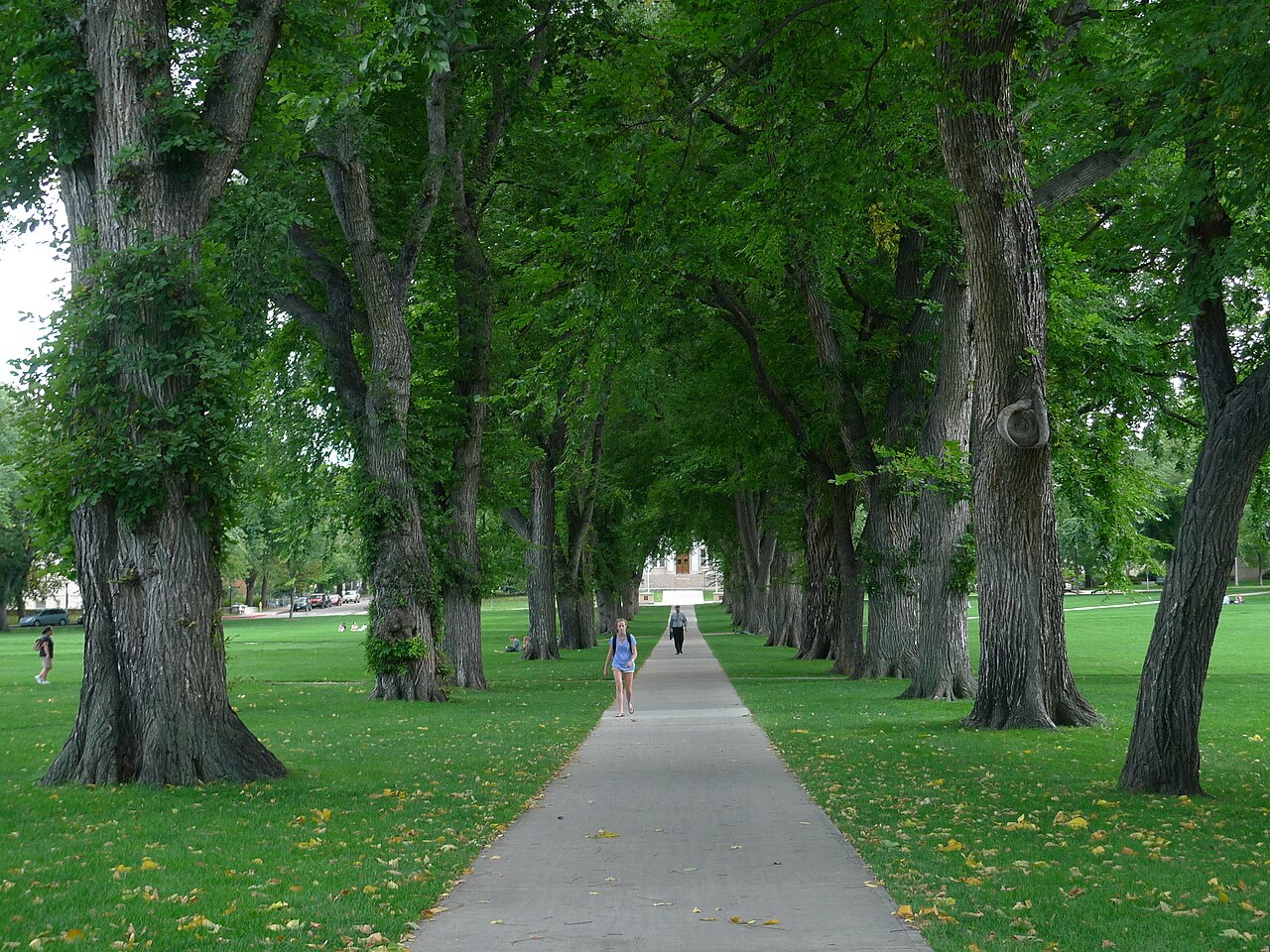
At the heart of the CSU campus lies the Oval, an expansive green area 2,065 feet (629 m) around, lined with 65 American elm trees. Designed in 1909, the Oval remains a center of activity and a major landmark at CSU. The Administration Building, constructed in 1924, faces the Oval from the south end, while several academic and administrative buildings occupy its perimeter. The Music Building, once the university library, currently houses the Institute for Learning and Teaching, which provides academic and career counseling as well as other student-focused programs. The music department moved to the University Center for the Arts upon its opening in 2008. At the northwest corner of the Oval is Ammons Hall, formerly the women's recreational center and now home to the University Welcome Center. Just to the east of Ammons stands Guggenheim Hall, which currently houses the Department of Manufacturing Technology and Construction Management. The building was constructed in 1910 as a gift from U.S. Senator Simon Guggenheim to promote the study of home economics, and was recently renovated according to green building standards. Rounding out the Oval are the Weber Building, the Statistics Building, the Occupational Therapy Building, and Laurel Hall.
Another campus focal point is the main plaza, around which can be found Lory Student Center and Morgan Library, as well as several academic buildings. The Lory Student Center, named for former CSU President Charles Lory, houses Student Media, numerous organization offices, Student Government, and spaces to eat, drink and study. The Morgan Library was originally constructed in 1965 and named for former CSU President William E. Morgan. Following the flood of '97, this facility went through an extensive improvement project that included an addition to the main building and a renovation of the existing structure, with works completed in 1998. Current holdings include more than 2 million books, bound journals, and government documents. Morgan Library also contains a 13,000 sq ft (1,200 m2) addition called the Study Cube that seats 80 additional patrons. With a university issued ID card, students and staff are able to access the Cube 24 hours a day, including during finals week. To accommodate, the Loan and Reserve desk checks out laptops and other accessories overnight if checked out less than six hours prior to closing.
Colorado State University's oldest existing building is Spruce Hall, constructed in 1881. Originally a dormitory that played a vital role in the early growth of the school's student enrollment, Spruce now houses the Division of Continuing Education and the Office of Admissions. The newest academic building on campus is the Behavioral Science building, which was completed in summer 2010. Other recent projects include the 2006 Transit Center addition to the north end of Lory Student Center (certified LEED Gold), an expansion of the Student Recreation Center, and the new Computer Science Building, completed in 2008.
In 2008, CSU also opened its University Center for the Arts, located in the old Fort Collins High School. CSU purchased this historic building in 1995 and has since converted it into a new home for its programs in music, dance, theatre and the visual arts. The three-phase building project included a 318-seat University Theatre, a 100-seat Studio Theatre, and the 24,000 sq ft (2,200 m2) Runyan Music Hall, an adaptable rehearsal and performance space created out of the old high school gymnasium. The center also houses the University Art Museum, the Avenir Museum of Design and Merchandising, a 285-seat organ recital hall, and the 200-seat University Dance Theatre.
The campus is served by Transfort bus service, including the MAX Bus Rapid Transit route that opened in 2014. The CSU Transit Center, which has stations for eleven different Transfort bus routes, is located just outside the Lory Student Center. In the summer of 2014, Transfort and CSU launched a bus route called Around the Horn, or simply Horn, that exclusively serves the campus. As of 2025, Around the Horn has 23 stations located both in CSU's main campus and the CSU Tennis Center, which is located immediately to the south.
Veterinary hospital
The James L. Voss Veterinary Teaching Hospital was constructed in 1979 and houses 28 specialties under one roof, ranging from emergency to oncology. Located in the Veterinary Health Complex south of the main campus in Fort Collins, the hospital has 79 veterinarians on clinics, educating 280 third- and fourth-year veterinary students on clinical rotations. In fiscal 2019, the hospital logged nearly 47,000 cases.
Foothills Campus
The 1,705-acre (6.9 km2) Foothills Campus, located on northwest edge of Fort Collins, is home to the department of atmospheric sciences, as well as several research and outreach centers. The Centers for Disease Control and Prevention, Engineering Research Center, B.W. Pickett Equine Center, Cooperative Institute for Research in the Atmosphere (CIRA), the Colorado Division of Wildlife, and the Animal Reproduction Biotechnology Lab can all be found at the Foothills Campus.
Organization
Administration
Colorado State University is a public land-grant institution. Its 13-member board of governors presides over the Colorado State University System, including the flagship campus in Fort Collins together with Colorado State University–Pueblo and the CSU–Global Campus. The board consists of nine voting members appointed by the Governor of Colorado and confirmed by the Colorado State Senate and four elected non-voting members. Voting members are community leaders from many fields, including agriculture, business, and public service. The student body president as well as a faculty representative from each university act as non-voting board members. Amy Parsons currently serves as the 16th president of Colorado State University.