
Fort Collins is a home rule city in Larimer County, Colorado, United States, and serves as the county seat and most populous municipality of the county. It is the fourth-most populous city in Colorado with a population of 169,810 at the 2020 census, while the Fort Collins, CO Metropolitan Statistical Area has an estimated 375,000 residents.
Situated on the Cache La Poudre River along the Colorado Front Range, Fort Collins is located 60 mi (97 km) north of the Colorado State Capitol in Denver and is a major city of the Front Range Urban Corridor. It is a prominent college town, home to Colorado State University, a public research university and the second-largest university by enrollment in Colorado.
History
The Northern Arapaho were centered in the Cache la Poudre River Valley near present-day Fort Collins. Friday, who attended school in St. Louis, Missouri in his youth, was a leader of the band of Arapahos as well as an interpreter, negotiator, and peacemaker. He made friends of white settlers who moved into the area, but was pushed out of Colorado in the 1860s.

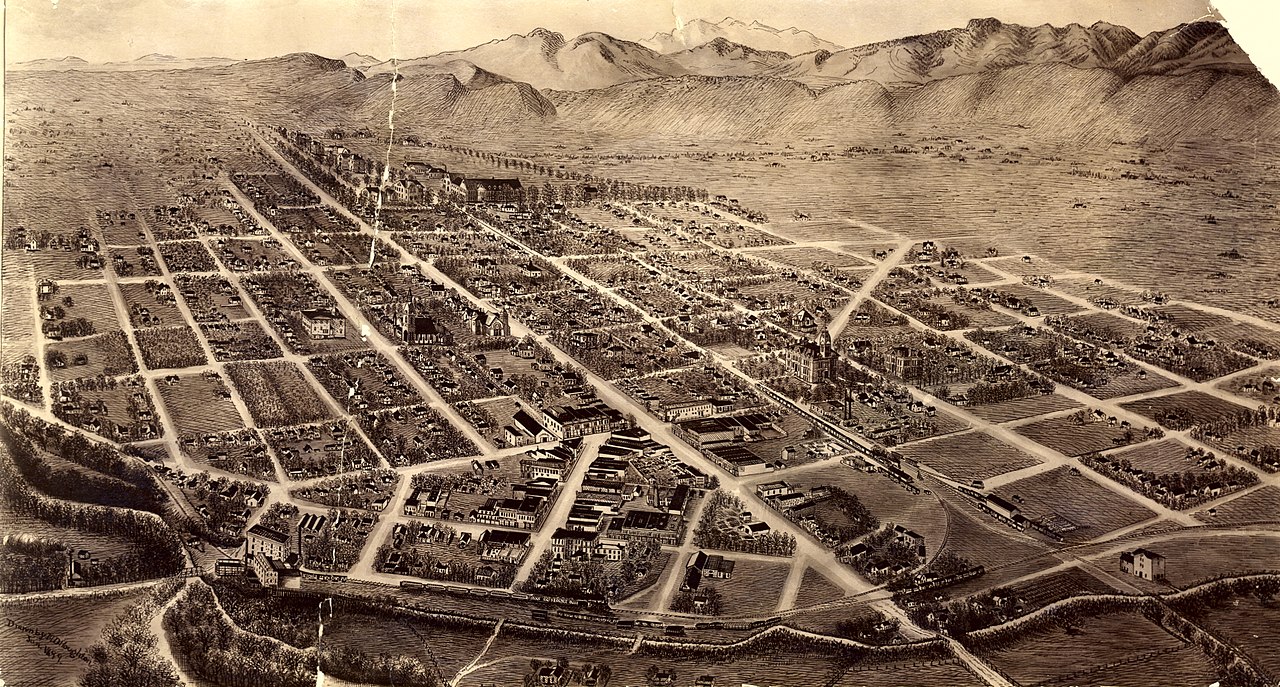
Fort Collins was founded as a military outpost of the United States Army in 1864. It succeeded a previous encampment, known as Camp Collins, on the Cache la Poudre River, near what is known today as Laporte. Camp Collins was erected during the Indian wars of the mid-1860s to protect the Overland mail route that had been recently relocated through the region. Travelers crossing the county on the Overland Trail would camp there, but a flood destroyed the camp in June 1864. Afterward, the commander of the fort wrote to the commandant of Fort Laramie in southeast Wyoming, Colonel William O. Collins, suggesting that a site several miles farther down the river would make a good location for the fort. The post was manned originally by two companies of the 11th Ohio Volunteer Cavalry and never had walls. The Fort Collins, Colorado Territory, post office opened on June 27, 1865.
Settlers began arriving in the vicinity of the fort nearly immediately. The fort was decommissioned in 1867. The original fort site is now adjacent to the present historic "Old Town" portion of the city. The first school and church opened in 1866, and the town was platted in 1867. The civilian population of Fort Collins, led by local businessman Joseph Mason, led an effort to relocate the county seat to Fort Collins from LaPorte, and they were successful in 1868.
The city's first population boom came in 1872, with the establishment of an agricultural colony. Hundreds of settlers arrived, developing lots just south of the original Old Town. Tension between new settlers and earlier inhabitants led to political divisions in the new town, which was incorporated in 1873. Although the Colorado Agricultural College was founded in 1870, the first classes were held in 1879.

The Town of Fort Collins was incorporated on February 12, 1883. The 1880s saw the construction of a number of elegant homes and commercial buildings and the growth of a distinctive identity for Fort Collins. Stone quarrying, sugar-beet farming, chestnut farming and the slaughter of sheep were among the area's earliest industries. During this the early 1800s many early settlers planted new plants such as beets, chestnuts; specifically horse-chestnuts (Aesculus hippocastanum), an ornamental species from the Balkans. These planted crops, served as an essential stepping stone in the change of the unique agricultural landscape that emerged in the Front Range. Beet tops, an industry supported by the college and its associated agricultural experiment station, proved to be an excellent and abundant food for local sheep, and by the early 1900s the area was being referred to as the "Lamb feeding capital of the world". In 1901 the Great Western sugar processing plant was built in the neighboring city of Loveland.
Although the city was affected by the Great Depression and simultaneous drought, it nevertheless experienced slow and steady growth throughout the early part off the twentieth century. During the decade following World War II, the population doubled and an era of economic prosperity occurred. Old buildings were razed to make way for new, modern structures. Along with revitalization came many changes, including the closing of the Great Western sugar factory in 1955, and a new city charter, adopting a council-manager form of government in 1954. Similarly, Colorado State University's enrollment doubled during the 1960s, making it the city's primary economic force by the end of the century.
Fort Collins gained a reputation as a very conservative city in the twentieth century, with a prohibition of alcoholic beverages, a contentious political issue in the town's early decades, being retained from the late 1890s until student activism helped bring it to an end in 1969. During that same period, civil rights activism and anti-war disturbances heightened tensions in the city, including the burning of several buildings on the CSU campus.

During the late 20th century, Fort Collins expanded rapidly to the south, adding new development, including several regional malls. Management of city growth patterns became a political priority during the 1980s, as well as the revitalization of Fort Collins' Old Town with the creation of a Downtown Development Authority. In late July 1997, the city experienced a flash flood after and during a 31-hour period when 10–14 in (250–360 mm) of rain fell. The rainfall was the heaviest on record for an urban area of Colorado. Five people were killed and $5 million in damages were dealt to the city. The waters flooded Colorado State University's library and brought about $140 million in damages to the institution.
Geography
Fort Collins is situated at the base of the Rocky Mountain foothills of the northern Front Range, approximately 60 miles (97 km) north of Denver, Colorado, and 45 miles (72 km) south of Cheyenne, Wyoming. Elevation is 4,982 ft (1,519 m) above sea level. Geographic landmarks include Horsetooth Reservoir and Horsetooth Mountain—so named because of a tooth-shaped granite rock that dominates the city's western skyline. Longs Peak can also clearly be seen on a clear day to the southwest of the city.
The Cache La Poudre River and Spring Creek run through Fort Collins.

At the 2020 United States census, the town had a total area of 37,423 acres (151.444 km2) including 807 acres (3.265 km2) of water.
Climate
Fort Collins has a cold semi-arid climate (Köppen climate classification BSk). Its climate is characterized by warm to hot summers and long and moderately cold winters (with frequent warm spells due to downslope winds, and somewhat less common intervals of severe cold). The average temperature in December, the coldest month, is 31.1 °F (−0.5 °C). Annual snowfall averages 51.4 inches (1.31 m), and can occur from early September through the end of May. Average precipitation overall is 15.88 inches (403 mm).
Demographics
Fort Collins is the fourth most populous city in Colorado and the 156th most populous city in the United States. The Census Bureau estimates that the city's population was 161,175 in 2015, the population of the Fort Collins-Loveland Metropolitan Statistical Area was 310,487 (151st most populous MSA), and the population of the Front Range Urban Corridor was 4,495,181.
As of the census of 2000, there were 118,652 people, 45,882 households, and 25,785 families residing in the city. The population density was 2,549.3 inhabitants per square mile (984.3/km2). There were 47,755 housing units at an average density of 1,026 units per square mile (396 units/km2). The racial makeup of the city was 82.4% White, 3.01% Black or African American, 0.6% Native American, 2.48% Asian, 0.12% Pacific Islander, 3.61% from other races, and 2.53% from two or more races. Hispanic or Latino residents of any race were 10.79% of the population.
There were 45,882 households, out of which 29% had children under the age of 18 living with them, 44.9% were married couples living together, 7.9% had a female householder with no husband present, and 43.8% were non-families. 26% of all households were made up of individuals, and 5.9% had someone living alone who was 65 years of age or older. The average household size was 2.45 and the average family size was 3.01.
In the city, the population was spread out, with 21.5% under the age of 18, 22.1% from 18 to 24, 31.5% from 25 to 44, 17% from 45 to 64, and 7.9% who were 65 years of age or older. The median age was 28 years. For every 100 females, there were 100.9 males. For every 100 females age 18 and over, there were 99.7 males.

The median income for a household in the city was $64,459, and the median income for a family was $110,332. Males had a median income of $60,856 versus $48,385 for females. The per capita income for the city was $32,133. About 5.5% of families and 14% of the population were below the poverty line, including 8.3% of those under age 18 and 5.8% of those age 65 or over.
2020 census
Economy
Employment
As of July 2025, Fort Collins had nearly 200,000 employed persons.
Fort Collins hosts federal government employees including some USDA offices. As of 2025, federal agencies based in Fort Collins employed over 5000 people across Colorado, with over 10 federal buildings used as offices.
According to the city's 2024 Annual Comprehensive Financial Report, the top employers are:
Regional economic development partners include the City of Fort Collins Economic Health Office, Northern Colorado Economic Development Corporation, Small Business Development Center, and Rocky Mountain Innovation Initiative (RMI2).
Major industries and commercial activity
Fort Collins' economy has a mix of manufacturing and service-related businesses. Fort Collins manufacturing includes Woodward Governor, Anheuser-Busch, Walker Mowers, and Otterbox. Many high-tech companies have relocated to Fort Collins because of the resources of Colorado State University and its research facilities. Hewlett-Packard, Intel, AMD, Broadcom, Beckman Coulter, Microsoft, Rubicon Water and Pelco all have offices in Fort Collins. Other industries include clean energy, bioscience, and agri-tech businesses.
Retail
The city's major shopping mall is The Shops at Foothills.
Sustainability programs
FortZED was a zero energy district encompassing the Downtown area of Fort Collins and the main campus of Colorado State University. The district's public-private partnerships employed smart grid and renewable energy technologies to manage the local use and supply of energy. FortZED relied upon energy demand management techniques to encourage use of energy at the most efficient times.
Federal, state, and local funding made the project a reality. The U.S. Department of Energy contributed $6.3 million and the Colorado Department of Local Affairs provided $778,000. Locally, private companies and foundations committed nearly $8 million.
The program ended in 2017 after a majority of its projects had been completed.
Brewing
Fort Collins has over 20 breweries. Notable breweries in the city include Anheuser-Busch, New Belgium Brewing Company, Intersect Brewing and Odell Brewing Company. The local chamber of commerce estimates that in 2010, the industry generated $309.9 million in output, 2,488 jobs and $141.9 million of local payrolls in Larimer County.
Arts and culture
Much of Fort Collins's culture is centered around the students of Colorado State University. The city provides school year residences for its large college-age population; there is a local music circuit which is influenced by the college town atmosphere and is home to a number of well known microbreweries. The Downtown Business Association hosts a number of small and large festivals each year in the historic Downtown district, including Bohemian Nights at NewWestFest in late summer (permanently discontinued in 2021) which featured local cuisine, music, and businesses. The Fort Collins Lincoln Center is home to the Fort Collins Symphony Orchestra and regularly attracts national touring companies of Broadway plays.
Brewing and cycling figure in local culture. The Colorado Brewer's Festival is held in late June annually in Fort Collins. The festival features beers from as many as 45 brewers from the state of Colorado and averages around 30,000 attendees. New Belgium Brewing Company hosts the Tour de Fat which draws over 20,000 people riding bikes and dressing in costume.
The Colorado Marathon is a yearly event running down the Poudre Canyon and finishing in downtown Fort Collins. The FORTitude 10K run, a partner running event of the Bolder Boulder, is held on Labor Day each year. The Horsetooth Half Marathon has been a fixture of the local running scene since 1973.
The Fort Collins Museum, established in 1941, is a regional center focusing on the culture and history of Fort Collins and the surrounding area. The Fort Collins Museum houses over 30,000 artifacts and features temporary and permanent exhibits, on-going educational programs and events, and is home to four historic structures located in the outdoor Heritage Courtyard.
The arts are represented by The Center for Fine Art Photography, University Center for the Arts, Fort Collins Museum of Art (FCMOA), and the Bas Bleu Theatre Company. The Arts Incubator of the Rockies (AIR), founded in Fort Collins in 2012, was acquired in 2016 by Berea College in Kentucky, where it became part of the College Crafts Program.
Parks and recreation
The city contains 875 acres (354 ha) of developed park areas, which include tennis courts, frisbee golf courses, golf courses, dog parks, baseball diamonds, basketball courts and picnic shelters. There are six community parks: City Park, Edora Park, Fossil Creek Park, Lee Martinez Park, Rolland Moore Park, and Spring Canyon Park. Whitewater Park, and Poudre Trail, are located alongside the Poudre River. The Gardens on Spring Creek is an 18-acre (7.3 ha) botanical garden that features themed gardens. Soapstone Prairie Natural Area features the Lindenmeier site, a stratified multi-component archaeological site notable for its Folsom component.
Government
Fort Collins has a council-manager form of government. The mayor, who serves a two-year term and stands for election in municipal elections held in odd-numbered years, presides over a seven-member City Council. The current mayor of Fort Collins is Emily Francis, who was elected to her first term in November 2025. The six remaining council members are elected from districts for staggered four-year terms.
Fort Collins is the largest city in Colorado's 2nd Congressional district, and is represented in Congress by Representative Joe Neguse. On the state level, the city lies in the 14th district of the Colorado Senate, represented by Cathy Kipp and is split between the 52nd and 53rd districts of the Colorado House of Representatives, represented by Yara Zokaie and Andrew Boesenecker, respectively. All three of Fort Collins' state legislators are Democrats. Fort Collins is additionally the county seat of Larimer County, and houses county offices and courts.
Education
K–12 public education is provided through Poudre School District (PSD). The district operates and manages the public schools in the city of Fort Collins, as well as in the surrounding towns of Wellington, Timnath, Windsor, Laporte and Livermore. The district is one of the fastest growing in Northern Colorado, adding 400–500 students — about the size of an elementary school — each year. To accommodate growth, the district plans to build three new schools in the next few years.
Poudre School District includes four comprehensive high schools that serve neighborhoods around Fort Collins, including Fort Collins High School, Rocky Mountain High School, Poudre High School, Fossil Ridge High School. The district also operates four alternative high schools: Centennial High School, Polaris School for Expeditionary Learning, Poudre Community Academy and Poudre School District Global Academy, a dual in-person/online school. Additionally, four public charter schools are chartered through PSD, including Ridgeview Classical Schools, and Liberty Common High School, Mountain Sage Community School and Fort Collins Montessori School.
The Poudre School District is also home to ten middle schools (Lesher Middle IB World School, Blevins Middle School, Boltz Middle School, Cache La Poudre Middle School, Kinard Core Knowledge Middle School, Lincoln IB World Middle School, Polaris Expeditionary Learning School, Preston Middle School, Webber Middle School, and Wellington Middle School) and 32 elementary schools.
In addition to PSD schools, several state charter schools serve Fort Collins, including Academy of Arts and Knowledge, Colorado Early Colleges, and Global Village Academy. Private schools include Heritage Christian Academy, Rivendell School, and St. Joseph's Catholic School.
Public libraries
The Poudre River Public Library District operates three branch locations in the city of Fort Collins—Old Town, Harmony, and Council Tree. The Library District was established in 2006 by voter approval, and aims to serve the more than 207,000 people in northern Larimer County, Colorado. The district is governed by a board of volunteer trustees, jointly appointed by the city of Fort Collins and Larimer County.
The library participates in cooperative projects with the local Poudre School District and Colorado State University.
Facilities
The Old Town Library (formerly, the Main Library) is a 43,000 square foot facility that has served the Fort Collins Community since 1976. It is located in the Fort Collins Old Town Historic District at 201 Peterson Street.