
The Year Without a Summer refers to 1816, when a massive volcanic eruption caused global temperatures to drop by 0.4–0.7°C, triggering widespread crop failures, famine, and social unrest across North America and Europe. The culprit was Mount Tambora in present-day Indonesia, which erupted in April 1815 in the most powerful volcanic event in recorded history. The resulting ash and sulfur dioxide cloud blocked sunlight worldwide, making 1816 the coldest year of the 19th century.
What Caused the Year Without a Summer?
On April 10–11, 1815, Mount Tambora on the island of Sumbawa erupted with a Volcanic Explosivity Index (VEI) of 7, ejecting an estimated 160 cubic kilometres of ash and debris into the atmosphere. The eruption killed approximately 71,000 people directly. More consequentially, it lofted around 60 megatons of sulfur dioxide into the stratosphere, where it formed a reflective aerosol veil that circled the globe within months. This veil reduced incoming solar radiation, suppressing temperatures across the Northern Hemisphere throughout 1816. The effect was compounded by a period of low solar activity known as the Dalton Minimum, which had already weakened solar output since the 1790s.
How Did the Climate Crisis Unfold in 1816?
Spring 1816 arrived late and left early. In New England, killing frosts struck in June, July, and August — earning the year the nickname 'Eighteen Hundred and Froze to Death.' Quebec received 30 centimetres of snow in June. European harvests collapsed: grain prices in Britain rose by 400% between 1815 and 1817, and famine swept Ireland, France, and Germany. In Switzerland, food riots broke out by the summer of 1816. The Rhine and Seine rivers flooded after abnormal cold snaps followed by sudden thaws. China and India experienced severe monsoon disruptions, leading to rice and wheat shortfalls across Asia.
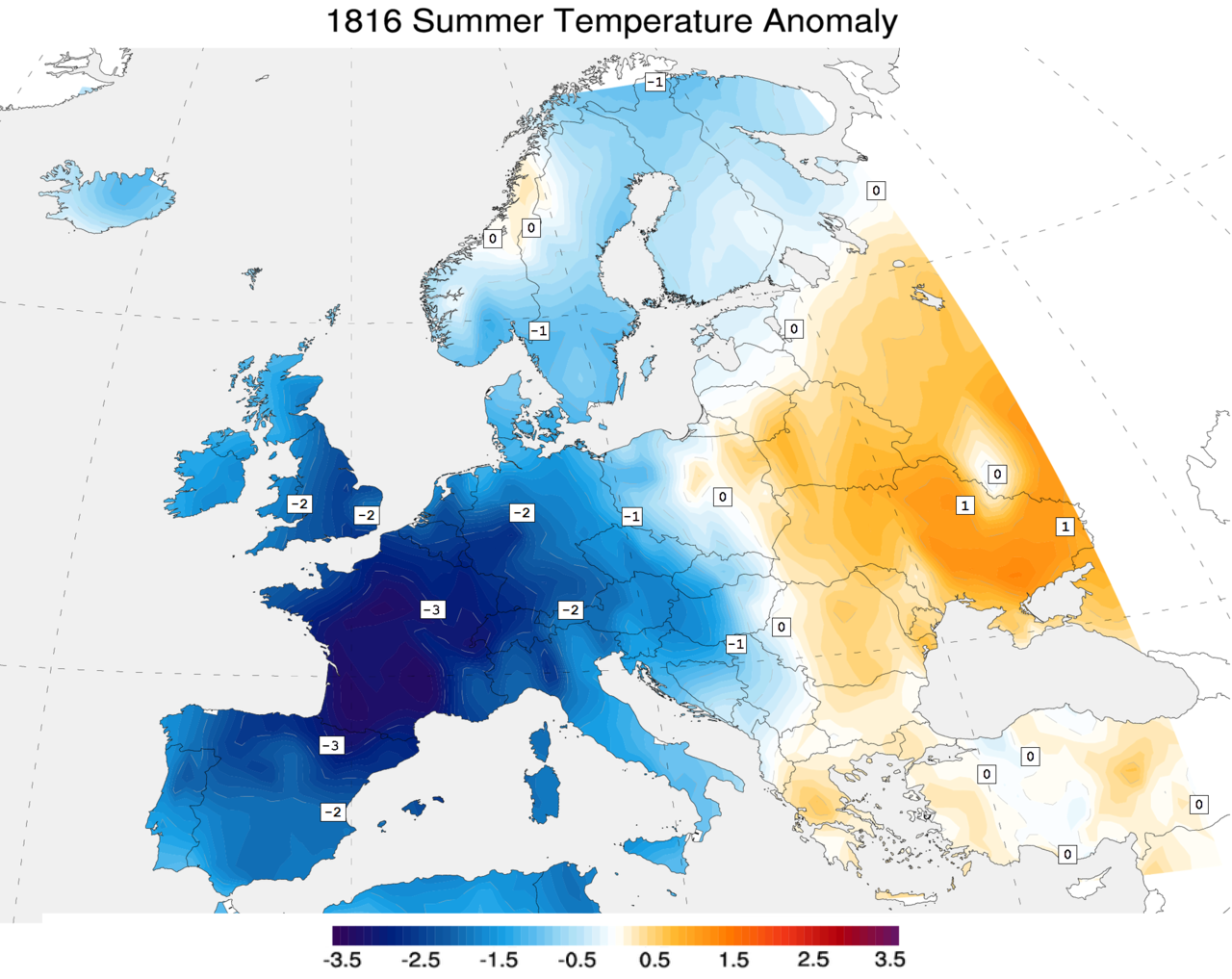
| Region | Impact in 1816 |
|---|---|
| New England, USA | Frosts in June–August; widespread harvest failure |
| Canada (Quebec) | 30 cm of snow in June; crop losses |
| Britain & Ireland | Grain prices up 400%; famine in rural Ireland |
| France & Germany | Food riots; grain shortages and social unrest |
| Switzerland | Famine; government emergency food distribution |
| China & India | Monsoon disruptions; rice and wheat shortfalls |
What Were the Long-Term Consequences?
The famine and despair of 1816 triggered mass migration from New England westward into the Ohio Valley, reshaping American demographics. In Europe, the crisis accelerated political discontent that fed into the revolutions of 1830 and 1848. Remarkably, the miserable wet summer of 1816 inspired lasting cultural works: Mary Shelley conceived Frankenstein while stranded indoors at Lake Geneva, and Lord Byron wrote his apocalyptic poem 'Darkness' that same summer. The global disruption also accelerated the cholera pandemic of 1817, as famine weakened immune systems across Asia. Scientists today cite Tambora's 1816 aftermath as a benchmark for understanding volcanic winter scenarios and climate vulnerability.
