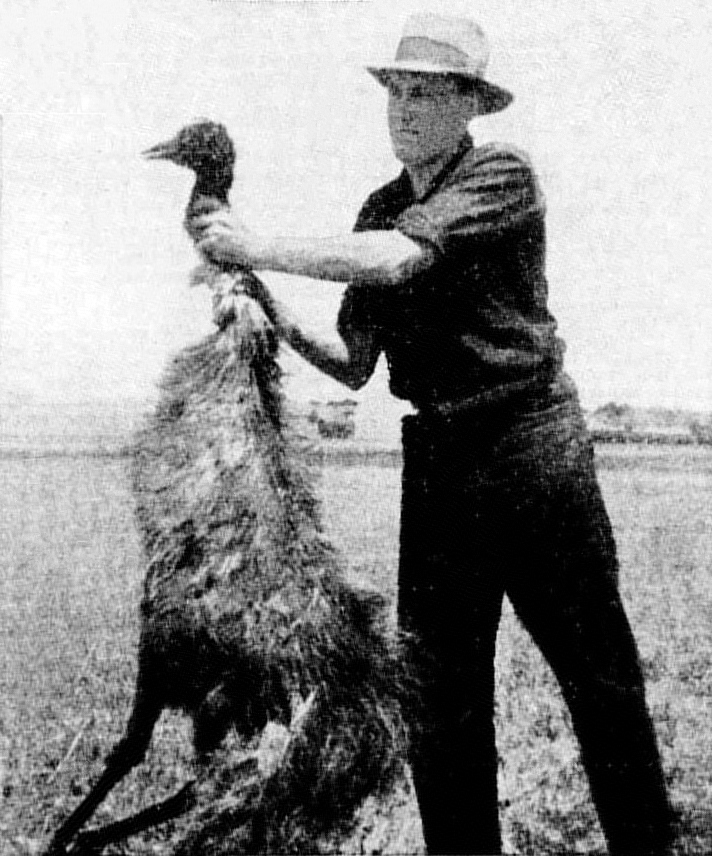
The Great Emu War was a wildlife culling operation conducted in the Campion district of Western Australia in November–December 1932, in which Royal Australian Artillery soldiers armed with Lewis guns attempted to reduce a population of roughly 20,000 emus devastating farmland. Despite firing thousands of rounds of ammunition, the campaign was widely judged a failure — the emus' resilience and mobility repeatedly outfoxed military tactics, prompting the operation to be abandoned and later mocked in the international press.
What Caused the Great Emu War?
After World War I, the Australian government resettled thousands of veterans as wheat farmers in Western Australia's Campion district. The region also sat on a major emu migration route. By 1932, an estimated 20,000 emus were flooding the area each breeding season, trampling crops, breaking fences, and allowing rabbits to enter through the gaps — a ruinous combination during the Great Depression when wheat prices had already collapsed. Desperate farmers, many of them ex-soldiers themselves, petitioned the government for military assistance. The Minister of Defence, George Pearce, approved the operation, dispatching Major G.P.W. Meredith of the Royal Australian Artillery with two soldiers, two Lewis light machine guns, and 10,000 rounds of ammunition.
How Did the Military Campaign Against Emus Unfold?
The operation launched on 2 November 1932. From the start, the emus proved remarkably difficult targets. When soldiers attempted to herd a large mob into a killing zone at a dam near Campion, the birds scattered into small groups before troops could open fire. A Lewis gun jammed during one early engagement, further limiting the kill count. Ornithologist and soldier Major Meredith later remarked that the emus 'could face machine guns with the invulnerability of tanks.' After just three days, the operation was suspended due to poor results and negative press coverage. It resumed on 13 November, continued until 10 December, then was halted again after parliamentary ridicule. A final phase ran into 1933. Across all phases, soldiers fired approximately 9,860 rounds and killed an estimated 986 emus — roughly one bird per ten bullets.

| Phase | Dates | Rounds Fired | Estimated Emus Killed |
|---|---|---|---|
| Phase 1 | 2–8 Nov 1932 | ~2,500 | ~50 |
| Phase 2 | 13 Nov – 10 Dec 1932 | ~9,860 total | ~986 total |
| Phase 3 | Early 1933 | Not recorded | ~100 |
Why Did Australia Fail to Defeat the Emus?
Emus are surprisingly resilient animals. They stand up to 1.9 metres tall, weigh as much as 60 kg, and can sustain bullet wounds and keep running. Their natural behaviour of splitting into small, fast-moving groups when threatened made massed machine-gun fire largely ineffective. The flat, semi-arid terrain offered little cover for soldiers to set ambushes, and the Lewis gun's tendency to overheat and jam further undermined firepower. Ornithologist Dominic Serventy later observed that the emus 'appeared to have a strategy of their own.' The episode was lampooned in newspapers at home and abroad; the Sydney Sun called the soldiers 'Emu War veterans,' and the story has been retold as comic legend ever since.
What Was the Legacy of the Great Emu War?
The operation was formally halted in December 1932 after Major Meredith's own report acknowledged failure. Renewed requests for military assistance in 1948 and 1950 were rejected by the government. Emu management was instead left to farmers using bounty schemes — between 1945 and 1960, Western Australia paid bounties on over 284,000 emus. Today the Great Emu War is remembered as a darkly comic episode in Australian history, a symbol of humanity's overconfidence when pitting industrial-age weapons against nature. The emu remains on Australia's coat of arms, a national emblem that proved, briefly, to be militarily unconquerable.
