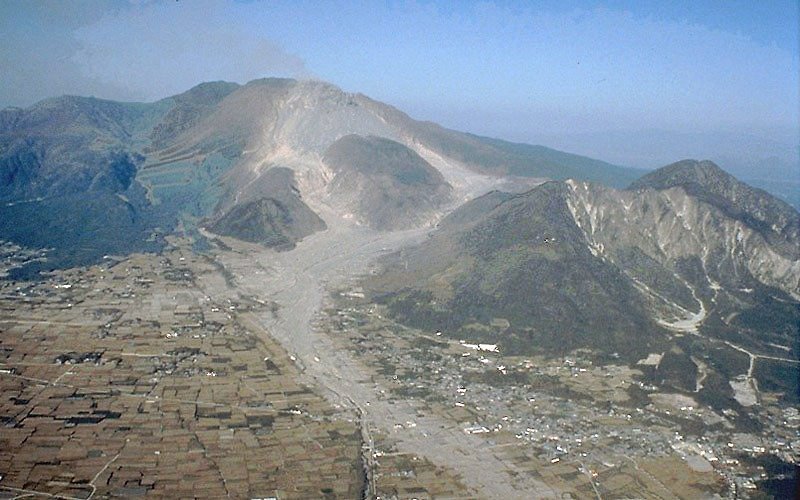
Mount Unzen, a volcanic complex on Japan's Shimabara Peninsula in Nagasaki Prefecture, produced its deadliest modern eruption on June 3, 1991, when a massive pyroclastic flow killed 43 people, including renowned French volcanologists Katia and Maurice Krafft and American scientist Harry Glicken. The disaster was Japan's worst volcanic tragedy since 1792, when a flank collapse on the same mountain triggered a tsunami that killed approximately 15,000 people. Today, Unzen stands as a landmark in the history of volcanology and disaster preparedness.
What Is Mount Unzen and Where Is It Located?
Mount Unzen is a group of overlapping stratovolcanoes situated on the Shimabara Peninsula in western Kyushu, Japan. Its highest peak, Heisei-Shinzan, reaches 1,483 metres and was actually formed during the 1990–1995 eruptive episode, making it Japan's youngest major lava dome. The Unzen volcanic complex sits above a subduction zone where the Philippine Sea Plate dives beneath the Eurasian Plate, providing the magmatic engine for recurring eruptions. The surrounding Unzen-Amakusa National Park, established in 1934, draws tourists for its hot springs (onsen) and scenic terrain, a stark contrast to the volcano's violent history.
How Did the 1991 Mount Unzen Eruption Unfold?
Unzen reawakened in November 1989 after 198 years of dormancy, with underwater earthquakes signalling rising magma. By May 1991, a lava dome had grown inside the Fugen-dake crater and was shedding hot debris. On June 3, 1991, a dome collapse sent a pyroclastic flow—a fast-moving current of superheated gas and volcanic rock reaching temperatures above 700°C and speeds of up to 200 km/h—surging 5.5 kilometres down the mountainside. The Kraffts and Glicken, along with 40 journalists and local officials, were caught in the flow while observing from what was believed to be a safe vantage point. The eruption continued until 1995, depositing over 130 million cubic metres of lava and forcing the evacuation of around 12,000 residents from Shimabara City.

| Event | Date | Key Detail |
|---|---|---|
| 1792 flank collapse and tsunami | May 21, 1792 | ~15,000 killed; Japan's worst volcanic disaster |
| Volcanic reawakening begins | November 1989 | Seismic swarms signal magma intrusion |
| Lava dome first appears | May 20, 1991 | Dome grows rapidly in Fugen-dake crater |
| Deadly pyroclastic flow | June 3, 1991 | 43 killed including the Kraffts and Glicken |
| Peak lava output | 1993 | Heisei-Shinzan dome reaches maximum growth |
| Eruption declared over | February 1996 | Activity ceased after 6 years of unrest |
What Was the Legacy of the 1991 Eruption?
The June 3 disaster permanently changed how scientists monitor active volcanoes. The deaths of the Kraffts—whose footage of pyroclastic flows had ironically been used to warn officials about Pinatubo just weeks before—prompted global investment in remote sensing technology, drone surveillance, and safer observation protocols. The United Nations designated 1991–2000 the International Decade for Natural Disaster Reduction partly in response to such events. In Shimabara City, the Unzen Disaster Memorial Hall opened in 2003, preserving houses buried under pyroclastic debris as a permanent warning. Heisei-Shinzan, the new peak born from the eruption, is now a UNESCO Global Geopark site attracting researchers and tourists worldwide.

