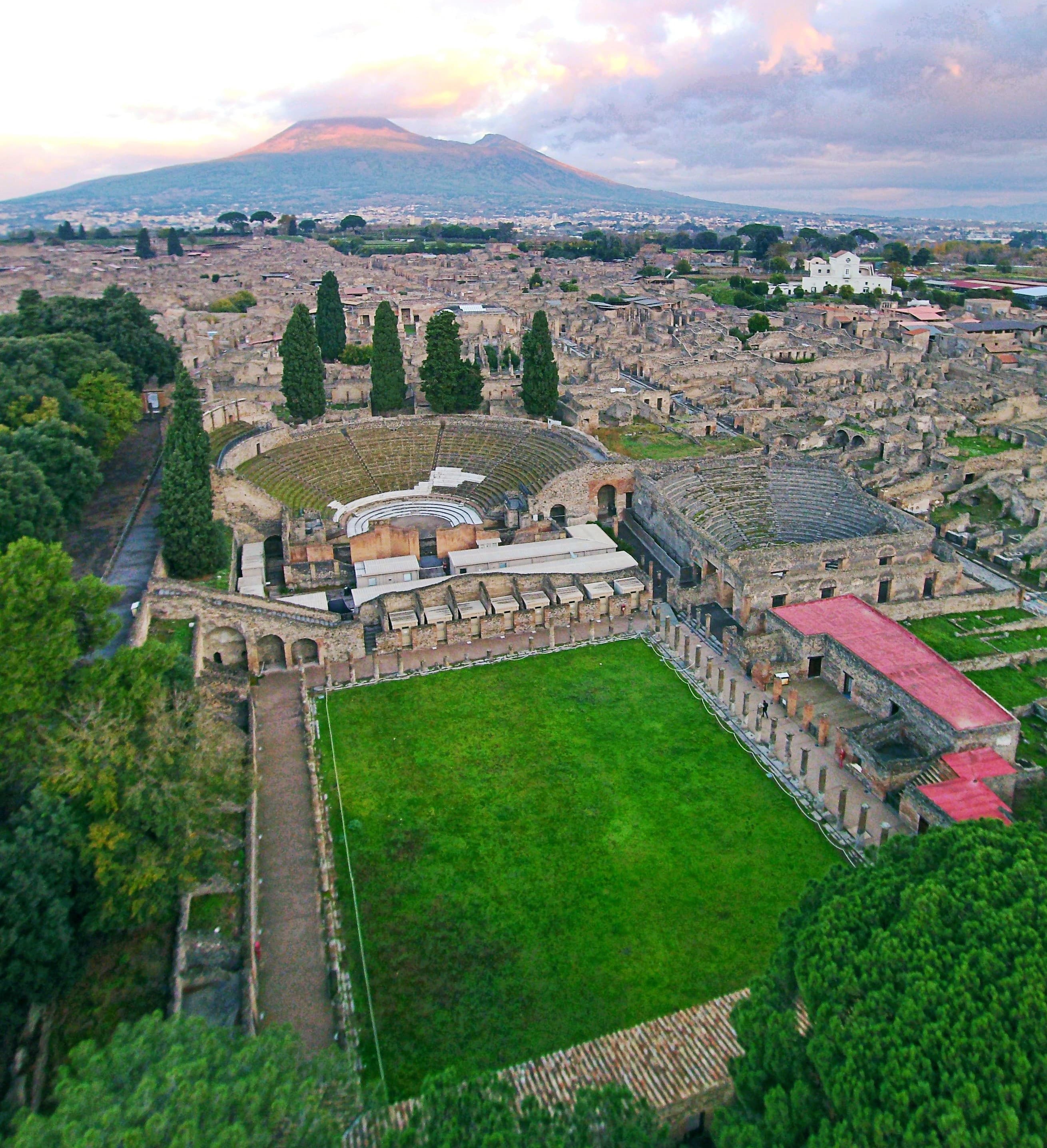
On the morning of August 24, 79 AD, the residents of Pompeii were going about their ordinary lives — bakers sliding loaves into stone ovens, merchants haggling in the forum, children chasing each other through narrow cobblestone streets. By nightfall, the city of roughly 11,000 people had been entombed beneath a crushing blanket of volcanic ash and pumice. Pompeii, one of the Roman Empire's most vibrant provincial cities, had ceased to exist. It would not be seen again for nearly 1,700 years.
A City at the Peak of Roman Life
Pompeii sat in the Campania region of southern Italy, near the Bay of Naples, in the shadow of Mount Vesuvius. Founded by the Oscan people around the 7th or 6th century BC, the city passed through Greek and Samnite hands before becoming a Roman colony in 80 BC following the Social War. By the first century AD, it had grown into a prosperous commercial hub of between 11,000 and 20,000 inhabitants. Its streets were lined with thermopolia — ancient fast-food counters — along with bakeries, brothels, temples, bathhouses, and an impressive amphitheater capable of seating 20,000 spectators. Election notices and bawdy graffiti alike were painted directly onto the walls, offering an unfiltered glimpse into the texture of Roman daily life.
The Day the Mountain Woke
Vesuvius had been dormant for centuries, and the Romans did not recognize it as a volcano at all — it was simply a fertile, vine-covered mountain. Warning signs preceded the catastrophe: a major earthquake in 62 AD had caused significant damage to the city, and smaller tremors had been felt in the days leading up to the eruption. When Vesuvius finally detonated, it unleashed what geologists estimate to have been a Plinian eruption — a column of ash and gas that rose some 20 to 30 kilometers into the sky.
The eruption unfolded in two phases. In the first, hot ash and pumice rained down on Pompeii for hours, collapsing roofs and burying streets. Many residents fled during this phase; others sheltered indoors, fatally underestimating the danger. In the second phase, a series of pyroclastic surges — superheated avalanches of gas and debris traveling at devastating speed — swept down the mountain. Victims found in Pompeii were largely killed by these surges, their bodies preserved in the hardened ash as haunting hollow molds. When archaeologists in the 19th century injected plaster into these voids, they revealed the final poses of the dead: a man covering his face, a family huddled together, a dog writhing against its chain.
An Eyewitness Account Across the Ages
Remarkably, the eruption was documented in near real-time by Pliny the Younger, an 18-year-old Roman lawyer staying with his uncle, Pliny the Elder, at Misenum across the bay. In two extraordinary letters written to the historian Tacitus decades later, the younger Pliny described the mushroom-shaped cloud, the panic of fleeing crowds, the darkness at midday, and the death of his uncle — who sailed toward the disaster in an attempt to rescue survivors and was overcome by fumes near Stabiae. These letters remain among the most vivid eyewitness accounts of a natural disaster to survive from antiquity and gave science the very term 'Plinian eruption.'
Rediscovery and the Birth of Modern Archaeology
Pompeii was not entirely forgotten in the ancient world — its name appeared in Roman texts — but its precise location was lost over centuries as the landscape changed and the name 'Pompeii' faded from maps. Occasional finds were made during the Renaissance, but systematic excavation did not begin until 1748, under the orders of the Bourbon King Charles III of Naples. Early excavations were little more than treasure hunts, with fine frescoes and statues carted off to royal collections. It was not until the 19th century, under the direction of Giuseppe Fiorelli, that excavation became more methodical. Fiorelli devised the plaster-casting technique, divided the city into numbered regions for systematic study, and is widely credited as a pioneer of scientific archaeology.
Excavations have continued, with interruptions, ever since. Today, roughly two-thirds of the approximately 66-hectare city has been uncovered. The remaining third has been deliberately left unexcavated, preserving it for future generations with more advanced technologies. In 2020, the ongoing Great Pompeii Project — a major conservation and excavation initiative — made headlines worldwide with the discovery of a richly decorated ceremonial chariot near the Villa of Civita Giuliana, alongside skeletal remains of horses and two men, one likely a slave.
What Pompeii Tells Us About Rome
The true value of Pompeii to historians is not its dramatic end but the extraordinary ordinary life it preserved. Because the city was sealed rather than gradually abandoned or rebuilt, it offers a snapshot of Roman provincial society at a precise moment in time. Researchers have discovered evidence of sophisticated urban infrastructure: a pressurized water distribution system with lead pipes and cisterns, stepping stones to cross flooded streets at crosswalks, and a road network deeply grooved by centuries of cart wheels. The social spectrum is equally vivid — from the opulent House of the Faun, one of the largest private residences in the Roman world, to cramped one-room dwellings and the sleeping quarters of enslaved people.
Recent multidisciplinary work has revolutionized our understanding further. DNA analysis of skeletal remains has revealed that Pompeii's population was ethnically diverse, reflecting the cosmopolitan nature of the Roman Empire. Isotope studies of teeth have traced migrants from North Africa and the eastern Mediterranean. Analysis of carbonized food remains has identified a surprisingly varied diet — not just the staples of bread and garum (fermented fish sauce), but also a wide range of fruits, vegetables, seafood, and even giraffe bone, suggesting exotic imports reached even mid-tier Roman towns.
Pompeii Today: Preservation and Peril
Pompeii receives approximately 3.5 million visitors annually, making it one of the most visited archaeological sites on Earth and a UNESCO World Heritage Site since 1997. That popularity is both a blessing and a curse. Decades of under-investment, combined with mass tourism and exposure to the elements, led to a period of alarming deterioration in the early 2000s — walls collapsed, frescoes faded, and buildings crumbled. The European Union and Italian government responded with significant funding; the Great Pompeii Project, launched in 2012 with €105 million in EU funds, has dramatically improved conservation. Yet experts warn that Vesuvius itself remains one of the most dangerous active volcanoes in the world, with three million people living in its potential blast zone — a sobering reminder that Pompeii's story is not only history.
| Feature | Detail |
|---|---|
| Estimated population (79 AD) | 11,000 – 20,000 |
| Area of city | ~66 hectares |
| Excavated to date | ~66% of total area |
| Annual visitors | ~3.5 million |
| UNESCO designation | 1997 |
| Great Pompeii Project funding | €105 million (EU) |
| Eruption column height | ~20–30 km |
A Monument to Mortality and Memory
Pompeii endures in the human imagination with a power few ancient sites can match. It is not a ruin in the conventional sense — it is a interruption, a life arrested mid-sentence. The half-eaten loaf of bread, the surgeon's instruments laid out on a table, the political slogan painted on a wall before the paint dried — these things speak across two millennia with an intimacy that no text alone can replicate. Pompeii does not merely illustrate the Roman world; it inhabits it, permanently and incompletely, still waiting to give up its last secrets.