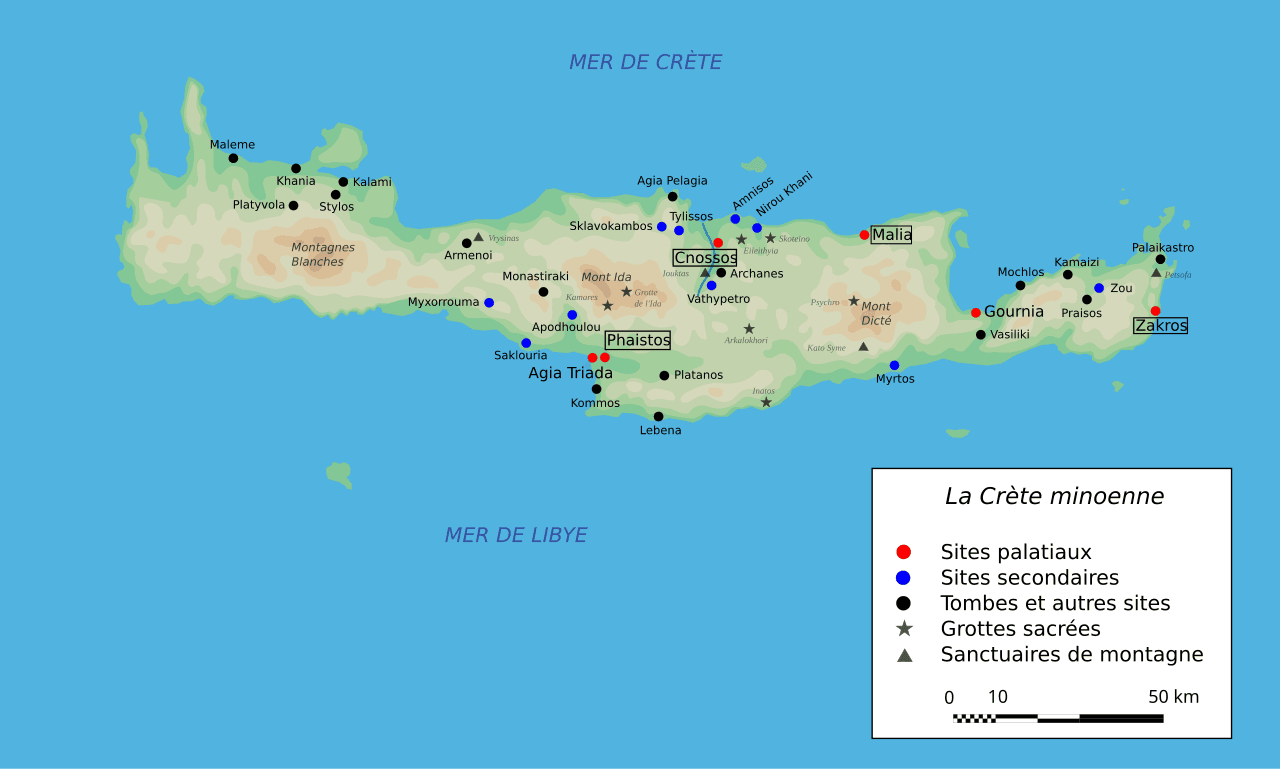
The Minoan civilization was Europe's first advanced Bronze Age society, flourishing on the island of Crete from approximately 2700 to 1450 BC. Centered on monumental palace complexes at Knossos, Phaistos, Malia, and Zakros, the Minoans developed sophisticated art, long-distance trade networks, two distinct writing systems, and a rich religious culture centuries before mainland Greece rose to prominence. Their sudden decline around 1450 BC — likely triggered by a catastrophic volcanic eruption at Thera (modern Santorini) combined with Mycenaean Greek invasion — remains one of archaeology's most debated mysteries.
Who Were the Minoans? Origins and Discovery
The Minoans take their name from the legendary King Minos of Crete, a figure embedded in Greek mythology as the ruler who commissioned the Labyrinth to house the monstrous Minotaur. The civilization itself, however, was not mythological. British archaeologist Sir Arthur Evans excavated the palace at Knossos beginning in 1900 AD and coined the term 'Minoan' to describe the previously unknown culture he uncovered beneath centuries of soil. Evans's excavations revealed a society of startling sophistication — multi-story palatial buildings with plumbing, vivid frescoes, and thousands of administrative clay tablets. Genetic studies published in 2013 in the journal Nature Genetics confirmed that the Minoans were largely of Anatolian (modern Turkish) descent, with ancestors who migrated to Crete during the Neolithic period around 7000 BC. Their language remains undeciphered, and their precise ethnic identity independent of archaeological evidence is still debated among scholars.
What Were the Minoan Palaces and Why Did They Matter?
The defining architectural achievement of Minoan civilization was the palace complex — a multifunctional hub of political power, economic redistribution, religious ceremony, and craft production. The Palace of Knossos, located just 5 kilometers south of modern Heraklion, is the largest and most extensively studied, covering roughly 20,000 square meters and containing over 1,300 rooms at its peak. Built in successive phases beginning around 1900 BC, Knossos featured a large central courtyard, lustral basins (ritual bathing areas), grand staircases, storerooms holding enormous ceramic jars called pithoi, and a sophisticated drainage system with terracotta pipes. The palace at Phaistos in southern Crete, constructed around 1900 BC as well, is considered architecturally superior in some respects and famously yielded the Phaistos Disc in 1908 — a clay artifact impressed with undeciphered pictographic signs that may represent the world's earliest printed document. The palaces functioned as redistributive economic centers: agricultural surpluses of grain, olive oil, and wine flowed in from the surrounding countryside, were recorded on clay tablets, and were redistributed to craftspeople, officials, and traders. This palace economy model underpinned Minoan prosperity for centuries.
How Did the Minoans Build Their Trade Empire?
By the Middle Bronze Age (roughly 2000–1700 BC), Minoan merchants had established a trading network that spanned the entire eastern Mediterranean. Archaeological evidence — including Minoan pottery, frescoes, and artifacts — has been found in Egypt, the Levant, Cyprus, mainland Greece, Anatolia, and even as far as Afghanistan in the form of lapis lazuli that passed through Minoan hands. Egyptian tomb paintings at Thebes, dating to around 1500 BC, depict figures carrying Aegean-style gifts labeled 'Keftiu,' widely identified as Cretans or Minoans. Minoan settlements and trading posts existed on the Aegean islands of Thera, Rhodes, and Kythera. Crete's strategic central position in the Mediterranean, combined with its productive agricultural lands — yielding surplus wine, olive oil, timber, and textiles — gave Minoan merchants enormous leverage. Some historians use the term 'thalassocracy' (sea-based dominion) to describe Minoan power, a concept echoed in Thucydides' assertion that King Minos controlled much of the Aegean Sea. While scholars debate whether this constituted true political empire or simply commercial dominance, the material evidence for Minoan cultural influence across a vast region is overwhelming.
What Writing Systems Did the Minoans Use?
The Minoans developed at least two writing systems, neither of which has been fully deciphered. The earlier script, known as Cretan Hieroglyphic, appeared around 2100 BC and consists of pictographic signs used primarily on seal stones and administrative clay tablets. It was gradually replaced by a more streamlined script called Linear A, which emerged around 1800 BC and remained in use until the civilization's collapse around 1450 BC. Linear A consists of roughly 90 syllabic signs combined with logograms and numerical notations; it appears on hundreds of clay tablets found across Crete and Minoan-influenced Aegean sites. Despite decades of scholarly effort, Linear A remains undeciphered because the underlying Minoan language is unknown and does not correspond to any identified language family. When the Mycenaean Greeks took control of Crete after 1450 BC, they adapted the Minoan Linear A script to write their own language — an early form of Greek — creating Linear B, which was successfully deciphered by British architect Michael Ventris in 1952. The Phaistos Disc, discovered at the southern Cretan palace, bears a third script of 45 unique signs arranged in a spiral and impressed with individual stamps or seals, potentially making it a prototype form of movable type printing dating to around 1700 BC.
What Did Minoan Religion and Art Reveal About Their Society?
Minoan religion was deeply nature-centered and appears to have been dominated by female deities and priestesses, a striking contrast to the male-dominated pantheons of contemporary Near Eastern and later Greek cultures. The most prominent divine figure is the so-called 'Snake Goddess,' represented in two famous faience figurines found at Knossos — each depicting a woman dressed in a layered skirt, bare-breasted, holding snakes in each raised hand. Scholars interpret these as representations of a goddess, a priestess, or both. Bull worship was central to Minoan religion: the famous bull-leaping frescoes at Knossos depict acrobatic figures — male and female — seizing a charging bull and somersaulting over its back, likely as a sacred ritual rather than a competitive sport. Sacred 'horns of consecration' symbols surmounted palace walls and peak sanctuaries throughout Crete. Minoan art was notably naturalistic and joyful in character. Wall frescoes — painted in vivid blues, yellows, and reds — depicted dolphins, octopuses, lilies, and saffron-gathering monkeys with an observational accuracy unmatched in the ancient world. The 'Saffron Gatherer' fresco at Akrotiri on Thera and the 'Blue Bird' and 'Prince of the Lilies' frescoes at Knossos exemplify a refined aesthetic that influenced Mycenaean Greek and eventually Classical Greek art. Minoan craftspeople also excelled in gold jewelry, bronze figurines, carved stone vessels (rhytons), and fine polychrome pottery known as Kamares ware.
Minoan Civilization at a Glance: Key Periods and Sites
| Period | Date (approx.) | Key Development | Major Site |
|---|---|---|---|
| Early Minoan (Prepalatial) | 2700–2000 BC | First settlements, basic pottery, copper tools | Vasiliki, Mochlos |
| Middle Minoan I–II (Protopalatial) | 2000–1700 BC | First palaces built; Cretan Hieroglyphic script | Knossos, Phaistos, Malia |
| Middle Minoan III (Neopalatial begins) | 1700–1640 BC | Palaces destroyed and rebuilt; Linear A emerges | Knossos, Zakros |
| Late Minoan I (Neopalatial peak) | 1640–1450 BC | Peak prosperity, trade empire, Thera eruption (~1620 BC) | Akrotiri (Thera), Knossos |
| Late Minoan II–III (Mycenaean period) | 1450–1100 BC | Mycenaean takeover; Linear B replaces Linear A | Knossos (Mycenaean phase) |
What Caused the Collapse of the Minoan Civilization?
The decline of the Minoan civilization involved a cascading series of catastrophes that scholars continue to debate. The first major blow was the eruption of the Thera (Santorini) volcano, now dated by ice core and radiocarbon evidence to approximately 1620–1600 BC — one of the largest volcanic eruptions in the past 10,000 years, ejecting an estimated 60 cubic kilometers of material. The eruption destroyed the flourishing Minoan colony at Akrotiri, preserved intact under volcanic ash like a Bronze Age Pompeii, and likely generated devastating tsunamis that struck Crete's northern coast, disrupting ports and agricultural infrastructure. However, Minoan palace culture continued for another 150–170 years after Thera, indicating the eruption alone did not end the civilization. The terminal collapse around 1450 BC saw almost every Minoan palace and major settlement on Crete burned and abandoned simultaneously. Archaeological evidence points strongly to Mycenaean Greek invasion: Linear B tablets (written in Greek) appear at Knossos shortly after this destruction horizon, and the material culture of Crete shifts markedly toward Mycenaean styles. The balance of scholarly opinion now holds that Thera severely weakened Minoan power — economically, psychologically, and demographically — while Mycenaean Greeks from the mainland exploited that vulnerability to conquer and colonize Crete around 1450 BC.
What Is the Legacy of Minoan Civilization?
The legacy of the Minoans is woven into the fabric of Western civilization in ways both direct and mythological. Greek mythology preserved garbled memories of Minoan Crete in the stories of Theseus and the Minotaur, the Labyrinth of Daedalus, and the laws of King Minos — the legendary ruler said to have received divine law from Zeus every nine years. The Mycenaean Greeks who succeeded the Minoans absorbed enormous amounts of Minoan art, religion, and administrative technology: the palace fresco tradition, the use of Linear script for record-keeping, certain religious iconography including the double axe (labrys) symbol, and aspects of goddess worship all passed from Minoan into Mycenaean culture, and from there into the broader stream of Greek civilization. Architecturally, the Minoan palace concept influenced later Greek palatial architecture. In the modern era, Arthur Evans's excavations at Knossos captivated the world at the turn of the 20th century and helped launch the academic discipline of Aegean prehistoric archaeology. Today, the reconstructed Palace of Knossos receives approximately 1 million visitors per year, and Minoan art in the Heraklion Archaeological Museum — including the Snake Goddesses, the Bull-Leaping Fresco, and the Phaistos Disc — remains among the most iconic imagery of the ancient world. The Minoans remind us that sophisticated, literate, artistically vibrant societies existed in Europe nearly two millennia before Classical Athens.
Why Is Minoan Civilization Still a Mystery Today?
Despite more than 120 years of archaeological investigation, the Minoans retain a powerful aura of mystery. Their language remains locked in the undeciphered script of Linear A, meaning we cannot read their literature, laws, religious texts, or historical records. We do not know what they called themselves — 'Minoan' is a modern term coined by Evans. Their precise religious beliefs, political structure, and social organization must be inferred from material evidence alone. The identity and fate of the Minoan ruling elite after the Mycenaean conquest is unknown. The Phaistos Disc has resisted all attempts at decipherment and even faces occasional challenges to its authenticity, though most specialists accept it as genuine. New excavations continue to reshape understanding: a 2011 discovery at Sissi on Crete revealed a previously unknown palatial complex, while ongoing DNA research is refining the picture of Minoan genetic origins and their relationship to other ancient Mediterranean populations. The Minoans stand as a testament to how much of human history remains irrecoverably lost — and how much still waits to be found.