
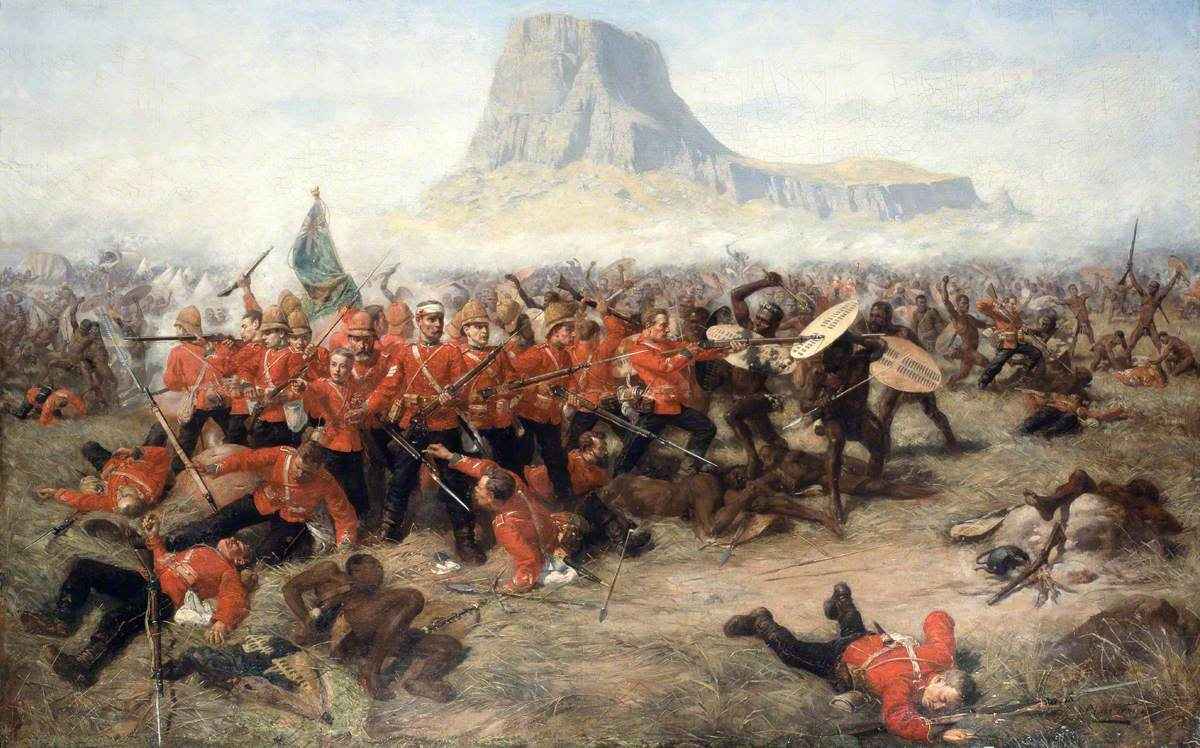
The Anglo-Zulu War, or simply the Zulu War, was fought in present-day South Africa from January to early July 1879 between forces of the British Empire and the Zulu Kingdom. Two famous battles of the war were the Zulu victory at Isandlwana and the British defence at Rorke's Drift.
Following the passing of the British North America Act 1867 forming a federation in Canada, Lord Carnarvon thought that a similar political effort, coupled with military campaigns, might lead to a ruling white minority over a black majority in South Africa. This would yield a large pool of cheap labour for the British sugar plantations and mines, and was intended to bring the African Kingdoms, tribal areas, and Boer republics into South Africa.
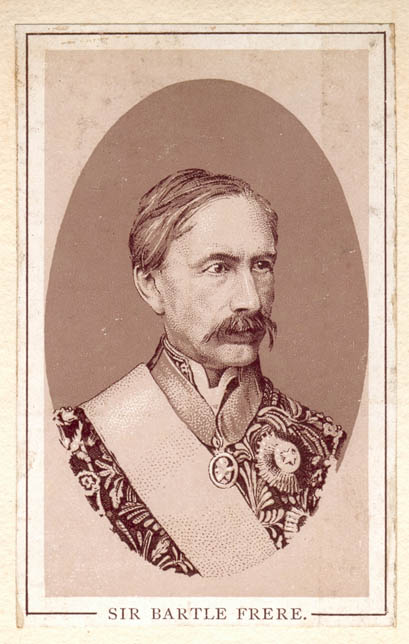
In 1874, Sir Bartle Frere was appointed as British High Commissioner for Southern Africa to effect such plans. Among the obstacles were the armed independent states of the South African Republic and the Zulu Kingdom.

Frere, on his own initiative, sent a provocative ultimatum on 11 December 1878 to Zulu King Cetshwayo. Upon its rejection, he ordered Lord Chelmsford to invade Zululand. The war had several particularly bloody battles, including an opening victory for the Zulu at the Battle of Isandlwana, followed by the defence of Rorke's Drift by a small British Garrison from an attack by a large Zulu force. However, the British eventually gained the upper hand at Kambula, before taking the Zulu capital of Ulundi. The British eventually won the war, ending Zulu dominance of the region. The British Empire made the Zulu Kingdom a protectorate and later annexed it in 1887.
The war dispelled prior colonial notions of British invincibility, due to their massive early defeats. Together with famines, diplomatic misadventures, and other unpopular wars overseas (such as the Second Anglo-Afghan War), it contributed to the ejection of Benjamin Disraeli's government from office in 1880, after only one term.
Background
British Empire
By the 1850s, the British Empire had colonies in southern Africa bordering on various Boer settlements, native African kingdoms such as the Zulus and the Basotho and numerous indigenous tribal areas and states. Various interactions with those groups followed an expansionist policy. Cape Colony was formed after the Anglo–Dutch Treaty of 1814 had permanently ceded the Dutch colony of Cape Town to Britain, and its territory expanded very substantially in the 19th century. Natal, in south-eastern Africa, was claimed by the British as a colony on 4 May 1843, after the British government had annexed the Boer Republic of Natalia. Matters were brought to a head when three sons (led by Mehlokazulu kaSihayo) and a brother of the Zulu inkosi Sihayo organized a raid into Natal and carried off two women who were under British protection.

The discovery of diamonds in 1867 near the Vaal River, some 550 mi (890 km) northeast of Cape Town, ended the isolation of the Boers in the interior and had a significant effect on events. The discovery triggered a diamond rush that attracted people from all over the world, which turned Kimberley into a town of 50,000 within five years and drew the attention of British imperial interests. In the 1870s, the British annexed West Griqualand, site of the Kimberley diamond discoveries.
In 1874 Lord Carnarvon, Secretary of State for the Colonies, who had brought about federation in Canada in 1867, thought that a similar scheme might work in South Africa, The South African plan called for a ruling white minority over a black majority, which would provide a large pool of cheap labour for the British sugar plantations and mines, Carnarvon, in an attempt to extend British influence in 1875, approached the Boer states of the Orange Free State and the Transvaal Republic and tried to organize a federation of the British and Boer territories but the Boer leaders turned him down.
In 1877, Sir Bartle Frere was made High Commissioner for Southern Africa by Lord Carnarvon. Carnarvon appointed Frere to the position on the understanding that he would work to enforce Carnarvon's confederation plan and Frere could then become the first British governor of a federated southern African dominion. Frere was sent to South Africa as High Commissioner to bring this plan about. One of the obstacles to such a scheme was the presence of the independent Boer states of the South African Republic, informally known as the Transvaal Republic and the Orange Free State, and the Kingdom of Zululand. Bartle Frere wasted no time in putting the scheme forward and manufacturing a casus belli against the Zulu by exaggerating the significance of a number of recent incidents.

By 1877, Sir Theophilus Shepstone, the British Secretary for Native Affairs in Natal, annexed the Transvaal Republic for Britain using a special warrant. The Transvaal Boers objected but as long as the Zulu threat remained, found themselves between two threats; they feared that if they took up arms to resist the British annexation, King Cetshwayo and the Zulus would take the opportunity to attack. The successive British annexations and in particular the annexation of West Griqualand caused a climate of simmering unease for the Boer republics.
Shepstone railed against the disruptive effect of allowing Cetshwayo's regime to remain. "Zulu power", he said, "is the root and real strength of all native difficulties in South Africa". In December 1877, he wrote to Carnarvon "Cetshwayo is the secret hope of every petty independent chief hundreds of miles from him who feels a desire that his colour shall prevail, and it will not be until this hope is destroyed that they will make up their minds to submit to the rule of civilisation". Earlier in October 1877, Shepstone had attended a meeting with Zulu leaders near the Blood River to resolve the land dispute between the Zulus and the Boers. He suggested a compromise with the Boers and the meeting broke up without clear resolutions. He turned against the Zulus with vengeance, saying he had come into possession of "the most incontrovertible, overwhelming and clear evidence" never previously disclosed, for supporting the claims of the Boers. He rejected Zulu claims as "characterised by lying and treachery to an extent that I could not have believed even savages are capable of".
Shepstone, in his capacity as British governor of Natal, had expressed concerns about the Zulu army under King Cetshwayo and the potential threat to Natal – especially given the adoption by some of the Zulus of old muskets and other out-of-date firearms. In his new role of Administrator of the Transvaal, he was now responsible for protecting the Transvaal and had direct involvement in the Zulu border dispute from the side of the Transvaal. Persistent Boer representations and Paul Kruger's diplomatic manoeuvres added to the pressure. There were incidents involving Zulu paramilitary actions on either side of the Transvaal/Natal border, and Shepstone increasingly began to regard King Cetshwayo, as having permitted such "outrages", and to be in a "defiant mood". King Cetshwayo now found no defender in Natal save the bishop of Natal, John Colenso.
Colenso advocated for native Africans in Natal and Zululand who had been unjustly treated by the colonial regime in Natal. In 1874 he took up the cause of Langalibalele and the Hlubi and Ngwe tribes in representations to the Colonial Secretary, Lord Carnarvon. Langalibalele had been falsely accused of rebellion in 1873 and, following a charade of a trial, was found guilty and imprisoned on Robben Island. In taking the side of Langalibalele against the colonial regime in Natal and Theophilus Shepstone, the Secretary for Native Affairs, Colenso found himself even further estranged from colonial society in Natal.
Bishop Colenso's concern about the misleading information that was being provided to the Colonial Secretary in London by Shepstone and the Governor of Natal prompted him to champion the cause of the Zulus against Boer oppression and official encroachments. He was a prominent critic of Frere's efforts to depict the Zulu kingdom as a threat to Natal. Colenso's campaigns revealed the racialist foundation underpinning the colonial regime in Natal and made him enemies among the colonists.
British Prime Minister Benjamin Disraeli's Tory administration in London did not want a war with the Zulus. "The fact is," wrote Sir Michael Hicks Beach, who was to replace Carnarvon as Secretary of State for the Colonies, in November 1878, "that matters in Eastern Europe and India ... wore so serious an aspect that we cannot have a Zulu war in addition to other greater and too possible troubles." However, Sir Bartle Frere had already been into the Cape Colony as governor and High Commissioner since 1877 with the brief of creating a Confederation of South Africa from the various British colonies, Boer Republics and native states and his plans were well advanced. He had concluded that the powerful Zulu kingdom stood in the way of this, and so was receptive to Shepstone's arguments that King Cetshwayo and his Zulu army posed a threat to the peace of the region. Preparations for a British invasion of the Zulu kingdom had been underway for months. In December 1878, notwithstanding the reluctance of the British government to start yet another colonial war, Frere presented Cetshwayo with an ultimatum that the Zulu army be disbanded and the Zulus accept a British resident. This was unacceptable to the Zulus as it effectively meant that Cetshwayo, had he agreed, would have lost his throne.

Zulu Kingdom
Shaka Zulu, the first Zulu king, had through war and conquest built the small Zulu tribe into the Zulu Kingdom, which by 1825 encompassed an area of around 11,500 square miles (30,000 km2). In 1828 he was assassinated at Dukuza by one of his inDunas and two of his half-brothers, one of whom, Dingane kaSenzangakhona, succeeded him as king. By the 1830s migrating Boers came into conflict with the Zulu Kingdom, then ruled by Dingane. Dingane suffered a crushing defeat on 16 December 1838, when he attacked a group of 470 Voortrekker settlers led by Pretorius at the Battle of Blood River. Dingane's half brother, Mpande kaSenzangakhona, then defected with some 17,000 followers and allied with the Boers against Dingane. Dingane was assassinated and Mpande became king of the Zulu empire.
In 1839, the Boer Voortrekkers, under Pretorius, formed the Boer Republic of Natalia, south of the Tugela, and west of the British settlement of Port Natal (now Durban). Mpande and Pretorius maintained peaceful relations. However, in 1842, war broke out between the British and the Boers, resulting in the British annexation of Natalia. Mpande shifted his allegiance to the British, and remained on good terms with them.
In 1843, Mpande ordered a purge of perceived dissidents within his kingdom. This resulted in numerous deaths, and the fleeing of thousands of refugees into neighbouring areas, including the British-controlled Natal. Many of these refugees fled with cattle, the main measure of the Zulu wealth. Mpande began raiding the surrounding areas, culminating in the invasion of Swaziland in 1852. However, the British pressured him into withdrawing, which he did shortly afterwards. At this time, a battle for the succession broke out between two of Mpande's sons, Cetshwayo and Mbuyazi. This culminated in 1856 with the Battle of Ndondakusuka, which left Mbuyazi dead. Cetshwayo then set about usurping his father's authority. When Mpande died of old age in 1872, Cetshwayo took over as ruler.
In 1861, Umtonga, another son of Mpande, fled to the Utrecht district, prompting Cetshwayo to assemble an army on the nearby frontier. According to claims later brought forward by the Boers, Cetshwayo offered the farmers a strip of land along the border if they would surrender his brother. The Boers complied on the condition that Umtonga's life was spared, and in 1861 Mpande signed a deed transferring this land to the Boers. The south boundary of the land added to Utrecht ran from Rorke's Drift on the Buffalo to a point on the Pongola River.
The boundary was beaconed in 1864, but when in 1865 Umtonga again fled from Zululand to Natal, Cetshwayo, seeing that he had lost his part of the bargain (for he feared that the still living Umtonga might be used to supplant him, as Mpande had been used to supplant Dingane), removed the beacon and claimed the land ceded by the Swazis to Lydenburg. The Zulus asserted that the Swazis were their vassals and therefore had no right to part with this territory. For a year, a Boer commando unit, under Paul Kruger and an army under Cetshwayo were posted to defend the newly acquired Utrecht border. The Zulu forces took back their land north of the Pongola. Questions were also raised as to the validity of the documents signed by the Zulus concerning the Utrecht strip; in 1869 the services of the lieutenant-governor of Natal, then Robert William Keate, were accepted by both parties as arbitrator, but the attempt then made to settle disagreements proved unsuccessful.
In spite of his dislike for their activities, Cetshwayo permitted European missionaries in Zululand. Though he did not harm or persecute the missionaries themselves, several converts were killed. The missionaries, for their part, were a source of hostile reports. While numerous Zulus of rival factions fled into Natal and some of the surrounding areas, Cetshwayo continued and maintained the peaceful relations with the Natal colonists that had prevailed for decades. Such was the political background when Cetshwayo became absolute ruler of the Zulus upon his father's death in 1873.
As ruler, Cetshwayo set about reviving the military methods of his uncle Shaka as far as possible. He formed new age-set regiments and even succeeded in equipping his regiments with a few antiquated muskets and other outdated firearms. Most Zulu warriors were armed with an iklwa (the Zulu refinement of the assegai thrusting spear) and a shield made of cowhide. The Zulu army drilled in the personal and tactical use and coordination of this weapons system. While some Zulus also had firearms, their marksmanship training was poor and the quality and supply of their powder and shot was dreadful. The Zulu attitude towards firearms was summarized: "The generality of Zulu warriors, however, would not have firearms – the arms of a coward, as they said, for they enable the poltroon to kill the brave without awaiting his attack."
History
Boundary Commission and ultimatum
The tension between Cetshwayo and the Transvaal over border disputes continued. Sir Theophilus Shepstone, whom Cetshwayo regarded as his friend, had supported him in the border dispute, but in 1877 he led a small force into the Transvaal and persuaded the Boers to give up their independence. Shepstone became administrator of the Transvaal, and in that role saw the border dispute from the other side. Shepstone claimed to have evidence supporting the Boer position but, ultimately, he failed to provide any. In a meeting with Zulu notables at Blood River in October 1877, Shepstone attempted to placate the Zulu with paternal speeches, however they were unconvinced and accused Shepstone of betraying them. Shepstone's subsequent reports to Carnarvon then began to paint the Zulu as an aggressive threat where he had previously presented Cetshwayo in a most favourable light.
In February 1878 a commission was appointed by Henry Bulwer, the lieutenant-governor of Natal since 1875, to report on the boundary question. The commission reported in July and found almost entirely in favour of the contention of the Zulu. However, Sir Henry Bartle Frere, then high commissioner and still pressing forward with Carnarvon's federation plan, characterized the award as "one-sided and unfair to the Boers", stipulated that on the land being given to the Zulu, the Boers living on it should be compensated if they left or protected if they remained. In addition, Frere planned to use the meeting on the boundary commission report with the Zulu representatives to also present a surprise ultimatum he had devised that would allow British forces under Lord Chelmsford, which he had previously been instructed to use only in defence against a Zulu invasion of Natal, to instead invade Zululand. Three incidents occurred in late July, August and September which Frere seized upon as his casus belli and were the basis for the ultimatum with which Frere knew Cetshwayo could not comply, giving Frere a pretext to attack the Zulu kingdom.
The first two incidents related to the flight into Natal of two wives of Sihayo kaXongo and their subsequent seizure and execution by his brother and sons and were described thus:
A wife of the chief Sihayo had left him and escaped into Natal. She was followed [on 28 July 1878] by a party of Zulus, under Mehlokazulu, the chief son of Sihayo, and his brother, seized at the kraal where she had taken refuge, and carried back to Zululand, where she was put to death, in accordance with Zulu law...
A week later the same young men, with two other brothers and an uncle, captured in like manner another refugee wife of Sihayo, in the company of the young man with whom she had fled. This woman was also carried back, and is supposed to have been put to death likewise; the young man with her although guilty in Zulu eyes of a most heinous crime, punishable with death, was safe from them on English soil; they did not touch him.
The third incident occurred in September when two men were detained while on a sandbank of the Thukela River near the Middle Drift. Sir Bartle Frere described this matter in a despatch to Sir Michael Hicks Beach, who had replaced Carnarvon as Secretary of State for the Colonies:
Mr. Smith, a surveyor in the Colonial Engineer Department, was on duty inspecting the road down to the Tugela, near Fort Buckingham, which had been made a few years ago by order of Sir Garnet Wolseley, and accompanied by Mr. Deighton, a trader, resident at Fort Buckingham, went down to the ford across the Tugela. The stream was very low, and ran under the Zulu bank, but they were on this side of it, and had not crossed when they were surrounded by a body of 15 or 20 armed Zulus, made prisoners, and taken off with their horses, which were on the Natal side of the river, and roughly treated and threatened for some time; though, ultimately, at the instance of a headman who came up, they were released and allowed to depart.
By themselves, these incidents were flimsy grounds upon which to found an invasion of Zululand. Bulwer did not initially hold Cetshwayo responsible for what was clearly not a political act in the seizure and murder of the two women.
I have sent a message to the Zulu King to inform him of this act of violence and outrage by his subjects in Natal territory, and to request him to deliver Up to this Government to be tried for their offence, under the laws of the Colony, the persons of Mehlokazulu and Bekuzulu the two sons of Sirayo who were the leaders of the party.
Cetshwayo also treated the complaint rather lightly, responding
Cetywayo is sorry to have to acknowledge that the message brought by Umlungi is true, but he begs his Excellency will not take it in the light he sees the Natal Government seem to do, as what Sirayo's sons did he can only attribute to a rash act of boys who in the zeal for their father's house did not think of what they were doing. Cetywayo acknowledges that they deserve punishing, and he sends some of his izinduna, who will follow Umlungi with his words. Cetywayo states that no acts of his subjects will make him quarrel with his fathers of the house of Shaka.
The original complaint carried to Cetshwayo from the lieutenant-governor was in the form of a request for the surrender of the culprits. The request was subsequently transformed by Sir Bartle Frere into a "demand". Frere wrote to Hicks Beach, 30 September 1878:
Apart from whatever may be the general wish of the Zulu nation, it seems to me that the seizure of the two refugee women in British territory by an armed force crossing an unmistakable and well known boundary line, and carrying them off and murdering them with contemptuous disregard for the remonstrances of the Natal policemen, is itself an insult and a violation of British territory which cannot be passed over, and unless apologised and atoned for by compliance with the Lieutenant Governor's demands, that the leaders of the murderous gangs shall be given up to justice, it will be necessary to send to the Zulu King an ultimatum which must put an end to pacific relations with our neighbours.
In reply, in at least three dispatches, 17 October 21 November and 18 December, Hicks Beach emphatically states that war is to be avoided and a British invasion of Zululand prohibited. From 21 November dispatch:
... Her Majesty's Government have arrived, it is my duty to impress upon you that in supplying these reinforcements it is the desire of Her Majesty's Government not to furnish means for a campaign of invasion and conquest, but to afford such protection as may be necessary at this juncture to the lives and property of the colonists. Though the present aspect of affairs is menacing in a high degree, I can by no means arrive at the conclusion that war with the Zulus should be unavoidable, and I am confident that you, in concert with Sir H. Bulwer, will use every effort to overcome the existing difficulties by judgment and forbearance, and to avoid an evil so much to be deprecated as a Zulu war.
After considerable discussion and exchanges of views between Sir Bartle Frere and Sir Henry Ernest Gascoyne Bulwer, it was decided to arrange a meeting with representatives of the Zulu king. The ostensible reason for this indaba was to present the findings of the long-awaited Boundary Commission to the Zulu people. The occasion was also to be used to present the king with an ultimatum.
When the ultimatum was presented, the two infractions by Sihayo's sons and the roughing up of Smith and Deighton had become only part of the justification that was used, as several matters had arisen in the meantime. One of them was Cetshwayo's apparent breaking of promises to Mr Theophilus Shepstone at the king's "coronation" in 1872. That farcical piece of theatre had been agreed to by Cetshwayo simply to satisfy the wishes of Shepstone and meant nothing to the Zulu people. Indeed, his real Zulu installation had taken place several weeks earlier when he had been acclaimed by his izinduna.
A second addition to the ultimatum, which seems almost like an afterthought, required the surrender of Mbelini kaMswati. Mbelini was the son of a Swazi king who unsuccessfully disputed the succession with his brother, resulting in his exile from the kingdom. He took refuge with Cetshwayo and was granted land in the region of the Intombe River in western Zululand. (It is entirely possible that Cetshwayo regarded him as a useful buffer between him and the Boers of the Transvaal.) Here, he took up residence on the Tafelberg, a flat-topped mountain overlooking the river. Something of a brigand, Mbelini made raids on anyone in his area, Boer and Zulu alike, accruing cattle and prisoners in the process. With the annexation of the Transvaal, Britain had also to deal with Mbelini and because Frere was convinced that the bandit chief was in the pay of the Zulu king, his surrender was included in the ultimatum. The light in which Mbelini was regarded is shown in a paragraph from a memorandum written by Sir Henry Bulwer:
The King disowned Umbilini's acts by saying that Umbilini had been giving him trouble, that he had left the Zulu country in order to wrest the Swazi chieftainship from his brother, the reigning Chief, and that if he returned he should kill him. But there is nothing to show that he has in any way punished him, and, on the contrary, it is quite certain that even if Umbilini did not act with the express orders of Cetywayo, he did so with the knowledge that what he was doing would be agreeable to the King.
Frere has been accused of chicanery by taking deliberate advantage of the length of time it took for correspondence to pass between South Africa and London to conceal his intentions from his political masters or at least defer giving them the necessary information until it was too late for them to act. The first intimation to the British government of his intention to make 'demands' on the Zulu was in a private letter to Hicks Beach written on 14 October 1878. The letter only arrived in London on 16 November and by then messengers had already been despatched from Natal to the Zulu king to request the presence of a delegation at the Lower Tugela on 11 December for the purpose of receiving the Boundary Commission's findings. Had Hicks Beach then sent off a telegraph forbidding any action other than the announcement of the boundary award, it might have arrived in South Africa just in time to prevent the ultimatum being presented. No prohibition was sent and could hardly be expected to have been, for Hicks Beach had no means of knowing the urgency of the events that were in train. Nowhere in Frere's letter was there anything to indicate how soon he intended to act, nor was there anything to suggest how stringent his demands would be.
In January 1879, Hicks Beach wrote to Bartle Frere:
I may observe that the communications which had previously been received from you had not entirely prepared them (Her Majesty's Government) for the course which you have deemed it necessary to take. The representations made by Lord Chelmsford and yourself last autumn as to the urgent need of strengthening Her Majesty's forces in South Africa were based upon the imminent danger of an invasion of Natal by the Zulus, and the inadequate means at that time at your disposal for meeting it. In order to afford protection to the lives and property of the colonists, the reinforcements asked for were supplied, and, in informing you of the decision of Her Majesty's Government, I took the opportunity of impressing upon you the importance of using every effort to avoid war. But the terms which you have dictated to the Zulu king, however necessary to relieve the colony in future from an impending and increasing danger, are evidently such as he may not improbably refuse, even at the risk of war; and I regret that the necessity for immediate action should have appeared to you so imperative as to preclude you from incurring the delay which would have been involved in consulting Her Majesty's Government upon a subject of so much importance as the terms which Cetywayo should be required to accept before those terms were actually presented to the Zulu king.
Hicks Beach had earlier admitted his helplessness with regard to the Frere's actions in a telling note to his Prime Minister:
I have impressed this [non-aggressive] view upon Sir B. Frere, both officially and privately, to the best of my power. But I cannot really control him without a telegraph (I don't know that I could with one) I feel it is as likely as not that he is at war with the Zulus at the present moment.
Frere wanted to provoke a conflict with the Zulus and in that goal he succeeded. Cetshwayo rejected the demands of 11 December, by not responding by the end of the year. A concession was granted by Bartle Frere until 11 January 1879, after which Bartle Frere deemed a state of war to exist. The British forces intended for the defence of Natal had already been on the march with the intention to attack the Zulu kingdom. On 10 January they were poised on the border. On 11 January, they crossed the border and invaded Zululand.
Terms
The terms included in the ultimatum were delivered to the representatives of King Cetshwayo on the banks of the Thukela river at the Ultimatum Tree on 11 December 1878. No time was specified for compliance with item 4; twenty days were allowed for compliance with items 1–3, that is, until 31 December inclusive; ten days more were allowed for compliance with the remaining demands, items 5–13. The earlier time limits were subsequently altered so that all expired on 10 January 1879.
Surrender of Sihayo's three sons and brother to be tried by the Natal courts.
Payment of a fine of 500 head of cattle for the outrages committed by the above and for Cetshwayo's delay in complying with the request of the Natal Government for the surrender of the offenders.
Payment of 100 head of cattle for the offence committed against Messrs. Smith and Deighton.
Surrender of the Swazi chief Umbilini and others to be named hereafter, to be tried by the Transvaal courts.
Observance of the coronation promises.
That the Zulu army be disbanded and the men allowed to go home.