
The United States Military Academy (USMA), commonly known as West Point, is a United States service academy in West Point, New York, that educates cadets for service as commissioned officers in the United States Army. The academy was founded in 1802, and it is the oldest of the five American service academies. The Army has occupied the site since establishing a fort there in 1780 during the American Revolutionary War, as it sits on strategic high ground overlooking the Hudson River 50 miles (80 km) north of New York City.
West Point's academic program grants the Bachelor of Science degree with a curriculum that grades cadets' performance upon a broad academic program, military leadership performance, and mandatory participation in competitive athletics. Candidates for admission must apply directly to the academy and receive a nomination, usually from a member of Congress. Students are officers-in-training with the rank of cadet. Collectively, the students at the academy are the "United States Corps of Cadets" (USCC). The Army fully funds tuition for cadets in exchange for an active duty service obligation upon graduation. About 1,300 cadets enter the academy each July, with about 1,000 cadets graduating. The academy began admitting female cadets in 1976, and women now make up around 20% of entrants. The academy's traditions have influenced other institutions because of its age and unique mission. It was the first American college to have an accredited civil engineering program, and its technical curriculum became a model for engineering schools. It was also the first college to have class rings.
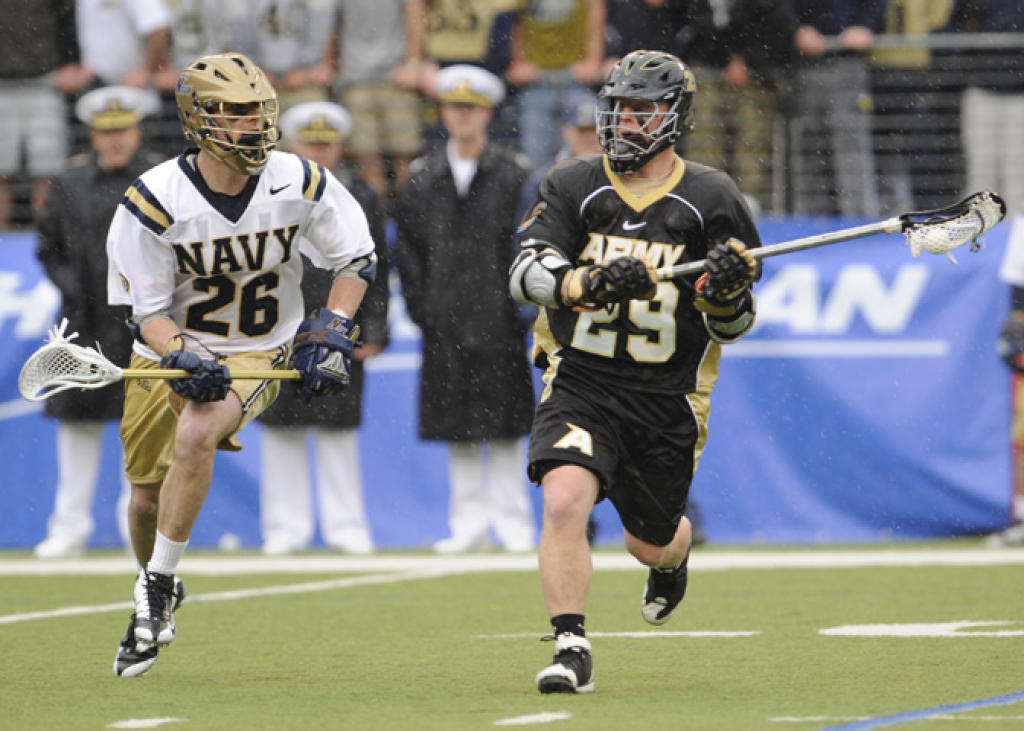
West Point fields 15 men's and nine women's National Collegiate Athletic Association (NCAA) sports teams. Cadets compete in one sport every fall, winter, and spring season at the intramural, club, or intercollegiate level. Its football team was a national power in the early and mid-20th century, winning three national championships. Its alumni are collectively referred to as "The Long Gray Line," which include U.S. presidents Dwight D. Eisenhower and Ulysses S. Grant; Confederate president Jefferson Davis; Confederate generals Robert E. Lee and Stonewall Jackson; American poet Edgar Allan Poe; U.S. generals William Tecumseh Sherman, John J. Pershing, Douglas MacArthur, Omar Bradley, and George Patton; presidents of Costa Rica, Nicaragua, and the Philippines; and 76 Medal of Honor recipients.

History
Colonial period, founding, and early years
The Continental Army first occupied West Point, New York, on 27 January 1778, and it is the oldest continuously operating Army post in the United States. Between 1778 and 1780, the Polish engineer and military hero Tadeusz Kościuszko oversaw the construction of the garrison defenses. However, Kościuszko's plan of a system of small forts did not meet with the approval of New York Governor (and General) George Clinton or the other general officers. It was determined that a battery along the river to "annoy the shipping" was more appropriate, and Washington's chief engineer, Rufus Putnam, directed the construction of a major fortification on a hill 500 feet (150 m) above sea level that commanded the West Point plain. General Alexander McDougall named it Fort Putnam. The Great Hudson River Chain and high ground above the narrow "S" curve in the river enabled the Continental Army to prevent the Royal Navy from sailing upriver and dividing Patriot forces in the Northern colonies from the south. While the fortifications at West Point were known as Fort Arnold during the war, as commander, Benedict Arnold committed his act of treason, attempting to turn the fort over to the British. After Arnold betrayed the patriot cause, the Army changed the name of the fortifications at West Point, New York, to Fort Clinton, named after General James Clinton. With the peace after the American Revolutionary War, various ordnance and military stores were left deposited at West Point.
"Cadets" underwent training in artillery and engineering studies at the garrison since 1794. During the Quasi-War, Alexander Hamilton laid out plans for the establishment of a military academy at West Point and introduced "A Bill for Establishing a Military Academy" in the House of Representatives. In 1801, shortly after his inauguration as president, Thomas Jefferson directed that plans be set in motion to establish at West Point the United States Military Academy. He selected Jonathan Williams to serve as its first superintendent. Congress formally authorized the establishment and funding of the school with the Military Peace Establishment Act of 1802, which Jefferson signed on 16 March. The academy officially commenced operations on 4 July 1802. The academy graduated Joseph Gardner Swift, its first official graduate, in October 1802. He later returned as Superintendent from 1812 to 1814. In its tumultuous early years, the academy featured few standards for admission or length of study. Cadets ranged in age from 10 years to 37 years and attended between 6 months to 6 years. The impending War of 1812 caused the United States Congress to authorize a more formal system of education at the academy and increased the size of the Corps of Cadets to 250.
In 1817, Colonel Sylvanus Thayer became the Superintendent and established the curriculum, elements of which are still in use as of 2020. Thayer instilled strict disciplinary standards, set a standard course of academic study, and emphasized honorable conduct. He was very much inspired by the curriculum of the French École Polytechnique, where he had been sent upon his demand, for two years in order to study the scientific and technological achievements developed by the French Republican faction and bring them back to the United States. Known as the "Father of the Military Academy," he is honored with a monument on campus for the profound impact he had on the academy. Founded as a school of engineering, for the first half of the 19th century, USMA produced graduates who gained recognition for engineering the bulk of the nation's initial railway lines, bridges, harbors, and roads. The academy was the only engineering school in the country until the founding of Rensselaer Polytechnic Institute in 1824. It was so successful in its engineering curriculum that it significantly influenced every American engineering school founded prior to the Civil War.

In 1835, during the Army's first year of the Second Seminole War, they had only three generals: Winfield Scott, Edmund P. Gaines, and Thomas S. Jesup. The Army's remaining fourteen generals held only brevet ranks, and none of them were West Point graduates. Nearly the only way to obtain a commission up to 1835 was through the academy, which raised loud complaints and added to the deep desire of the era's Jacksonian Democracy "to get rid of the Academy, where Jacksonians were sure, an aristocratic tradition was being bred."
The Mexican–American War brought the academy to prominence as graduates proved themselves in battle for the first time. Future Civil War commanders Ulysses S. Grant and Robert E. Lee, who also later became the superintendent of the academy, first distinguished themselves in battle in Mexico. In all, 452 of 523 graduates who served in the war received battlefield promotions or awards for bravery. The school experienced a rapid modernization during the 1850s, often romanticized by the graduates who led both sides of the Civil War as the "end of the Old West Point era." New barracks brought better heat and gas lighting, while new ordnance and tactics training incorporated new rifle and musket technology and accommodated transportation advances created by the steam engine. With the outbreak of the Civil War, West Point graduates filled the general officer ranks of the rapidly expanding Union and Confederate armies. 294 graduates served as general officers for the Union, and 151 served as general officers for the Confederacy. Of all living graduates at the time of the war, 105 (10%) were killed, and another 151 (15%) were wounded. Nearly every general officer of note from either army during the Civil War was a graduate of West Point, and a West Point graduate commanded the forces of one or both sides in every one of the 60 major battles of the war.
After the Civil War
Immediately following the Civil War, the academy enjoyed unprecedented fame as a result of the role its graduates had played. The post-war years were a difficult time for the academy as it struggled to admit and reintegrate cadets from former Confederate states. The first cadets from Southern states were re-admitted in 1868, and 1870 saw the admission of the first black cadet, James Webster Smith of South Carolina. Smith endured harsh treatment and was eventually dismissed for academic deficiency under controversial circumstances in 1874. As a result, Henry O. Flipper of Georgia became the first black graduate in 1877, graduating 50th in a class of 76. Two of the most notable graduates during this period were George Washington Goethals from the class of 1880 and John J. Pershing from the class of 1886. Goethals gained prominence as the chief engineer of the Panama Canal, and Pershing would become famous for his exploits against the famed Pancho Villa in Mexico and later for leading American Forces during World War I. In 1898, the first Confederate leader since the Civil War was invited to the academy.
Besides the integration of southern-state and black cadets, the post-war academy also struggled with the issue of hazing. In its first 65 years, hazing was uncommon or non-existent beyond small pranks played upon the incoming freshmen, but it took a harsher tone as Civil War veterans began to fill the incoming freshman classes. The upper-class cadets saw it as their duty to "teach the plebes their manners." Hazing at the academy entered the national spotlight with the death of former cadet Oscar L. Booz on 3 December 1900. Congressional hearings, which included testimony by cadet Douglas MacArthur, investigated his death and the pattern of freshmen's systemic hazing. When MacArthur returned as superintendent, he made an effort to end the practice of hazing the incoming freshmen by placing Army sergeants in charge of training new cadets during freshman summer. The practice of hazing continued on some levels well into the late 20th century, but is no longer allowed in the present day.
The demand for junior officers during the Spanish–American War caused the class of 1899 to graduate early, and the Philippine–American War did the same for the class of 1901. This increased demand for officers led Congress to increase the Corps of Cadets' size to 481 cadets in 1900. The period between 1900 and 1915 saw a construction boom as much of West Point's old infrastructure was rebuilt. Many of the academy's most famous graduates graduated during the 15 years between 1900 and 1915: Douglas MacArthur (1903), Joseph Stilwell (1904), Henry "Hap" Arnold (1907), George S. Patton (1909), Dwight D. Eisenhower, and Omar Bradley (both 1915). The class of 1915 is known as "the class the stars fell on" for the exceptionally high percentage of general officers that rose from that class (59 of 164).
The outbreak of America's involvement in World War I caused a sharp increase in the demand for army officers, and the academy accelerated graduation of all four classes then in attendance to meet this requirement, beginning with the early graduation of the First Class on 20 April 1917, the Second Class in August 1917, and both the Third and Fourth Classes just before the Armistice of 11 November 1918, when only freshman cadets remained (those who had entered in the summer of 1918). In all, wartime contingencies and post-war adjustments resulted in ten classes, varying in length of study from two to four years, within a seven-year period before the regular course of study was fully resumed.

Douglas MacArthur became superintendent in 1919, instituting sweeping reforms to the academic process, including introducing a greater emphasis on history and humanities. He made major changes to the field training regimen, and the Cadet Honor Committee was formed under his watch in 1922. MacArthur was a firm supporter of athletics at the academy, as he famously said, "Upon the fields of friendly strife are sown the seeds that, upon other fields, on other days, will bear the fruits of victory." West Point was first officially accredited in 1925, and in 1933 began granting Bachelor of Science degrees to all graduates. In 1935, the academy's authorized strength increased to 1,960 cadets.
World War II and the Cold War
As World War II engulfed Europe, Congress authorized an increase to 2,496 cadets in 1942 and began graduating classes early. The class of 1943 graduated six months early in January 1943, and the next four classes graduated after only three years. To accommodate this accelerated schedule, summer training was formally moved to a recently acquired piece of land southwest of the main post. The site would later become Camp Buckner. The academy had its last serious brush with abolition or major reform during the war, when some members of Congress charged that even the accelerated curriculum allowed young men to "hide out" at West Point and avoid combat duty. A proposal was put forth to convert the academy to an officer's training school with a six-month schedule, but this was not adopted. West Point played a prominent role in WWII; four of the five, five-star generals were alumni, and nearly 500 graduates died. Immediately following the war in 1945, Maxwell Taylor (class of 1922) became superintendent. He expanded and modernized the academic program and abolished antiquated courses in fencing and horsemanship.
Unlike previous conflicts, the Korean War did not disrupt class graduation schedules. More than half of the Army leadership during the war comprised West Point graduates. The Class of 1950, which graduated only two weeks prior to the war's outbreak, suffered some of the heaviest casualties of any 20th-century class and became known sourly as "the class the crosses fell on." A total of 157 alumni perished in the conflict. Garrison H. Davidson became superintendent in 1956 and instituted several reforms that included refining the admissions process, changing the core curriculum to include electives, and increasing the academic degree standards for academy instructors. The 1960s saw the size of the Corps expand to 4,400 cadets while the barracks and academic support structure grew proportionally.

West Point was not immune to the social upheaval of American society during the Vietnam War. The first woman joined the faculty of the all-male institution amidst controversy in 1968. West Point granted its first honorable discharge in 1971 to an African-American West Point cadet, Cornelius M. Cooper, of California, who applied for conscientious objector status in 1969. The academy struggled to fill its incoming classes as its graduates led troops in Southeast Asia, where 333 graduates died.
Modern era
Following the 1973 end of American involvement in Vietnam, the strain and stigma of earlier social unrest dissolved, and West Point enjoyed surging enrollments. On 20 May 1975, an amendment to the Defense Authorization Bill of 1976 opening the service academies to women was approved by the House of Representatives, 303–96. The Senate followed suit on 6 June. President Ford signed the bill on 7 October 1975.
West Point admitted its first 119 female cadets in 1976. That same year, physics professor James H. Stith became the first tenured African American Professor. In 1979, Cadet, later General, Vincent K. Brooks became the first African American to lead the Corps of Cadets. Kristin Baker, ten years later, became the first female First Captain, the highest-ranking senior cadet at the academy in 1989. Seven other women have been appointed as First Captain: Grace H. Chung in 2003, Stephanie Hightower in 2005, Lindsey Danilack in 2013, Simone Askew in 2017, Reilly McGinnis in 2020, Lauren Drysdale in 2022, and Caroline Robinson in 2025. Simone Askew was the first African American woman to lead the Corps. In the 21st century, women comprise approximately 20% of entering new cadets.

In 1985, cadets were formally authorized to declare an academic major; all previous graduates had been awarded a general Bachelor of Science degree. Five years later there was a major revision of the Fourth-Class System, as the Cadet Leader Development System (CLDS) became the guidance for the development of all four classes. The class of 1990 was the first one to be issued a standard and mandatory computer to every member of the class at the beginning of Plebe year, the Zenith 248 SX. The academy was also an early adopter of the Internet in the mid-1990s and was recognized in 2006 as one of the nation's "most wired" campuses.
During the Gulf War, alumnus General Schwarzkopf was the commander of Allied Forces. The American senior generals in Iraq, Generals Petraeus, Odierno and Austin, and Afghanistan, retired General Stanley McChrystal and General David Rodriguez, are also alumni. Following the September 11 attacks, applications for admission to the academy increased dramatically, security on campus was increased, and the curriculum was revamped to include coursework on terrorism and military drills in civilian environments. One graduate was killed during the 9/11 terrorist attacks and ninety graduates have died during operations in Afghanistan, Iraq, and the ongoing global war on terror. The Class of 2005 has been referred to as The Class of 9/11 as the attacks occurred during their first year at the academy, and they graduated 911 students. In 2008 gender-neutral lyrics were incorporated into West Point's "Alma Mater" and "The Corps" – replacing lines like "The men of the Corps" with "The ranks of the Corps." In December 2009, President Barack Obama delivered a major speech in Eisenhower Hall Theater outlining his policy for deploying 30,000 additional troops to Afghanistan as well as setting a timetable for withdrawal. President Obama also provided the commencement address in 2014.
After the Don't Ask, Don't Tell policy was lifted 20 September 2011, the academy began admitting and retaining openly gay cadets. By March 2012, cadets were forming a gay-straight alliance group called Spectrum. By March 2015, Spectrum had two faculty and 40 cadet members, a mixture of gay, straight, bi, and undecided. According to a Vanity Fair essay, the LGBT cadets were well accepted. After the ban on transgender service members was lifted in 2016, the Class of 2017 saw the first openly transgender graduate. However, she was denied a commission and was honorably discharged.
Brig. Gen. Diana Holland became West Point's first woman Commandant of Cadets in January 2016.
In 2020, the campus confronted its first major pandemic in a century, with the COVID-19 pandemic causing limitations on classes, and the relocation of the traditional Army-Navy football game to ensure social distancing. For the first time in many years, the 121st iteration of the game was held at West Point rather than the traditional Lincoln Financial Field in Philadelphia. Ultimately, West Point beat Navy 15–0.
Campus
The academy is located approximately 50 miles (80 km) north of New York City on the western bank of the Hudson River. West Point, New York, is incorporated as a federal military reservation in Orange County and is adjacent to Highland Falls. Based on the significance both of the Revolutionary War fort ruins and of the military academy itself, the majority of the academy area was declared a National Historic Landmark in 1960. In 1841, Charles Dickens visited the academy and said "It could not stand on more appropriate ground, and any ground more beautiful can hardly be." One of the most visited and scenic sites on post, Trophy Point, overlooks the Hudson River to the north, and is home to many captured cannon from past wars as well as the Stanford White-designed Battle Monument. Though the entire military reservation encompasses 15,974 acres (65 km2), the academic area of the campus, known as "central area" or "the cadet area", is entirely accessible to cadets or visitors by foot.
In 1902, the Boston architectural firm Cram, Goodhue, and Ferguson was awarded a major construction contract that set the predominantly neogothic architectural style still seen today. Most of the buildings of the central cadet area are in this style, as typified by the Cadet Chapel, completed in 1910. These buildings are nearly all constructed from granite that has a predominantly gray and black hue. The barracks that were built in the 1960s were designed to mimic this style. Other buildings on post, notably the oldest private residences for the faculty, are built in the Federal, Georgian, or English Tudor styles. A few buildings, such as Cullum Hall and the Old Cadet Chapel, are built in the Neoclassical style.
The academy grounds are home to numerous monuments and statues. The central cadet parade ground, the Plain, hosts the largest number, and includes the Washington Monument, Thayer Monument, Eisenhower Monument, MacArthur Monument, Kosciuszko Monument, and Sedgwick Monument. Patton Monument was first dedicated in front of the cadet library in 1950, but in 2004 it was placed in storage to make room for the construction of Jefferson Hall. With the completion of Jefferson Hall, Patton's statue was relocated and unveiled at a temporary location on 15 May 2009, where it will remain until the completion of the renovation of the old cadet library and Bartlett Hall. There is also a statue commemorating brotherhood and friendship from the École Polytechnique in the cadet central area just outside Nininger Hall. The remaining campus area is home to 27 other monuments and memorials.
The West Point Cemetery is the final resting place of many notable graduates and faculty, including George Armstrong Custer, Winfield Scott, William Westmoreland, Earl Blaik, Margaret Corbin, and eighteen Medal of Honor recipients. The cemetery is also the burial place of several recent graduates who have died during the ongoing conflict in Iraq and Afghanistan. Many of the older grave sites have large and ornate grave markers, the largest belonging to Egbert Viele (class of 1847), chief engineer of Brooklyn's Prospect Park. The cemetery is also home to a monument to Revolutionary War heroine Margaret Corbin.
Athletic facilities
West Point is home to historic athletic facilities like Michie Stadium and Gillis Field House as well as modern facilities such as the Lichtenberg Tennis Center, Anderson Rugby Complex, and the Lou Gross Gymnastics Facility. Michie Stadium recently underwent a significant upgrade in facilities for the football team, and the academy installed a new artificial turf field in the summer of 2008.
West Point Museum
The visitor center is just outside the Thayer Gate in the village of Highland Falls and offers the opportunity to arrange for a guided tour. These tours, which are the only way the general public can access the academy grounds, leave the visitor center several times a day. The old West Point Visitor Center was housed in the now-demolished Ladycliff College library building. On 9 September 2016, West Point broke ground in order to begin construction of the new 31,000 square foot Malek West Point Visitors Center. It is being built on the location of the former visitor center. The Malek West Point Visitors Center is named after Frederic Malek, USMA Class of 1959 and a 2014 Distinguished Graduate.
The West Point Museum is directly adjacent to the visitor center, in the renovated Olmsted Hall on the grounds of the former Ladycliff College. Originally opened to the public in 1854, the West Point Museum is the oldest military museum in the country. During the summer months, the museum operates access to the Fort Putnam historic site on main post and access to the 282 acre Constitution Island. Some of the most notable items on display at the museum are George Washington's pistols, Napoleon's sword, a dagger carried by Hermann Göring when he was captured, a revolver that belonged to Göring, and a silver-plated party book, signed by Charles Lindbergh, Herbert Hoover and Mussolini, among others. In addition, a gold-plated Liliput pistol that belonged to Adolf Hitler is on display.
Administration
Academy leadership
The commanding officer at the USMA is the Superintendent, equivalent to the president or chancellor of a civilian university. In recent years, the position of superintendent has been held by a lieutenant general (three star general). The 61st Superintendent, Lieutenant General Steven W. Gilland, took command on 27 June 2022, replacing Darryl A. Williams. The academy is a direct reporting unit, and as such, the Superintendent reports directly to the Army Chief of Staff (CSA).
There are two other general officer positions at the academy. Brigadier General R.J. Garcia is the Commandant of Cadets, equivalent to a dean of students at the civilian level. Brigadier General Shane Reeves is the Dean of the Academic Board, equivalent to a provost at the civilian level. Brigadier General Diana Holland was the first female commandant. Brigadier General Jebb was the first female Dean. There are 13 academic departments at USMA, each with a colonel as the head of department. These 13 tenured colonels comprise the core of the Academic Board. These officers are titled "Professors USMA" or PUSMA. The academy is also overseen by the Board of Visitors (BOV). The BOV is a panel of Senators, Congressional Representatives, and presidential appointees who "shall inquire into the morale and discipline, curriculum, instruction, physical equipment, fiscal affairs, academic methods, and other matters relating to the academy that the board decides to consider." Currently the BOV is chaired by Representative John Shimkus and is composed of three Senators, five Representatives and six presidential appointees.
Admission requirements
Candidates must be between 17 and 23 years old (waivers have been accepted for 24-year olds in rare cases where the candidate is in the military and deployed and therefore unable to attend before their 24th birthday), unmarried, and with no legal obligation to support a child. Above-average high school or previous college grades and strong performance on standardized testing are expected. The interquartile range on the old SAT was 1100–1360 and 68% ranked in the top fifth of their high school class.
To be eligible for appointment, candidates must also undergo a Candidate Fitness Assessment and a complete physical exam. Up to 60 students from foreign countries are present at USMA, educated at the expense of the sponsoring nation, with tuition assistance based on the GNP of their country. Of these foreign cadets the Code of Federal Regulations specifically permits one Filipino cadet designated by the President of the Philippines.
The actual application process consists of two main requirements: candidates apply to USMA for admission and separately provide a nomination. The majority of candidates receive a nomination from their United States Representative or Senator. Some receive a nomination from the Vice President or even the President of the United States.
The nomination process is not political. The academy applicant typically provides written essays and letters of recommendation. The applicant then submits to a formal interview. Admission to West Point is selective: 7.74% of applicants were admitted (total of 1232) to the Class of 2024.
Candidates may have previous college experience, but they may not transfer, meaning that regardless of previous college credit, they enter the academy as a fourth class cadet and undergo the entire four-year program. Candidates considered academically disqualified and not selected may receive an offer to attend to the United States Military Academy Preparatory School. Upon graduation from USMAPS, these candidates are appointed to the academy if they receive the recommendation of the USMAPS Commandant and meet medical admission requirements.
The West Point Association of Graduates (WPAOG) also offers scholarship support to people who are qualified but not selected. The scholarships usually cover around $7,000 to civilian universities; the students who receive these scholarships do so under the stipulation that they will be admitted to and attend West Point a year later. Those who do not must repay the AOG. Marion Military Institute, New Mexico Military Institute, Georgia Military College, Hargrave Military Academy, Greystone Preparatory School at Schreiner University, and Northwestern Preparatory School are approved programs that students attend on the AOG scholarship prior to admission to West Point.
Research centers and institutes
The academy's research centers and institutes include:
Curriculum
West Point is a highly residential baccalaureate college, with a full-time, four-year undergraduate program that emphasizes instruction in the arts, sciences, and professions with no graduate program. There are forty-five academic majors, the most popular of which are foreign languages, management information systems, history, economics, and mechanical engineering. West Point is accredited by the Middle States Commission on Higher Education. Military officers compose 75% of the faculty, while civilian professors make up the remaining 25%.
A cadet's class rank, which determines their Army branch and assignment upon graduation, is calculated as a combination of academic performance (55%), military leadership performance (30%), and physical fitness and athletic performance (15%).
Academics
The academy's teaching style forms part of the Thayer method, which was implemented by Sylvanus Thayer during his tour as Superintendent. This form of instruction emphasizes small classes with daily homework, and strives to make students actively responsible for their own learning by completing homework assignments prior to class and bringing the work to class to discuss collaboratively.
The academic program consists of a structured core of thirty-one courses balanced between the arts and sciences. The academy operates on the semester system, which it labels as "terms" (Term 1 is the fall semester; Term 2 is the spring semester). Although cadets choose their majors in the spring of their freshmen year, all cadets take the same course of instruction until the beginning of their second year. This core course of instruction consists of mathematics, information technology, chemistry, physics, engineering, history, physical geography, philosophy, leadership and general psychology, English composition and literature, foreign language, political science, international relations, economics, and constitutional law. Some advanced cadets may "validate" out of the base-level classes and take advanced or accelerated courses earlier as freshmen or sophomores. Regardless of major, all cadets graduate with a Bachelor of Science degree.
Military
As all cadets are commissioned as second lieutenants upon graduation, military and leadership education is nested with academic instruction. Military training and discipline fall under the purview of the Office of the Commandant of Cadets. Entering freshmen, or fourth class cadets, are referred to as New Cadets, and enter the academy on Reception Day or R-day, which marks the start of cadet basic training (CBT), known colloquially as Beast Barracks, or simply Beast. Most cadets consider Beast to be their most difficult time at the academy because of the transition from civilian to military life. Their second summer, cadets undergo cadet field training (CFT) at nearby Camp Buckner, where they train in more advanced field craft and military skills. During a cadet's third summer, they may serve as instructors for CBT or CFT. Rising Firstie (senior) cadets also spend one-month training at Camp Buckner, where they train for modern tactical situations that they will soon face as new platoon leaders. Cadets also have the opportunity during their second, third and fourth summers to serve in active army units and military schools around the world. The schools include Airborne, Air Assault, Sapper, Pathfinder, etc.
Active duty officers in the rank of captain or major serve as Company Tactical Officers (TAC Officers). The role of the TAC is to mentor, train, and teach the cadets proper standards of good order and discipline and be a good role model. There is one TAC for every cadet company. There is also one senior Non-Commissioned Officer to assist each TAC, known as TAC-NCOs.