
The Franks (Latin: Franci or gens Francorum) were a northern European group of peoples who first appeared under this name in the third century AD, when the Franks were a category of Germanic tribes living near the lower stretches of the Rhine River military border of the Roman Empire. The Franks however gradually became a larger, multilingual, Catholic Christian group of peoples, who inhabited several post-Roman kingdoms both inside and outside the former empire. Much of what is now the Netherlands, Germany, Belgium, Luxembourg, France, and in a broader sense much of the population of medieval western Europe, could eventually be described as Franks in some contexts.
The Frankish tribes such as the Bructeri and Chattuari acquired their new collective name during the crisis of the 3rd century, a period when Rome lost control of regions near the lower Rhine, within the Roman province of Germania Inferior. They had been living across the Rhine under Roman hegemony for centuries, under various tribal names, and during the crisis they made frequent incursions, and settled in some Roman areas near the Rhine. Despite the reassertion of Roman authority in the 4th century, Franks continued to live semi-independently on both sides of the Rhine, while the Romans came to agreements with them, recruiting large numbers of Frankish soldiers, some of whom achieved high imperial rank. With the Roman administration of Britain and northern Gaul eventually breaking down once more in the fifth century, it was the Franks who attempted to defend the Roman border in 406 when a largescale crossing was made by Alans and Vandals from eastern Europe. Frankish kings subsequently divided up Germania Inferior between them, and at least one, Chlodio, also began to rule more Romanized populations to the south, in what is now northern France. In 451, Frankish groups participated on both sides in the Battle of the Catalaunian Plains, where Attila and his allies were defeated by a Roman-led alliance of various peoples established in Gaul. By the early 6th century, the whole of Gaul north of the Loire, and all the Frankish kingdoms, were united within the kingdom of the Frank Clovis I, the founder of the Merovingian dynasty. By building upon the basis of this empire, the subsequent Frankish dynasty, the Carolingians, eventually came to be seen as the new emperors of Western Europe in 800, when Charlemagne was crowned by the pope.
As the original Frankish communities merged into others, the term Frank lost its original meaning. In 870, the Frankish realm was permanently divided between western and eastern kingdoms, which were the predecessors of the later Kingdom of France and Holy Roman Empire respectively. The Latin term Franci, and equivalents in other languages, came to refer mainly to the people of the Kingdom of France, the forerunner of present day France. However, in various historical contexts, such as during the medieval crusades, not only the French, but also people from neighbouring regions in Western Europe, continued to be referred to collectively as Franks. The crusades in particular had a lasting impact on the use of Frank-related names, which are now used generically for all Western Europeans in many non-European languages.

Meaning of the term "Franks"
Etymology
While the original meaning of the word is not certain, it is commonly believed to have a Germanic etymology. Following the precedents of Edward Gibbon and Jacob Grimm, the name of the Franks was traditionally linked Old French franc, and related terms such as the English adjective frank, meaning "free". This term is however derived from the term Frank itself, as it referred to their free status. Similarly, the word has been connected to a Germanic word for "javelin", reflected in words such as Old English franca or Old Norse frakka, but these terms possibly also derive from the name of the Franks, as the name of a Frankish weapon. Alternatively, this Germanic word may share its origins with an older term recorded in Latin framea, which was used to describe the javelin used by Germani already in the first century.
A common proposal to explain the ultimate origin of all these terms is that it meant "fierce". According to one version of this proposal, the name is related to a proto-Germanic word which has been reconstructed, *frekaz, which meant "greedy", but sometimes tended towards meanings such as "bold". It has descendants such as German frech (cheeky, shameless), Middle Dutch vrec (miserly), Old English frǣc (greedy, bold), and Old Norse frekr (brazen, greedy).
The traditional idea that the name of the Franks meant fierce is partly derived from classical stereotypes of their ferocity and unreliability. For example, Eumenius rhetorically addressed the Franks when Frankish prisoners were executed at Trier by Constantine I in 306: Ubi nunc est illa ferocia? Ubi semper infida mobilitas? ("Where now is that ferocity of yours? Where is that ever untrustworthy fickleness?"). Isidore of Seville (died 636) said that there were two proposals known to him. Either the Franks took their name from a war leader who founded them, called Francus, or else their name referred to their wild manners (feritas morum).

Evolution as demonym
The origins of the term Franci (singular Francus) are unclear, but by the 4th century it was commonly used as a collective term to refer to several tribes who were also known to the Romans by their own tribal names. It also became a more commonly used term than the older but much broader collective name Germani, which also covered many non-Frankish peoples such as the Alemanni and Marcomanni. Within a few centuries the term had eclipsed the names of the original peoples who constituted the Frankish population.
The nature of the Franks’ conquests and expansion as a people fundamentally differed from other peoples originating in Germania as they did not completely settle a seperate territory while leaving abandoning their native lands. Hutton Webster wrote about the Franks in 1917:
The Frankish conquests differed in two important respects from those of the other Germanic peoples. In the first place, the Franks did not cut themselves off completely from their original homes. They kept permanently their territory in Germany, drawing from it continual reinforcements of fresh German blood. In the second place, the Franks steadily added new German lands to their possessions. They built up in this way what was the largest and the most permanent of all the barbarian states founded on the ruins of the Roman Empire.

After their conquest of northern Gaul, many Germanic-speaking Franks lived in communities where the majority population was not Frankish, and the dominant language was Gallo-Roman. However, as the Franks became more powerful, and more integrated with the peoples they ruled over, the name came to be more broadly applied, especially in what is now northern France. Christopher Wickham pointed out that "the word 'Frankish' quickly ceased to have an exclusive ethnic connotation. North of the River Loire everyone seems to have been considered a Frank by the mid-7th century at the latest (except Bretons); Romani (Romans) were essentially the inhabitants of Aquitaine after that".
As societies changed, the name acquired new meanings, and the old Frankish community ceased to exist in its original form.
In Europe in later times, it was mainly the inhabitants of the Kingdom of France who came to be referred to in Latin as the Franci (Franks), although new terms soon became more common, which connect the French to the earlier Franks, but also distinguish them. The modern English word "French" comes from the Old English word for "Frankish", Frenċisċ. Modern European terms such as French français and German Franzose, derive from Medieval Latin francensis meaning "from Francia", the country of the Franks, which for medieval people was France. In Medieval Latin, French people were also commonly referred to as francigenae, similarly meaning "from Francia" or literally "Francia-born".

Similarly to France, the region of Franconia (German: Franken) in what is now Germany has a name which originally referred to the Franks, but developed a distinct meaning over time. It was an eastern extension of the core Frankish Merovingian empire. It became the medieval Duchy of Franconia in the Holy Roman Empire which evolved from the eastern part of the Frankish empire. Unlike France, despite the role that Franks played in creating this eastern realm most of it did not come to be considered Frankish. Franconia's name therefore contrasted it with the similarly powerful non-Frankish stem duchies east of the Rhine: Thuringia, Swabia, Saxony, and Bavaria.
In contrast to France and Franconia, the centrally-positioned Frankish lands west of the Rhine came to be referred to by other names. The region was initially the core of Merovingian Frankish Austrasia, which ruled over early Franconia east of the Rhine, and was contrasted to Frankish Neustria to its the west, in France. The part of Austrasia west of the Rhine later came to be referred to as Lotharingia, after its Carolingian Frankish king Lothair II. However, after his death the region was divided between the eastern and western Franks and never regained lasting independence.
The nature of the Frankish expansion fundamentally differed
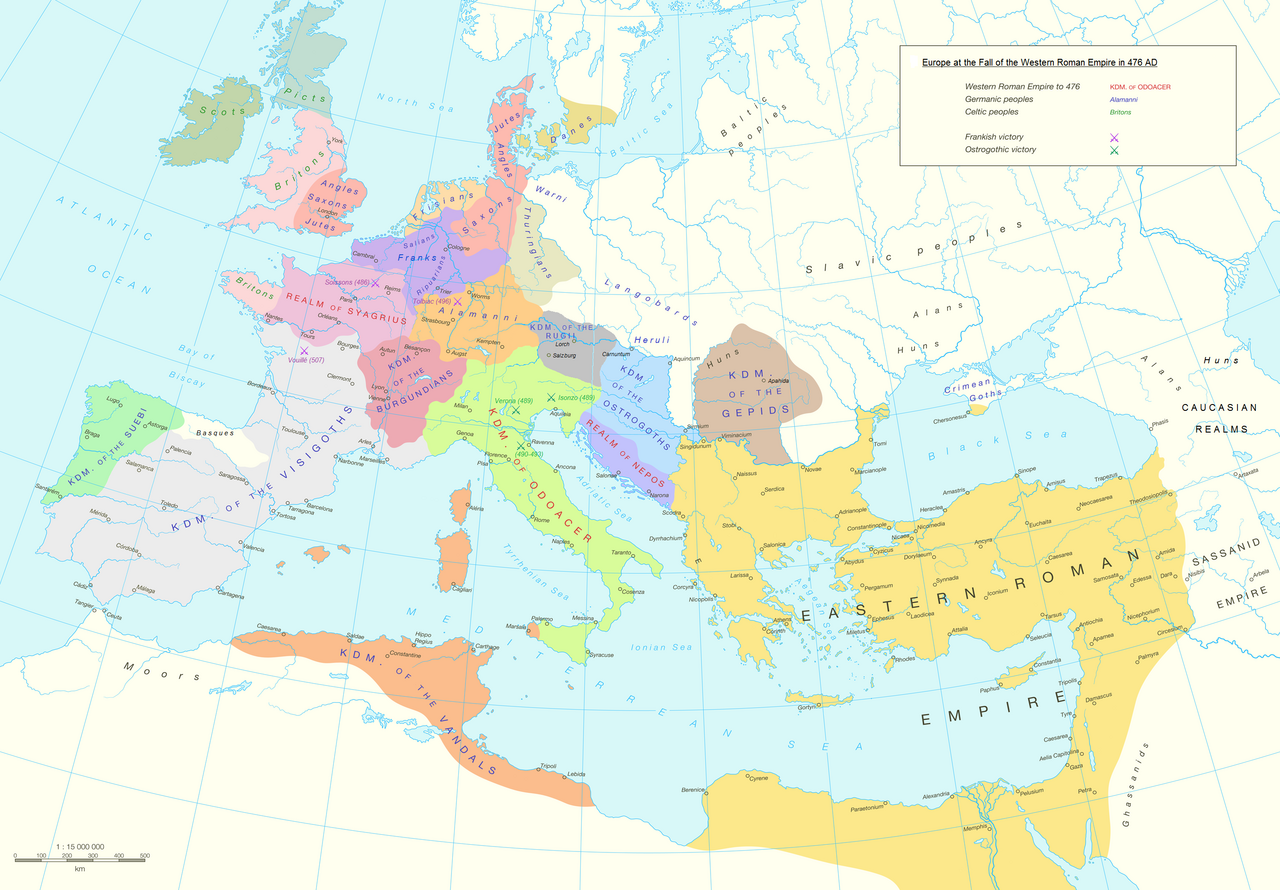
"Westerner" in Eastern understanding
In more international contexts such as during the crusades in the Eastern Mediterranean, the term Frank was also used for any Europeans from Western and Central Europe who followed the Latin rites of Christianity under the authority of the pope in Rome. The use of the term Frank to refer to all western Europeans spread eastwards to many Asian languages (see Farang).
Mythological origins
Several accounts from Merovingian times report that some medieval Franks believed that their ancestors originally moved to their Rhineland homeland from the Roman province of Pannonia on the Danube. These include the History of the Franks which was written by Gregory of Tours in the 6th century, a 7th-century work known as the Chronicle of Fredegar, and the anonymous Liber Historiae Francorum, written a century later.
While Gregory did not go deeply into the story, possibly because he rejected it, the other two sources report variants of the idea that, just as in the mythical origin story of the Romans created by Virgil, the Franks descended from Trojan royalty, who escaped from westwards after the Fall of Troy. Fredegar's version, which mentions the poet Virgil by name, connected the Franks not only to the Romans but also to the Phrygians, Macedonians, and Turks. He also reported that they built a new city on the Rhine named Troy after their ancestral home. The city he had in mind is likely to be the real Roman city now known as Xanten, based by the old Roman fort of Colonia Traiana, which was really named after Trajan, but was known as Troja minor (lesser Troy) in the Middle Ages.
The other work, the Liber Historiae Francorum, adds an episode to the story whereby the Pannonian Franks instead founded a city called Sicambria in Pannonia, and while there they fought successfully for a Roman emperor named Valentinian against the Alans, near the Sea of Azov, where the Franks themselves had, according to the story, previously lived before moving to Pannonia. This city name appears to be based upon the Sicambri who were one of the most well-known tribes in the Frankish Rhine homeland in the time of the early Roman empire. According to the story the Franks were forced to leave Pannonia, after rebelling against Roman taxes.
In reality, the Franks had been living near the Rhine for centuries before the Valentinian dynasty really did confront the Alans, which happened in the late 4th century. It has been suggested that this element in the story may preserve stories from Frankish officers who served the dynasty against the Alans in southeastern Europe, such as Merobaudes. The story might also be influenced by memories of the later Frankish defence of the Roman empire during the subsequent entrance of Alans and other peoples into Gaul in about 406 AD, many of whom had previously been living in or near Pannonia. In particular, the Alans and other peoples who arrived from Pannonia were well-known to later generations of Franks and Romans in northern Gaul. A kingdom of Alans was founded near Orleans after 406, and Attila's Hun alliance, also based near Pannonia, invaded Gaul in 451. The name "Sicambria" can be explained as a derivative of the idea found in Graeco-Roman literature, that the Sicambri were ancestors of the later Franks, although in reality they had lived near the Rhine, like the Franks.
On the other hand, concerning the Trojan element in the Frankish origin stories, historian Patrick J. Geary has for example written that they are "alike in betraying both the fact that the Franks knew little about their background and that they may have felt some inferiority in comparison with other peoples of antiquity who possessed an ancient name and glorious tradition."
History
Early Franks (250–350)
The term "Franks" was probably first used during the Crisis of the Third Century (235–284 AD). However, most of the sources which mention Franks in this period were written much later, and cannot provide conclusive evidence about third-century terminology. In some cases, specific older tribes were explicitly categorized as Franks, including the Chamavi, Bructeri, and Chattuari. The Chamavi are called Franks in the Tabula Peutingeriana, a 13th-century copy of a 4th or 5th century atlas of Roman roads that reflects information from the 3rd century. The Chattuari were described as Franks living across from Xanten in an account of a Roman attack upon them in 360, and the Bructeri were also described as Franks living across from Cologne in an account of a Roman attack in 392/393.
Archaeological evidence confirms that from around 250, the period when the Frankish name apparently first appeared, there was a massive decrease in population in many northern parts of Germania Inferior including cities. Several regions around the Rhine-Meuse and Scheldt deltas, remained relatively unpopulated until around 400. Roymans and Heeren proposed that one possible explanation for this sudden depopulation is that the Roman emperors deported very large numbers of rebellious locals out of the region. Productive agricultural land was abandoned on a large scale, making the Roman military along the Rhine highly dependent on grain imports from other provinces. Although the Rhine forts did not cease to function completely, the districts around the delta were "dispensed with once and for all as tax-paying administrative units".
It has been noted by scholars of the earliest records mentioning Franks that there are also surprisingly frequent references to them raiding by sea. In contrast, later records describe the Frankish tribes living inland, separated from the sea by the Frisians and Saxons. It appears that in the third and fourth centuries the Romans did not yet clearly distinguish the sea-going Saxons, another new category of people in this period, from the Franks and Frisians. There are indications that the coastal Frisians who were always distinguished from the Franks in later records, may have played a major role in the ethnogenesis of the Franks. It is even speculated that the so-called Salian Franks, who appear only in records from around 378, may have originally been a Frisian or Chauci tribe.
The earliest mention of Franks in the Augustan History is very uncertain. This is a much-later written collection of biographies of Roman emperors, which modern scholars believe to be largely fabricated. In its biography of the emperor Aurelian (reigned 270–275) it says that before being emperor he was at Mainz as "tribune of the Sixth Legion, the Gallican", a legion known from no other record, when he "crushed the Franks, who had burst into Gaul and were roving about through the whole country". He supposedly killed seven hundred of them and captured three hundred, selling them as slaves, and a song was supposedly composed about him: "Franks, Sarmatians by the thousand, once and once again we've slain. Now we seek a thousand Persians" (Mille Sarmatas, mille Francos semel et semel occidimus, mille Persas quaerimus). While the naming of the Franks within a supposedly popular song may seem unlikely to be fabricated, even this is considered likely by some scholars. If real though, the song would have come into being before 270 when Aurelian became emperor, and the events themselves would have been around 245 to 253.
Other late sources for this period are considered somewhat more reliable. However, most of them did not use the term Frank, but less specific terms such as Germani or "barbarians". Around 256/257, Germani crossed the Rhine and attacked Gaul. Some were Alemanni rather than Franks, who went on to invade Italy from Gaul. By 258/259 other Germani had gotten as far as Tarragona in Spain, and these even acquired ships in Spain with which they attacked North Africa. According to Aurelius Victor writing in the 4th century this latter group were Franks. In the aftermath, Postumus, emperor of the breakaway Gallic Empire in the period 260-268, apparently managed to stabilize the Rhine border, and recruited Franks into his army, using them against his rival Gallienus. It has been argued that Postumus himself was a native of the Rhine delta, and that he allowed the settlement of early Franks south of the Rhine.
Throughout the 260s and 270s very few surviving records explicitly mention the Franks, although the barbarians of the later Frankish region were very active. During the period when Gallienus reigned solo, the document known as the Laterculus Veronensis, which was made about 314, notes that the Romans lost five civitates (small countries) along the eastern bank of the Lower Rhine. The three which are legible are those of the Usipii, Tubantes, and Chattuari. These probably all became Frankish. During this period, the 260s, archaeologists also note an increase in coin hoards on the Roman side the Rhine, attesting to Frankish activity in the areas of Tongeren, Amiens, Beauvais, Trier, Metz, Toul, and Chalon-sur-Saône. Under the last Gallic emperor Tetricus, (who reigned 270–274), there are even more hoard finds, and evidence of military conflicts.
In 275/276, after the death of Tetricus and the reunification of the empire under Probus (reigned 276–282) archaeologists believe that a larger incursion into Gaul occurred, with the main thrust seemingly along the Meuse. In the context of these conflicts, Trier itself fell to an attack. The only involved barbarian group who is named by Roman sources are the Franks, mentioned by the later writer Zosimus. Probus subsequently appears to have restabilized the border.
About 280, while Probus was confronted with a rebel named Proculus, the 8th Latin Panegyric, of 297, reports that some captive Franks seized some ships, and "plundered their way from the Black Sea right to Greece and Asia and, driven not without causing damage from very many parts of the Libyan shore, finally took Syracuse itself", and eventually made it back to their homeland via the Ocean. In 281 Probus captured and killed Proculus and the Historia Augusta account of this says that it was the Franks who handed him over, because he had fled to them, having Frankish origins himself.
Before 286, Eutropius the historian, writing in the 4th century, and Orosius, writing around 400, reported that emperor Maximian assigned Carausius to lead a naval force to pacify the English channel coasts of Roman Belgica, and Armorica, because these waters were infested by Frankish and Saxon pirates. This is also one of the first uses of the term Saxon, which was subsequently used for seagoing Germanic raiders.
The first really contemporary record using the term Frank is the so-called 11th Latin Panegyric written in 291. Taken in combination with the 10th panegyric 289, these records indicate that in the winter of 287/288 Maximian, based in Trier at this time, forced a Frankish king Genobaud and his people to become Roman clients. Probably connected to this, Maximian had recently had at least one successful campaign east of the Rhine. Elsewhere the 11th panegyric also specifically mentions Franks being subdued in this period.
In 293/294, Constantius Chlorus, son-in-law of the emperor Maximian, and father of the future emperor Constantine I defeated Franks south of the Rhine-Meuse-Scheldt delta. Various groups had settled there within the empire, but were living outside of Roman governance during the rebellion of Carausius. The "6th" Latin Panegyric written in 310 says that Constantius "killed, expelled, captured [and] kidnapped" the Franks who had settled in Batavia under the leadership of Carausius. It uses the term nationes Franciae (Frankish nations) for the first time, indicating that the Franks were seen as more than one tribe or nation. The 8th Latin Panegyric written in 297 is commonly interpreted as naming two of these peoples conquered in this campaign as the Chamavi and Frisians, which makes it likely (but not certain) that both these peoples were considered Franks in this period. The same panegyric also emphasizes that there were Franks among the barbarian mercenaries of Carausius based in and around London, and the locals there had even begun to dress like them.
In 308, Constantine the Great executed two "kings of Francia", Ascaric and Merogaisus, who violated the peace after the death of his father Constantius, and then "so that the enemy should not merely grieve over the punishment of their kings" made a devastating raid on the Bructeri, and built a bridge over the Rhine at Cologne to "lord it over the remnants of a shattered nation". Further north, the Panegyric celebrated Constantine's pacification of the Rhine by claiming that Roman farmers can now safely farm on the banks of both arms of the Rhine in Batavia. The later "4th" panegyric of 321 lists Bructeri, Chamavi, Cherusci, Lancionae, Alamanni, and Tubantes as peoples Constantine fought against successfully, and who eventually formed an alliance against him. Several or all of these people were probably involved in the major field battle on the Rhine in 313, which is reported in the "12th" panegyric.
The same panegyric of 321 gives the Franks "who are more ferocious than other nations", one last seagoing role, saying they "held even the coasts of Spain infested with arms when a large number of them spread abroad beyond the Ocean itself in an outburst of fury in their passion to make war". It calls the Franks a "nation which is fecund to its own detriment".
The Laterculus Veronensis, a list of barbarian nations under Roman domination which was made about 314, lists Saxons and Franks separately from several of the older Rhineland tribal names including the Chamavi ("Camari"), Cattuari ("Gallouari"), Amsiuari, Angriuari, Bructeri, and Cati.
In 341 the emperor Constans I, one of the sons of Constantine, attacked the Franks in the Rhine delta, and in 342 the situation was pacified. Scholars speculate that some Franks were given permission to remain in the area at this time, possibly including the Salians.
Late fourth century (350–400)
In 350 Magnentius, described by contemporaries as someone having Frankish and Saxon ancestry, became a rebel emperor. He killed Constans I, and took control of much of the western empire, battling the brother of Constans, Constantius II for control. During his revolt, which lasted until 353, the Rhine borders were undermanned and barbarians were able to enter Gaul. At the Battle of Mursa Major Roman soldiers, including many with Frankish and Saxon backgrounds, fought each other, further weakening Rome's ability to defend itself. Magnentius finally died in Lyon in 353. Silvanus, one of his main commanders, who had defected to Constantius, and also had Frankish ancestry, was given the task of rebuilding defences in Gaul. However, being accused of plotting to become emperor, he decided to really make an attempt in 355 and was killed soon afterwards.
In the spring of 358 the Salian Franks were described under that name for the only time in written history, and important new agreements were made between Franks and Romans. Julian the Apostate commanding Roman forces in Gaul, and not yet an emperor, made a rapid attack against both the Salians and the Chamavi, who were both making inroads within Roman territory around the Rhine-Meuse delta. The reason for this was primarily that he needed to ensure the arrival of 600 grain carrying ships coming up the rivers from Britain, and he preferred not to simply pay the tribes off, as previous administrators had been doing. Similar accounts are given by Julian himself in his letter to the Athenians, Ammianus Marcellinus who served under him, Libanius who wrote his funeral oration, and the later Greek historians Eunapius and Zosimus. He first confronted the people who Ammianus called "Franks who are customarily called Salians". Julian says he received the submission of part of the Salian tribe, but does not call them Franks. Zosimus says the Salians were descended from the Franks.
According to Eunapius the Salians were allowed by Julian to holds lands which they had not fought for. Ammianus indicates that they had been settling in Roman Texandria, south of the delta, which modern scholars believe was lightly populated at this time. However, Zosimus explains that they had previously been settled on the large island of Batavia in the delta, until an invasion by a people who Zosimus called the "Quadi", and described as "Saxons". Zosimus also reports that before settling in Batavia, which had once been Roman ruled, the Salians had previously lived outside the empire and similarly been forced by Saxons to move. Historians speculate that they may have been given permission by the Romans to settle in Texandria already in 342.
According to Zosimus, the Franks near the delta had been defending the Roman lands against Saxon raids, so that the "Quadi" had been forced to build boats, in which they sailed along the Rhine beyond the territory of the Franks, in order to enter the Roman empire. Eunapius says that Julian instructed his men not to hurt the Salians. The people who Zosimus calls Saxons or Quadi are called Chamavi by the other sources. (The Chamavi are treated as Franks in other records, but Zosimus contrasted them with the Franks.) Despite these differences in terminology, Zosimus and Eunapius both remark how the barbarian Charietto was brought from Trier to neutralize this group's raiding, and how Julian captured the son of their king. Julian reported to the Athenians that he subsequently ejected them from lands, and took captives, and cattle. However both Eunapius and Julian make it clear that he also needed an agreement with the Chamavi in order to secure a safe passage for food supplies.
All later references to the Salians as a people, as opposed to the much later legal code, could be connected to these events. The 5th century Notitia Dignitatum mentions three military units whose names include the term "Salii", all three of which were created by Julian, who also created three parallel Tubantes units: the Salii and the Salii seniores, who both belonged to the auxilia palatina, and the Salii (iuniores) Gallicani. However in this period units did not necessary recruit from the barbarian groups they were named after. The tribe was also mentioned in a poetic way twice by fifth century poets, Claudius Claudianus and Sidonius Apollinaris. Historian Matthias Springer has argued that the Salian name was not really their tribal name, but rather a Germanic word meaning something like "comrades". He proposed that the Salians were just called Franks. According to Springer, the Salic law first mentioned centuries later is derived from the same word, but has no specific ethnic connotation, being simply the customary law holding for non-Roman free men.
In 360/361 Julian crossed the Rhine near Xanten and defeated the Chattuari, who were described as Franks in records of this event.
During the late 360s, after the death of Julian, the "second" Latin Panegyric indicates that Count Theodosius fought and won an infantry campaign in Batavia, and perhaps also a naval campaign in the Maas and Waal rivers which surround it. The details are not explained in this or any other record, but other records mention that northern Gaul was afflicted by Saxon sea raiders and Frankish land raiders in this period.
The archaeological evidence for the late fourth century suggestions that the population remained low in the northern part of Roman Germania Inferior until almost 400.
During the reigns of Emperors of the Valentinian dynasty four franks served as magistri militum (commanders-in-chief of the imperial army):
Merobaudes (372–383, under Valentinian I and Gratian in Trier)
Ricomer (382–394, under Theodosius the Great in Constantinople)
Bauto (383–387/388, under Valentinian II in Milan)
Arbogast (388–394, under Valentinian II and then under Eugenius in Trier, who Arbogast himself placed in the position of emperor).
In 388, Arbogast entered the Frankish frontier region personally, and faced a Frankish invasion. In this year, Arbogast went to Trier on the orders of Theodosius and assassinated Victor, the son and heir of the recently executed Gaulish usurper Magnus Maximus. In the previous year, while Maximus had been attempting to take control of Italy, Franks under the command of three war leaders, Marcomer, Sunno and Genobaud, had crossed the Rhine and raided deep into Roman Gaul. Some returned over the Rhine successfully with their plunder, while others entered the Silva Carbonaria, a forest in present day Belgium, where they were tracked down by Roman forces. Roman forces that tried to pursue the Franks over the Rhine were however cut to pieces. After the death of Maximus, Arbogast urged action. He met Marcomer and Sunno and demanded hostages, and then based himself in Trier. After the death of Valentinian II, Arbogast took advantage of the leaves falling, and went to Cologne. He crossed the bridge there into the country of the Bructeri, and plundered it, and then also plundered the region inhabited by the Chamavi. The Franks did not engage with him although some Ampsivarii and Chatti under the command of Marcomer appeared on the ridge of a distant hill. By this time Arbogast had created his own usurper emperor, Eugenius. Eugenius was captured and executed by Theodosius after the Battle of the Frigidus in 394, and Arbogast subsequently committed suicide.
Fifth century
Under Theodosius the Great (emperor 379–395), the new magister militum on the Rhine, Stilicho managed to pacify Germania Inferior for a short time. However, the prefecture of Gaul was relocated from Trier, near the Franks, to Vienne in what is now southern France, and then still further away to Arles, closer to Italy. After the death of Theodosius, Stilicho became more powerful, because Honorius the son of Theodosius was still young. In about 401/402 Stilicho moved Rhine forces to assist with the wars against the Goths in other parts of the empire. Large numbers of people from Central Europe, including Romans from Pannonia, moved west, crossed the Rhine, and entered Gaul. In about 406 a large force of Alans and Vandals from eastern Europe confronted the Rhine and in the ensuing Vandal–Frankish war it was the Franks who attempted to block them from passing into Gaul. They succeeded in killing one of the Alan kings, Respendial. In 407, with Gaul and Brittania in chaos and unprotected, another Roman usurper arose there to try to pacify the situation, Constantine III. Stilicho was killed in 408. By about 409 most of these Alans and Vandals had moved to Roman Hispania. The Franks took control of the area around Trier. Constantine III died in 411, and a new usurper Jovinus was proclaimed. Within a few decades Trier was taken and plundered by the Franks at least three times. Northern Gaul was no longer effectively being governed by the Roman empire although Roman military commanders were clearly still present there sometimes.