
Nazism, also known as National Socialism (NS), is the far-right, ultranationalist, totalitarian ideology associated with Adolf Hitler and the Nazi Party (NSDAP). It emerged in Germany during Hitler's rise to power and was frequently called Hitlerism. Nazism is a form of fascism that emphasizes pseudo-scientific theories of racial hierarchy which identify ethnic Germans and Nordic Aryans as a master race. The term "neo-Nazism" is applied to far-right groups formed after World War II with a similar ideology.
Nazism opposes liberal democracy and the parliamentary system. It advocates dictatorship, fervent antisemitism, anti-communism, anti-Slavism, anti-Romani sentiment, scientific racism, anti-Chinese sentiment, white supremacy, Nordicism, social Darwinism, homophobia, ableism, and eugenics. The Nazis sought to overcome social divisions and create a homogeneous German society based on racial purity. They aimed to unite all Germans living in historically German territory, gain lands for expansion under the doctrine of Lebensraum, and exclude those deemed either Community Aliens or "inferior" races (Untermenschen).
The term "National Socialism" arose from attempts to create a nationalist alternative to Marxist socialism and free-market capitalism. Nazism rejected Marxist concepts of class conflict and universal equality, opposed cosmopolitan internationalism, and sought to convince the social classes in German society to subordinate their interests to the "common good". The Nazi Party's precursor, the German Workers' Party, was founded in 1919. In 1920, the party was renamed the National Socialist German Workers' Party to appeal to left-wing workers, a renaming Hitler initially opposed. In Mein Kampf (My Struggle), Hitler outlined his antisemitism, anti-communism, and opposition to representative democracy, proposing instead the Führerprinzip (leader principle). Hitler's objectives involved eastward expansion of German territories, colonization of Eastern Europe, and an alliance with Britain and Italy against the Soviet Union.

The Nazi Party became the largest party in the German parliament in the elections of 1932, but it did not have a majority. Because other parties were unable or unwilling to form a coalition government, Hitler was appointed Chancellor in January 1933 by President Paul von Hindenburg, with the support of conservative nationalists who believed they could control Hitler. Using the Reichstag Fire Decree and the Enabling Act, the Nazis established a one-party state and began the Gleichschaltung (Nazification). The Sturmabteilung (SA) and the Schutzstaffel (SS) functioned as the party's paramilitary organisations. Hitler purged the leadership of the SA in the 1934 Night of the Long Knives, and later that year assumed the title of Führer und Reichskanzler. He was now the dictator of Nazi Germany, under which Jews, political opponents and other "undesirable" elements were marginalised, imprisoned or murdered. During World War II, millions – including two-thirds of Europe's Jewish population – were exterminated in a genocide known as the Holocaust. After Germany's defeat and the public disclosure of the full extent of the Holocaust, Nazi ideology became widely regarded as evil. Only a few fringe racist groups, usually called neo-Nazis, describe themselves as its followers. Use of Nazi symbols is illegal in many European countries, including Germany and Austria.
Etymology
The full name of the Nazi Party was Nationalsozialistische Deutsche Arbeiterpartei (German for 'National Socialist German Workers' Party'), and the party officially used the acronym NSDAP. The renaming of the German Workers' Party (DAP) to the National Socialist German Workers' Party (NSDAP) was partially driven by a desire to use both left- and right-wing terminology, with "Socialist" and "Workers'" appealing to the left, and "National" and "German" appealing to the right.
George Sylvester Viereck interviewed Hitler in 1923 for the American Monthly:
"Why," I asked Hitler, "do you call yourself a National Socialist, since your party program is the very antithesis of that commonly accredited to socialism?" "Socialism," he retorted, putting down his cup of tea, pugnaciously, "is the science of dealing with the common weal. Communism is not Socialism. Marxism is not Socialism. The Marxians have stolen the term and confused its meaning. I shall take Socialism away from the Socialists. Socialism is an ancient Aryan, Germanic institution […] We demand the fulfilment of the just claims of the productive classes by the state on the basis of race solidarity. To us state and race are one."
Regarding the use of the word workers in the party name, Hitler was asked in 1934, "Inasmuch as you were forced by the Weimar Constitution to organize along party lines, you called your movement the National Socialist Workers' Party. In my opinion, you are thus giving the concept of the worker priority over the concept of the bourgeoisie." Hitler responded:
I chose the word "worker" because it was more natural and corresponded with every element of my being, and because I wanted to recapture this word for the national force. I did not and will not allow the concept of the worker to simply take on an international connotation and become an object of distrust to the bourgeoisie. In a certain sense, I had to "naturalize" the term worker and subject it once again to the control of the German language and the sovereign rights and obligations of the German Volk. Similarly, I will not tolerate that the correctly used and essentially understood concept of the "Bürger" [citizen/bourgeoisie] is spoiled. But I believe the "Bürger" is called upon to ensure this.

The term nazi had been in use before the rise of the NSDAP as a colloquial and derogatory word for a backwards farmer or peasant. It characterised an awkward, clumsy person, a yokel. It was a hypocorism (pet name) of the German male name Igna(t)z (a variation of Ignatius), which was common in Bavaria, where the NSDAP originated.
In the 1920s, labour movement opponents of the NSDAP seized on this, and shortened the party's name, Nationalsozialistische, to the dismissive Nazi, to associate the NSDAP with the derogatory use of this term. This was inspired by the earlier use of the abbreviation Sozi for Sozialist (German for 'Socialist'). The first use of the term "Nazi" by the National Socialists themselves occurred in 1926 in a publication by Joseph Goebbels called Der Nazi-Sozi ("The Nazi-Sozi"). There, the term Nazi-Sozi (but not Nazi alone) is used as an abbreviation of "National Socialism".
After the NSDAP's rise to power in the 1930s, terms such as Nazi, Nazi Germany, and Nazi regime were popularised by German exiles, but were not used in Germany. The terms spread into other languages and were brought back to Germany after World War II. The NSDAP briefly adopted Nazi in an attempt to reappropriate it, for example in articles published in the Nazi newspaper Völkischer Beobachter under the title Ein Nazi fährt nach Palästina in 1934. However, the Nazis soon gave up and avoided using the term while in power. They typically referred to themselves as "National Socialists" and their movement as "National Socialism".
Position within the political spectrum
The majority of scholars identify Nazism, in both theory and practice, as a form of far-right politics. Far-right themes in Nazism include the argument that superior people have a right to dominate, and purge society of supposed inferior elements. When on trial in February 1924 for his leading role in the Beer Hall Putsch Hitler stated "I have resolved to be the destroyer of Marxism", a statement which he later applied to those opposed to the Nazi Party in 1926, claiming that "[t]hey tried to paralyze the one party that would have been able to give opposition to this Red pest." At times, Adolf Hitler and other proponents denied that Nazism was left or right, and instead portrayed it as syncretic, combining elements from across the political spectrum. In Mein Kampf, Hitler attacked both left-wing and right-wing politicians in Germany, saying:
Today our left-wing politicians in particular are constantly insisting that their craven-hearted and obsequious foreign policy necessarily results from the disarmament of Germany, whereas the truth is that this is the policy of traitors [...] But the politicians of the Right deserve exactly the same reproach. It was through their miserable cowardice that those ruffians of Jews who came into power in 1918 were able to rob the nation of its arms.
In a 1921 speech, Hitler stated:

But amongst the masses there begins to flow a new stream – a stream of opposition. It is the recognition of the facts which is already in pursuit of this system, it already is hunting the system down; it will one day scourge the masses into action and carry the masses along with it. And these leaders, they see that behind them the anti-Semitic wave grows and grows; and when the masses once recognize the facts, that is the end of these leaders. [...] There are only two possibilities in Germany; do not imagine that the people will forever go with the middle party, the party of compromises; one day it will turn to those who have most consistently foretold the coming ruin and have sought to dissociate themselves from it. And that party is either the Left: and then God help us! for it will lead us to complete destruction—to Bolshevism, or else it is a party of the Right which at the last, when the people is in utter despair, when it has lost all its spirit and has no longer any faith in anything, is determined for its part ruthlessly to seize the reins of power—that is the beginning of resistance of which I spoke a few minutes ago. Here, too, there can be no compromise – there are only two possibilities: either victory of the Aryan or annihilation of the Aryan and the victory of the Jew.
The German newspaper General-Anzeiger reported on a dispute in 1930 between the Nazi Party and the German National People's Party (DNVP), their representatives being Wilhelm Frick and Oskar Hergt respectively, concerning the seating arrangement in the Reichstag whilst Paul Löbe was serving as President of the Reichstag:
Who is furthest to the right? Berlin, September 23.
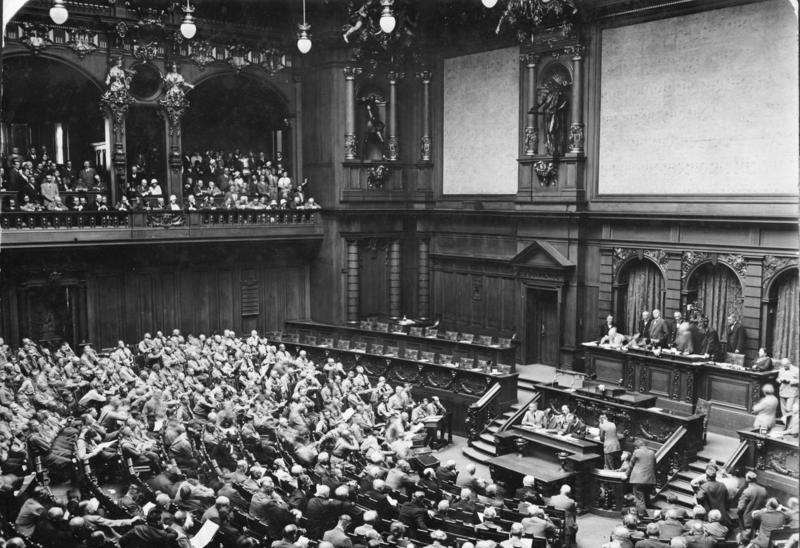
In the Reichstag on Tuesday afternoon, President Löbe gathered representatives of the various parties to discuss the question of seating, which had become difficult due to the increase in the number of seats. At the end of the meeting, a dispute arose between the representatives of the German Nationals and the National Socialists over which of the two parties was the more explicitly right-wing party. Representative Hergt once again asserted his party's claim to the seat on the far-right wing of the House. Representative Dr. Frick protested against this demand. He believed that this question had been settled once and for all, namely in the sense that the National Socialists were the most right-wing party. The claim of the National Socialists was provisionally recognized in today's discussion, however subject to any agreement between the two parties or any other decision by the Council of Elders after the Reichstag has convened.
On 31 December 1930, the German newspaper Annaburger Zeitung reprinted a story from Völkischer Beobachter concerning a poll about possible involvement of the Nazi Party in government:
The Participation of the National Socialists in the Government.
What the Völkische Beobachter says about it: Since the new elections to the Reichstag, the question of a reorganization of the Reich government continues to be vigorously discussed in public. The main issue is whether the National Socialists should enter the Reich government on the basis of their great electoral success or not. Left-leaning circles have repeatedly spoken out against the participation of the National Socialists in government affairs, while the parties to the right of the Center Party are actively advocating for the involvement of the National Socialists in the government. A right-wing Berlin newspaper recently conducted a survey among right-wing economists and politicians on the expediency of National Socialist participation in the Reich government. This survey came to the overwhelming conclusion that the National Socialists should be given the opportunity to assume responsibility in the Reich government. Among others, former Reichsbank President Dr. Schacht and the People's Party Reichstag deputy Colonel General von Seekt spoke in favor of this.
On the same day, the Annaburger Zeitung reported on French reactions to the 1930 German federal election:
Germany and France.
It will not be so easily forgotten in Germany that, unlike America and England, France responded to the election result of September 14th with a comprehensive withdrawal of the credit invested in our economy. Twice, then, Paris had used this credit policy weapon for a purely power-political purpose: in 1929, to force Germany to accept the Entente demands at the Young Conference in Paris. And a few weeks ago, this weapon was used again to prevent what France considered an imminent shift in German politics to the right. Thus, one finds in a right-wing Parisian newspaper the view that only the fear of a "new credit freeze"—the concession inherent in it is, incidentally, quite valuable!—is preventing Germany from "throwing itself into the arms of Hitler's people" already; for Germany and its government are undoubtedly moving further and further to the right.
Hitler at times redefined socialism. In a speech he gave on 28 July 1922, he said:
Whoever is prepared to make the national cause his own to such an extent that he knows no higher ideal than the welfare of the nation; whoever has understood our great national anthem, "Deutschland über Alles," to mean that nothing in the wide world surpasses in his eyes this Germany, people and land – that man is a Socialist.
In 1929, Hitler gave a speech to Nazi leaders and simplified 'socialism' to mean, "Socialism! That is an unfortunate word altogether... What does socialism really mean? If people have something to eat and their pleasures, then they have their socialism." When asked in an interview in 1934 whether he supported the "bourgeois right-wing", Hitler claimed Nazism was not exclusively for any class stating: "From the camp of bourgeois tradition, it takes national resolve, and from the materialism of the Marxist dogma, living, creative Socialism."
Historians regard the equation of Nazism as "Hitlerism" as too simplistic, as the term was used prior to the rise of Hitler and the Nazis. Ideologies incorporated into Nazism were already well established in parts of German society long before World War I. The Nazis were strongly influenced by the post–World War I far-right, which held common beliefs such as anti-Marxism, anti-liberalism and antisemitism, along with nationalism, contempt for the Treaty of Versailles and condemnation of the Weimar Republic for signing the armistice in 1918 and later the treaty. An inspiration for the Nazis were the far-right nationalist Freikorps, paramilitary organisations that engaged in political violence after World War I. Initially, the post–World War I far-right was dominated by monarchists, but the younger generation, associated with völkisch nationalism, was more radical and did not express any emphasis on restoration of the monarchy. This younger generation desired to dismantle the Weimar Republic, and create a new, radical and strong state, based upon a martial ruling ethic that could revive the "Spirit of 1914" which was associated with national unity (Volksgemeinschaft).
The Nazis, the far-right monarchists, the reactionary German National People's Party (DNVP) and others, such as monarchist army officers and several prominent industrialists, formed an alliance in opposition to the Weimar Republic in October 1931, in Bad Harzburg, officially known as the "National Front", but referred to as the Harzburg Front. The Nazis stated the alliance was tactical and continued to have differences with the DNVP. Hugenberg intiated the alliance in the hopes of forming a united front with Hitler; even earlier in February 1931 the DNVP parliamentary group had joined the Nazi parliamentary group in dramatically walking out of the Reichstag in a protest against the government. After the elections of July 1932, the alliance temporarily broke down when the DNVP lost many seats in the Reichstag. The Nazis called them "an insignificant heap of reactionaries". The DNVP responded by attacking the Nazis for their "socialism", street violence and the "economic experiments" that would take place if the Nazis gained power. However, the spat was short-lived, and the Nazi Party and DNVP ran as coalition partners again during the November 1932 German federal election. In January 1933 the Nazi Party and DNVP entered a coalition government, bringing Hitler into power as Chancellor.
Amidst an inconclusive situation in which conservative politicians Franz von Papen and Kurt von Schleicher were unable to form governments without the Nazis, Papen proposed to President Hindenburg to appoint Hitler as Chancellor at the head of a government formed primarily of conservatives, with only three Nazi ministers. Hindenburg did so, and Hitler was able to establish a Nazi one-party dictatorship.
Kaiser Wilhelm II, who had been forced to abdicate amidst an attempted communist revolution in Germany, initially supported the Nazis. His sons became members of the Party hoping that in exchange, the Nazis would permit restoration of the monarchy. Hitler dismissed the possibility, calling it "idiotic." Wilhelm grew to distrust Hitler and was appalled at the Kristallnacht of 1938. The former emperor denounced the Nazis as a "bunch of shirted gangsters" and "a mob [...] led by a thousand liars or fanatics."
There were factions within the Nazi Party, both conservative and radical. The conservative Nazi Hermann Göring urged Hitler to conciliate with capitalists and reactionaries. Other conservative Nazis included Heinrich Himmler and Reinhard Heydrich. Meanwhile, the radical Nazi Joseph Goebbels opposed capitalism, viewing it as having Jews at its core and he stressed the need for the Party to emphasise both a proletarian and national character. Those views were shared by Otto Strasser, who later left the Party and formed the Black Front in the belief Hitler had betrayed the party's socialist goals by endorsing capitalism.
When the Nazi Party emerged from obscurity to become a political force after 1929, the conservative faction rapidly gained more influence, as wealthy donors took an interest in the Nazis, as a potential bulwark against communism. The Party had previously been financed from membership dues, but after 1929 its leadership sought donations from industrialists, and Hitler began holding many fundraising meetings with business leaders. In the midst of the Great Depression, facing economic ruin and the possibility of a Communist or Social Democrat government, business turned to Nazism as a way out, as it promised to support, rather than attack, business interests. By January 1933, the Party had secured the support of important sectors of industry, mainly among steel and coal producers, insurance, and the chemical industry.
Large segments of the Party, particularly among the members of the Sturmabteilung (SA), were committed to the party's official socialist, revolutionary and anti-capitalist positions and expected a social and economic revolution when the party gained power in 1933. Just before the seizure of power, there were even Social Democrats and Communists who switched sides and became known as "Beefsteak Nazis": brown on the outside and red inside. The leader of the SA, Ernst Röhm, pushed for a "second revolution" (the first being the seizure of power) that would enact socialist policies. Röhm also desired that the SA absorb the much smaller German Army into its ranks, under his leadership. Once the Nazis achieved power, Röhm's SA was directed by Hitler to violently suppress the parties of the left, but they also attacked individuals associated with conservative reaction. Hitler saw Röhm's independent actions as violating and threatening his leadership, as well as jeopardising the regime by alienating conservative President Hindenburg and the conservative-oriented German Army. This resulted in Hitler purging Röhm and other radical members of the SA in 1934, in the Night of the Long Knives.
Hitler expressed opposition to capitalism, regarding it as having Jewish origins and holding nations ransom to a parasitic cosmopolitan rentier class. He also expressed opposition to communism and egalitarian forms of socialism, arguing that inequality and hierarchy are beneficial to the nation. He believed communism was invented by Jews to weaken nations by promoting class struggle. After seizing power, Hitler took a pragmatic position on economics, accepting private property and allowing capitalist private enterprises, so long as they adhered to the goals of the Nazi state, but not tolerating enterprises he saw as opposed to the national interest.
German business leaders disliked Nazi ideology but came to support Hitler, because they saw the Nazis as an ally to promote their interests. Business groups made significant financial contributions to the Nazi Party before and after the Nazi seizure of power, hoping that a Nazi dictatorship would eliminate the organised labour movement and left-wing parties. Hitler actively sought to gain the support of business leaders by arguing that private enterprise is incompatible with democracy.
Hitler admired the British Empire and its colonial system as proof of Germanic superiority over "inferior" races and saw the United Kingdom as Germany's natural ally. He wrote in Mein Kampf: "For a long time to come there will be only two Powers in Europe with which it may be possible for Germany to conclude an alliance. These Powers are Great Britain and Italy."
Origins
The roots of Nazism are to be found in elements of European political culture in circulation before 1914, what Joachim Fest called the "scrapheap of ideas" then prevalent. Martin Broszat points out:
[A]lmost all essential elements of [...] Nazi ideology were to be found in the radical positions of ideological protest movements [in pre-1914 Germany]. These were: a virulent anti-Semitism, a blood-and-soil ideology, the notion of a master race, [and] the idea of territorial acquisition and settlement in the East. These ideas were embedded in a popular nationalism which was vigorously anti-modernist, anti-humanist and pseudo-religious.
Brought together, the result was an anti-intellectual and politically semi-illiterate ideology lacking cohesion, a product of mass culture which allowed its followers emotional attachment and offered a simplified and easily digestible world-view, based on a political mythology for the masses.
Völkisch nationalism
Hitler, along with others in the Nazi Party, were influenced by several 19th- and early 20th-century thinkers and proponents of philosophical, onto-epistemic, and theoretical perspectives on ecological anthropology, scientific racism, holistic science, and organicism regarding the constitution of complex systems and theorization of organic-racial societies.
The ultranationalism of the Nazis originated in pan-Germanism and the ethno-nationalist Völkisch movement, which had been prominent within German nationalism since the late 19th century. Nazism was also influenced by the Freikorps paramilitary groups that emerged after Germany's defeat in World War I, which was the origin of the party's "cult of violence".
A significant influence was the 19th-century German nationalist philosopher Johann Gottlieb Fichte, whose works served as an inspiration to Hitler and other Nazis, and whose ideas were implemented among the philosophical and ideological foundations of Nazi-oriented Völkisch nationalism. In Speeches to the German Nation (1808), written amid the First French Empire's occupation of Berlin during the Napoleonic Wars, Fichte called for a German national revolution against the occupiers, making passionate speeches, arming his students for battle against the French and stressing the need for action by the German nation, so it could free itself. Fichte's German nationalism was populist and opposed to traditional elites, spoke of the need for a "People's War" (Volkskrieg) and put forth concepts similar to those which the Nazis adopted. Fichte promoted German exceptionalism and stressed the need for the German nation to purify itself (including purging German of French words, which the Nazis undertook).
Another important figure in pre-Nazi völkisch thinking was Wilhelm Heinrich Riehl, whose work—Land und Leute (Land and People, written between 1857–63)—collectively tied the organic German Volk to its native landscape and nature, a pairing in stark opposition to the mechanical and materialistic civilisation then developing as a result of industrialisation. Geographers Friedrich Ratzel and Karl Haushofer borrowed from Riehl's work as did Nazi ideologues Alfred Rosenberg and Paul Schultze-Naumburg, who employed Riehl's philosophy in arguing "each nation-state was an organism that required a particular living space in order to survive". Riehl's influence is discernible in the Blut und Boden (Blood and Soil) philosophy introduced by Oswald Spengler, which the Nazi agriculturalist Walther Darré and other prominent Nazis adopted.
Völkisch nationalism denounced soulless materialism, individualism and secularised urban industrial society, while advocating a "superior" society based on ethnic German "folk" culture and "blood". It denounced foreigners and foreign ideas and declared that Jews, Freemasons and others were "traitors to the nation" and unworthy of inclusion. Völkisch nationalism saw the world in terms of natural law and romanticism and viewed societies as organic, extolling the virtues of rural life, condemning the neglect of tradition and decay of morals, denounced the destruction of the natural environment and condemned "cosmopolitan" cultures such as Jews and Romani.
The first party that attempted to combine nationalism and socialism was the (Austria-Hungary) German Workers' Party, which aimed to solve the conflict between the Austrian Germans and Czechs in the multi-ethnic Austrian Empire, then part of Austria-Hungary. In 1896 the German politician Friedrich Naumann formed the National-Social Association, which aimed to combine German nationalism and a non-Marxist form of socialism together; the attempt turned out to be futile and the idea of linking nationalism with socialism quickly became equated with antisemites, extreme German nationalists and the völkisch movement in general.
During the German Empire, völkisch nationalism was overshadowed by Prussian patriotism and the federalist tradition of its component states. World War I, including the end of the Prussian monarchy, resulted in a surge of revolutionary völkisch nationalism. The Nazis supported such revolutionary völkisch policies and claimed their ideology was influenced by the leadership and policies of German Chancellor Otto von Bismarck, who was instrumental in founding the German Empire. The Nazis declared they were dedicated to continuing the process of creating a unified German nation state. While Hitler was supportive of Bismarck's creation of the German Empire, he was critical of Bismarck's moderate domestic policies. On the issue of Bismarck's support of a Kleindeutschland ("Lesser Germany", excluding Austria) versus the Pan-German Großdeutschland ("Greater Germany") which the Nazis advocated, Hitler stated that Bismarck's attainment of Kleindeutschland was the "highest achievement" Bismarck could have achieved "within the limits possible at that time". In Mein Kampf, Hitler presented himself as a "second Bismarck".
During his youth in Austria, Hitler was politically influenced by Austrian Pan-Germanist proponent Georg Ritter von Schönerer, who advocated radical German nationalism, antisemitism, anti-Catholicism, anti-Slavic sentiment and anti-Habsburg views. From von Schönerer and his followers, Hitler adopted the Heil greeting, Führer title and model of absolute party leadership. Hitler was also impressed by the populist antisemitism and anti-liberal bourgeois agitation of Karl Lueger, who as mayor of Vienna during Hitler's time there used rabble-rousing oratory that appealed to the masses. Unlike von Schönerer, Lueger was not a German nationalist, but a pro-Catholic Habsburg supporter and only used German nationalist notions occasionally for his agenda. Although Hitler praised Lueger and Schönerer, he criticised the former for not applying a racial doctrine against the Jews and Slavs. By comparison, the Nazis rejected Hegel for his influence on Karl Marx.
Racial theories and antisemitism
The concept of the Aryan race, which the Nazis promoted, stems from racial theories asserting that Europeans are the descendants of Indo-Iranian settlers, people of ancient India and Persia. Proponents of this based their assertion on the fact that words in European and Indo-Iranian languages have similar pronunciations and meanings. Johann Gottfried Herder argued that the Germanic peoples held close racial connections to the ancient Indians and Persians, who he claimed were advanced peoples that possessed a great capacity for wisdom, nobility, restraint and science. Contemporaries of Herder used the concept of the Aryan race to draw a distinction between what they deemed to be "high and noble" Aryan culture versus that of "parasitic" Semitic culture.
Notions of white supremacy and Aryan racial superiority were combined in the 19th century, with white supremacists maintaining the belief that certain white people were members of an Aryan "master race" superior to other races and particularly superior to the Semitic race, which they associated with "cultural sterility". Arthur de Gobineau, a French racial theorist and aristocrat, blamed the fall of the French ancien régime on racial degeneracy caused by racial intermixing, which he argued had destroyed the purity of the Aryan race, a term which he reserved for Germanic people. Gobineau's theories, which attracted a strong following in Germany, emphasised the existence of an irreconcilable polarity between Aryan (Germanic) and Jewish cultures.
Aryan mysticism claimed that Christianity originated in Aryan religious traditions, and Jews had usurped the legend from Aryans. Houston Stewart Chamberlain, an English-born German proponent of racial theory, supported notions of Germanic supremacy and antisemitism. Chamberlain's The Foundations of the Nineteenth Century (1899), praised Germanic peoples for their creativity and idealism while asserting that the Germanic spirit was threatened by a "Jewish" spirit of selfishness and materialism. Chamberlain used his thesis to promote monarchical conservatism while denouncing democracy, liberalism and socialism. The book became popular, especially in Germany. Chamberlain stressed a nation's need to maintain its racial purity to prevent its degeneration and argued that racial intermingling with Jews should never be permitted. In 1923, Chamberlain met Hitler, whom he admired as a leader of the rebirth of the free spirit. Madison Grant's The Passing of the Great Race (1916) advocated Nordicism and proposed that a eugenics program should be implemented to preserve the purity of the Nordic race. After reading it, Hitler called it "my Bible".
In Germany, the belief that Jews were economically exploiting Germans became prominent due to the ascendancy of wealthy Jews into prominent positions upon the unification of Germany in 1871. From 1871 to the early 20th century, German Jews were overrepresented in Germany's upper and middle classes, and underrepresented in Germany's lower classes, particularly in agricultural and industrial labour. German Jewish financiers and bankers played a key role in Germany's economic growth from 1871 to 1913 and benefited enormously. In 1908, amongst the 29 wealthiest German families with fortunes of up to 55 million marks, five were Jewish and the Rothschilds were the second wealthiest. The predominance of Jews in Germany's banking, commerce and industry sectors was high, even though Jews accounted for only 1% of the population. Their overrepresentation in these sectors fuelled resentment, among non-Jewish Germans, during economic crises. The 1873 stock market crash, and ensuing depression, resulted in attacks on alleged Jewish economic dominance and antisemitism increased. In the 1870s, German völkisch nationalism began to adopt antisemitic and racist themes and was adopted by radical right political movements.
Radical antisemitism was promoted by prominent advocates of völkisch nationalism, including Eugen Diederichs, Paul de Lagarde and Julius Langbehn. De Lagarde called the Jews a "bacillus, the carriers of decay...who pollute every national culture ... and destroy all faiths with their materialistic liberalism" and he called for the extermination of the Jews. Langbehn called for a war of annihilation against the Jews, and his genocidal policies were later published by the Nazis and given to soldiers during World War II. One antisemitic ideologue of the period, Friedrich Lange, even used the term "National Socialism" to describe his anti-capitalist take on the völkisch nationalist template.
Johann Fichte accused Jews in Germany of being a "state within a state" that threatened German national unity. Fichte promoted two options to address this. His first was the creation of a Jewish state in Palestine, so the Jews could be impelled to leave Europe. His second was violence against Jews and he said the goal would be "to cut off all their heads in one night, and set new ones on their shoulders, which should not contain a single Jewish idea".