The New Orphan Houses, Ashley Down, commonly known as the Muller Homes, were an orphanage in the district of Ashley Down, in the north of Bristol. They were built between 1849 and 1870 by the Prussian evangelist George Müller to show the world that God not only heard, but answered, prayers. The five Houses held 2,050 children at any one time and some 17,000 passed through their doors before the buildings were sold to Bristol City Council in 1958.
Background
The work of George Müller and his wife with orphans began in 1836 with the preparation of their own home at 6 Wilson Street, Bristol for the accommodation of thirty girls. At that time, there were very few orphanages in the country - there was accommodation for only 3,600 orphans in England. Orphans tended to go to "homes for foundlings" or the workhouses, which were akin to slave labour. In his Annual Report for 1861, Müller informs that there is still "entirely inadequate accommodation" in the UK and that admission was by votes for most of the available homes. This, he said, made it "difficult, if not impossible, for the poorest and most destitute of persons, to avail themselves of them. ... .. Thousands of votes, sometimes even many thousands, are required, in order that the candidate should be successful. But the really poor and destitute have neither time, nor money, nor ability, nor influence, to set about canvassing for votes; and therefore, with rare exceptions, they derive no benefit from such Institutions". Although Müller ran the orphanage on Christian principles, no regard was made to the religious denomination of the orphan. Müller's only requirements for admission were that the child be born in wedlock, that both parents were dead and that the child be in needy circumstances.
Early days
On 20 November 1835, Müller had it in mind to open an orphan house in Bristol to prove that God not only existed but that He heard and answered prayer, and Müller set about doing so on 21 November. He prayed that he might be given £40 as an encouragement but by 23 November he received gifts of around £50 from unexpected sources. His reasons for establishing this work were "1. That God may be glorified, should He be pleased to furnish me with the means, in its being seen that it is not a vain thing to trust in Him; and that thus the faith of His children may be strengthened. 2. The spiritual welfare of fatherless and motherless children. 3. Their temporal welfare." He took inspiration from the large orphanage established in the 18th century by AH Francke at Halle, Germany. A public meeting was held at which Müller announced his intentions but that he would be making no appeal to any man for funding. It was his intention to receive only children who had lost both parents through death, to train girls for domestic service and boys for a trade. He prayed for £1,000 and staff to run the home, together with premises from which to operate. Although the £1,000 had yet to be received, 6 Wilson Street was fitted up for the orphans, Mr and Mrs Müller moving to 14 Wilson Street, and, on 11 April 1836, the first girls moved in. By 21 April, 26 children had taken up residence.

Due to the number of applications being made to receive infants, a second house in Wilson Street, No 1, was rented, and this opened on 28 November 1836 for the care of infants. A piece of ground for use as a playground was also acquired. By 15 June 1837, the £1,000 prayed for had been received in full, by which time a considerable number of items had also been donated, either for use or for selling. It was now time to consider opening a third house in order to take orphaned boys into care. A large, cheap house in another area was found and a rental agreement was signed in late summer, but the neighbours objected and threatened the landlord with legal action so Müller withdrew on 5 October. That same day, he received £50 from a poor woman for the express purpose of furnishing a house for orphan boys. Müller took this as proof that God still wanted him to open a third house and, indeed, premises were secured on 21 October 1837 at No 3 Wilson Street for this purpose. A fourth house, No 4 Wilson Street, was opened for the reception of orphans in early July 1843.
The Move to Ashley Down
On 30 October 1845, a letter was received from one of the neighbours, written on behalf of other residents in Wilson Street, complaining "in kind and courteous terms" about the serious inconvenience being caused by the presence of so many children. Müller went to prayer concerning this, and believed that God was directing him to buy land on which to build a purpose-built orphanage.
The cost of building an orphan house for 300 children was £10,000. The very first donation for this new project was £1,000, received on 10 December 1845. "When I received it," Müller said, "I was as calm, as quiet, as if I had received one shilling; for my heart was looking out for answers. Day by day I was expecting to receive answers to my prayers; therefore, having faith concerning the matter, this donation did not in the least surprise me." Before the month was over, a second donation of £1,000 was received - more than one-fifth of the required sum had been received in the two months since Müller started praying. He continued his supplication to God and, amongst other unsolicited gifts, a single donation of £2,000 came in during the following summer, with another lump sum of £1,000 in the December. On 25 January 1847, Müller asked God to provide the balance of the required funds "soon". Within an hour, another single donation of £2,000 was handed in. The building fund now stood at £9,285 3s 9½d and topped £11,000 before the end of May that year.
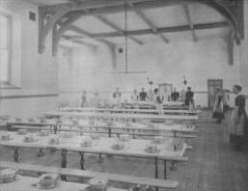
Müller then prayed for the land on which to build and was guided to a 7-acre (28,000 m2) site in Ashley Down surrounded by fields, on sale at £200 an acre. He went to the landowner's home to speak to him, but was told that the owner was at his place of business. Müller duly went there to be told that the owner had returned home. Müller returned to his own home having left his card. The following morning, the landowner called to say that he'd had a sleepless night and believed that God was telling him to sell the land to Müller for £120 an acre. In 1845 Müller entered into a contract for the purchase of 7 acres (28,000 m2) of ground at £120 per acre (£0.03/m2) for "the accommodation, feeding, clothing and education of 300 destitute and orphan children". Three days later, local Christian architect Thomas Foster, asked if he might prepare plans and supervise the work gratuitously. On 25 January 1847, just over a year since he started praying for the building costs, Müller's records show that the building fund held £9,285 - all unsolicited gifts. The building was estimated to cost £10,000 to build but Müller did not enter into any contract until this sum had been received. Instead of starting the work, he waited until the full amount was in hand, and a few months later a further gift of £1,000 was received, giving him more than enough to erect the building. The cornerstone of what became known as The New Orphan House was laid on 19 August 1847. As it neared completion, Müller gave thought to the need for furnishings and again prayed. Shortly afterwards, he received a single donation of £2,000. The donor was so anxious to remain anonymous that he came to Müller and gave the £2,000 in cash.
On 18 June 1849 the 118 orphans living in Wilson Street transferred to the new building. Müller waited for a month, to ascertain the costs of running the House, before accepting any further children - 170 new children were then admitted. Eleven trustees were appointed and the deeds enrolled at Chancery.
Expansion of the work
Some eighteen months later, Müller started to think about erecting a second House - he first discusses this in his journal on 5 December 1850. He mentions it again on 4 January 1851, when he receives a single donation of £3,000, Again, after much prayer, he made public his intention, on 28 May 1851, to build a second home for orphans. The cost was estimated to be £27,000 for land and construction, and another £8,000 for furnishing. Twelve months later, only £3,530 - a tenth of the amount required - had been received, but Müller was not discouraged. By the end of the fourth year, the building fund stood at just over £23,059. It was his original intention to build a home for 700 children but he found that the surrounding fields could not be sold at that time, under a clause in the late owner's will, so the plans were changed to build a smaller house for 400 children on the existing ground he owned, to the south of No 1 House. Building work started on 29 May 1855, and seven months later received a boost when a local glazier asked if he could provide all the glass for 300 large windows gratuitously.

At the end of the financial year, 26 May 1856, the building fund had a balance of just under £29,300. Müller came back from visiting the finished building on 18 September 1857 to find another unsolicited cheque for £1,000 had been left for the fund. Further sums came in and by 26 May 1858, £35,000 was to hand - sufficient to build a third house, which would take the number of orphans who could be accommodated to 1,000.
On 2 February 1858, plans started to be made for the erection of the third orphan house. Many significant donations were received during this time but on 20 June 1858, from a previously unknown benefactor, came a gift of £3,500, of which £3,350 was to be put to the building fund. The donor wished it to be sent before his imminent death to avoid delay and tax. In September a site of eleven and a half acres was purchased, just across the road from the existing buildings, at a cost of £3,631 15s.
Müller's original plan was to accommodate 300 orphans on this site but felt that better use would be made if 400 could be housed. After discussions with the architects, however, he found that, for a little extra expense, he could build for 450 children instead. He at once prayed for the provision of the extra funds required and, on 4 January 1859, received a gift of £7,000, £4,000 of which he set aside for the building fund. Two days later £300 came in from an anonymous donor with the promise of a further £8900 later in the year. On 1 February, two gifts totalling £2,700 were received, of which £700 was applied to the fund. By the end of May, the fund held £41,911 15s 11d and, in early July, the construction work started.

The building was completed and opened its doors to orphans on 12 March 1862. It was, like the other two Houses, plain in appearance. W Elfe Tayler reports that it contained 94 rooms, 36 on the ground floor, 35 on the first floor and 23 on the second floor. Two 90 feet (27 m) long dormitories each held 50 beds. Mr Haden of Trowbridge, an eminent heating engineer, installed modern and efficient kitchen and laundry equipment, together with ventilation and heating systems.
Before New Orphan House No 3 was even opened, Müller contemplated expanding the work even further by building two more houses capable of holding another 850 children. It was estimated that to do so would cost at the very least £50,000. As well as expecting God to provide this, Müller also prayed that the increased running costs, from £20,000 to £35,000 annually, be sent.
After much further prayer, Müller received the first donation for this latest expansion on 6 June 1861: five rupees, six annas, three seams, three Spanish coins, and three other silver coins". By 3 November 1864, the building fund held over £27,000, including just under £3,000 left over from the fund to build No 3 House. The land Müller desired for the next two houses was separated from No 2 House by a turnpike road and he found that it was for sale. However, it would not be available for a further 28 months, due to an existing lease agreement. Furthermore, the landowner was asking £7,000 - more than Müller considered it to be worth. As if this wasn't enough, the Bristol Water Works Company intended to use the site on which to construct a reservoir. Müller was unfazed by these obstacles and submitted them to God in prayer. His supplications were quickly answered. The tenant willingly accepted an offer of compensation for giving up the lease. The owner agreed to accept £5,500 instead of £7,000. The water company said that they only required a small portion of the site and, if avoidable, they wouldn't even take that. It would have been disadvantageous to start building one house before the other, so Müller waited until he had sufficient funds to start both houses together. By the end of May 1865, the fund balance stood at just over £24,635, and one year later Müller had £34,002 available. It was then discovered that the cost would exceed the estimate by £8,000, due to increase in labour and material costs. As Müller could not sign the contract for both without the full amount to hand, it was agreed that the contractors would tender separately for the two buildings. The contract for No 4 House was, therefore, signed with an option of accepting the contract for No 5 on or before 1 January 1867. Work started on No 4 on 7 May 1866. The balance of funds needed for No 5 were to hand by 31 December 1866 and the contract was duly signed. This last house started to be built on 15 January 1867. By 1 February 1868, all the money required to build and furnish the two houses had been received. The 700 large windows were glazed gratuitously by a firm. No 4 House accepted its first child on 5 November 1868, with No 5 following on 6 January 1870. There were now living at Ashley Down some 2,050 children and 112 staff.

In 1868, figures were published detailing the amount and types of materials used to build the last two houses: 36,000 tons of building stone; 15,000 tons of freestone; 14,000 tons of lime and ashes; 10,000 tons of timber; 2 acres (8,100 m2) of deal boarding; one and a half acres of paving; 10 acres (40,000 m2) of plastering; 2 acres (8,100 m2) of slating; four and half acres of painting; quarter of an acre of glazing; one and three-quarter miles of rainwater pipes and three miles (5 km) of drain pipes. The cost of construction was put at £115,000.
Funding
The total amount of money and articles to be sold, received by Mr Müller without any form of fund-raising and purely as a result of prayer, from the inception of the work in 1835 to 26 May 1870, was as follows:
Even though he constantly prayed for, and expected to receive, funds, not every gift was immediately accepted. In 1853, an old widow sold her house for £90 and put it in the Orphan donation box in her local church anonymously. The church treasurer knew that she had received £90 for her house and surmised that this money had come from her. He sent two colleagues to talk to her, but she would only retract £5 and so the treasurer forwarded the balance to Müller. Müller then wrote to the widow and paid her travelling expenses to Bristol in order that he might interview her to ascertain her motives. She insisted that she had resolved some 10 years previously to give the proceeds of her house to the orphan work, saying "God has always provided for me and I have no doubt he will do so in the future also". Müller then accepted the money from her but still would not apply it to the work - instead, he kept it aside for seven months and wrote to the widow again offering the return of the money. She refused to hear of it.

Müller never made requests for financial support, nor did he go into debt, even though the five homes cost over £100,000 to build. By the time he died in 1898, Müller had received £1,500,000 through prayer and had had over 10,000 children in his care.
He mentioned in each Annual Report that God had protected the buildings from fire and other calamity - "Though erected and fitted up at an expense of £115,000, they were never insured in any Company, but simply committed to the care of our Heavenly Father, who is our Helper and Friend."
Health
Several children died each year (perhaps as many as 14 each year) but comparisons cannot be made with life expectancy outside the orphanage. Many parents died from tuberculosis, and many of the children who were admitted were suffering themselves from the disease, which was the chief cause of mortality in the homes. Müller commented that most weak children soon enjoyed improved health not long after they entered the home, and this was probably due to the high standards of hygiene and regular, nourishing meals available in the homes. Before long, children had to be certified as being free from any infection before admittance was granted. Each House had an infirmary on the top floor, where the children were cared for. They would receive extra milk, bread and butter mid-mornings and excused physical work.
In 1862, an outbreak of smallpox was confirmed in the local area which lasted for two years before the infection spread to the Orphanage. Although there were 320 children in No 1 House, only 10 at any one time were taken ill, and then only mildly. The disease then manifested itself in No 2 House, where there were 400 children but only 11 suffered a light touch of the pox. No 3 House did not escape and of the 450 children, 15 were taken ill but, again, none seriously. None of the children died and the disease disappeared in December 1864.
Scarlet Fever broke out in September 1865 and infected 36 of the 200 infants in No 2 House. Three children caught the disease in No 3 House but none of the orphans at Ashley Down died. Whooping Cough then appeared the 450 girls in No 3 during December 1865, which then spread to the other two houses. Although many children in Bristol died of Whooping Cough at this time, only one orphan girl died, and she was known to have weak lungs and a tendency to consumption.
In 1884, there were many cases of typhoid fever, and Müller asked for the water in the homes' wells to be tested. Dr Davis, Bristol's sanitary officer, found the supply to be pure but, nevertheless, recommended that the homes be connected to the municipal supply. Work to accomplish this was started in the summer and took many months to complete.
Food
By today's standards, meals were inadequate and monotonous, however by the standards of the day, they were nutritious. Even in a private home, a child might expect to have just bread and milk for breakfast. Müller fed his children bread, with treacle or dripping; oatmeal; potatoes and other vegetables; stew; corned beef; rice. W Elfe Taylor notes that "The food of the Orphans at breakfast is always oatmeal porridge; they use milk with it. No doubt this wholesome food is one cause of the healthy, ruddy appearance of the Orphans generally; for notwithstanding a strong prejudice against it in this country, a more wholesome, nutritious article of diet certainly does not exist. The dinner provided for the children varies almost every day. Monday there is boiled beef; Tuesday, soup, with a good proportion of meat in it; Wednesday, rice-milk with treacle, Thursday they have boiled leg of mutton; the following day they have soup again, and on Saturday bacon; on Sundays they always dine on rice with treacle in order that as few as possible may be kept from attending public worship. The Orphans breakfast at eight o’clock, dine at one, and take tea at six."
The boys cultivated the land around the homes to grow their own vegetables, to help reduce expenditure as well as training them for later life. A former orphan wrote, in 1931, "What a witness to the loving care of our Heavenly Father. I was in the schools Nos 2 and 3 eight years. Someone lately asked me if we were ever short of food while there. I said "No". Never one meal was missing, neither did we think there would be, for we knew in whom we trusted.". On many occasions, there would either be no money for food, or no food in the Houses, and yet no meal was ever missed. On one occasion, the children gave thanks for breakfast, even though there was nothing to eat in the house. As they finished praying, the baker knocked on the door with sufficient fresh bread to feed everyone. This was a rare treat, as normally bread was two days old (and thus stale) when purchased, in order to conserve funds. At other times, an unsolicited gift of money would arrive in time for supplies to be purchased.
Clothing
The older boys were given a navy blue Eton jacket, with a waistcoat that buttoned up to a white collar, both of heavy serge. Their trousers were of brown corduroy and a glazed-peak cap completed the uniform. Each boy had three suits.
The smaller boys, up to 8–9 years old, were given a cotton smock, blue serge shorts and strap shoes for everyday use. For special occasions, they wore Norfolk suits with broad Eton collars, and the same caps as their elders.
The boys had to learn how to knit their own socks.
The girls wore long green and blue plaid cloaks in cold weather, and a shepherd's plaid shawl in warm weather. Their summer walking out dresses were dull lilac cotton with a small cape or tippet. A straw bonnet was worn all year, to which was attached a green and white check ribbon for tying the bonnet on. Everyday wear was provided for by navy cotton dresses with white polka dots. Girls up to the age of 14 wore blue-checked gingham pinafores indoors, after this they added aprons and were promoted to "House Girls". As part of their domestic training, the girls made their own clothes.
The nursery infants tended to wear whatever baby clothes had been donated.
The uniforms remained the same until 1936, when the girls started to wear knee-length skirts and "hats like pudding basins".
Education
Each House contained its own school rooms and Müller employed a number of teachers amongst his staff. The children were instructed in Scripture, reading, writing, arithmetic, English grammar, history, geography, Swedish drill and singing. The girls were taught sewing and all the children learned how to knit. The boys had to knit themselves three pairs of socks as part of their leaving outfit. Müller even employed a schools inspector to maintain high standards. In fact, many claimed that nearby factories and mines were unable to obtain enough workers because of his efforts in securing apprenticeships, professional training, and domestic service positions for the children old enough to leave the orphanage. Boys left Ashley Down at the age of 14, while girls of the same age moved from the classroom to spend their final three years in what was, effectively, a domestic science school. They helped with the cleaning, cooking, laundering, dressmaking, and parlour-maid duties, while others helped in the nursery and infirmary. These girls were paid 6d a week, although threepence of this was banked on their behalf to build up a cash sum to be given on their eventual departure.
In September 1951, the Bristol Education Committee assumed responsibility for educating the children at Ashley Down.
Daily routine
The author, Charles Dickens, heard a rumour that the orphans were being mistreated and came down from London unannounced to verify this. Initially, Müller refused to grant access as it was not one of the days set aside to receive visitors to the Homes, but Dickens refused to leave. It is unclear whether Müller showed Dickens around himself, or if he gave Dickens a bunch of keys and invited him to go around the homes, or if he asked one of the orphans to guide Dickens round, but Dickens went back to London and wrote a fulsome report on the activities of the orphan houses in his publication "Household Words". Müller makes no mention of this visit in his writings.
There were three events each year that were marked for celebration: Mr Müller's birthday on 27 September, Christmas, and the Pur Down summer outing.
The week of 27 September was a holiday and the day itself marked by a cake.
Pur Down was a mile and a half away, and the children would walk there in a long procession, each carrying a small cloth bag containing biscuits and sweets.
Christmas was an especially happy time. Each House had a large Christmas tree to decorate and every child had a present. Staff opened small sweet shops in each of the buildings, where the children were allowed to spend 8d on sweets that were purchased from local manufacturers and sold at cost.
Conditions of Reception
From the outset, only children who had been born in wedlock, were bereft of both parents through death and were destitute would be considered for admission.
By the end of the nineteenth century, the equivalent of one and a half houses were standing empty and the decision was taken to start admitting "partial" orphans - i.e. those who had lost only one parent and the survivor was unable to cope. Priority was always given to full orphans. The first "partial" orphan was admitted on 1 August 1901.
Boys were accepted up to age 10, girls to age 12 subject to satisfactory school and home reports.
On 13 May 1948, in view of diminishing numbers of children in the orphanage, the Trustees took the decision to accept any needy child, irrespective of whether they were born in wedlock or, indeed, even orphaned.
Leaving
Müller stated in his Annual Reports (this particular one from the 1889 report):
"The girls who are received into the establishment, are kept till they are able to go to service. Our aim is to keep them till they shall have been sufficiently qualified for situations, and especially, also, till they are strong enough to go out, as far as we are able to judge. We uniformly prefer fitting the girls for service, instead of apprenticing them to businesses, as being generally far better for their bodies and their souls. Only in a few instances have female Orphans been apprenticed to a business, when their health would not allow them to go to service. If the girls give us satisfaction, while under our care, so that we can recommend them to a situation, they are fitted-out at the expense of the Institution. The girls generally remain under our care till they are 17 years old. They rarely leave sooner; and, as we receive children from their earliest days, we have often had girls 13, 14, and even 17 years under our care. They are instructed in reading, writing, arithmetic, English grammar, geography, English history, a little of universal history, all kinds of useful needlework, and household work. They make their clothes and keep them in repair; they work in the kitchens, sculleries, wash-houses, and laundries; and, in a word, we aim at this, that, if any of them do not turn out well, temporally or spiritually, and do not become useful members of society, it shall not at least be our fault. The boys are, generally, apprenticed when they are between 14 and 15 years old; but in each case we consider the welfare of the individual Orphan, without having any fixed rule respecting these matters. The boys have a free choice of the trade or business they like to learn; but, having once chosen, and having been apprenticed, we do not allow them to alter. The boys, as well as the girls, have an outfit provided for them, and any other expenses, that may be connected with their apprenticeship, are also met by the funds of the Orphan Establishment. As it may be interesting to the reader to know the kind of trades or businesses to which we generally apprentice the boys, I state that, during the last fifty years, all the boys who were apprenticed, were bound to carpenters, or carpenters and joiners, cabinet makers, basket makers, boot and shoe makers, tailors and drapers, plumbers, painters and glaziers, linen drapers, printers, bakers, grocers, hair-dressers, iron-mongers, tin-plate workers, confectioners, hosiers, builders, millers, gas-fitters, smiths, out-fitters, provision dealers, sailmakers, upholsterers, wholesale grocers, chemists, seed merchants, umbrella makers, electro-plate manufacturers, or machine makers. Some have been sent out to become post-office or telegraph clerks. A few also became clerks in offices. The boys have the same kind of mental cultivation as the girls, and learn to knit their stockings. They also make their beds, clean their shoes, scrub their rooms, go on errands and work in the garden around the Orphan Establishment, in the way of digging, planting, weeding &c."
Concerning the boys' apprenticeships, Müller said in the 1863 report:
"we not only look for [applications made by] Christian masters, but consider their business, and examine their position, to see whether they are suitable; but, if all other difficulties were out of the way, the master must also be willing to receive the apprentice into his own family. Under these circumstances, we again gave ourselves to prayer, as we had done for more than twenty years before, concerning this thing, instead of advertising, which, in all probability, would only bring before us masters who desire an apprentice for the sake of the premium."
Suitable children were also trained as teachers and many remained at the Homes, or came back in later years, to work in the classrooms. In later years, some of the girls stayed on as nursing assistants, cooks or clerical staff.