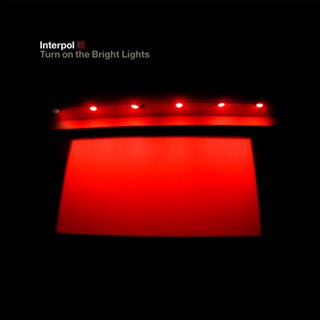
Turn On the Bright Lights is the debut studio album by American rock band Interpol. It was released in the United Kingdom on August 19, 2002, and in the United States the following day, through independent record label Matador Records. Produced by Peter Katis, the album was recorded in November 2001 at Tarquin Studios in Bridgeport, Connecticut. Producer Gareth Jones assisted Katis with mixing. The title derives from a recurring lyric in the song "NYC".
Upon release, the record peaked at No. 101 on the UK Albums Chart. It reached No. 158 on the Billboard 200 in the United States, as well as spending 73 weeks on the Billboard Independent Albums chart, peaking at No. 5. The songs "PDA", "Obstacle 1" and the double A-side single "Say Hello to the Angels" / "NYC" were released as singles, with music videos being shot for all except "Say Hello to the Angels".
Turn On the Bright Lights received critical acclaim and was ranked among the year's best albums by several publications. Retrospectively, it is considered a seminal album of the 2000s, influencing several indie rock acts.
Composition and writing
Interpol began recording Turn On the Bright Lights in October or November 2001. According to bassist Carlos Dengler, the album's songs were written before the September 11 attacks, but the attacks affected the band members deeply. Dengler said that "the unintentional meaning [the songs] take on isn't any less of a meaning; we were holding the cards to a certain message that was about to become relevant". Recording in the secluded Tarquin Studios in Bridgeport, Connecticut, with producer Peter Katis, the sessions were tense, with interpersonal conflicts amongst the band members, particularly Dengler. The band's limited time and budget also contributed to a tense atmosphere. Nevertheless, the members' different personalities contributed to the final album's sound. Attempting to recreate their live sound, the band recorded the songs live in the studio. British producer Gareth Jones helped Katis mix the album after the sessions were completed.
In a brief interview about the fifteenth anniversary of Turn On the Bright Lights, Interpol guitarist Daniel Kessler stated the album's opening track, "Untitled" was written specifically to open the band's live shows. Lead singer Paul Banks described the riff from the song as "signature Daniel".
Promotion and release
The release of Turn On the Bright Lights was preceded by the marketing of the band's self-titled EP Interpol in June 2002, their first release for Matador. The EP contained three tracks: radio single "PDA", future single "NYC", and "Specialist". All three tracks later appeared on the album, with "Specialist" included as a bonus track in Australian and Japanese editions. Further promotion continued at the beginning of the following year, when the band played the 2003 NME Awards Tour alongside the Datsuns, the Polyphonic Spree and the Thrills. The song "PDA" is featured as a playable track in 2008 video game Rock Band 2.
In 2012, a remastered edition of Turn On the Bright Lights was issued to commemorate the album's tenth anniversary. The release featured a range of additional material, including early demo recordings, bonus tracks previously exclusive to international editions, and a DVD containing live performances and music videos. It also introduced five previously unreleased tracks from the band's “Third Demo” sessions, providing further insight into the development of the album's sound during its formative period.
Critical reception
Turn On the Bright Lights was released to critical acclaim. The album holds a score of 81 out of 100 from the aggregate site Metacritic based on 21 reviews, indicating universal acclaim. Contemporary reviews of the album often noted Interpol's influences and drew comparisons to several other acts. Michael Chamy of The Austin Chronicle cited "melodic Peter Hook-like basslines; the divine shoegazer textures of My Bloody Valentine and Ride; a peppy, Strokes-like bounce; and a singer who's a dead ringer for Ian Curtis." "It's almost as if Ian Curtis never hanged himself," began Blender's review, with critic Jonah Weiner adding that Paul Banks' vocals echoed Curtis' "gloomy moan."
NME's Victoria Segal argued that the album's "ashen atmospherics" made comparisons to Joy Division both "obvious and unmistakable," while praising Interpol's take on the "grey‑skinned British past." Billboard wrote that Interpol had created an "homage to their particular vision of the '80s that stands proudly alongside the best of its idols." Scott Seward, writing in The Village Voice, remarked that while he appreciated the band because they evoked "eating bad bathtub mescaline in the woods and listening to Cure singles," he sarcastically acknowledged that others "might like them for completely different reasons."
Noel Murray of The A.V. Club opined that Interpol's virtue "lies in the way its music unfurls from pinched openings to wide-open codas", while Rob Sheffield of Rolling Stone wrote that their "sleek, melancholy sound is a thing of glacial beauty." Eric Carr of Pitchfork argued that the band had forged their own distinct sound, "a grander, more theatrical atmosphere with lush production that counters their frustrated bombast", praising Turn On the Bright Lights as "one of the most strikingly passionate records I've heard this year." However, The Village Voice's Robert Christgau, naming it "Dud of the Month" in his Consumer Guide column, felt that Interpol "exemplify and counsel disengagement, self-seeking, a luxurious cynicism," downplaying Joy Division comparisons as "too kind". Q's lukewarm assessment of the album described it as "predictably claustrophobic listening".
By the end of 2002, Turn On the Bright Lights featured on several publications' end-of-year lists, including Pitchfork, who named it the best album of the year, NME, who ranked it at No. 10, and Stylus Magazine, who ranked it at No. 5. The album placed at No. 15 on The Village Voice's year-end Pazz & Jop critics' poll.
Legacy
Hailed as a seminal album of the 2000s, Turn On the Bright Lights has been cited as an influence on many indie rock bands, including the Killers, Editors, the xx, the Organ, She Wants Revenge, and others to the extent that many of these bands have been disparagingly referred to as "Interpol clones". Closely associated with 9/11-era New York City, the album has been seen as helping define 2000s indie rock, and Interpol have been cited as helping usher in the New York-born post-punk revival scene, along with contemporaries such as the Strokes, Yeah Yeah Yeahs, and TV on the Radio.
Summing up the album's impact in a review of its 2012 reissue, Matt LeMay of Pitchfork wrote: "Suggesting that this album is simply a product of its time and place is no less naive than suggesting that anyone who has ever been in love could easily write, arrange and record an amazing love song. There were a lot of good bands in New York in 2002, but only one band made this record."
In 2017, the band embarked on a worldwide tour to celebrate the album's album's 15th anniversary.
In a 2018 interview with Vice, Paul Banks stated:"as far as ease of making it, we had years to write these songs. The longest writing period of any of your records is your debut. We formed in 1997, so it's five years, and three-and-a-half/four of playing shows and trying out that material. So it went down smoothly in the studio, and then you have all the excitement of it being your first album. It was a good time in our lives." Drummer Sam Fogarino reflected on the album by saying: "we were very naïve, we didn’t know how to make a record together, and we were lucky to have a good snapshot taken of who we were at the time. And we got a little more confident with every record."
Accolades
Track listing
Turn On the Bright Lights: Tenth Anniversary Edition
Tenth Anniversary Edition bonus DVD
Personnel
According to the album's liner notes:
Interpol
Paul Banks – vocals, rhythm guitar
Daniel Kessler – lead guitar, vocals on "PDA"
Carlos D – bass guitar, keyboards
Samuel Fogarino – drums, percussion
Audio engineers
All songs recorded by Peter Katis at Tarquin Studios
All songs mixed at Tarquin Studios
Tracks 1, 2, 4, 5, 7, 9, 10 mixed by Peter Katis
Tracks 3, 6, 8, 11 mixed by Gareth Jones
Mastered by Greg Calbi at Sterling Sound
Design
Sean McCabe – photography, design
Andrew Zaeh – photography