
Muhammad (c. 570 CE – 8 June 632 CE) was an Arab religious, military, and political leader, and the founder of Islam. According to Islam, he was the final prophet of God who was divinely inspired to preach and confirm the monotheistic teachings of Adam, Noah, Abraham, Moses, Jesus, and other prophets in Islam. He is believed by Muslims to be the Seal of the Prophets, and along with the Quran, his teachings and normative examples form the basis for Islamic religious belief.
According to the traditional account, Muhammad was born in Mecca to the aristocratic Banu Hashim clan of the Quraysh. He was the son of Abdullah ibn Abd al-Muttalib and Amina bint Wahb. His father, Abdullah, the son of tribal leader Abd al-Muttalib ibn Hashim, died around the time Muhammad was born. His mother Amina died when he was six, leaving Muhammad an orphan. He was raised under the care of his grandfather, Abd al-Muttalib, and paternal uncle, Abu Talib. In later years, he would periodically seclude himself in a mountain cave named Hira for several nights of prayer. When he was 40, in c. 610, Muhammad reported being visited by Gabriel in the cave and receiving his first revelation from God. In 613, Muhammad started preaching these revelations publicly, proclaiming that "God is One", that complete "submission" (Islām) to God (Allāh) is the right way of life (dīn), and that he was a prophet and messenger of God, similar to other prophets in Islam.
Muhammad's followers were initially few in number, and experienced persecution by Meccan polytheists for 13 years. To escape ongoing persecution, he sent some of his followers to Abyssinia in 615, before he and his followers migrated from Mecca to Medina (then known as Yathrib) later in 622. This event, the Hijrah, marks the beginning of the Islamic calendar, also known as the Hijri calendar. In Medina, Muhammad united the tribes under the Constitution of Medina. In December 629, after eight years of intermittent fighting with Meccan tribes, Muhammad gathered an army of 10,000 Muslim converts and marched on the city of Mecca. The conquest went largely uncontested, and Muhammad seized the city with minimal casualties. In 632, a few months after returning from the Farewell Pilgrimage, he fell ill and died. By the time of his death, most of the Arabian Peninsula had converted to Islam.
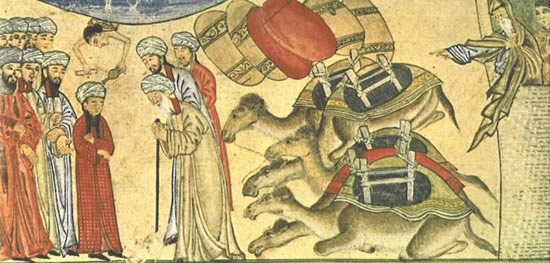
The revelations (waḥy) that Muhammad reported receiving until his death form the verses (āyah) of the Quran, upon which Islam is based, and are regarded by Muslims as the verbatim word of God and his final revelation. Besides the Quran, Muhammad's teachings and practices, found in transmitted reports, known as hadith, and in his biography (sīrah), are also upheld and used as sources of Islamic law. Apart from Islam, Muhammad has received praise in Sikhism as an inspirational figure, in the Druze faith as one of the seven main prophets, and in the Baháʼí Faith as a Manifestation of God.
Biographical sources
Critical evaluation of sources is of particular importance in uncovering Muhammad's historical existence beyond the myths. Early sources for the life of Muhammad are authors from the 2nd and 3rd centuries AH (8th and 9th centuries CE), whose works constructed main biographical information to the Muslim traditions regarding his life, but the reliability of this information is contentious in academic circles due to the oral gap between the recorded dates of Muhammad's life and the dates when these writings begin to appear in sources. John Burton summarizes the information provided by the multitude of available sources, from a historian's perspective, and states
In judging the content, the only resort of the scholar is to the yardstick of probability, and on this basis, it must be repeated, virtually nothing of use to the historian emerges from the sparse record of the early life of the founder of the latest of the great world religions ... so, however far back in the Muslim tradition one now attempts to reach, one simply cannot recover a scrap of information of real use in constructing the human history of Muhammad, beyond the bare fact that he once existed.

Early biographies
The information used in early Islamic historiography emerged as the sporadic products of storytellers (qāṣṣ, pl. quṣṣāṣ) -they were quite prestigious then- without details. At the same time the study of the earliest periods in Islamic history is made difficult by a lack of sources. While the narratives were initially in the form of a kind of heroic epics called magāzī, details were added later, edited and transformed into sirah compilations. Western historians describe the purpose of these early biographies as largely to convey a message, (of a hagiographic nature) rather than to strictly and accurately record history.
Important early sources for the life of Muhammad are authors from the 2nd and 3rd centuries AH (overlapping with the 8th and 9th centuries CE), whose works supplied additional biographical information to the Muslim traditions regarding his life. The earliest written sira (biographies of Muhammad and quotes attributed to him) is Ibn Ishaq's Life of God's Messenger written c. 767 (150 AH). Although the original work was lost, this sira survives as extensive excerpts in works by Ibn Hisham and to a lesser extent by al-Tabari. However, Ibn Hisham wrote in the preface to his biography of Muhammad that he omitted matters from Ibn Ishaq's biography that "would distress certain people". Another early historical source is the history of Muhammad's campaigns by al-Waqidi (d. 207 AH), and the work of Waqidi's secretary Ibn Sa'd al-Baghdadi (d. 230 AH). Karen Armstrong believes that—thanks to these early biographical efforts—more is known about Muhammad than about the founders of almost all the other major religions.
Hadith
Other important traditional sources include the hadith collections, accounts of verbal and physical teachings and approvals attributed to Muhammad. Hadiths were compiled several generations after his death by Muslims including Muhammad al-Bukhari, Muslim ibn al-Hajjaj, Muhammad ibn Isa at-Tirmidhi, Abd ar-Rahman al-Nasai, Abu Dawood, Ibn Majah, Malik ibn Anas, al-Daraqutni and attributed to Muhammad through a chain of isnad. The hadiths generally present an idealized view of Muhammad.
Hadiths were classified by Islamic scholars according to their reliability based on the reliability of chain of transmission; and different schools of thought relied on different collections. Muslim scholars placed more trust in hadith than in biographical literature because hadiths were generally based on a chain of transmission; the absence of such a chain in biographical literature made it, in their eyes, unverifiable. Hadiths that pass the classical grading and selection processes are labeled as authentic. This labeling is subjective, and their reliability is often determined by sectarian leanings. These sources, distrusted by Quranist scholars, are also viewed with suspicion by Western researchers who believe that they were fabricated in the early centuries of Islam to support certain theological and legal positions. In addition, the meaning of a hadith may have drifted from its original telling to when it was finally written down.
Early Western scholars mistrusted the later narrations and reports, regarding them as fabrications. Caetani considered the attribution of historical reports to Ibn Abbas and Aisha as mostly fictitious, preferring accounts reported without isnad by early historians such as Ibn Ishaq. Although the "dominant paradigm", some have—with caution—regarded them as accurate historical sources. Madelung has rejected the indiscriminate dismissal of everything not included in "early sources", instead judging later narratives in the context of historical compatibility with events and figures.
Quran
The Quran is the central religious text of Islam. Muslims believe it represents the word of God revealed to Muhammad by the archangel Gabriel. The Quran is primarily addressed to a single "Messenger of God," identified as Muhammad in a number of verses. In contrast to the hundreds of references to earlier prophets such as Moses and Jesus, it contains comparatively little direct information about Muhammad himself, or his companions. The text also briefly refers to episodes from Muhammad's career, such as the migration of his followers to Yathrib and the Battle of Badr.

Meccan years
Early life
The name Muhammad means "praised" in Arabic and it appears four times in the Quran. He was also known as "al-Amin" (lit. 'Assured') when he was young; however, historians differ as to whether it was given by people as a reflection of his nature or was simply a given name from his parents, i.e., a masculine form of his mother's name "Amina". Muhammad acquired the kunya of Abu al-Qasim later in his life after the birth of his son Qasim, who died two years afterwards.
It is believed that Muhammad ibn Abdullah ibn Abd al-Muttalib ibn Hashim was born in Mecca around c. 570 and that his birthday was on a Monday night, the 12th day of the month of Rabi' al-Awwal. He belonged to the Banu Hashim clan of the Quraysh tribe, which was a dominant force in western Arabia. Although he was born into a house belonging to the prominent Abdulmuttalib family of the tribe, it is said that he lacked prosperity during his youth. He is also claimed to have been a descendant of Ishmael, son of Abraham. Islamic tradition states that Muhammad's birth year coincided with the elephant incident named legend, when Abraha, the Aksumite viceroy in the former Himyarite Kingdom, unsuccessfully attempted to conquer Mecca.
Muhammad's father, Abdullah, died almost six months before he was born. Muhammad then stayed with his foster mother, Halima bint Abi Dhu'ayb, and her husband until he was two years old. At the age of six, Muhammad lost his biological mother Amina to illness and became an orphan. For the next two years, until he was eight years old, Muhammad was under the guardianship of his paternal grandfather, Abd al-Muttalib, until the latter's death. He then came under the care of his uncle, Abu Talib, the new leader of the Banu Hashim. Abu Talib's brothers assisted with Muhammad's learning – Hamza, the youngest, trained Muhammad in archery, swordsmanship, and martial arts. Another uncle, Abbas, provided Muhammad with a job leading caravans on the northern segment of the route to Syria.

The historical record of Mecca during Muhammad's early life is limited and fragmentary, making it difficult to distinguish between fact and legend. Several Islamic narratives relate that Muhammad, as a child, went on a trading trip to Syria with his uncle Abu Talib and met a monk named Bahira, who is said to have then foretold his prophethood. There are multiple versions of the story with details that contradict each other. All accounts of Bahira and his meeting with Muhammad have been considered fictitious by modern historians as well as by some medieval Muslim scholars such as al-Dhahabi.
Sometime later in his life, Muhammad proposed marriage to his cousin and first love, Fakhitah bint Abi Talib. But likely owing to his poverty, his proposal was rejected by her father, Abu Talib, who chose a more illustrious suitor. When Muhammad was 25, his fortunes turned around; his business reputation caught the attention of his 40-year-old distant relative Khadija, a wealthy businesswoman who had staked out a successful career as a merchant in the caravan trade industry. She asked him to take one of her caravans into Syria, after which she was so impressed by his competence in the expedition that she proposed marriage to him; Muhammad accepted her offer and remained monogamous with her until her death.
In 605, the Quraysh decided to roof the Kaaba, which had previously consisted only of walls. A complete rebuild was needed to accommodate the new weight. Amid concerns about upsetting the deities, a man stepped forth with a pickaxe and exclaimed, "O goddess! Fear not! Our intentions are only for the best." With that, he began demolishing it. The anxious Meccans awaited divine retribution overnight, but his unharmed continuation the next day was seen as a sign of heavenly approval. According to a narrative collected by Ibn Ishaq, when it was time to reattach the Black Stone, a dispute arose over which clan should have the privilege. It was determined that the first person to step into the Kaaba's court would arbitrate. Muhammad took on this role, asking for a cloak. He placed the stone on it, guiding clan representatives to jointly elevate it to its position. He then personally secured it within the wall.

Beginnings of the Quran
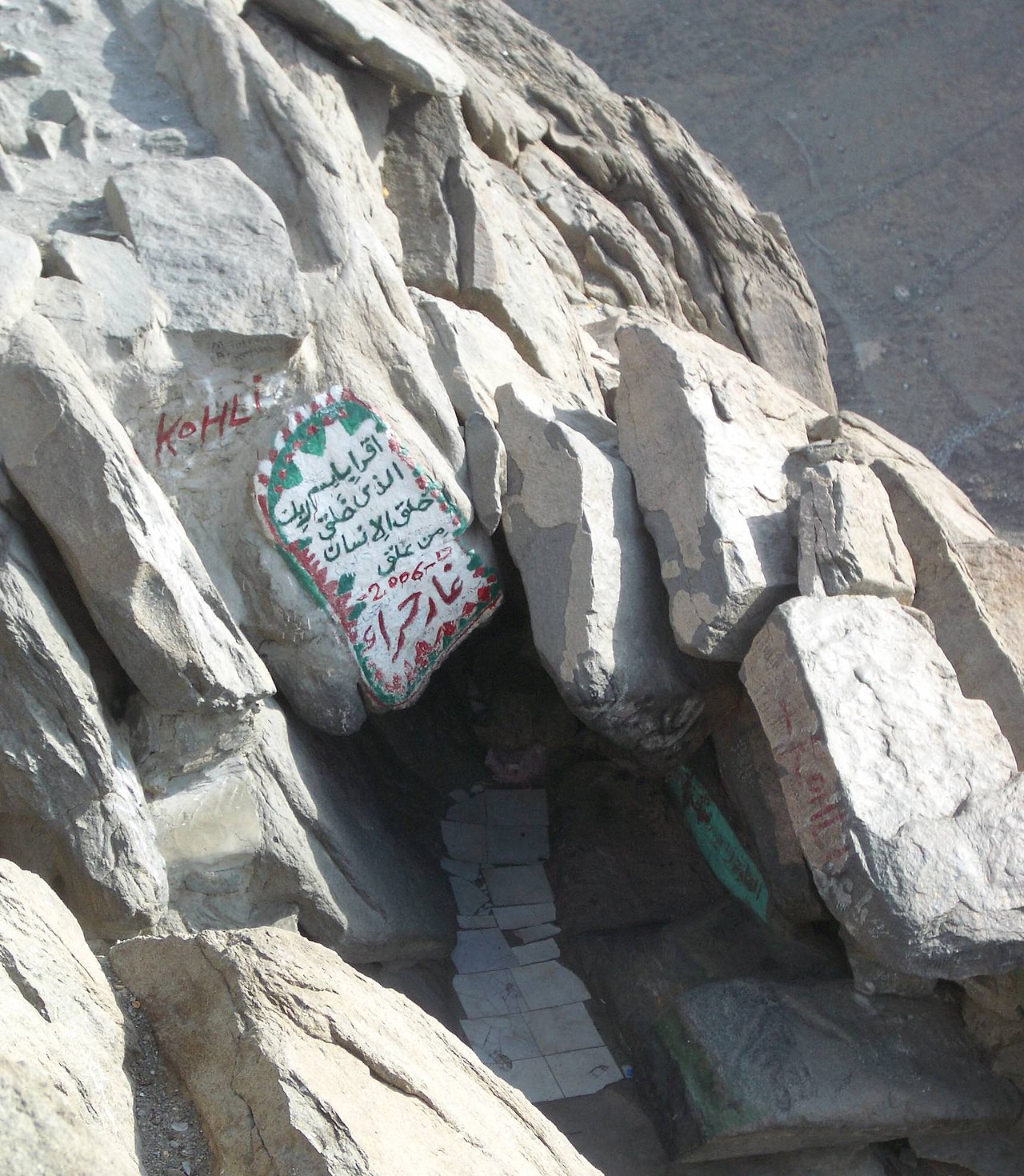
According to Muslim tradition, Muhammad was a hanif, someone who professed monotheism in pre-Islamic Arabia. The financial security Muhammad enjoyed from Khadija, his wealthy wife, gave him plenty of free time to spend in solitude in the cave of Hira. According to Islamic tradition, in 610, when he was 40 years old, the angel Gabriel appeared to him during his visit to the cave. The angel showed him a cloth with Quranic verses on it and instructed him to read. When Muhammad confessed his illiteracy, Gabriel choked him forcefully, nearly suffocating him, and repeated the command. As Muhammad reiterated his inability to read, Gabriel choked him again in a similar manner. This sequence took place once more before Gabriel finally recited the verses, allowing Muhammad to memorize them. These verses later constituted Quran 96:1-5.
When Muhammad came to his senses, he felt scared; he started to think that after all of this spiritual struggle, he had been visited by a jinn, which made him no longer want to live. In desperation, Muhammad fled from the cave and began climbing up towards the top of the mountain to jump to his death. But when he reached the summit, he experienced another vision, this time seeing a mighty being that engulfed the horizon and stared back at Muhammad even when he turned to face a different direction. This was the spirit of revelation (rūḥ), which Muhammad later referred to as Gabriel; it was not a naturalistic angel, but rather a transcendent presence that resisted the ordinary limits of humanity and space.
Frightened and unable to understand the experience, Muhammad hurriedly staggered down the mountain to his wife Khadija. By the time he got to her, he was already crawling on his hands and knees, shaking wildly and crying "Cover me!", as he thrust himself onto her lap. Khadija wrapped him in a cloak and tucked him in her arms until his fears dissipated. She had absolutely no doubts about his revelation; she insisted it was real and not a jinn. Muhammad was also reassured by Khadija's Christian cousin Waraqah ibn Nawfal, who jubilantly exclaimed "Holy! Holy! If you have spoken the truth to me, O Khadijah, there has come to him the great divinity who came to Moses aforetime, and lo, he is the prophet of his people." Khadija instructed Muhammad to let her know if Gabriel returned. When he appeared during their private time, Khadija conducted tests by having Muhammad sit on her left thigh, right thigh, and lap, inquiring Muhammad if the being was still present each time. After Khadija removed her clothes with Muhammad on her lap, he reported that Gabriel left at that moment. Khadija thus told him to rejoice as she concluded it was not shayatin but an angel visiting him.
Muhammad's demeanor during his moments of inspiration frequently led to allegations from his contemporaries that he was under the influence of a jinn, a soothsayer, or a magician, suggesting that his experiences during these events bore resemblance to those associated with such figures widely recognized in ancient Arabia. Nonetheless, these enigmatic seizure events might have served as persuasive evidence for his followers regarding the divine origin of his revelations. Some historians posit that the graphic descriptions of Muhammad's condition in these instances are likely genuine, as they are improbable to have been concocted by later Muslims.
Shortly after Waraqa's death, the revelations ceased for a period, causing Muhammad great distress and thoughts of suicide. On one occasion, he reportedly climbed a mountain intending to jump off. However, upon reaching the peak, Gabriel appeared to him, affirming his status as the true Messenger of God. This encounter soothed Muhammad, and he returned home. Later, when there was another long break between revelations, he repeated this action, but Gabriel intervened similarly, calming him and causing him to return home.
Muhammad was confident that he could distinguish his own thoughts from these messages. The early Quranic revelations utilized approaches of cautioning non-believers with divine punishment, while promising rewards to believers. They conveyed potential consequences like famine and killing for those who rejected Muhammad's God and alluded to past and future calamities. The verses also stressed the imminent final judgment and the threat of hellfire for skeptics. Due to the complexity of the experience, Muhammad was initially reluctant to tell others about his revelations; at first, he confided in only a few select family members and friends. According to Muslim tradition, Muhammad's wife Khadija was the first to believe he was a prophet. She was followed by Muhammad's ten-year-old cousin Ali ibn Abi Talib, close friend Abu Bakr, and adopted son Zayd. As word of Muhammad's revelations continued to spread throughout the rest of his family, they became increasingly divided on the matter, with the youth and women generally believing in him, while most of the men in the elder generations were staunchly opposed.
Opposition in Mecca
Around 613, Muhammad began to preach to the public; many of his first followers were women, freedmen, servants, slaves, and other members of the lower social class. These converts keenly awaited each new revelation from Muhammad; when he recited it, they all would repeat after him and memorize it, and the literate ones recorded it in writing. Muhammad also introduced rituals to his group which included prayer (salat) with physical postures that embodied complete surrender (islam) to God, and almsgiving (zakat) as a requirement of the Muslim community (ummah). By this point, Muhammad's religious movement was known as tazakka ('purification').
Initially, he had no serious opposition from the inhabitants of Mecca, who were indifferent to his proselytizing activities, but when he started to attack their beliefs, tensions arose. The Quraysh challenged him to perform miracles, such as bringing forth springs of water, yet he declined, reasoning that the regularities of nature already served as sufficient proof of God's majesty. Some satirized his lack of success by wondering why God had not bestowed treasure upon him. Others called on him to visit Paradise and return with tangible parchment scrolls of the Quran. But Muhammad asserted that the Quran, in the form he conveyed it, was already an extraordinary proof.
According to Amr ibn al-As, several of the Quraysh gathered at Hijr and discussed how they had never faced such serious problems as they were facing from Muhammad. They said that he had derided their culture, denigrated their ancestors, scorned their faith, shattered their community, and cursed their gods. Sometime later, Muhammad came, kissing the Black Stone and performing the ritual tawaf. As Muhammad passed by them, they reportedly said hurtful things to him. The same happened when he passed by them a second time. On his third pass, Muhammad stopped and said, "Will you listen to me, O Quraysh? By Him (God), who holds my life in His hand, I bring you slaughter." They fell silent and told him to go home, saying that he was not a violent man. The next day, a number of Quraysh approached him, asking if he had said what they had heard from their companions. He answered yes, and one of them seized him by his cloak. Abu Bakr intervened, tearfully saying, "Would you kill a man for saying God is my Lord?" And they left him.
The Quraysh attempted to entice Muhammad to quit preaching by giving him admission to the merchants' inner circle as well as an advantageous marriage, but he refused both of the offers. A delegation of them then, led by the leader of the Makhzum clan, known by the Muslims as Abu Jahl, went to Muhammad's uncle Abu Talib, head of the Hashim clan and Muhammad's caretaker, giving him an ultimatum to disown Muhammad:
By God, we can no longer endure this vilification of our forefathers, this derision of our traditional values, this abuse of our gods. Either you stop Muhammad yourself, Abu Talib, or you must let us stop him. Since you yourself take the same position as we do, in opposition to what he's saying, we will rid you of him.
Abu Talib politely dismissed them at first, thinking it was just a heated talk. But as Muhammad grew more vocal, Abu Talib requested Muhammad to not burden him beyond what he could bear, to which Muhammad wept and replied that he would not stop even if they put the sun in his right hand and the moon in his left. When he turned around, Abu Talib called him and said, "Come back nephew, say what you please, for by God I will never give you up on any account."
Quraysh delegation to Yathrib
The leaders of the Quraysh sent Nadr ibn al-Harith and Uqba ibn Abi Mu'ayt to Yathrib to seek the opinions of the Jewish rabbis regarding Muhammad. The rabbis advised them to ask Muhammad three questions: recount the tale of young men who ventured forth in the first age; narrate the story of a traveler who reached both the eastern and western ends of the earth; and provide details about the spirit. If Muhammad answered correctly, they stated, he would be a Prophet; otherwise, he would be a liar. When they returned to Mecca and asked Muhammad the questions, he told them he would provide the answers the next day. However, 15 days passed without a response from his God, leading to gossip among the Meccans and causing Muhammad distress. At some point later, the angel Gabriel came to Muhammad and provided him with the answers.
In response to the first query, the Quran tells a story about a group of men sleeping in a cave (Quran 18:9–25), which scholars generally link to the legend of the Seven Sleepers of Ephesus. For the second query, the Quran speaks of Dhu al-Qarnayn, literally 'he of the two horns' (Quran 18:93–99), a tale that academics widely associate with the Alexander Romance. As for the third query, concerning the nature of the spirit, the Quranic revelation asserted that it was beyond human comprehension. Neither the Jews who devised the questions nor the Quraysh who posed them to Muhammad converted to Islam upon receiving the answers. Nadr and Uqba were later executed on Muhammad's orders after the Battle of Badr, while other captives were held for ransom. As Uqba pleaded, "But who will take care of my children, Muhammad?" Muhammad responded, "Hell!"
Migration to Abyssinia
In 615, Muhammad sent some of his followers to emigrate to the Abyssinian Kingdom of Aksum and found a small colony under the protection of the Christian Ethiopian emperor Aṣḥama ibn Abjar. While Tabari and Ibn Hisham mentioned only one migration to Abyssinia, there were two sets according to Ibn Sa'd. Of these two, the majority of the first group returned to Mecca before the event of Hijrah, while the majority of the second group remained in Abyssinia at the time and went directly to Medina after the event of Hijrah. These accounts agree that persecution played a major role in Muhammad sending them there. According to W. Montgomery Watt, the episodes were more complex than the traditional accounts suggest; he proposes that there were divisions within the embryonic Muslim community, and that they likely went there to trade in competition with the prominent merchant families of Mecca.
During this period, Tabari, along with others, recorded the so-called Satanic Verses incident in which Muhammad was said to have been given false verses by Satan acknowledging pre-Islamic pagan goddesses. This led to a reconciliation between Muhammad and the Meccans, and word was sent to the Muslims in Abyssinia to return home. However, the next day, Muhammad retracted and abrogated the verses at the behest of fresh divine revelation from Gabriel. The returning Muslims thus had to make arrangements for clan protection before they could re-enter Mecca. According to the scholar Shahab Ahmed, the so-called Satanic Verses incident was reported en masse and documented by nearly all of the major biographers of Muhammad during Islam's first two centuries. More recent scholarship is mixed. By the 20th century, Muslim scholars had unanimously rejected this incident. Western scholars have both posited reasons for its potential veracity, and questioned its veracity.
Social exclusion of the Banu Hashim
In 616, an agreement was established whereby all other Quraysh clans were to enforce a ban on the Banu Hashim, prohibiting trade and marriage with them. Nevertheless, Banu Hashim members could still move around Mecca freely. Despite facing increasing verbal abuse, Muhammad continued to navigate the streets and engage in public debates without being physically harmed. At a later point, a faction within Quraysh, sympathizing with Banu Hashim, initiated efforts to end the sanctions, resulting in a general consensus in 619 to lift the ban.
Attempt to establish himself in Ta'if
In 619, Muhammad faced a period of sorrow. His wife, Khadija, a crucial source of his financial and emotional support, died. In the same year, his uncle and guardian, Abu Talib, also died. Despite Muhammad's persuasions to Abu Talib to embrace Islam on his deathbed, he clung to his polytheistic beliefs until the end. Muhammad's other uncle, Abu Lahab, who succeeded the Banu Hashim clan leadership, was initially willing to provide Muhammad with protection. However, upon hearing from Muhammad that Abu Talib and Abd al-Muttalib were destined for hell due to not believing in Islam, he withdrew his support.
Muhammad then went to Ta'if to try to establish himself in the city and gain aid and protection against the Meccans, but he was met with a response: "If you are truly a prophet, what need do you have of our help? If God sent you as his messenger, why doesn't He protect you? And if Allah wished to send a prophet, couldn't He have found a better person than you, a weak and fatherless orphan?" Realizing his efforts were in vain, Muhammad asked the people of Ta'if to keep the matter a secret, fearing that this would embolden the hostility of the Quraysh against him. However, instead of accepting his request, they pelted him with stones, injuring his limbs. He eventually evaded this chaos and persecution by escaping to the garden of Utbah ibn Rabi'ah, a Meccan chief with a summer residence in Ta'if. Muhammad felt despair due to the unexpected rejection and hostility he received in the city; at this point, he realized he had no security or protection except from God, so he began praying. Shortly thereafter, Utbah's Christian slave Addas stopped by and offered grapes, which Muhammad accepted. By the end of the encounter, Addas felt overwhelmed and kissed Muhammad's head, hands, and feet in recognition of his prophethood.
On Muhammad's return journey to Mecca, news of the events in Ta'if had reached the ears of Abu Jahl, and he said, "They did not allow him to enter Ta'if, so let us deny him entry to Mecca as well." Knowing the gravity of the situation, Muhammad asked a passing horseman to deliver a message to Akhnas ibn Shariq, a member of his mother's clan, requesting his protection so that he could enter in safety. But Akhnas declined, saying that he was only a confederate of the house of Quraysh. Muhammad then sent a message to Suhayl ibn Amir, who similarly declined on the basis of tribal principle. Finally, Muhammad dispatched someone to ask Mut'im ibn 'Adiy, the chief of the Banu Nawfal. Mut'im agreed, and after equipping himself, he rode out in the morning with his sons and nephews to accompany Muhammad to the city. When Abu Jahl saw him, he asked if Mut'im was simply giving him protection or if he had already converted to his religion. Mut'im replied, "Granting him protection, of course." Then Abu Jahl said, "We will protect whomever you protect."
Isra' and Mi'raj
The writers of the Sīrah place the famous Isra and Mi'raj at this low point in Muhammad's life, where Muslims today believe the Isra to be Muhammad's journey from Mecca to Jerusalem and the Mi'raj to be his journey from Jerusalem to heaven. There is no substantial basis for the Mi'raj in the Quran, as the Quran does not address it directly.
The 17th chapter of the Quran takes its name from a word used in the first verse; The name of the sura, -which was probably original one- "Surat Banī Isrāʾīl" (Surat Children of Israel), during the time of the Companions, gradually became the Surat Al-Isra, and simultaneously, narrations and explanations for Isra began to enter Islamic literature, which is presented as the first stage of the journey, expressed as Isra meaning to make someone walk. Verse 17:1 of the Quran recounts someone's (Abd-servant; according to the interpretation, this was Muhammad) night journey from a "revered place of prayer" to the "most distant place of worship".
Glory be to the One Who took His servant by night from Masjid al-Haram to the Masjid al-Aqsa whose surroundings We have blessed, so that We may show him some of Our signs....
The Kaaba, holy enclosure in Mecca, is widely accepted as the starting point, but there is disagreement among Islamic traditions as to what constitutes "the farthest place of worship"; Some modern scholars maintain that the earliest tradition saw this faraway site as a celestial twin of the Kaaba, so that Muhammad's journey took him directly from Mecca through the heavens. A later tradition, however, refers to it as Bayt al-Maqdis, which is generally associated with Jerusalem. Over time, these different traditions merged to present the journey as one that began in Mecca, passed through Jerusalem, and then ascended to heaven. A different interpretation of the verse, the Al-aqsa used in the verse is not associated with Jerusalem, but with Al-Ji'rana, which is located near Mecca based on the hint that Masjid al-Haram is a night walk away from Masjid al-Aqsa.
Hans Wehr says that the 27th night of the month of Rajab chosen for the Miraj is not based on a report and is an arbitrary choice; Ibn Sa'd recorded that Muhammad's Mi'raj took place first, from near the Kaaba to the heavens, on the 27th of Ramadan, 18 months before the Hijrah, while the Isra' from Mecca to Bayt al-Maqdis took place on the 17th night of the Rabi' al-Awwal before the Hijrah as two different, unconnected events. In Ibn Hisham's account, the Isra' came first and then the Mi'raj, and he put these stories before the deaths of Khadija and Abu Talib. In contrast, Al-Tabari placed this story at the beginning of Muhammad's public ministry, between his account of Khadija becoming "the first to believe in the Messenger of God" and his account of "the first male to believe in the Messenger of God".
Migration to Medina
As resistance to his proselytism in Mecca grew, Muhammad began to limit his efforts to non-Meccans who attended fairs or made pilgrimages. During this period, Muhammad had an encounter with six individuals from the Banu Khazraj. These men had a history of raiding Jews in their locality, who in turn would warn them that a prophet would be sent to punish them. On hearing Muhammad's religious message, they said to each other, "This is the very prophet of whom the Jews warned us. Don't let them get to him before us!" Upon embracing Islam, they returned to Medina and shared their encounter, hoping that by having their people—the Khazraj and the Aws, who had been at odds for so long—accept Islam and adopt Muhammad as their leader, unity could be achieved between them.
The next year, five of the earlier converts revisited Muhammad, bringing with them seven newcomers, three of whom were from the Banu Aws. At Aqaba, near Mecca, they pledged their loyalty to him. Muhammad then entrusted Mus'ab ibn Umayr to join them on their return to Medina to promote Islam. Come June 622, a significant clandestine meeting was convened, again at Aqaba. In this gathering, seventy-five individuals from Medina (then Yathrib) attended, including two women, representing all the converts of the oases. Muhammad asked them to protect him as they would protect their wives and children. They concurred and gave him their oath, commonly referred to as the second pledge at al-Aqabah or the pledge of war. Paradise was Muhammad's promise to them in exchange for their loyalty.
Subsequently, Muhammad called upon the Meccan Muslims to relocate to Medina. This event is known as the Hijrah, literally meaning 'severing of kinship ties'. The departures spanned approximately three months. To avoid arriving in Medina by himself with his followers remaining in Mecca, Muhammad chose not to go ahead and instead stayed back to watch over them and persuade those who were reluctant. Some were held back by their families from leaving, but in the end, there were no Muslims left in Mecca.