
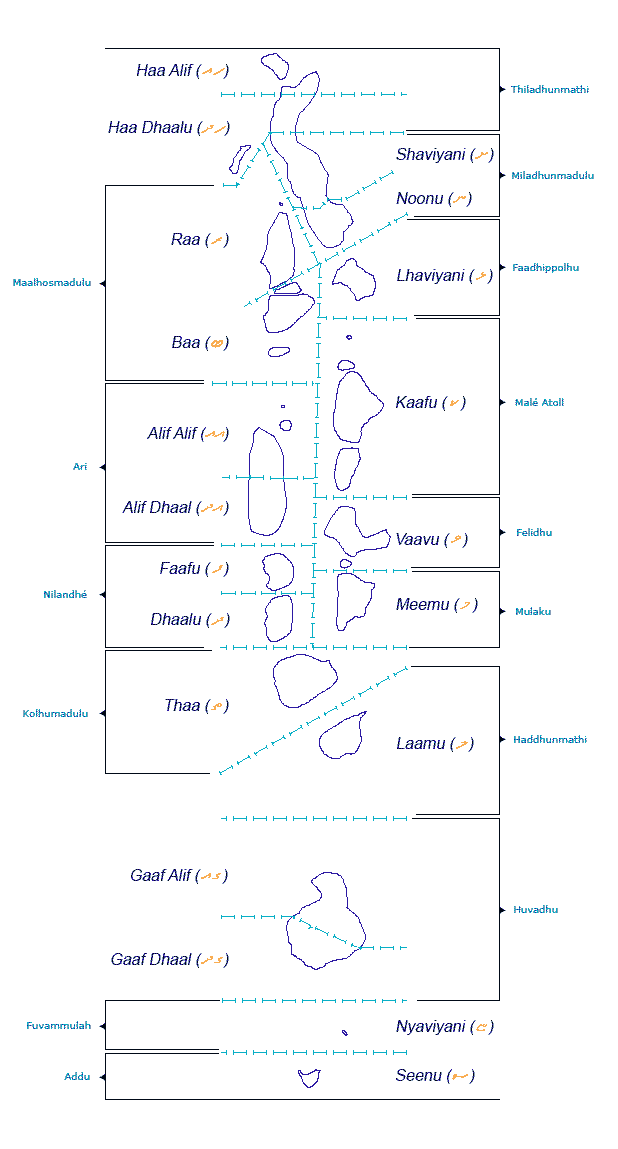
The Maldives, officially the Republic of Maldives, and historically known as the Maldive Islands, is an archipelagic country in South Asia, located in the Indian Ocean, near the southeastern boundary of the Arabian Sea. The Maldives is located southwest of India and Sri Lanka, about 750 kilometres (470 miles; 400 nautical miles) from the Asian continent's mainland. The Maldives' chain of 26 atolls stretches across the equator from Ihavandhippolhu Atoll in the north to Addu Atoll in the south.
The Maldives is the smallest country in Asia. Its land area is only 298 square kilometres (115 sq mi), but this is spread over roughly 90,000 square kilometres (35,000 sq mi) of the sea, making it one of the world's most spatially dispersed sovereign states. With a population of 515,132 in the 2022 census, it is the second least populous country in Asia and the ninth-smallest country by area, but also one of the most densely populated countries. The Maldives has an average ground-level elevation of around 1.5 metres (4 ft 11 in) above sea level, and a highest natural point of only 2.4 metres (7 ft 10 in), making it the world's lowest-lying country. Some sources state the highest point, Mount Villingili, as 5.1 metres or 17 feet.
Malé is the capital and the most populated city, traditionally called the "King's Island", where the ancient royal dynasties ruled from its central location. The Maldives has been inhabited for over 2,500 years. Documented contact with the outside world began around 947 AD when Arab travellers began visiting the islands. In the 12th century, partly due to the importance of the Arabs and Persians as traders in the Indian Ocean, Islam reached the Maldivian Archipelago. The Maldives was soon consolidated as a sultanate, developing strong commercial and cultural ties with Asia and Africa. From the mid-16th century, the region came under the increasing influence of European colonial powers, with the Maldives becoming a British protectorate in 1887. Independence from the United Kingdom came in 1965, and a presidential republic was established in 1968 with an elected People's Majlis. The ensuing decades have seen political instability, efforts at democratic reform, and environmental challenges posed by climate change and rising sea levels. The Maldives became a founding member of the South Asian Association for Regional Cooperation (SAARC).

Fishing has historically been the dominant economic activity, and remains the second largest sector, behind the rapidly growing tourism industry. The Maldives rates "high" on the Human Development Index, with a per capita income significantly higher than other SAARC nations. The World Bank classifies the Maldives as having an upper-middle income economy.
The Maldives is a member of the United Nations, the Commonwealth of Nations, the Organisation of Islamic Cooperation, and the Non-Aligned Movement, and is a Dialogue Partner of the Shanghai Cooperation Organisation. It temporarily withdrew from the Commonwealth in October 2016 after being threatened with expulsion from the organisation for its human rights infringements and democratic backsliding. It was readmitted to the Commonwealth on 1 February 2020 after showing evidence of reform and functioning democratic processes.
Etymology
According to legends, the first settlers of The Maldives were people known as Dheyvis. The first Kingdom of the Maldives was known as Kingdom of Dheeva Maari. During the 3rd century BCE visit of emissaries, it was noted that the Maldives was known as Dheeva Mahal.

During c. 1100 – 1166, the Maldives was also referred to as Diva Kudha, and the Laccadive archipelago which was a part of the Maldives was then referred to as Diva Kanbar by the scholar and polymath al-Biruni.
The name Maldives may also derive from Sanskrit माला mālā (garland) and द्वीप dvīpa (island), or මාල දිවයින Maala Divaina ("Necklace Islands") in Sinhala. The Maldivian people are called Dhivehin. The word Dheeb/Deeb (archaic Dhivehi, related to Sanskrit द्वीप, dvīpa) means "island", and Dhives (Dhivehin) means "islanders" (i.e., Maldivians). In Tamil, "Garland of Islands" can be translated as Mālaitīvu (மாலைத்தீவு).
The venerable Sri Lankan chronicle Mahavamsa mentions an island designated as Mahiladiva ("Island of Women", महिलादिभ) in Pali, likely arising from an erroneous translation of the Sanskrit term, signifying "garland".
Jan Hogendorn, professor of economics at Colby College, theorised that the name Maldives derives from the Sanskrit mālādvīpa (मालाद्वीप), meaning "garland of islands". In Malayalam, "Garland of Islands" can be translated as Maladweepu (മാലദ്വീപ്). In Kannada, "Garland of Islands" can be translated as Maaledweepa (ಮಾಲೆದ್ವೀಪ). None of these names are mentioned in any literature, however, classical Sanskrit texts dating back to the Vedic period mention the "Hundred Thousand Islands" (Lakshadweepa), a generic name which would include not only the Maldives, but also the Laccadives, Aminidivi Islands, Minicoy, and the Chagos island groups.
Medieval Muslim travellers such as Ibn Battuta called the islands Maḥal Dībīyāt (محل ديبية) from the Arabic word maḥal ("palace"), which must be how the Berber traveller interpreted the name of Malé, having been through Muslim North India, where Perso-Arabic words were introduced to the local vocabulary. This is the name currently inscribed on the scroll in the Maldives state emblem. The classical Persian/Arabic name for Maldives is Dibajat. The Dutch referred to the islands as the Maldivische Eilanden (pronounced [mɑlˈdivisə ˈʔɛilɑndə(n)]), while the British anglicised the local name for the islands first to the "Maldive Islands" and later to "Maldives".
In a conversational book published in 1563, Garcia de Orta writes: "I must tell you that I have heard it said that the natives do not call it Maldiva but Nalediva. In the Malabar language, nale means four, and diva means island. So that in that language, the word signifies 'four islands', while we, corrupting the name, call it Maldiva."

The local name for Maldives by the Maldivian people in Dhivehi language is Dhivehi Raajje, (ދިވެހިރާއްޖެ).
History
Ancient history and settlement
In the 6th–5th century BCE, kingdoms already existed in the modern-day Maldives. The country has an established history of over 2,500 years according to historical evidence and legends.
The Mahāvaṃsa (300 BCE) has records of people from Sri Lanka emigrating to the Maldives. Assuming that cowrie shells come from the Maldives, historians believe that there may have been people living in the Maldives during the Indus Valley Civilisation (3300–1300 BCE). Several artefacts show the presence of Hinduism in the country before the Islamic period.
According to the book Kitāb fi āthār Mīdhu al-qādimah (كتاب في آثار ميذو القديمة) (On the Ancient Ruins of Meedhoo), written in the 17th century in Arabic by Allama Ahmed Shihabuddine (Allama Shihab al-Din) of Meedhoo in Addu Atoll, the first settlers of the Maldives were people known as Dheyvis. They are said to be from Kalibangan in India. The time of their arrival is unknown but before Emperor Ashoka's kingdom in 269–232 BCE. Shihabuddin's story tallies remarkably well with the recorded history of South Asia and that of the copperplate document of the Maldives known as Lōmāfānu.
The ancient history of the Maldives is told in copperplates, ancient scripts carved on coral artefacts, traditions, language, and different ethnicities of Maldivians. The Maapanansa, the copper plates on which the history of the first kings of the Maldives from the Solar Dynasty was recorded, were lost early.
A 4th-century notice written by Ammianus Marcellinus (362 CE) speaks of gifts sent to the Roman emperor Julian by a deputation from the nation of Divi. The name Divi is very similar to Dheyvi who were the first settlers of the Maldives.

The first Maldivians did not leave any archaeological artifacts. Their buildings were probably built of wood, palm fronds, and other perishable materials, which would have quickly decayed in the salt and wind of the tropical climate. Moreover, chiefs or headmen did not reside in elaborate stone palaces, nor did their religion require the construction of large temples or compounds.
Comparative studies of Maldivian oral, linguistic, and cultural traditions confirm that the first settlers were people from the southern shores of the neighbouring Indian subcontinent, including the Giraavaru people, mentioned in ancient legends and local folklore about the establishment of the capital and kingly rule in Malé.
A strong underlying layer of Dravidian and North Indian cultures survives in Maldivian society, with a clear Elu substratum in the language, which also appears in place names, kinship terms, poetry, dance, and religious beliefs. The North Indian system was brought by the original Sinhalese from Sri Lanka. Malabar and Pandya seafaring culture led to the settlement of the Islands by Tamil and Malabar seafarers.
Buddhist period
Despite being just mentioned briefly in most history books, the 1,400 year-long Buddhist period has a foundational importance in the history of the Maldives. It was during this period that the culture of Maldives both developed and flourished, a culture that survives today. The Maldivian language, early Maldive scripts, architecture, ruling institutions, customs, and manners of the Maldivians originated at the time when Maldives were a Buddhist kingdom.
Buddhism probably spread to the Maldives in the 3rd century BCE at the time of Emperor Ashoka's expansion and became the dominant religion of the people of the Maldives until the 12th century. Archeological evidence from an ancient Buddhist monastery in Kaashidhoo has been dated between 205 and 560 AD, based on the radiocarbon dating of shell deposits unearthed from the foundations of stupas and other structures in the monastery. The ancient Maldivian Kings promoted Buddhism, and the first Maldive writings and artistic achievements, in the form of highly developed sculpture and architecture, originate from that period. Nearly all archaeological remains in the Maldives are from Buddhist stupas and monasteries, and all artefacts found to date display characteristic Buddhist iconography.
Islamic period
The importance of the Arabs as traders in the Indian Ocean by the 12th century may partly explain why the last Buddhist king of Maldives, Dhovemi, converted to Islam in 1153 (or 1193). Adopting the Muslim title of Sultan Muhammad al-Adil, he initiated a series of six Islamic dynasties that lasted until 1932 when the sultanate became elective. The formal title of the sultan up to 1965 was, Sultan of Land and Sea, Lord of the twelve-thousand islands and Sultan of the Maldives which came with the style Highness.
A Moroccan traveller named Abu al-Barakat Yusuf al-Barbari is traditionally cited for this conversion. According to the story told to Ibn Battutah, a mosque was built with the inscription: 'The Sultan Ahmad Shanurazah accepted Islam at the hand of Abu al-Barakat Yusuf al-Barbari.'
The folk tale regarding the spread of Islam by al-Barbari involved a local belief to an oceanic deity named Rannamaari. According to the legend, Rannamaari demanded the sacrifice of a female virgin each month by the locals. This tradition was practiced for a long time, until al-Barbari visited Maldives and managed to convert the local ruler and convinced him along with his subjects to abandon the Rannamari worship.
According to Norwegian archaeologist Egil Mikkelsen, it is likely the myth of Rannamari was heavily influenced by Buddhist tantric rituals and beliefs that were practiced in the islands at the time.
Some scholars have suggested the possibility of Ibn Battuta misreading Maldive texts, and having a bias towards the North African, Maghrebi narrative of this Shaykh, instead of the Persian origins account that was known as well at the time.
Others have it that he may have been from the Persian town of Tabriz.
This interpretation, held by the more reliable local historical chronicles, Raadavalhi and Taarikh,
is that Abu al-Barakat Yusuf al-Barbari was Abdul Barakat Yusuf Shams ud-Dīn at-Tabrīzī, also locally known as Tabrīzugefānu. In the Arabic script the words al-Barbari and al-Tabrizi are very much alike, since at the time, Arabic had several consonants that looked identical and could only be differentiated by overall context (this has since changed by the addition of dots above or below letters to clarify pronunciation. For example, the letter "B" in modern Arabic has a dot below, whereas the letter "T" looks identical except there are two dots above it). "ٮوسڡ الٮٮرٮرى" could be read as "Yusuf at-Tabrizi" or "Yusuf al-Barbari".
The venerated tomb of the scholar now stands on the grounds of Medhu Ziyaaraiy, across the street from the Friday Mosque, or Hukuru Miskiy, in Malé. Originally built in 1153 and re-built in 1658,
this is one of the oldest surviving mosques in the Maldives. Following the Islamic concept that before Islam there was the time of Jahiliya (ignorance), in the history books used by Maldivians the introduction of Islam at the end of the 12th century is considered the cornerstone of the country's history. Nonetheless, the cultural influence of Buddhism remains, a reality directly experienced by Ibn Battuta during his nine months there sometime between 1341 and 1345, serving as a chief judge and marrying into the royal family of Omar I.
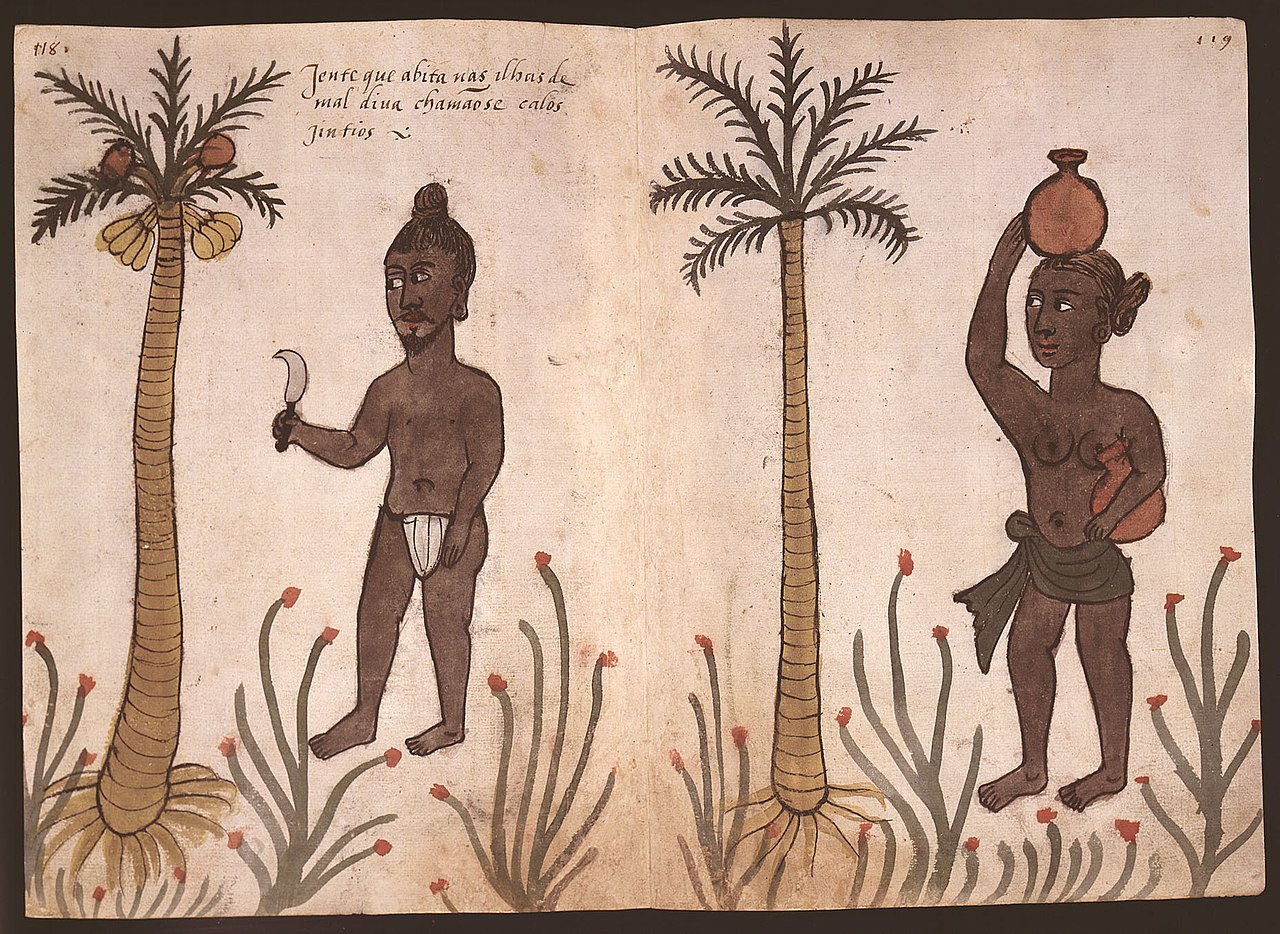
For he became embroiled in local politics and left when his strict judgements in the laissez-faire island kingdom began to chafe with its rulers. In particular, he was angered at the local women going about with no clothing above the waist— a cultural epithet of the region at the time- was seen as a violation of Middle Eastern Islamic rules of modesty—and the locals taking no notice when he complained.
Compared to the other areas of South Asia, the conversion of the Maldives to Islam happened relatively late. The Maldives remained a Buddhist kingdom for another 500 years. Arabic became the prime language of administration (instead of Persian and Urdu), and the Maliki school of jurisprudence was introduced, both hinting at direct contact with the core of the Arab world.
Middle Eastern seafarers had just begun to take over the Indian Ocean trade routes in the 10th century and found the Maldives to be an important link in those routes as the first landfall for traders from Basra sailing to Southeast Asia. Trade involved mainly cowrie shells—widely used as a form of currency throughout Asia and parts of the East African coast—and coir fibre. The Bengal Sultanate, where cowrie shells were used as legal tender, was one of the principal trading partners of the Maldives. The Bengal–Maldives cowry shell trade was the largest shell currency trade network in history.
The other essential product of the Maldives was coir, the fibre of the dried coconut husk, resistant to saltwater. It stitched together and rigged the dhows that plied the Indian Ocean. Maldivian coir was exported to Sindh, China, Yemen, and the Persian Gulf.
Protectorate period
In 1558, the Portuguese established a small garrison with a Viador (Viyazoaru), or overseer of a factory (trading post) in the Maldives, which they administered from their main colony in Goa. Their attempts to forcefully impose Christianity with the threat of death provoked a local revolt led by Muhammad Thakurufaanu al-A'uẓam, his two brothers, and Dhuvaafaru Dhandahele, who fifteen years later drove the Portuguese out of the Maldives. This event is now commemorated as Qaumee Dhuvas (lit. 'National Day'). It is celebrated on the 1st of Rabi' al-Awwal, the third month of Hijri (Islamic) calendar.
In the mid-17th century, the Dutch, who had replaced the Portuguese as the dominant power in Ceylon, established hegemony over Maldivian affairs without involving themselves directly in local matters, which were governed according to centuries-old Islamic customs.
The British expelled the Dutch from Ceylon in 1796 and included the Maldives as a British protectorate. The status of the Maldives as a British protectorate was officially recorded in an 1887 agreement in which the sultan Muhammad Mueenuddeen II accepted British influence over Maldivian external relations and defence while retaining home rule, which continued to be regulated by Muslim traditional institutions in exchange for an annual tribute. The status of the islands was akin to other British protectorates in the Indian Ocean region, including Zanzibar and the Trucial States.
In the British period, the Sultan's powers were taken over by the Chief Minister, much to the chagrin of the British Governor-General who continued to deal with the ineffectual Sultan. Consequently, Britain encouraged the development of a constitutional monarchy, and the first Constitution was proclaimed in 1932. However, the new arrangements favoured neither the Sultan nor the Chief Minister, but rather a young crop of British-educated reformists. As a result, angry mobs were instigated against the Constitution which was publicly torn up.
The Maldives remained a British crown protectorate until 1953 when the sultanate was suspended and the First Republic was declared under the short-lived presidency of Mohamed Amin Didi. While serving as prime minister during the 1940s, Didi nationalised the fish export industry. As president, he is remembered as a reformer of the education system and an advocate of women's rights. Conservatives in Malé ousted his government, and during a riot over food shortages, Didi was beaten by a mob and died on a nearby island.
Beginning in the 1950s, the political history in the Maldives was largely influenced by the British military presence on the islands. In 1954, the restoration of the sultanate perpetuated the rule of the past. Two years later, the United Kingdom obtained permission to reestablish its wartime RAF Gan airfield in the southernmost Addu Atoll, employing hundreds of locals. In 1957, however, the new prime minister, Ibrahim Nasir, called for a review of the agreement. Nasir was challenged in 1959 by a local secessionist movement in the three southernmost atolls that benefited economically from the British presence on Gan. This group cut ties with the Maldivian government and formed an independent state, the United Suvadive Republic with Abdullah Afeef as president and Hithadhoo as its capital. One year later the Suvadive Republic was scrapped after Nasir sent gunboats from Malé with government police, and Abdullah Afeef went into exile. Meanwhile, in 1960 the Maldives allowed the United Kingdom to continue to use both the Gan and the Hithadhoo facilities for thirty years, with the payment of £750,000 from 1960 to 1965 for the Maldives' economic development. The base was closed in 1976 as part of the larger British withdrawal of permanently stationed forces 'East of Suez'.
Independence and republic
When the British became increasingly unable to continue their colonial hold on Asia and were losing their colonies to the indigenous populations who wanted freedom, on 26 July 1965 an agreement was signed on behalf of the Sultan by Ibrahim Nasir Rannabandeyri Kilegefan, Prime Minister, and on behalf of the British government by Sir Michael Walker, British Ambassador-designate to the Maldive Islands, which formally ended the British authority on the defence and external affairs of the Maldives. The islands thus achieved independence, with the ceremony taking place at the British High Commissioner's Residence in Colombo. After this, the sultanate continued for another three years under Sir Muhammad Fareed Didi, who declared himself King upon independence.
On 15 November 1967, a vote was taken in parliament to decide whether the Maldives should continue as a constitutional monarchy or become a republic. Of the 44 members of parliament, 40 voted in favour of a republic. On 15 March 1968, a national referendum was held on the question, and 93.34% of those taking part voted in favour of establishing a republic. The republic was declared on 11 November 1968, thus ending the 853-year-old monarchy, which was replaced by a republic under the presidency of Ibrahim Nasir.
Tourism began to be developed on the archipelago by the beginning of the 1970s. The first resort in the Maldives was Kurumba Maldives which welcomed the first guests on 3 October 1972. The first accurate census was held in December 1977 and showed 142,832 people living in the Maldives.
Political infighting during the 1970s between Nasir's faction and other political figures led to the 1975 arrest and exile of elected prime minister Ahmed Zaki to a remote atoll. Economic decline followed the closure of the British airfield at Gan and the collapse of the market for dried fish, an important export. With support for his administration faltering, Nasir fled to Singapore in 1978, with millions of dollars from the treasury.
Maumoon Abdul Gayoom began his 30-year role as president in 1978, winning six consecutive elections without opposition. His election was seen as ushering in a period of political stability and economic development given Maumoon's priority to develop the poorer islands. Tourism flourished and increased foreign contact spurred development. However, Maumoon's rule was controversial, with some critics saying Maumoon was an autocrat who quelled dissent by limiting freedoms and practising political favouritism.
A series of coup attempts (in 1980, 1983, and 1988) by Nasir supporters and business interests tried to topple the government without success. While the first two attempts met with little success, the 1988 coup attempt involved a roughly 80-strong mercenary force of the PLOTE who seized the airport and caused Maumoon to flee from house to house until the intervention of 1,600 Indian troops airlifted into Malé restored order.
The November 1988 coup d'état was headed by Ibrahim Lutfee, a businessman, and Sikka Ahmed Ismail Manik, the father of the former first lady of the Maldives Fazna Ahmed. The attackers were defeated by then National Security Services. On the night of 3 November 1988, the Indian Air Force airlifted a parachute battalion group from Agra and flew them over 2,000 kilometres (1,200 mi) to the Maldives. By the time Indian armed forces reached the Maldives, the mercenary forces has already left Malé on the hijacked ship MV Progress Light. The Indian paratroopers landed at Hulhulé and secured the airfield and restored the government rule at Malé within hours. The brief operation labelled Operation Cactus, also involved the Indian Navy that assisted in capturing the freighter MV Progress Light and rescued the hostages and crew.
21st century
The Maldives were devastated by a tsunami on 26 December 2004, following the Indian Ocean earthquake. Only nine islands were reported to have escaped any flooding, while fifty-seven islands faced serious damage to critical infrastructure, fourteen islands had to be totally evacuated, and six islands were destroyed. A further twenty-one resort islands were forced to close because of tsunami damage. The total damage was estimated at more than US$400 million, or some 62% of the GDP. 102 Maldivians and 6 foreigners reportedly died in the tsunami. The destructive impact of the waves on the low-lying islands was mitigated by the fact there was no continental shelf or land mass upon which the waves could gain height. The tallest waves were reported to be 14 feet (4.3 m) high.
During the later part of Maumoon's rule, independent political movements emerged in the Maldives, which challenged the then-ruling Dhivehi Rayyithunge Party (Maldivian People's Party, MPP) and demanded democratic reform. The dissident journalist and activist Mohamed Nasheed founded the Maldivian Democratic Party (MDP) in 2003 and pressured Maumoon into allowing gradual political reforms. In 2008, a new constitution was approved and the first direct presidential elections occurred, which were won by Nasheed in the second round. His administration faced many challenges, including the huge debt left by the previous government, the economic downturn following the 2004 tsunami, overspending using overprinting of local currency (the rufiyaa), unemployment, corruption, and increasing drug use. Taxation on goods was imposed for the first time in the country, and import duties were reduced on many goods and services. Universal health insurance (Aasandha) and social welfare benefits were given to those aged 65 years or older, single parents, and those with special needs.