
Louisiana State University and Agricultural and Mechanical College, commonly referred to as Louisiana State University (LSU), is an American public land-grant research university in Baton Rouge, Louisiana, United States. The university was founded in 1860 near Pineville, Louisiana, under the name Louisiana State Seminary of Learning & Military Academy. The current LSU main campus was dedicated in 1926 and consists of more than 250 buildings constructed in the style of Italian Renaissance architect Andrea Palladio, occupying a 650-acre (260 ha) plateau on the banks of the Mississippi River.
LSU is the flagship university of the state of Louisiana, as well as the flagship institution of the Louisiana State University System. In 2021, the university enrolled over 28,000 undergraduate and more than 4,500 graduate students in 14 schools and colleges. It is classified among "R1: Doctoral Universities – Very high research activity".
LSU's athletics department fields teams in 21 varsity sports (9 men's, 12 women's), and is a member of the National Collegiate Athletic Association (NCAA) and the Southeastern Conference (SEC). The university is represented by its mascot, Mike the Tiger.
History
19th century
Louisiana State University Agricultural and Mechanical College had its origin in several land grants made by the United States government in 1806, 1811, and 1827 for use as a seminary of learning. It was founded as a military academy and is still today steeped in military tradition, giving rise to the school's nickname "The Ole War Skule". In 1853, the Louisiana General Assembly established the Seminary of Learning of the State of Louisiana near Pineville in Rapides Parish in Central Louisiana. Modeled initially after Virginia Military Institute, the institution opened with five professors and nineteen cadets on January 2, 1860, with Major, later Colonel, William Tecumseh Sherman as superintendent.
The Old LSU Site, the school's original location, is listed on the National Register of Historic Places.
On January 26, 1861, when Louisiana became the fifth state to secede from the Union, Sherman resigned his position after only a year as Superintendent to return north and eventually resume his service in the Union Army. The school closed on June 30, 1861, after the start of the American Civil War.
During the war, the university reopened briefly in April 1863 but was closed once again during the Union Army's Red River Campaign. The losses sustained by the institution during the Union occupation were heavy, and after 1863 the seminary remained closed for the remainder of the Civil War. Following the surrender of the Confederates at Appomattox Court House on April 9, 1865, General Sherman donated two cannons to the institution. These cannons had been captured from Confederate forces after the close of the war and had been used during the initial firing upon Fort Sumter in April 1861. The cannons are still displayed in front of LSU's Military Science/Aerospace Studies Building.
The seminary officially reopened its doors on October 2, 1865, only to be burned October 15, 1869. On November 1, 1869, the institution resumed its exercises in Baton Rouge, where it has since remained. In 1870, the name of the institution was officially changed to Louisiana State University.
Louisiana State University Agricultural and Mechanical College was established by an act of the legislature, approved April 7, 1874, to carry out the United States Morrill Act of 1862, granting lands for this purpose. It temporarily opened in New Orleans, June 1, 1874, where it remained until it merged with Louisiana State University in 1877. This prompted the final name change for the university to the Louisiana State University and Agricultural and Mechanical College.

20th century
In 1905, LSU admitted its first female student, R. O. Davis. She was admitted into a program to pursue a master's degree. The following year, 1906, LSU admitted sixteen female students to its freshman class as part of an experimental program. Before this, LSU's student body was all-male. In 1907, LSU's first female graduate, Martha McC. Read, was awarded a Bachelor of Arts degree. After this two year experimental program, the university fully opened its doors to female applicants in 1908, and thus coeducation was born at LSU.
On April 30, 1926, the present LSU campus was formally dedicated, following the school's history at the federal garrison grounds (now the site of the state capitol) where it had been since 1886. Before this, LSU used the quarters of the Institute for the Deaf, Mute, and Blind. Land for the present campus was purchased in 1918, construction started in 1922, and the move began in 1925; however, the move was not completed until 1932. The campus was originally designed for 3000 students but was cut back due to budget problems. After years of enrollment fluctuation, student numbers began a steady increase, new programs were added, curricula and faculty expanded, and a true state university emerged.
LSU was hit by scandal in 1939 when James Monroe Smith, appointed by Huey Long as president of LSU, was charged with embezzling a half-million dollars. In the ensuing investigation, at least twenty state officials were indicted. Two committed suicide as the scandal enveloped Governor Richard W. Leche, who received a 10-year federal prison sentence as a result of a kickback scheme. Paul M. Hebert, Dean of LSU's law school at the time, then assumed interim presidency in Smith's place.
During World War II, LSU was one of 131 colleges and universities nationally that took part in the V-12 Navy College Training Program which offered students a path to a Navy commission.
In 1969, mandatory ROTC for freshmen and sophomores was abolished; however, LSU continues to maintain Air Force and Army ROTC.
In 1978, LSU was named a sea-grant college, the 13th university in the nation to be so designated. In 1992, the LSU Board of Supervisors approved the creation of the LSU Honors College.

21st century
After Hurricane Katrina, LSU accepted 2,300 displaced students from schools in the greater New Orleans area such as Tulane University, Loyola University New Orleans, Xavier University of Louisiana, and the University of New Orleans. The Pete Maravich Assembly Center was converted into a fully functional field hospital, with approximately 3,000 student volunteers.
In 2012, LSU was censured by the American Association of University Professors for firing Professor Ivor van Heerden after he made comments critical of the U.S. Army Corps of Engineers for their design and construction of the levees that broke following Hurricane Katrina.
In 2013, F. King Alexander was named President of Louisiana State University.

In fall 2020, LSU broke its record for the most diverse and largest freshman class in history. Of the record 6,690 freshmen, more than 30% identified as students of color, African-Americans made up the most at 16.8%. Additionally, LSU reached its all-time highest enrollment at 34,290 undergraduate and graduate students.
William F. Tate IV was named the new president of the university on May 6, 2021, effective in July. He is the first African-American president in LSU's history and the first African-American president in the SEC.
Sexual misconduct controversies
A November 2020 investigative report in USA Today accused LSU of mishandling sexual misconduct claims against LSU football players. LSU hired Husch Blackwell LLP to review policies in response to the report. Husch Blackwell released a 262-page report in March 2021 confirming the USA Today story, adding that the problems within LSU went far beyond the allegations detailed in the investigation, with many of the problems being widespread across the university. In the fallout of the report, former LSU Tigers football coach Les Miles and former LSU president F. King Alexander were forced to resign from their jobs at the University of Kansas and Oregon State University, respectively.
In February 2021, the US Department of Education announced a formal, federal investigation will be conducted on the university's reported mishandling of sexual misconduct cases; specifically on possible violations of the Clery Act. In April 2021, the Department of Education announced the opening of a second federal investigation where LSU's handling of student complaints of sexual assault and harassment from the 2018–2019 academic year to the present will be analyzed.
Two months later, seven women filed a federal class-action lawsuit against LSU and its leadership based on their inability to report their incidents to the university's Title IX office. The seven women were six former students (three of whom were part of the women's tennis team at LSU and two of whom were student employees in the football recruiting office) and one current student. In June 2021, football coach Ed Orgeron was added as a defendant to the Title IX lawsuit, alleging that Orgeron was aware of and failed to report the rape allegation of former running back Derrius Guice.
LSU's Assistant Athletic Director of Football Recruiting and Alumni Relations, Sharon Lewis, also filed a $50 million federal lawsuit against the university for years of harassment for her attempts to report sexual misconduct allegations against players, coaches, and athletic officials. In January 2022, Lewis' legal team alleged that the university had violated Louisiana's whistleblower law, Equal Employment Opportunity Commission guidelines, and Title IX as Lewis was fired in retaliation for her lawsuit. In July 2022, the trial date for Lewis' lawsuit was scheduled for May 22, 2023, while the joint lawsuit filed by the LSU students was scheduled for June 26, 2023. In December 2023, a federal jury dismissed all the claims in Lewis' lawsuit.
In October 2023, as a result of federal lawsuit linked to LSU's tennis program, a judge sanctioned the university due to the data of university-issued phones that once belonged to former tennis coaches, Julia and Michael Sell, being deleted after they left the school. Both coaches were accused of failing to act on reports of sexual assaults they received from students which were communicated electronically.
Corporate influence on research controversy
An April 2024 investigative report co-published in The Guardian and The Lens, a non-profit newsroom in New Orleans, found that LSU gave corporations robust powers to review and influence academic research and coursework at the university in exchange for donations. Records show that the university granted Shell a seat on the board of the LSU Institute for Energy Innovation, including the right to vote on the Institute's research activities and to review study output, following a donation by Shell of $25 million in 2022, and that LSU's fundraising arm, the LSU Foundation, circulated a boilerplate document offering similar privileges to other companies in exchange for a $5 million investment in the Institute. The university also offered "strategic partner"-level privileges, which included voting rights on research activities at the Institute, in exchange for at least a $1.25 million investment, with ExxonMobil becoming the Institute's first "strategic partner"-level donor and at least eight other companies having discussed similar deals with LSU, according to a "Partnership Update" that LSU sent to ExxonMobil in August 2023. Records also show that a representative from Shell helped to shape the curriculum of the six courses under the Institute's Carbon Capture, Use, and Storage concentration, as well as representatives from BP, Chevron, ConocoPhillips, and ExxonMobil.
Former LSU journalism professor Robert Mann labeled the ability of oil companies to vote on research agendas "an egregious violation of academic freedom," and Jane Patton, an LSU alumna and US Fossil Economy Campaign Manager at the Center for International Environmental Law, referred to the practice as "a gross misuse of the public trust.” In response, Brad Ives, the director of LSU Institute for Energy Innovation, defended the partnerships, characterized the claim that "having corporate funding for research damages the integrity of that research" as being "a little far-fetched", and argued that what the institute is doing is no different from similar institutes across the US.
Campus
The LSU campus sits on 1,000 acres (8.1 km2) just south of downtown Baton Rouge. Most of the university's 250 buildings, most of which were built between 1925 and 1940, occupy a 650-acre (2.6 km2) plateau on the banks of the Mississippi River. Campus buildings adhere to an overall design emphasizing use of stucco on walls beneath roofs of Ludowici tile.
Theodore C. Link collaborated with Wilbur Trueblood on the project but remained faithful to the campus the Olmsted firm had designed. Unfortunately, Link died in 1923 before the plan was completed. New Orleans architects Wogan and Bernard completed Link's work and the campus was dedicated on April 30, 1926.
Under Huey Long, the governor from 1928 to 1932, LSU "more than doubled its enrollment despite the Great Depression; its standing had risen to Grade A; dormitories and buildings for departments of music, dramatic arts, and physical education had been completed; other buildings were soon to start, and costs of attendance had been lowered within the reach of many."
Nine LSU buildings, including the library and the academic buildings for dairying and physics, were constructed by George A. Caldwell, a native of Abbeville. Caldwell designed twenty-six public buildings in Louisiana.
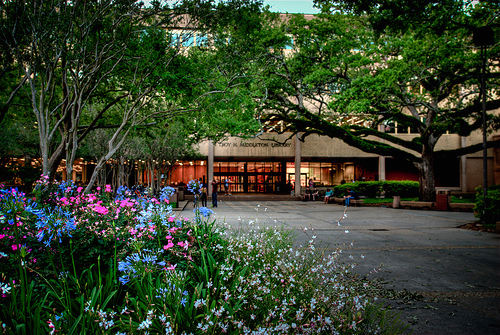
The campus is known for the 1,200 live oak trees that shade the ground of the university.
Historic district
Fifty-seven resources on the LSU campus were listed in the 95 acres (38 ha) Louisiana State University Historic District on the National Register of Historic Places on September 15, 1988. Forty-six of the enlisted resources were considered contributing buildings and structures. The campus is protected by the State Capital Historic District Legislation.
The LSU Campus Mounds, which are part of a larger mound group spread throughout the state, are near the northwestern corner of the campus and were built an estimated 5,000 years ago. They were individually enlisted in the National Register of Historic Places on March 1, 1999.
Campus housing
On-campus housing options include on-campus apartments (East Campus Apartments, West Campus Apartments, and Nicholson Gateway Apartments), Annie Boyd Hall, Evangeline Hall, the Agricultural Residence College, the Engineering Residential College, the Business Residential College, Broussard, Acadian, Beauregard, Blake, Cypress, Herget, Highland, Jackson, LeJeune, McVoy, Miller, Taylor, East Laville, and West Laville.
Museums
The LSU Museum of Art shares the Shaw Center for the Arts with many cultural partners including the LSU School of Art Gallery, LSU's Laboratory for Creative Arts and Technology, the Manship Theatre, and the Community School for the Arts of the Arts Council of Greater Baton Rouge. There is also the LSU Museum of Natural Science, LSU Rural Life Museum, and the Louisiana Museum of Natural History. The LSU Textile & Costume Museum, located in the Human Ecology Building, houses more than 7,000 examples of historic dress and textiles dating from the eighteenth century to the present day.
Other campuses
Other Louisiana State University campuses include the LSU Agricultural Center, Pennington Biomedical Research Center, LSU of Alexandria, LSU Shreveport, LSU Eunice, LSU Health Sciences Center New Orleans and LSU Health Sciences Center Shreveport.
The University of New Orleans was a member of Louisiana State University from 1958 until 1963 as LSUNO and under its own name from 1974 until 2011, when it was transferred to the University of Louisiana System by the Louisiana Legislature.
LSU owns and operates the J. Bennett Johnston Sr. Center for Advanced Microstructures and Devices (CAMD), which is a 1.3 GeV synchrotron radiation facility.
Academics
Undergraduate admissions
The 2022 annual ranking of U.S. News & World Report categorizes LSU-Baton Rouge as "more selective". For the Class of 2025 (enrolled fall 2021), LSU received 36,561 applications and accepted 25,907 (70.9%). Of those accepted, 7,045 enrolled, a yield rate (the percentage of accepted students who choose to attend the university) of 27.2%. LSU's freshman retention rate is 82.9%, with 69% going on to graduate within six years.
The enrolled first-year class of 2025 had the following standardized test scores: the middle 50% range (25th percentile-75th percentile) of SAT scores was 1130–1300, while the middle 50% range of ACT scores was 23–29.
Colleges and schools
Laboratory school
The university operates the Louisiana State University Laboratory School, a kindergarten through 12 public school.
Farm
Hill Farm established in 1927 by the Louisiana Agricultural Experiment Station in order to carry out research horticultural crops as part of Louisiana State University's mission as a land-grant university.
During the 1960s a large part of the Farm's land was reallocated for the construction of sorority houses, as a result, many of the fruit breeding programs had to be moved to other parts of the state. In the 1990s a new student recreation center and playing fields were created on the site of most of the remaining land, the remaining research programs were moved to the Burden Research Plantation. Today five acres of the original Hill Farm remain and used primarily as an agriculture teaching facility and community garden. Individual garden plots are nine by five feet (9' × 5') and may be rented by students, faculty, and the community at large. The price per lot has been deliberately kept low to support the Farm's mission to "provide access to gardening space, education, and resources necessary for the community to grow food in environmentally sustainable ways as a means of creating a food system where locally produced, affordable and nutritious food is available to all, and where the community can come together to share, play, and inspire one another." Although the gardeners are not required to plant certified organic seeds and plants, the Farm requires gardeners to use organic farming methods.