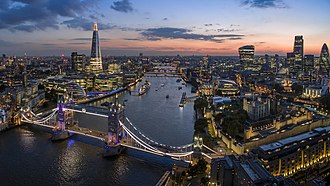
London is the capital and largest city of England and the United Kingdom, with a population of 9.1 million people in 2024. Its wider metropolitan area is the largest in Western Europe, with a population of 15.1 million. London stands on the River Thames in southeast England, at the head of a 50-mile (80 km) tidal estuary down to the North Sea, and has been a major settlement for nearly 2,000 years. Its ancient core and financial centre, the City of London, was founded by the Romans as Londinium and has retained its medieval boundaries. The City of Westminster, to the west of the City of London, has been the site of the national government and parliament for centuries. London grew rapidly in the 19th century, becoming the world's largest city at the time. Since the 19th century the name "London" has referred to the metropolis around the City of London, historically split among the counties of Middlesex, Essex, Surrey, Kent and Hertfordshire. Since 1965 it has largely comprised the administrative area of Greater London, governed by 33 local authorities and the Greater London Authority.
As one of the world's major global cities, London exerts a strong influence on world art, architecture, culture, cinema, entertainment, commerce, finance, education, healthcare, media, science, technology, tourism, transport and communications. London is Europe's largest city economy and one of the world's major financial centres. London is home to several of the world's leading academic institutions and hosts Europe's largest concentration of higher education institutions, comprising over 50 universities and colleges collectively enrolling more than 500,000 students in 2023. It is the most-visited city in Europe and has the world's busiest city airport system. The London Underground is the world's oldest rapid transit system.
London's diverse cultures encompass over 300 languages. The 2025 population of Greater London of just over 9.8 million made it Europe's third-most populous city, accounting for 13.1 per cent of the United Kingdom's population and 15.5 per cent of England's population. The Greater London Built-up Area is the fourth-most populous in Europe, with about 9.8 million inhabitants as of 2011. The London metropolitan area is the third-most-populous in Europe, with about 15 million inhabitants as of 2025, making London a megacity.
Landmarks include the Tower of London, Westminster Abbey, Buckingham Palace, the London Eye, Piccadilly Circus, St Paul's Cathedral, Tower Bridge and Trafalgar Square. The city has the most museums, art galleries, libraries and cultural venues in the UK, including the British Museum, the National Gallery, the Natural History Museum, Tate Modern, the British Library and numerous West End theatres. Annual sporting events include the FA Cup Final (held at Wembley Stadium), the Wimbledon Tennis Championships and the London Marathon. It became the first city to host three Summer Olympic Games upon hosting the 2012 Summer Olympics.
Etymology
The name London is attested in the first century AD, usually in the Latinised form Londinium. Modern scientific analyses of the name must account for the origins of the different forms that are found in early sources, such as Latin Londinium, Old English Lunden, and Welsh Llundein, with reference to the known developments over time of sounds in those different languages. The name came into these languages from Common Brythonic; the lost Celtic form of the name was most likely *Londonjon.
Until 1889, the name "London" applied officially only to the City of London, but since then it has also denoted the County of London and Greater London.
History
Prehistory
In 1993 remains of a Bronze Age bridge were found on the south River Thames foreshore, upstream from Vauxhall Bridge. Two of the timbers were radiocarbon dated to 1750–1285 BC. In 2010 foundations of a large timber structure, dated to 4800–4500 BC, were found on the Thames' south foreshore downstream from Vauxhall Bridge. Both are on the south bank of the Thames, where the now-underground River Effra flows into the Thames.
Roman London
Despite the evidence of scattered Brythonic settlements in the area, the first major settlement was founded by the Romans around AD 47, about 4 years after their invasion of AD 43. This only lasted until about AD 61, when the Iceni tribe led by Queen Boudica stormed it and burnt it to the ground.
The next planned incarnation of Londinium prospered, superseding Colchester as the principal city of the Roman province of Britannia in 100. At its height in the 2nd century, Roman London had a population of about 60,000.
Anglo-Saxon and Viking-period London
With the early-5th-century collapse of Roman rule, the walled city of Londinium was effectively abandoned, although Roman civilisation continued around St Martin-in-the-Fields until about 450. From about 500 an Anglo-Saxon settlement known as Lundenwic developed slightly west of the old Roman city. By about 680 the city had become a major port again, but there is little evidence of large-scale production. From the 820s repeated Viking assaults brought decline.
The Vikings applied Danelaw over much of eastern and northern England from 886; The Anglo-Saxon Chronicle records that Alfred "refounded" London that year. This involved the abandonment of Lundenwic and a revival of life and trade within the old Roman walls. London then grew slowly until a dramatic increase in about 950.
By the 11th century, London was clearly the largest town in England. Westminster Abbey, rebuilt in Romanesque style by King Edward the Confessor, was one of the grandest churches in Europe. Winchester had been the capital of Anglo-Saxon England, but from this time, London became the main forum for foreign traders and the base for defence in time of war. In the view of Frank Stenton: "It had the resources, and it was rapidly developing the dignity and the political self-consciousness appropriate to a national capital."
Middle Ages
After winning the Battle of Hastings, William, Duke of Normandy, was crowned King of England as William I in the newly completed Westminster Abbey on Christmas Day 1066. He built the Tower of London to intimidate the inhabitants. In 1097 William II began building Westminster Hall, near the abbey. It became the basis of a new Palace of Westminster.
In the 12th century the institutions of central government, which had followed the royal English court around the country, grew in size and sophistication and became increasingly fixed, for most purposes at Westminster, although the royal treasury came to rest in the Tower of London. While the City of Westminster developed into a true governmental capital, its distinct neighbour, the City of London, remained England's largest city and principal commercial centre and flourished under its own unique administration, the Corporation of London. In 1100, its population was some 18,000; by 1300, it had grown to nearly 100,000. With the Black Death in the mid-14th century, London lost nearly a third of its population. London was the focus of the Peasants' Revolt in 1381.
London was a centre of England's Jewish population before their expulsion by Edward I in 1290. Violence against Jews occurred in 1190, when it was rumoured that Richard I had ordered their massacre after some of their leaders had presented themselves at his coronation. In 1264, during the Second Barons' War, Simon de Montfort's rebels killed 500 Jews while attempting to seize records of debts.
Early modern
The Reformation produced a shift to Protestantism. Much property passed into private ownership, accelerating business in the city. In 1475 the Hanseatic League set up a trading base. Woollen cloth was shipped undyed from 14th- and 15th-century London to the Low Countries. The reopening of the Netherlands to English shipping in January 1565 spurred a burst of commercial activity. Mercantilism grew and monopoly traders such as the East India Company were founded as trade expanded to the New World. London became the main North Sea port, with migrants from England and abroad. The population rose from about 50,000 in 1530 to about 225,000 in 1605. Shakespeare built his Globe Theatre in Southwark in 1599. Stage performances halted when Puritan authorities shut down the theatres in the 1640s. The ban was lifted during the 1660 Restoration; London's oldest theatre, Drury Lane, opened in 1663. By the end of the Tudor period in 1603, London was still compact. There was an assassination attempt on James I in Westminster, in the Gunpowder Plot of 5 November 1605. In 1637 the government of Charles I attempted to reform London's administration; the Corporation made "The Great Refusal", explaining the City of London's unique governmental status.
In the English Civil War, most Londoners supported the Roundheads. After an advance by the Cavaliers in 1642, culminating in the battles of Brentford and Turnham Green, London was surrounded by a defensive perimeter wall. The fortifications failed their only test when the New Model Army entered London in 1647. London suffered the Great Plague of 1665–1666, killing some 100,000 people, a fifth of the population. In 1666, the Great Fire destroyed much of the wooden-built city. Rebuilding took over 10 years, supervised by the polymath Robert Hooke.
In 1710, Christopher Wren's masterpiece St Paul's Cathedral was completed, replacing its medieval predecessor, lost in the Great Fire. Its dome dominated the London skyline for centuries, inspiring William Blake, whose 1789 poem "Holy Thursday" mentions 'the high dome of Pauls'. During the Georgian era new districts such as Mayfair were formed in the west, while new bridges encouraged development in South London. In the east, the Port of London expanded downstream, while the financial centre matured. In 1762 George III acquired Buckingham House. During the 18th century London was dogged by crime, and the Bow Street Runners were established in 1750 as a professional police force. Epidemics during the 1720s and 30s saw most children born in the city die before reaching their fifth birthday. Growing literacy and printed papers made news widely available; Fleet Street became the centre of the British press, and Londoners debated in coffeehouses. Napoleon's invasion of Amsterdam led many financiers to relocate to London and the first London international issue was arranged in 1817. The Royal Navy became the world's leading war fleet, acting as a deterrent to economic adversaries. Following an 1838 fire, the Royal Exchange was rebuilt in 1844. The 1846 repeal of the Corn Laws, meant to weaken Dutch economic power, enabled London to overtake Amsterdam as the leading international financial centre.
Late modern and contemporary
The Industrial Revolution saw unprecedented urbanisation. London was the world's largest city from about 1831 to 1925, with a population density of 132 per acre (325 per hectare). Harding, Howell & Co. on Pall Mall was one of the first department stores, alongside many street sellers. The London Underground, the world's first urban rail network, was created in response to traffic congestion. Overcrowding led to cholera epidemics, claiming 14,000 lives in 1848, and 6,000 in 1866. A modern sewage system was created by the Metropolitan Board of Works; it diverted waste to the Thames Estuary, and by the 1890s used biological treatment of sewage to oxidise the waste. The Metropolitan Board of Works oversaw infrastructure expansion in the capital and some surrounding counties. Lyons opened the first of their chain of teashops in Piccadilly in 1894. Tearooms became popular meeting places for women from the suffrage movement. Westminster Abbey and St Paul's Cathedral were bombed in the 1912–14 suffragette bombing and arson campaign.
London was bombed by the Germans in the First World War. During the Second World War, the Blitz killed over 30,000 Londoners, destroying many buildings. The tomb of the Unknown Warrior was created in Westminster Abbey on 11 November 1920 and The Cenotaph, in Whitehall, was unveiled on the same day; it is the focus the National Service of Remembrance held annually on Remembrance Sunday. The 1948 Summer Olympics were held at the original Wembley Stadium, while London was still recovering from the war. From the 1940s, London became home to many immigrants, primarily from Commonwealth countries such as Jamaica, India, Bangladesh and Pakistan, making London one of the most multiracial cities in the world. In 1951 the Festival of Britain was held on the South Bank. The Great Smog of 1952 led to the Clean Air Act 1956, which ended the "pea soup fogs" which had earned London the nickname the "Big Smoke".
Starting in the mid-1960s, London became a centre for worldwide youth culture, exemplified by the Swinging London sub-culture of the King's Road, Chelsea and Carnaby Street. The role of trendsetter revived in the punk era. In 1965 London's political boundaries were expanded in response to the city's growth, and a new Greater London Council was created. During the Troubles in Northern Ireland, London was hit from 1973 by bomb attacks by the Provisional Irish Republican Army. These attacks lasted for two decades, starting with the Old Bailey bombing. Greater London's population declined after the Second World War, from an estimated peak of 8.6 million in 1939 to around 6.8 million in the 1980s. By January 2015 Greater London's population had increased again to 8.63 million. The principal ports for London moved downstream to Felixstowe and Tilbury, with the London Docklands area becoming a focus for regeneration. 2 miles (3.2 km) east of central London, the Thames Barrier was completed in 1982 to protect London against tidal surges from the North Sea.
The Greater London Council was abolished in 1986, leaving London with no central administration until the creation of the Greater London Authority in 2000. To mark the 21st century the Millennium Dome, the London Eye and the Millennium Bridge were constructed. On 7 July 2005, three London Underground trains and a double-decker bus were bombed in a series of terrorist attacks. In 2008 Time magazine hailed London as one of the world's three most influential global cities. In terms of international connectedness, as of 2024, London was one of two cities worldwide classified as an "Alpha++" city by the Globalization and World Cities Research Network.
Administration
Local government and services
The administration of London is formed of two tiers: a citywide, strategic tier coordinated by the Greater London Authority (GLA), and a local tier with 33 local administrations. The GLA consists of the mayor of London, who has executive powers, and the London Assembly, which scrutinises the mayor's decisions and can accept or reject the mayor's annual budget proposals. The GLA is responsible for most of London's transport system through Transport for London (TfL), overseeing the city's police and fire services, and setting a strategic vision for London. The headquarters of the GLA is City Hall, Newham. The mayor since 2016 is Sadiq Khan.
The local authorities are the councils of the 32 London boroughs and the City of London Corporation. They are responsible for most local services, including local planning, schools, libraries, leisure and recreation, social services, local roads and refuse collection. Some functions, such as waste management, are provided through joint arrangements. In 2009–2010 the revenue expenditure by London councils and the GLA amounted to just over £22 billion (£14.7 billion for the boroughs and £7.4 billion for the GLA).
The London Fire Brigade is the statutory fire and rescue service for Greater London, run by the London Fire and Emergency Planning Authority. National Health Service ambulance services are provided by the London Ambulance Service (LAS) NHS Trust. The London Air Ambulance charity operates in conjunction with the LAS where required. His Majesty's Coastguard and the Royal National Lifeboat Institution operate on the River Thames, under the jurisdiction of the Port of London Authority from Teddington Lock to the sea.
Policing in Greater London, with the exception of the City of London, is provided by the Metropolitan Police ("The Met"), overseen by the mayor through the Mayor's Office for Policing and Crime. The British Transport Police are responsible for police services on National Rail, London Underground, Docklands Light Railway and Tramlink services. The Ministry of Defence Police is a specialised police force in London.
National government
London is the seat of the Government of the United Kingdom. Many government departments and the prime minister's residence at 10 Downing Street are based close to the Palace of Westminster, particularly along Whitehall. There are 75 members of Parliament from London; as at June 2024, 59 are from the Labour Party, 9 are Conservatives, 6 are Liberal Democrats and one constituency is held by an independent. The ministerial post of Minister for London was created in 1994; it has been vacant since July 2024.
Geography
Scope
Greater London is one of nine regions of England and the top subdivision covering most of the metropolis. The City of London at its core once comprised the whole settlement; as its urban area grew, the Corporation of London resisted attempts to amalgamate the city with its suburbs, causing "London" to be defined several ways.
Forty per cent of Greater London is covered by the London post town, in which "London" forms part of postal addresses.
The London telephone area code (020) covers an area similar in size to Greater London, although some outer districts are excluded and some just outside included. The London linked-number area extends 18 miles around Kings Cross, see Director telephone system.
The Greater London boundary has been aligned to the M25 motorway in places.
Urban expansion is prevented by the Metropolitan Green Belt, although the built-up area extends beyond the boundary in places, producing a separately defined Greater London Urban Area. Beyond this is the London commuter belt. Greater London is split for some purposes into Inner London and Outer London, and by the River Thames into North and South, with an informal Central London area. The coordinates of the nominal "centre of London", traditionally the original Eleanor Cross at Charing Cross near the junction of Trafalgar Square and Whitehall, are about 51°30′26″N 00°07′39″W.
Status
Within London, the City of London and the City of Westminster have city status. The City of London and the remainder of Greater London are ceremonial counties. Greater London includes parts of the historic counties of Middlesex, Kent, Surrey, Essex and Hertfordshire. Greater London has been defined as a region of England.
London is the capital of the United Kingdom and of England by convention. The capital of England was moved from Winchester as the Palace of Westminster developed in the 12th and 13th centuries to become the home of the royal court, and thus the nation's political capital. The city has four World Heritage Sites: Kew Gardens; the Tower of London; the site featuring the Palace of Westminster, the Church of St Margaret, and Westminster Abbey; and the historic settlement in Greenwich where the Royal Observatory defines the prime meridian (0° longitude) and Greenwich Mean Time.
Topography
Greater London has an area of 611 square miles (1,583 km2), while the London Metropolitan Region has an area of 3,236 square miles (8,382 km2).
Modern London stands on the Thames, its primary geographical feature, a navigable river which crosses the city from the south-west to the east. The Thames Valley is a flood plain surrounded by gently rolling hills including Parliament Hill, Addington Hills, and Primrose Hill. Historically, London grew up at the river's lowest bridging point. The Thames was once much broader and shallower with extensive wetlands; at high tide, its shores reached five times their present width.
Since the Victorian era the Thames has been embanked, and many of its London tributaries now flow underground. The Thames is tidal, and London is vulnerable to flooding. The threat has increased because of a continuous rise in high water level caused by climate change and by the slow 'tilting' of the British Isles through post-glacial rebound.
Climate
London has a temperate oceanic climate (Köppen: Cfb). The average annual precipitation is about 600 mm (24 in). Despite relatively low annual precipitation, London receives 109.6 rainy days on the 1 mm (0.039 in) threshold annually. London is vulnerable to climate change, and experts are concerned that households may run out of water before 2050.
Summers are generally warm, sometimes hot. London's average July high is 23.5 °C (74.3 °F). On average each year, London experiences 31 days above 25 °C (77.0 °F) and 4.2 days above 30.0 °C (86.0 °F). Winters are generally cool with little temperature variation. Heavy snow is rare, but snow usually falls at least once each winter. As a large city, London has a considerable urban heat island effect, making the centre of London at times 5 °C (9 °F) warmer than the suburbs and outskirts.
Areas
Places within London are identified using area names, such as Mayfair, Southwark, and Whitechapel. These are informal designations, reflect the names of villages that have been absorbed by sprawl, or are superseded administrative units. Since 1965, Greater London has been divided into 32 London boroughs in addition to its once walled ancient core, the City of London. The City of London is the main financial district, and Canary Wharf has developed into a new financial and commercial hub in the Docklands. The West End is an area of inner West London with the main shopping and entertainment areas, including West End theatre, and attracts many tourists. Its residential areas where properties can sell for tens of millions of pounds. The East End is the part of East London closest to the City of London. It has a high immigrant population and is one of the poorest areas of the capital. It once included the main northern part of the Port of London and extensive industry. In the late 20th century, deindustrialisation and the closure of the docks brought hardship. Large redeveloped brownfield areas include London Riverside and the Lower Lea Valley, which was developed into the Olympic Park for the 2012 Olympics.
Architecture
London's buildings are of many architectural styles and ages. Many grand houses and public buildings, such as the National Gallery, are constructed from Portland stone. Some areas, particularly just west of the centre, are characterised by white stucco or whitewashed buildings. Few structures in central London pre-date the Great Fire of 1666, other than the Tower of London. Further out is the Tudor-period Hampton Court Palace. The 17th-century is represented by Christopher Wren churches alongside neoclassical financial institutions such as the Royal Exchange and the Bank of England, and the 1960s Barbican Estate. The 1939 Battersea Power Station by the river in the south-west is a local landmark, while the St. Pancras and Paddington railway termini exemplify Victorian architecture.
The Monument to the Great Fire of London in the City of London provides views of the surrounding area while commemorating the Great Fire of London, which originated nearby. Marble Arch and Wellington Arch, at the north and south ends of Park Lane, have royal connections, as do the Albert Memorial and Royal Albert Hall in Kensington. Nelson's Column in Trafalgar Square is a focal point. Older buildings are mainly brick, commonly the yellow London stock brick.