
The Dow Jones Industrial Average (DJIA), Dow Jones, or simply the Dow (), is a stock market index of 30 prominent companies listed on stock exchanges in the United States.
The DJIA is one of the oldest and most commonly followed equity indices. It is price-weighted, unlike other common indices such as the Nasdaq Composite or S&P 500, which use market capitalization. The primary pitfall of this approach is that a stock's price—not the size of the company—determines its relative importance in the index. For example, as of March 2025, Goldman Sachs represented the largest component of the index with a market capitalization of ~$167B. In contrast, Apple's market capitalization was ~$3.3T at the time, but it fell outside the top 10 components in the index.
The DJIA also contains fewer stocks than many other major indices, which could heighten risk due to stock concentration. However, some investors believe it could be less volatile when the market is rapidly rising or falling due to its components being well-established large-cap companies.
The value of the index can also be calculated as the sum of the stock prices of the companies included in the index, divided by a factor, which is approximately 0.168 as of July 2026. The factor is changed whenever a constituent company undergoes a stock split so that the value of the index is unaffected by the stock split.
First calculated on May 26, 1896, the index is the second-oldest among U.S. market indices, after the Dow Jones Transportation Average. It was created by Charles Dow, co-founder of The Wall Street Journal and Dow Jones & Company, and named after him and his business associate, statistician Edward Jones.
The index is maintained by S&P Dow Jones Indices, an entity majority-owned by S&P Global. Its components are selected by a committee that includes three representatives from S&P Dow Jones Indices and two representatives from the Wall Street Journal. The ten components with the largest dividend yields are commonly referred to as the Dogs of the Dow. As with all stock prices, the prices of the constituent stocks and consequently the value of the index itself are affected by the performance of the respective companies as well as macroeconomic factors.

Components
As of March 25, 2026, the Dow Jones Industrial Average consists of the following companies, with a weighting as shown:
Former components
As of November 8, 2024, the components of the DJIA have changed 60 times since its beginning on May 26, 1896. General Electric had the longest presence on the index, beginning in the original index in 1896 and ending in 2018, but was dropped and re-added twice between 1898 and 1907. Changes to the index since 1991 are as follows:
Investment methods
Investing in the DJIA is possible via index funds as well as via derivatives such as option contracts and futures contracts.
Mutual and exchange-traded funds
Index funds, including mutual funds and exchange-traded funds (ETF) can replicate, before fees and expenses, the performance of the index by holding the same stocks as the index in the same proportions. An ETF that replicates the performance of the index is issued by State Street Corporation (NYSE Arca: DIA).
ProShares offers leveraged ETFs that attempt to produce three times the daily result of either investing in (NYSE Arca: UDOW) or shorting (NYSE Arca: SDOW) the Dow Jones Industrial Average.
Futures contracts
In the derivatives market, the CME Group through its subsidiaries the Chicago Mercantile Exchange (CME) and the Chicago Board of Trade (CBOT), issues futures contracts: the E-mini Dow ($5) Futures (YM).
Options contracts
Cboe Global Markets issues option contracts on the DJIA through the root symbol DJX. Options on various Dow-underlying ETFs are also available for trading.
Annual returns
The following table shows the annual development of the Dow Jones Index, which was calculated back to 1896.
History
Precursor
In 1884, Charles Dow composed his first stock average, which contained nine railroads and two industrial companies that appeared in the Customer's Afternoon Letter, a daily two-page financial news bulletin which was the precursor to The Wall Street Journal. On January 2, 1886, the number of stocks represented in what is now the Dow Jones Transportation Average dropped from 14 to 12, as the Central Pacific Railroad and Central Railroad of New Jersey were removed. Though comprising the same number of stocks, this index contained only one of the original twelve industrials that would eventually form Dow's most famous index.
Initial components
Dow calculated his first average purely of industrial stocks on May 26, 1896, creating what is now known as the Dow Jones Industrial Average. None of the original 12 industrials still remain part of the index.
American Cotton Oil Company, a predecessor company to Hellmann's and Best Foods, now part of Unilever.
American Sugar Refining Company, became Domino Sugar in 1900, now Domino Foods, Inc.
American Tobacco Company, broken up in a 1911 antitrust action.
Chicago Gas Company, bought by Peoples Gas Light in 1897, was an operating subsidiary of the now-defunct Integrys Energy Group until 2014.
Distilling & Cattle Feeding Company, now Millennium Chemicals, formerly a division of LyondellBasell.
General Electric, still in operation, removed from the Dow Jones Industrial Average in 2018.
Laclede Gas Company, still in operation as Spire Inc, removed from the Dow Jones Industrial Average in 1899.
National Lead Company, now NL Industries, removed from the Dow Jones Industrial Average in 1916.
North American Company, an electric utility holding company, broken up by the U.S. Securities and Exchange Commission (SEC) in 1946.
Tennessee Coal, Iron and Railroad Company in Birmingham, Alabama, bought by U.S. Steel in 1907; U.S. Steel was removed from the Dow Jones Industrial Average in 1991.
United States Leather Company, dissolved in 1952.
United States Rubber Company, changed its name to Uniroyal in 1961, merged with private Goodrich Corporation in 1986, tire business bought by Michelin in 1990. The remainder of Goodrich remained independent until it was acquired by United Technologies in 2012 and became a part of UTC Aerospace Systems, now Collins Aerospace, a Raytheon Technologies subsidiary.
Early years
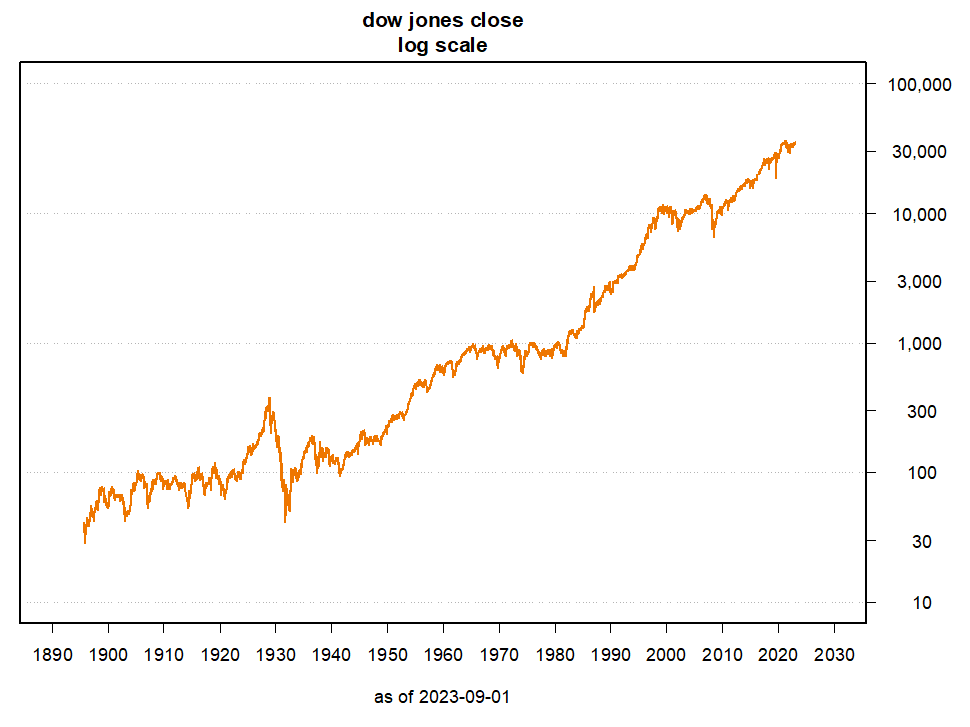
When it was first published in the mid-1880s, the index stood at a level of 62.76. It reached a peak of 78.38 during the summer of 1890, but reached its all-time low of 28.48 in the summer of 1896 during the Panic of 1896. Many of the biggest percentage price moves in the Dow occurred early in its history, as the nascent industrial economy matured. In the 1900s, the Dow halted its momentum as it worked its way through two financial crises: the Panic of 1901 and the Panic of 1907. The Dow remained stuck in a range between 53 and 103 until late 1914. The negativity surrounding the 1906 San Francisco earthquake did little to improve the economic climate; the index broke 100 for the first time in 1906.
At the start of the 1910s, the Panic of 1910–1911 stifled economic growth. On July 30, 1914, as the average stood at a level of 71.42, a decision was made to close the New York Stock Exchange, and suspend trading for a span of four and a half months. Some historians believe the exchange was closed because of a concern that markets would plunge as a result of panic over the onset of World War I. An alternative explanation is that the United States Secretary of the Treasury, William Gibbs McAdoo, closed the exchange to conserve the U.S. gold stock in order to launch the Federal Reserve System later that year, with enough gold to keep the United States on par with the gold standard. When the markets reopened on December 12, 1914, the index closed at 74.56, a gain of 4.4%. This is frequently reported as a large drop, due to using a later redefinition. Reports from the time say that the day was positive. Following World War I, the United States experienced another economic downturn, the Post–World War I recession. The Dow's performance remained unchanged from the closing value of the previous decade, adding only 8.26%, from 99.05 at the beginning of 1910, to a level of 107.23 at the end of 1919.
The Dow experienced a long bull run from 1920 to late 1929 when it rose from 73 to 381 points. In 1928, the components of the Dow were increased to 30 stocks near the economic height of that decade, which was nicknamed the Roaring Twenties. This period downplayed the influence of the Depression of 1920–1921 and certain international conflicts such as the Polish–Soviet War, the Irish Civil War, the Turkish War of Independence and the initial phase of the Chinese Civil War. After a peak of 381.17 on September 3, 1929, the bottom of the 1929 crash came just 2 months later on November 13, 1929, at 195.35 intraday, closing slightly higher at 198.69. The Wall Street Crash of 1929 and the ensuing Great Depression over the next several years saw the Dow continue to fall until July 8, 1932, when it closed at 41.22, roughly two-thirds of its mid-1880s starting point and almost 90% below its peak. Overall for the 1920s decade, the Dow still ended with a healthy 131.7% gain, from 107.23 to 248.48 at the end of 1929. In inflation-adjusted numbers, the high of 381.17 on September 3, 1929, was not surpassed until 1954.
Marked by global instability and the Great Depression, the 1930s contended with several consequential European and Asian outbreaks of war, leading to the catastrophic World War II in 1939. Other conflicts during the decade which affected the stock market included the 1936–1939 Spanish Civil War, the 1935–1936 Second Italo-Abyssinian War, the Soviet-Japanese Border War of 1939, and the Second Sino-Japanese War of 1937. The United States experienced the Recession of 1937–1938, which temporarily brought economic recovery to a halt. The largest one-day percentage gain in the index happened in the depths of the 1930s bear market on March 15, 1933, when the Dow gained 15.34% to close at 62.10. However, as a whole throughout the Great Depression, the Dow posted some of its worst performances, for a negative return during most of the 1930s for new and old stock market investors. For the decade, the Dow Jones average was down from 248.48 at the beginning of 1930, to a stable level of 150.24 at the end of 1939, a loss of about 40%.
1940s
Post-war reconstruction during the 1940s, along with renewed optimism of peace and prosperity, brought about a 33% surge in the Dow from 150.24 to 200.13. The strength in the Dow occurred despite the Recession of 1949 and various global conflicts.
1950s
During the 1950s, the Korean War and the Cold War did not stop the Dow's climb higher. A nearly 240% increase in the average from 200.13 to 679.36 ensued over the course of that decade.
1960s
The Dow began to stall during the 1960s as the markets trudged through the Kennedy Slide of 1962, but still managed an 18% gain from 679.36 to 800.36.
1970s
The 1970s marked a time of economic uncertainty and troubled relations between the U.S. and certain Middle-Eastern countries. The 1970s energy crisis was a prelude to a disastrous economic climate along with stagflation, the combination of high unemployment and high inflation. However, on November 14, 1972, the average closed at 1,003.16, above the 1,000 mark for the first time, during a brief relief rally in the midst of a lengthy bear market. Between January 1973 and December 1974, the average lost 48% of its value in what became known as the 1973–1974 stock market crash, closing at 577.60 on December 6, 1974. The nadir came after prices dropped more than 45% over two years since the NYSE's high point of 1,003.16 on November 4, 1972. In 1976, the index reached 1,000 several times and it closed the year at 1,004.75. Although the Vietnam War ended in 1975, new tensions arose towards Iran surrounding the Iranian Revolution in 1979. Performance-wise for the 1970s, the index remained virtually flat, rising 4.8% from 800.36 to 838.74.
1980s
The 1980s began with the early 1980s recession. In early 1981, the index broke above 1,000 several times, but then retreated. After closing above 2,000 in January 1987, the largest one-day percentage drop occurred on Black Monday, October 19, 1987, when the average fell 22.61%. There were no clear reasons given to explain the crash.
On October 13, 1989, the Friday the 13th mini-crash, which initiated the collapse of the junk bond market, resulted in a loss of almost 7% of the index in a single day.
During the 1980s, the Dow increased 228% from 838.74 to 2,753.20; despite the market crashes, Silver Thursday, an early 1980s recession, the 1980s oil glut, the Japanese asset price bubble, and other political distractions. The index had only two negative years in the 1980s: in 1981 and 1984.
1990s
The 1990s brought on rapid advances in technology along with the introduction of the dot-com era. The markets contended with the 1990 oil price shock compounded with the effects of the early 1990s recession and a brief European situation surrounding Black Wednesday. Certain influential foreign conflicts such as the 1991 Soviet coup d'état attempt which took place as part of the initial stages of the Dissolution of the Soviet Union and the Revolutions of 1989; the First Chechen War and the Second Chechen War, the Gulf War, and the Yugoslav Wars failed to dampen economic enthusiasm surrounding the ongoing Information Age and the "irrational exuberance" (a phrase coined by Alan Greenspan) of the dot-com bubble. Between late 1992 and early 1993, the Dow staggered through the 3,000 level making only modest gains as the biotechnology sector suffered through the downfall of the Biotech Bubble; as many biotech companies saw their share prices rapidly rise to record levels and then subsequently fall to new all-time lows.
The Dow soared from 2,753 to 8,000 between January 1990 to July 1997. In October 1997, the events surrounding the 1997 Asian financial crisis plunged the Dow into a 554-point loss to a close of 7,161.15; a retrenchment of 7.18% in what became known as the October 27, 1997 mini-crash.
However, the Dow continued climbing past 9,000 despite negativity surrounding the 1998 Russian financial crisis along with the subsequent fallout from the 1998 collapse of Long-Term Capital Management due to bad bets placed on the movement of the Russian ruble.
On March 29, 1999, the average closed at 10,006.78, its first close above 10,000. This prompted a celebration on the New York Stock Exchange trading floor, complete with party hats. Total gains for the decade exceeded 315%; from 2,753.20 to 11,497.12, which equates to 12.3% annually.