
Hamburg, officially the Free and Hanseatic City of Hamburg, is the second-largest city in Germany after Berlin and sixth-largest city in the European Union, with a population of over 1.9 million. The Hamburg Metropolitan Region has a population of over 5.1 million and is the tenth-largest metropolitan region by GDP in the European Union. At the southern tip of the Jutland Peninsula, Hamburg stands on the branching River Elbe at the head of a 110 km (68 mi) estuary to the North Sea, at the confluence of the Alster and Bille. Hamburg is one of Germany's three city-states alongside Berlin and Bremen, and is surrounded by Schleswig-Holstein to the north and Lower Saxony to the south. The Port of Hamburg is Germany's largest and Europe's third-largest, after Rotterdam and Antwerp. The local dialect is a variant of Low Saxon.
The official name reflects Hamburg's history as a member of the medieval Hanseatic League and a free imperial city of the Holy Roman Empire. Before the 1871 unification of Germany, it was a fully sovereign city state, and before 1919 formed a civic republic headed constitutionally by a class of hereditary Grand Burghers, or Hanseaten. Beset by disasters such as the Great Fire of Hamburg, North Sea flood of 1962 and military conflicts including World War II bombing raids, the city has managed to recover and emerge wealthier after each catastrophe. Major regional broadcaster NDR, the printing and publishing firm Gruner + Jahr and the newspapers Der Spiegel and Die Zeit are based in the city. Hamburg is the seat of Germany's oldest stock exchange and the world's oldest merchant bank, Berenberg Bank. Media, commercial, logistical, and industrial firms with significant locations in the city include multinationals Airbus, Blohm + Voss, Aurubis, Beiersdorf, Lufthansa and Unilever.
Hamburg is also a major European science, research, and education hub, with several universities and institutions, including the University of Hamburg, and the Deutsches Elektronen-Synchrotron Laboratory DESY. The city enjoys a very high quality of living, being ranked 28th in the 2024 Mercer Quality of Living Survey. Hamburg hosts specialists in world economics and international law, including consular and diplomatic missions such as the International Tribunal for the Law of the Sea, the EU-LAC Foundation, and the UNESCO Institute for Lifelong Learning, multipartite international political conferences and summits such as Europe and China and the G20. Former German chancellors Helmut Schmidt and Angela Merkel were both born in Hamburg. The former Mayor of Hamburg, Olaf Scholz, was chancellor from December 2021 until May 2025.
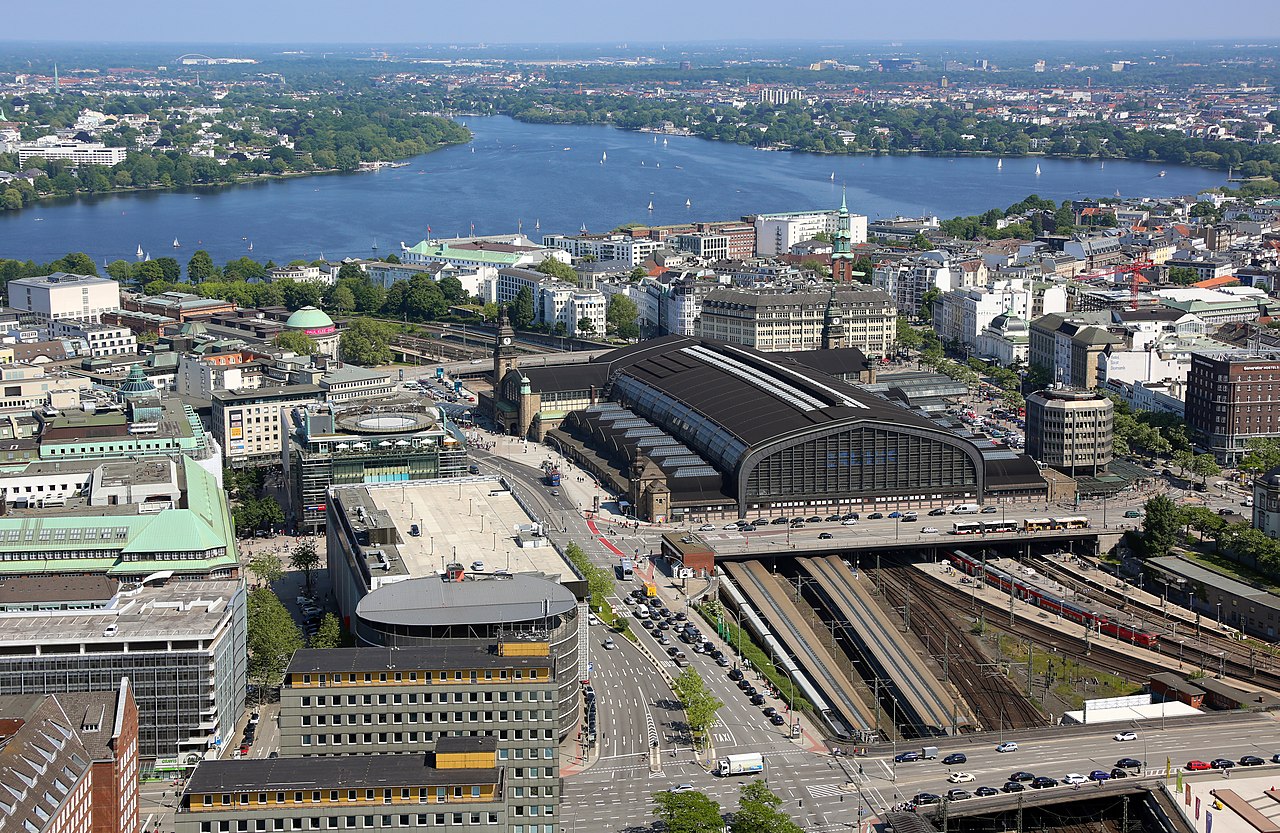
Hamburg is a major international and domestic tourist destination. The Speicherstadt and Kontorhausviertel were declared World Heritage Sites by UNESCO in 2015. Hamburg's rivers and canals are crossed by around 2,500 bridges, making it the city with the highest number of bridges in Europe, and Hamburg is also home to five of the world's 29 tallest churches, making it the city with the greatest number of churches surpassing 100 metres (330 ft) worldwide. Aside from its rich architectural heritage, the city is also home to notable cultural venues such as the Elbphilharmonie and Laeiszhalle concert halls. It gave birth to movements like Hamburger Schule and paved the way for bands including the Beatles. Hamburg is also known for several theatres and a variety of musical shows. St. Pauli's Reeperbahn is among the best-known European red-light districts.
History
Origins
Claudius Ptolemy (2nd century AD) reported the first name for the vicinity as Treva.
Etymology
The name Hamburg comes from the first permanent building on the site, a castle which the Emperor Charlemagne ordered constructed in AD 808. It rose on rocky terrain in a marsh between the Alster and the Elbe rivers as a defence against Slavic incursion, and acquired the name Hammaburg, burg meaning castle or fort. The origin of the Hamma term remains uncertain, but its location is estimated to be at the site of today's Hammaburgplatz.

Medieval Hamburg
In 834 CE, Hamburg was established as the seat of a bishopric. Its first bishop, Ansgar, later known as the Apostle of the North, founded the city's early Christian institutions. Two years later, Hamburg was linked with Bremen to form the Bishopric of Hamburg-Bremen.
Hamburg faced repeated destruction in its early centuries. In 845, a fleet of 600 Viking ships sailed up the River Elbe and destroyed the town, which then had about 500 inhabitants. In 1030, King Mieszko II Lambert of the Kingdom of Poland burned the city, and in 1201 and 1214 it was raided and occupied by Valdemar II of Denmark. The Black Death reached Hamburg in 1350, killing at least 60% of its population, and the city also suffered several major fires in the medieval period.
A major turning point came in 1189 when Frederick Barbarossa granted Hamburg the status of a Free Imperial City. The imperial charter included tax-free passage down the Lower Elbe to the North Sea (a form of free-trade zone). In 1265, an allegedly forged charter was presented to or by the Rath of Hamburg.

Hamburg's location between the North Sea and Baltic Sea trade routes helped it become a major port in Northern Europe. Its 1241 alliance with Lübeck is regarded as the founding moment of the Hanseatic League. On 8 November 1266, a contract between Henry III of England and Hamburg's merchants allowed them to establish a hanse in London — the first recorded use of the word for the League's trading guild.
In 1270, Jordan von Boitzenburg, solicitor to the Senate of Hamburg, wrote the Ordeelbook, the first description of civil, criminal and procedural law for a German city in the German language. On 10 August 1410, civil unrest resulted in a negotiated compromise (German: Rezeß), considered the first constitution of Hamburg.
On 25 February 1356 — the first day of spring in medieval reckoning — the Matthiae-Mahl feast for Hanseatic League cities was celebrated for the first time. It continues today as the world's oldest ceremonial meal.

Early modern period
In 1529, the city embraced Lutheranism, and it received Reformed refugees from the Netherlands and France.
When Jan van Valckenborgh introduced a second layer to the fortifications to protect against the Thirty Years' War in the seventeenth century, he extended Hamburg and created a "New Town" (Neustadt) whose street names are still based upon the grid system of roads he introduced.
From the autumn of 1696 to the spring of 1697, the Company of Scotland trading to Africa and the Indies was active in Hamburg. While it was unsuccessful in raising capital locally, it commissioned the construction of four vessels in the port. The Caledonia, a ship of 600 tons with 56 guns, and the Instuaration (later renamed the St. Andrew), a vessel of 350 tons, were launched in March 1697.

Upon the dissolution of the Holy Roman Empire in 1806, the Free Imperial City of Hamburg was not incorporated into a larger administrative area while retaining special privileges (mediatised), but became a sovereign state with the official title of the Free and Hanseatic City of Hamburg. Hamburg was briefly annexed by Napoleon I to the First French Empire (1804–1814/1815). Russian forces under General Bennigsen finally freed the city in 1814. Hamburg re-assumed its pre-1811 status as a city-state in 1814. The Congress of Vienna of 1815 confirmed Hamburg's independence and it became one of 39 sovereign states of the German Confederation (1815–1866).
In 1842, about a quarter of the inner city was destroyed in the Great Fire of Hamburg. The fire started on the night of 4 May and was not extinguished until 8 May. It destroyed three churches, the town hall, and many other buildings. 51 people were killed and an estimated 20,000 people were left homeless. Reconstruction took more than 40 years.
After periodic political unrest, particularly during the Revolutions of 1848, Hamburg adopted in 1860 a semidemocratic constitution that provided for the election of the Senate, the governing body of the city-state, by adult taxpaying males. Other innovations included the separation of powers, the separation of Church and State, freedom of the press, of assembly and association. Hamburg became a member of the North German Confederation (1866–1871) and of the German Empire (1871–1918), and maintained its self-ruling status during the Weimar Republic (1919–1933). Hamburg acceded to the German Customs Union or Zollverein in 1888, the last (along with Bremen) of the German states to join. The city experienced its fastest growth during the second half of the 19th century when its population more than quadrupled to 800,000 as the growth of the city's Atlantic trade helped make it Europe's second-largest port. The Hamburg America Line, with Albert Ballin as its director, became the world's largest transatlantic shipping company around the start of the 20th century. Shipping companies sailing to South America, Africa, India and East Asia were based in the city. Hamburg was the departure port for many Germans and Eastern Europeans to emigrate to the United States in the late 19th and early 20th centuries. Trading communities from all over the world established themselves there.

A major outbreak of cholera in 1892 was badly handled by the city government, which retained an unusual degree of independence for a German city. About 8,600 died in the largest German epidemic of the late 19th century, and the last major cholera epidemic in a major city of the Western world.
Second World War
Hamburg was a Gau within the administrative division of Nazi Germany from 1934 until 1945. The bombing of Hamburg in World War II devastated much of the city and the harbour. On 23 July 1943, the Royal Air Force (RAF) and United States Army Air Force firebombing created a firestorm which spread from the Hauptbahnhof (main railway station) and quickly moved south-east, completely destroying entire boroughs such as Hammerbrook, Billbrook and Hamm South. Thousands of people perished in these densely populated working class boroughs. The raids, codenamed Operation Gomorrah by the RAF, killed at least 42,600 civilians; the precise number is not known. About one million civilians were evacuated in the aftermath of the raids. While some of the boroughs destroyed were rebuilt as residential districts after the war, others such as Hammerbrook were entirely developed into office, retail and limited residential or industrial districts.
The Hamburg Commonwealth War Graves Commission Cemetery is in the greater Ohlsdorf Cemetery in the north of Hamburg.
At least 42,900 people are thought to have perished in the Neuengamme concentration camp (about 25 km, 16 mi outside the city in the marshlands), mostly from epidemics and in the destruction of Kriegsmarine vessels housing evacuees at the end of the war.
Systematic deportations of Jewish Germans and Gentile Germans of Jewish descent started on 18 October 1941. These were all directed to ghettos in Nazi-occupied Europe or to Nazi concentration camps. Most deported persons perished in the Holocaust. By the end of 1942, the Jüdischer Religionsverband in Hamburg was dissolved as an independent legal entity and its remaining assets and staff were assumed by the Reich Association of Jews in Germany (District Northwest). On 10 June 1943, the Reich Security Main Office dissolved the association by a decree. The few remaining employees not somewhat protected by a mixed marriage were deported from Hamburg on 23 June to Theresienstadt, where most of them perished. About 7800 Hamburg Jews were murdered in the Holocaust, of the nearly 17 thousand who had lived in the city before Hitler's rise to power.
Post-war history
The city was surrendered to British Forces on 3 May 1945, in the Capture of Hamburg, three days after Adolf Hitler's death. After the Second World War, Hamburg formed part of the British Zone of Occupation; it became a state of West Germany in 1949.
The North Sea flood of 1962 caused the Elbe to rise to an all-time high, inundating one-fifth of Hamburg and killing more than 300 people.
The inner German border – only 50 kilometres (30 mi) east of Hamburg – separated the city from much of its hinterland and reduced Hamburg's global trade. Since German reunification in 1990, and the accession of several Central European and Baltic countries into the European Union in 2004, the Port of Hamburg has restarted ambitions for regaining its position as the region's largest deep-sea port for container shipping and its major commercial and trading hub.
Geography
Hamburg is at a sheltered natural harbour on the southern fanning-out of the Jutland Peninsula, between Continental Europe to the south and Scandinavia to the north, with the North Sea to the west and the Baltic Sea to the northeast. It is on the River Elbe at its confluence with the Alster and Bille. The city centre is around the Binnenalster ("Inner Alster") and Außenalster ("Outer Alster"), both formed by damming the Alster river to create lakes. The islands of Neuwerk, Scharhörn, and Nigehörn, 100 kilometres (60 mi) away in the Hamburg Wadden Sea National Park, are also part of the city of Hamburg.
The neighbourhoods of Neuenfelde, Cranz, Francop and Finkenwerder are part of the Altes Land (old land) region, the largest contiguous fruit-producing region in Central Europe. Neugraben-Fischbek has Hamburg's highest elevation, the Hasselbrack at 116.2 metres (381 ft) AMSL. Hamburg borders the states of Schleswig-Holstein and Lower Saxony.
Climate
Hamburg has an oceanic climate (Köppen: Cfb; Trewartha: Dobk), influenced by its proximity to the coast and maritime influences that originate over the Atlantic Ocean. The location in the north of Germany provides extremes greater than typical marine climates, but definitely in the category due to the prevailing westerlies. Nearby wetlands enjoy a maritime temperate climate. The amount of snowfall has varied greatly in recent decades. In the late 1970s and early 1980s, heavy snowfall sometimes occurred, the winters of recent years have been less cold, with snowfall just a few days per year.
The warmest months are June, July, and August, with high temperatures of 20.1 to 22.5 °C (68.2 to 72.5 °F). The coldest are December, January, and February, with low temperatures of −0.3 to 1.0 °C (31.5 to 33.8 °F). The annual extreme temperatures range from −29.1 °C (−20.4 °F) on 13 February 1940, to 40.1 °C (104.2 °F) on 20 July 2022, and the latter was measured at Hamburg-Neuwiedenthal Meteorological Station, on the same day, a high temperature record of 39.1 °C (102.4 °F) was recorded at Hamburg Airport.
Demographics
On 31 December 2016, there were 1,860,759 people registered as living in Hamburg in an area of 755.3 km2 (291.6 sq mi). The population density was 2,464/km2 (6,380/sq mi). The metropolitan area of the Hamburg region (Hamburg Metropolitan Region) is home to 5,107,429 living on 196/km2 (510/sq mi).
There were 915,319 women and 945,440 men in Hamburg. For every 1,000 females, there were 1,033 males. In 2015, there were 19,768 births in Hamburg (of which 38.3% were to unmarried women); 6422 marriages and 3190 divorces, and 17,565 deaths. In the city, 16.1% of the population was under the age of 18, while 18.3% was 65 years of age or older. There were 356 people in Hamburg over the age of 100.
According to the Statistical Office for Hamburg and Schleswig-Holstein, there were 631,246 residents with a migrant background, representing 34% of the population. Immigrants come from 200 countries. 5,891 people have acquired German cititzenship in 2016.
In 2016, there were 1,021,666 households, of which 17.8% had children under the age of 18; 54.4% of all households were made up of singles. 25.6% of all households were single parent households. The average household size was 1.8.
Portuguese community
Hamburg has the largest Portuguese community in Germany; the city is home to about 30,000 people of Portuguese heritage. Many Portuguese sailors and merchants came to Hamburg beginning in the 15th century due to its port. Since the 1970s, there has been a district in Hamburg called the Portugiesenviertel (Portuguese quarter) where many Portuguese people settled and which has a variety of Portuguese restaurants, cafes and shops that attract many tourists. There are several statues, squares and streets in Hamburg that are named after Portuguese historical figures. These include the Vasco da Gama statue on the Kornhaus bridge, which was suggested by Portuguese residents to bring visibility to the Portuguese community in Hamburg.
Afghan community
Hamburg's Afghan community of about 50,000 people is the largest not only in Germany, but also in Europe. They first came to Hamburg in the 1970s before expanding during the Afghan conflict in the 1980s and 1990s where many Afghan migrants chose to live in Hamburg. After 2015 the Afghan population almost doubled due to a new influx from the migrant crisis. There is an area in Hamburg behind the central station where many Afghan restaurants and shops are located. Many carpet businesses in Speicherstadt are operated by Afghan traders, with Hamburg still a global leader in the trade of oriental rugs.
Foreign residents
The breakdown of all Hamburg residents with foreign citizenship (as of 31 December 2016) by their continent of origin is as follows:
Language
As elsewhere in Germany, Standard German is spoken in Hamburg, but as typical for northern Germany, the original language of Hamburg is Low German, usually referred to as Hamborger Platt (German Hamburger Platt) or Hamborgsch. Since large-scale standardisation of the German language beginning in earnest in the 18th century, various Low German-coloured dialects have developed (contact-varieties of German on Low Saxon substrates). Originally, there was a range of such Missingsch varieties, the best-known being the low-prestige ones of the working classes and the somewhat more bourgeois Hanseatendeutsch (Hanseatic German), although the term is used in appreciation. All of these are now moribund due to the influences of Standard German used by education and media. However, the former importance of Low German is indicated by several songs, such as the sea shanty Hamborger Veermaster, written in the 19th century when Low German was used more frequently. Many toponyms and street names reflect Low Saxon vocabulary, partially even in Low Saxon spelling, which is not standardised, and to some part in forms adapted to Standard German.
Religion
In 2018, 65.2% of the population was not religious or adhered to religions other than the Evangelical Church or Catholicism.
In 2018, 24.9% of the population belonged to the North Elbian Evangelical Lutheran Church, the largest religious body, and 9.9% to the Roman Catholic Church. Hamburg is the seat of one of the three bishops of the Evangelical Lutheran Church in Northern Germany, as well as of the Roman Catholic Archdiocese of Hamburg.
According to the publication Muslimisches Leben in Deutschland ("Muslim life in Germany"), an estimated 141,900 Muslim migrants (from nearly 50 countries of origin) lived in Hamburg in 2008. About three years later (May 2011) calculations based on census data for 21 countries of origin resulted in a figure of about 143,200 Muslim migrants in Hamburg, making up 8.4% percent of the population. As of 2021, there were more than 50 mosques in the city, including the Ahmadiyya run Fazle Omar Mosque, which is the oldest in the city, and which hosts the Islamic Centre Hamburg.
A Jewish Community also exists. As of 2022, around 2,500 Jews live in Hamburg.
Government
The city of Hamburg is one of 16 German states, therefore the Mayor of Hamburg's office corresponds more to the role of a minister-president than to that of a city mayor. As a German state government, it is responsible for public education, correctional institutions and public safety; as a municipality, it is additionally responsible for libraries, recreational facilities, sanitation, water supply and welfare services.
Since 1897, the seat of the government has been Hamburg City Hall (Hamburg Rathaus), with the office of the mayor, the meeting room for the Senate and the floor for the Hamburg Parliament. From 2001 until 2010, the mayor of Hamburg was Ole von Beust, who governed in Germany's first statewide "black-green" coalition, consisting of the conservative CDU Hamburg and the alternative GAL, which are Hamburg's regional wing of the Alliance 90/The Greens party. Von Beust was briefly succeeded by Christoph Ahlhaus in 2010, but the coalition broke apart on 28 November 2010. On 7 March 2011 Olaf Scholz (SPD) became mayor. After the 2015 election the SPD and the Alliance 90/The Greens formed a coalition.