
The Elbe (Czech: Labe) is one of the major rivers of Central Europe. It rises in the Giant Mountains of the northern Czech Republic before traversing much of Bohemia (western half of the Czech Republic), then Germany before flowing into the North Sea at Cuxhaven, 110 kilometres (68 miles) northwest of Hamburg. Its total length is 1,094 km (680 mi).
The Elbe's major tributaries include the rivers Vltava, Ohře, Saale, Havel, Mulde, and Schwarze Elster.
The Elbe river basin, comprising the Elbe and its tributaries, has a catchment area of 148,268 square kilometres (57,247 sq mi), the twelfth-largest in Europe. The basin spans four countries; however, it lies almost entirely within two of them: Germany (65.5%) and the Czech Republic (33.7%), covering about two-thirds of the basin's area. On its southeastern edge, the Elbe River Basin also comprises small parts of Austria (0.6%) and Poland (0.2%). The Elbe catchment area is inhabited by 24.4 million people; its biggest cities are Berlin, Hamburg, Prague, Dresden and Leipzig.

Etymology
First attested in Latin as Albis, the name Elbe means 'river' or 'riverbed' and is simply the High German version of a word (*albī) found elsewhere in Germanic; cf. Old Norse river name Elfr, Swedish älv 'river', Norwegian elv 'river', Old English river name Elf, and Middle Low German elve 'riverbed'.
Course
In the Czech Republic
The Elbe (Labe) rises on the slopes of Mt. Violík at an elevation of 1,386 metres (4,547 ft) in the Giant Mountains on the northwest border of the Czech Republic. After descending the 30 metres (98 ft) Elbe Falls, it is joined by the steep, fast-flowing Bílé Labe. The combined stream then flows south, emerging from the mountain valleys at Jaroměř, where it is joined by the Úpa and Metuje.
Here, the Elbe enters the vast vale named Polabí (meaning "land along the Elbe"), and continues southward through Hradec Králové (where Orlice flows in) and then to Pardubice, where it turns sharply to the west. At Kolín, some 43 kilometres (27 mi) further on, it bends gradually northwest. At the village of Káraný, a little above Brandýs nad Labem, the Jizera enters.

At Mělník, its stream is more than doubled in volume by the Vltava, a major river which winds northwards through Bohemia. Upstream from the confluence, the Vltava is in fact much longer (434 km (270 mi) against 294 km (183 mi) of the Elbe so far), and has a greater discharge and a larger drainage basin. Nonetheless, for historical reasons, the river retains the name Elbe, also because at the confluence point, it is the Elbe that flows through the main wider valley. In contrast, the Vltava flows into the valley to meet the Elbe at almost a right angle, and thus appears to be the tributary river.
Some distance lower down, at Litoměřice, the waters of the Elbe are tinted by the reddish Ohře. Thus augmented, and swollen into a stream 140 m (460 ft) wide, the Elbe carves a path through the basaltic mass of the Central Bohemian Uplands, churning its way through a picturesque, deep, narrow, and curved rocky gorge.
In Germany
Shortly after crossing the Czech-German frontier and passing through the sandstone defiles of the Elbe Sandstone Mountains, the river assumes a north-westerly direction, which it generally maintains all the way to the North Sea.
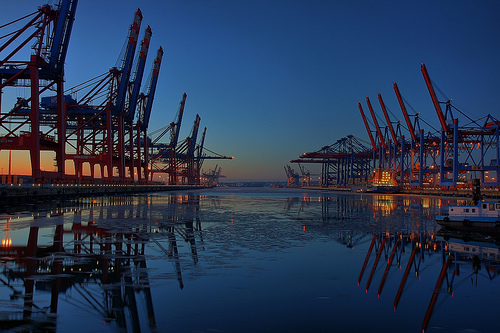
The river flows through Dresden and finally, beyond Meissen, enters upon its long journey across the North German Plain passing along the former western border of East Germany, touching Torgau, Wittenberg, Dessau, Magdeburg, Wittenberge, and Hamburg along the way, and taking on the waters of the Mulde and Saale from the west, and those of the Schwarze Elster, Havel and Elde from the east. In its northern section, both banks of the Elbe are characterized by flat, very fertile marshlands (Elbe Marshes), former flood plains of the Elbe now diked.
At Magdeburg, there is a viaduct, the Magdeburg Water Bridge, that carries a canal and its shipping traffic over the Elbe and its banks, allowing shipping traffic to pass under it unhindered.
From the sluice of Geesthacht (at kilometer 586) downstream, the Elbe is subject to the tides; the tidal Elbe section is called the Unterelbe (Low Elbe). Soon, the Elbe reaches Hamburg. Within the city-state, the Unterelbe has several branch streams, such as Dove Elbe, Gose Elbe, Köhlbrand, Norderelbe (Northern Elbe), Reiherstieg, Süderelbe (Southern Elbe). Some of which have been disconnected from the main stream for vessels by dikes. In 1390, the Gose Elbe (literally in English: shallow Elbe) was separated from the main stream by a dike connecting the two then-islands of Kirchwerder and Neuengamme. The Dove Elbe (literally in English: deaf Elbe) was diked off in 1437/38 at Gammer Ort. These hydraulic engineering works were carried out to protect marshlands from inundation, and to improve the water supply of the Port of Hamburg. After the heavy inundation by the North Sea flood of 1962, the western section of the Southern Elbe was separated, becoming the Old Southern Elbe, while the waters of the eastern Southern Elbe now merge into the Köhlbrand, which is bridged by the Köhlbrandbrücke, the last bridge over the Elbe before the North Sea.

The Northern Elbe passes the Elbe Philharmonic Hall and is then crossed under by the old Elbe Tunnel (Alter Elbtunnel), both in Hamburg's city center. A bit more downstream, the Lower Elbe's two main anabranches, the Northern Elbe and the Köhlbrand, reunite south of Altona-Altstadt, a locality of Hamburg. Right after both anabranches reunite, the Low Elbe is crossed by the New Elbe Tunnel (Neuer Elbtunnel), the last structural road link across the river before the North Sea. At the bay Mühlenberger Loch in Hamburg at kilometer 634, the Northern Elbe and the Southern Elbe (here now the cut-off meander Old Southern Elbe) used to reunite, which is why the bay is seen as the starting point of the Niederelbe (Lower Elbe). Leaving the city-state, the Lower Elbe then passes between Holstein and the Elbe-Weser Triangle with Stade until it flows into the North Sea at Cuxhaven. Near its mouth, it passes the entrance to the Kiel Canal at Brunsbüttel before it flows into the North Sea.
Cities and towns
Navigation
The Elbe has always been navigable by commercial vessels, and provides important trade links as far inland as Prague. The river is linked by canals (Elbe Lateral Canal, Elbe-Havel Canal, Mittellandkanal) to the industrial areas of Germany and to Berlin. The Elbe-Lübeck Canal links the Elbe to the Baltic Sea, as does the Kiel Canal, whose western entrance is near the mouth of the Elbe. The Elbe-Weser Shipping Channel connects the Elbe with the Weser.
By the Treaty of Versailles, the navigation on the Elbe became subject to the International Commission of the Elbe, seated in Dresden. The statute of the commission was signed in Dresden on 22 February 1922. Following articles 363 and 364 of the Treaty of Versailles, Czechoslovakia was entitled to lease its own harbor basin, Moldauhafen in Hamburg. The lease contract with Germany, supervised by the United Kingdom, was signed on 14 February 1929 and ended in 2028. Since 1993, the Czech Republic has held the former Czechoslovak legal position.

Before Germany was reunited, waterway transport in Western Germany was hindered because inland navigation to Hamburg had to pass through the German Democratic Republic. The Elbe-Seitenkanal (Elbe Lateral Canal) was built between the West German section of the Mittellandkanal and the Lower Elbe to restore this connection. When the two nations were reunited, work began to improve and restore the original links: the Magdeburg Water Bridge now allows large barges to cross the Elbe without entering the river. The often low water levels of the Elbe no longer hinder navigation to Berlin.
Islands
Headwaters
Hořejší – in Kolín
Kmochův – in Kolín

Upper reaches
Pillnitzer Elbinsel – in Dresden's southern quarter of Pillnitz in the Dresden Basin
Gauernitzer Elbinsel – east of Gauernitz in the Dresden Basin between Dresden and Meißen
Middle Elbe
Rotehorninsel – in Magdeburg
Steinkopfinsel – in Magdeburg
Between Northern and Southern Elbe (Norderelbe/Süderelbe)
Wilhelmsburg, including the islands Veddel, Georgswerder, Kleiner Grasbrook, Steinwerder, Peute and several more – in Hamburg's borough of Mitte (centre)
Kaltehofe (also "Kalte Hofe") – in Hamburg's borough of Mitte
Finkenwerder – in Hamburg's borough of Mitte
Lower Elbe
Schweinesand – south of Blankenese (Hamburg)
Neßsand – south of Tinsdal
Hahnöfersand – north of Jork
Hanskalbsand – south of Schulau
Lühesand – east of Stade
Bisterhorster Sand – west of Wedel
Pagensand – west of Seestermühe
Schwarztonnensand – east of Drochtersen
Rhinplate – west of Glückstadt
Outer Elbe (estuary)
Neuwerk – an exclave – in Hamburg's borough of Mitte
Scharhörn – an exclave of Hamburg's borough of Mitte
Nigehörn – an exclave Hamburg's borough of Mitte
Former islands
Medemsand
Ferries
The Elbe is crossed by many ferries, both passenger and car-carrying. In downstream order, these include:
Dolní Žleb Ferry, at Dolní Žleb part of Děčín
Rathen Ferry, at Rathen
Pillnitz Kleinzschachwitz Ferry, in the eastern suburbs of Dresden
Laubegast Niederpoyritz Ferry, in Dresden
Johannstadt Neustadt Ferry, in Dresden
Belgern Ottersitz Ferry, between Belgern and Ottersitz