
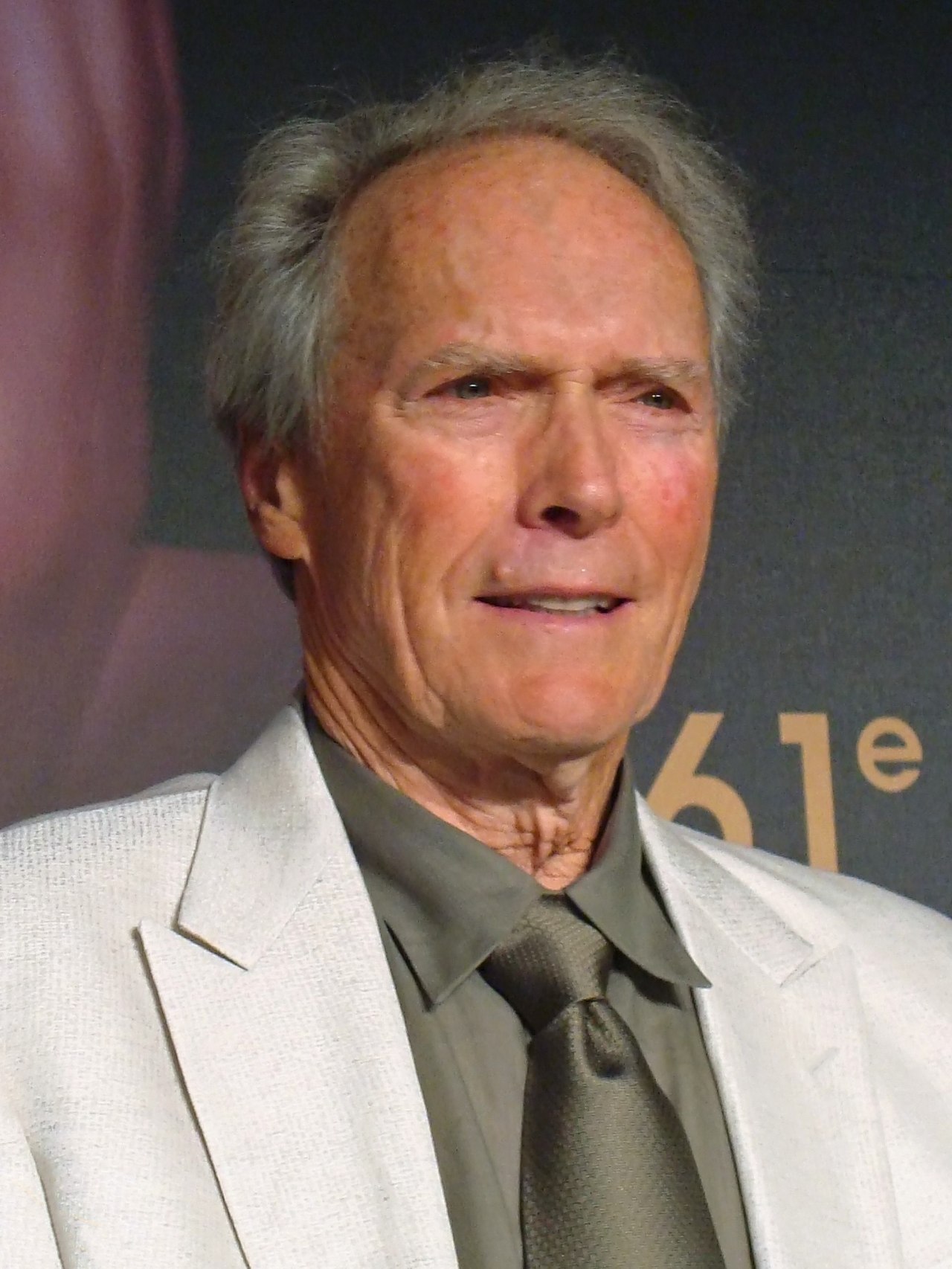
Clinton Eastwood Jr. (born May 31, 1930) is an American retired actor, filmmaker, and musician. After achieving success in the Western TV series Rawhide, Eastwood rose to international fame with his role as the "Man with No Name" in Sergio Leone's Dollars Trilogy of spaghetti Westerns during the mid-1960s and as antihero cop Harry Callahan in the five Dirty Harry films throughout the 1970s and 1980s. These roles, among others, have made Eastwood an enduring cultural icon of masculinity. Elected in 1986, Eastwood served for two years as the mayor of Carmel-by-the-Sea, California.
Eastwood's greatest commercial successes are the adventure comedy Every Which Way but Loose (1978) and its action comedy sequel Any Which Way You Can (1980). Other popular Eastwood films include the Westerns Hang 'Em High (1968), The Outlaw Josey Wales (1976) and Pale Rider (1985), the action-war film Where Eagles Dare (1968), the prison film Escape from Alcatraz (1979), the war film Heartbreak Ridge (1986), the action film In the Line of Fire (1993), and the romantic drama The Bridges of Madison County (1995). More recent works include Gran Torino (2008), The Mule (2018), and Cry Macho (2021). Since 1967, Eastwood's company Malpaso Productions has produced all but four of his American films.
An Academy Award nominee for Best Actor, Eastwood won Best Director and Best Picture for his Western film Unforgiven (1992) and his sports drama Million Dollar Baby (2004). In addition to directing many of his own star vehicles, Eastwood has directed films in which he did not appear, such as the mystery drama Mystic River (2003) and the war film Letters from Iwo Jima (2006), for which he received Academy Award nominations, as well as the legal thriller Juror #2 (2024). He also directed the biographical films Changeling (2008), Invictus (2009), American Sniper (2014), Sully (2016), and Richard Jewell (2019).
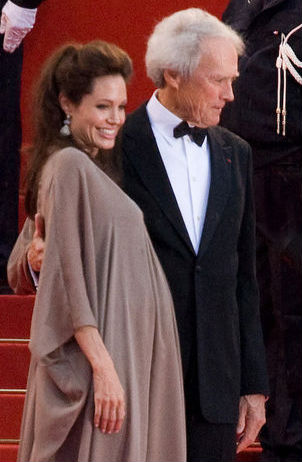
Eastwood's accolades include four Academy Awards, four Golden Globe Awards, three César Awards, the Golden Lion for Lifetime Achievement, the Honorary Palme d'Or, and an AFI Life Achievement Award, as well as nominations for three BAFTA Awards. Bestowed two of France's highest civilian honors, he received the Commander of the Ordre des Arts et des Lettres in 1994, and the Legion of Honour in 2007.
Early life
Clinton Eastwood Jr. was born on May 31, 1930, at Saint Francis Memorial Hospital in San Francisco, to Ruth (née Margret Runner; 1909–2006) and Clinton Eastwood (1906–1970), who at the time lived in Oakland's Lake Merritt neighborhood. During her son's fame, Ruth was known by the surname of her second husband, John Belden Wood (1913–2004), whom she married after the death of Clinton Sr. Eastwood was nicknamed "Samson" by hospital nurses because he weighed 11 pounds 6 ounces (5.2 kg) at birth. He has a younger sister, Jeanne Bernhardt (b. 1934).
He is of English, Irish, Scottish, and Dutch ancestry. Eastwood is descended from Mayflower passenger William Bradford, making him the 12th generation of his family born in North America. His family relocated three times during the 1930s as his father changed occupations. Contrary to what Eastwood has suggested in media interviews, they did not move between 1940 and 1949. After settling in Piedmont, California, the Eastwoods lived in an affluent part of town, had a swimming pool, belonged to a country club, and each parent drove their own car. Eastwood's father worked as manufacturing executive at Georgia-Pacific for most of his career. As Clint and Jeanne grew older, Ruth took a clerical job at IBM.

Eastwood attended Piedmont Middle School, where he was held back due to poor academic performance, and records indicate he also attended summer school. From January 1945 until at least January 1946, he attended Piedmont High School, but was asked to leave after writing an obscene suggestion to a school official on the athletic field scoreboard and burning an effigy on the school lawn, in addition to other infractions. He transferred to Oakland Technical High School and graduated on February 2, 1949.
Eastwood worked a number of odd jobs, including lifeguard, paper carrier, grocery clerk, forest firefighter, and golf caddy. He said he attempted to enroll at Seattle University in 1951, but instead was drafted into the United States Army during the Korean War. Don Loomis recalled hearing that Eastwood was romancing one of the daughters of a Fort Ord officer, who may have been encouraged to look out for him when postings were assigned. While returning from a prearranged tryst in Seattle, he was a passenger on a Douglas AD bomber that ran out of fuel and crashed into the ocean near Point Reyes. Using a life raft, he and the pilot swam 2 miles (3.2 km) to safety. Eastwood was discharged in February 1953.
Career
1954–1962: Acting debut and Rawhide
According to a CBS press release for Rawhide, Universal-International's camera crew was shooting in Fort Ord when an enterprising assistant spotted Eastwood and invited him to meet the director, although this is disputed by Eastwood's unauthorized biographer, Patrick McGilligan. According to Eastwood's official biography, the key figure was a man named Chuck Hill, who was stationed in Fort Ord and had contacts in Hollywood. While in Los Angeles, Hill became reacquainted with Eastwood and managed to sneak him into a Universal studio, where he introduced him to cameraman Irving Glassberg. Glassberg arranged for an audition under Arthur Lubin, who, although very impressed with Eastwood's appearance and stature (then 6 ft 4 in [193 cm]), disapproved of his acting, remarking, "He was quite amateurish. He didn't know which way to turn or which way to go or do anything." Lubin suggested that he attend drama classes and arranged for Eastwood's initial contract in April 1954, at $100 per week. After signing, Eastwood was initially criticized for his stiff manner and delivering his lines through his teeth, a lifelong trademark.
In May 1954, Eastwood made his first real audition for Six Bridges to Cross, but was rejected by Joseph Pevney. After many unsuccessful auditions, he was eventually given a minor role by director Jack Arnold in Revenge of the Creature (1955), a sequel to the recently released Creature from the Black Lagoon. In September 1954, Eastwood worked for three weeks on Arthur Lubin's Lady Godiva of Coventry, won a role in February 1955, playing "Jonesy", a sailor in Francis in the Navy and appeared uncredited in another Jack Arnold film, Tarantula, where he played a squadron pilot. In May 1955, Eastwood put four hours' work into the film Never Say Goodbye and had a minor uncredited role as a ranch hand in August 1955 with Star in the Dust, starring John Agar and Mamie Van Doren, the latter of whom he dated briefly. Universal presented him with his first television role on July 2, 1955, on NBC's Allen in Movieland, which starred comedian Steve Allen, actor Tony Curtis, and swing musician Benny Goodman. Although he continued to develop as an actor, Universal terminated his contract on October 23, 1955.
Eastwood joined the Marsh Agency, and although Lubin landed him his biggest role to date in The First Traveling Saleslady (1956) and later hired him for Escapade in Japan (1957), without a formal contract, Eastwood was struggling. On his financial advisor Irving Leonard's advice, he switched to the Kumin-Olenick Agency in 1956 and Mitchell Gertz in 1957. He landed several small roles in 1956 as a temperamental army officer for a segment of ABC's Reader's Digest series, and as a motorcycle gang member on a Highway Patrol episode. In 1957, Eastwood played a cadet in the West Point series and a suicidal gold prospector on Death Valley Days.
In 1958, he played a Navy lieutenant in a segment of Navy Log and in early 1959 made a notable guest appearance as Red Hardigan on Maverick opposite James Garner as a cowardly villain intent on marrying a rich girl for money. Eastwood had a small part as an aviator in Lafayette Escadrille (1958) and played a major role as an ex-renegade of the Confederacy in Ambush at Cimarron Pass (also 1958), a film that Eastwood considers the low point of his career.

In 1958, Eastwood was cast as Rowdy Yates in the CBS hour-long western series Rawhide, the career breakthrough he had long sought. Eastwood was not especially happy with his character; Eastwood was almost 30, and Rowdy was too young and cloddish for his comfort. Filming began in Arizona in the summer of 1958. It took just three weeks for Rawhide to reach the top 20 in TV ratings and, although it never won an Emmy, it was a major success for several years, and peaked at number six in the ratings from October 1960 to April 1961. The Rawhide years (1959–65) were some of the most grueling of Eastwood's career, often filming six days a week for an average of 12 hours a day, but some directors still criticized him for not working hard enough. By late 1963, Rawhide was beginning to decline in the ratings and lacked freshness in the scripts; it was canceled in the middle of the 1965–66 season. Eastwood made his first attempt at directing when he filmed several trailers for the show, but was unable to convince producers to let him direct an episode. In the show's first season, Eastwood earned $750 an episode. At the time of Rawhide's cancellation, he received $119,000 an episode as severance pay.
1963–1969: Spaghetti Westerns and stardom
In late 1963, Eastwood's Rawhide co-star Eric Fleming rejected an offer to star in an Italian-made western called A Fistful of Dollars (1964), filmed in a remote region of Spain by a then–relatively unknown director, Sergio Leone. Richard Harrison suggested Eastwood to Leone because Harrison knew that Eastwood could play a cowboy convincingly. Eastwood thought the film would be an opportunity to escape from his Rawhide image. He signed a contract for $15,000 in wages for eleven weeks' work, with a bonus of a Mercedes-Benz automobile upon completion. Eastwood later said of the transition from a TV western to A Fistful of Dollars: "In Rawhide I did get awfully tired of playing the conventional white hat. The hero who kisses old ladies and dogs and was kind to everybody. I decided it was time to be an antihero." Eastwood was instrumental in creating the Man with No Name character's distinctive visual style and, although a nonsmoker, Leone insisted Eastwood smoke cigars as an essential ingredient of the "mask" he was attempting to create for the character. "I needed a mask more than an actor," Leone would later explain, "and back then Eastwood had only two facial expressions: with the hat and without the hat".
A Fistful of Dollars proved a landmark in the development of spaghetti Westerns, with Leone depicting a more lawless and desolate world than traditional westerns, and challenging the American stereotype of the western herο by offering a morally ambiguous antihero. The film's success made Eastwood a major star in Italy and he was rehired to star in For a Few Dollars More (1965), the second of the trilogy. Through the efforts of screenwriter Luciano Vincenzoni, the rights to For a Few Dollars More and the trilogy's final film, The Good, the Bad and the Ugly (1966), were sold to United Artists for about $900,000.

In January 1966, Eastwood met producer Dino De Laurentiis in New York City and agreed to star in a non-Western five-part anthology production, The Witches (Le Streghe, 1967), opposite De Laurentiis's wife, Silvana Mangano. Eastwood's 19-minute installment took only a few days to shoot. Two months later he began work on The Good, the Bad and the Ugly, again playing the mysterious Man with No Name. Lee Van Cleef returned as a ruthless fortune seeker, with Eli Wallach portraying the Mexican bandit Tuco Ramirez. The storyline involved the search for a cache of Confederate gold buried in a cemetery. During the filming of a scene in which a bridge was blown up, Eastwood urged Wallach to retreat to a hilltop. "I know about these things", he said. "Stay as far away from special effects and explosives as you can." Minutes later, confusion among the crew over the word "Vaya!" resulted in a premature explosion that could have killed Wallach.
I wanted to play it with an economy of words and create this whole feeling through attitude and movement. It was just the kind of character I had envisioned for a long time, keep to the mystery and allude to what happened in the past. It came about after the frustration of doing Rawhide for so long. I felt the less he said, the stronger he became and the more he grew in the imagination of the audience.
The Dollars trilogy was not released in the United States until 1967, when A Fistful of Dollars opened on January 18, followed by For a Few Dollars More on May 10, and The Good, the Bad and the Ugly on December 29. All three were commercially successful, particularly The Good, the Bad and the Ugly, which eventually earned $8 million in rental earnings and turned Eastwood into a major film star being ranked for the first time on Quigley's Top Ten Money Making Stars Poll in 1968 in fifth place. All three received poor reviews, and marked the beginning of a battle for Eastwood to win American film critics' respect. Judith Crist described A Fistful of Dollars as "cheapjack", while Newsweek called For a Few Dollars More "excruciatingly dopey". Renata Adler of The New York Times said The Good, the Bad and the Ugly was "the most expensive, pious and repellent movie in the history of its peculiar genre". Time drew attention to the film's wooden acting, especially Eastwood's, though a few critics such as Vincent Canby and Bosley Crowther of The New York Times praised his coolness. Leone's cinematography was widely acclaimed, even by critics who disparaged the acting.
Stardom brought Eastwood more roles. He signed to star in the American revisionist western Hang 'Em High (1968) alongside Inger Stevens, Pat Hingle, Ed Begley, playing a man who takes up a marshal's badge and seeks revenge as a lawman after being lynched by vigilantes and left for dead. The film earned Eastwood $400,000 and 25% of its net box office. Using money earned from the Dollars trilogy, Eastwood's advisor Irving Leonard helped establish Eastwood's own production company, Malpaso Productions, named after Malpaso Creek on Eastwood's property in Monterey County, California. The 38-year-old actor was still relatively unknown as late as a month prior to the film's release, as evidenced by a July 1968 news item by syndicated columnist Dorothy Manners: "The proverbial man in the street is still asking, 'Who's Clint Eastwood?'" Leonard arranged for Hang 'Em High to be a joint production with United Artists; when it opened in August, it had the largest opening weekend in United Artists' history. Hang 'Em High was widely praised by critics, including Archer Winsten of the New York Post, who called it "a western of quality, courage, danger and excitement".
Before Hang 'Em High's release, Eastwood had already begun working on Coogan's Bluff (1968), about an Arizona deputy sheriff tracking a wanted psychopathic criminal (Don Stroud) through New York City. He was reunited with Universal Studios for it after receiving an offer of $1 million – more than double his previous salary. Jennings Lang arranged for Eastwood to meet Don Siegel, a Universal contract director who later became Eastwood's close friend, forming a partnership that would last more than ten years and produce five films. Shooting began in November 1967, before the script had been finalized. The film was controversial for its portrayal of violence. Coogan's Bluff also became the first collaboration with Argentine composer Lalo Schifrin, who scored several Eastwood films in the 1970s and 1980s, including the Dirty Harry films.
Eastwood was paid $750,000 for the war epic Where Eagles Dare (1968), about a World War II squad parachuting into a Gestapo stronghold in the Alps. Richard Burton played the squad's commander, with Eastwood as his right-hand man. Eastwood was also cast as Two-Face in the Batman television show, but the series was canceled before filming began.
Eastwood then branched out to co-star in a musical, Paint Your Wagon (1969). Eastwood and Lee Marvin play gold miners who buy a Mormon settler's less favored wife (Jean Seberg) at an auction. Bad weather and delays plagued the production, and the film's budget eventually exceeded $20 million, which was high for the time. The film was not a critical or commercial success, but was nominated for a Golden Globe Award for Best Motion Picture – Musical or Comedy.
1970–1989: Directorial debut and Dirty Harry
Eastwood starred with Shirley MacLaine in the western Two Mules for Sister Sara (1970), directed by Don Siegel. The film follows an American mercenary, who becomes mixed up with a prostitute disguised as a nun, and ends up helping a group of Juarista rebels during the reign of Emperor Maximilian I of Mexico. Eastwood again played a mysterious stranger – unshaven, wearing a serape-like vest, and smoking a cigar. Although it received moderate reviews, the film is listed in The New York Times Guide to the Best 1,000 Movies Ever Made. Around the same time, Eastwood starred as one of a group of Americans who steals a fortune in gold from the Nazis, in the World War II film Kelly's Heroes (also 1970), with Donald Sutherland and Telly Savalas. Kelly's Heroes was the last film Eastwood appeared in that was not produced by his own Malpaso Productions. Shot on location in Yugoslavia and London, the film received mostly a positive reception and its anti-war sentiments were recognized. Siegel directed Eastwood's next film, The Beguiled (1971), a tale of a wounded Union soldier, held captive by the sexually repressed matron (played by Geraldine Page) of a Southern girls' school. Upon release the film received major recognition in France and is considered one of Eastwood's finest works by French critics. However, it grossed less than $1 million and, according to Eastwood and Lang, flopped due to poor publicity and the "emasculated" role of Eastwood.
Eastwood's career reached a turning point in 1971. Before Irving Leonard died, he and Eastwood had discussed the idea of Malpaso producing Play Misty for Me, a film that was to give Eastwood the artistic control he desired, and his debut as a director. The script was about a jazz disc jockey named Dave (Eastwood), who has a casual affair with Evelyn (Jessica Walter), a listener who had been calling the radio station repeatedly at night, asking him to play her favorite song – Erroll Garner's "Misty". When Dave ends their relationship, the unhinged Evelyn becomes a murderous stalker. Filming commenced in Monterey in September 1970 and included footage of that year's Monterey Jazz Festival. The film was highly acclaimed with critics, such as Jay Cocks in Time, Andrew Sarris in the Village Voice, and Archer Winsten in the New York Post all praising the film, as well as Eastwood's directorial skills and performance. Walter was nominated for a Golden Globe Best Actress Award (Drama), for her performance in the film.
I know what you're thinking – "Did he fire six shots or only five?" Well, to tell you the truth, in all this excitement, I've kinda lost track myself. But, being as this is a .44 Magnum, the most powerful handgun in the world and would blow your head clean off, you've got to ask yourself one question: "Do I feel lucky?" Well, do you, punk?
Dirty Harry (1971), written by Harry and Rita Fink, centers on a hard-edged New York City (later changed to San Francisco) police inspector named Harry Callahan who is determined to stop a psychotic killer by any means. Dirty Harry has been described as being arguably Eastwood's most memorable character, and the film has been credited with inventing the "loose-cannon cop" genre. Author Eric Lichtenfeld argues that Eastwood's role as Dirty Harry established the "first true archetype" of the action film genre. His lines (quoted above) are regarded by firearms historians, such as Garry James and Richard Venola, as the force that catapulted the ownership of .44 Magnum revolvers to new heights in the United States; specifically the Smith & Wesson Model 29 carried by Harry Callahan. Dirty Harry, released in December 1971, earned $22 million in the United States and Canada. It was Siegel's highest-grossing film and the start of a series of films featuring the character Harry Callahan. Although a number of critics praised Eastwood's performance as Dirty Harry, such as Jay Cocks who described him as "giving his best performance so far, tense, tough, full of implicit identification with his character", the film was also widely criticized as being fascistic. After having been second for the past two years, Eastwood was voted first in Quigley's Top Ten Money Making Stars Poll in 1972 and again in 1973.
Following Sean Connery's announcement that he would not play James Bond again, Eastwood was offered the role but turned it down, saying, "that was someone else's gig. That's Sean's deal. It didn't feel right for me to be doing it." He next starred in the loner Western Joe Kidd (1972), based on a character inspired by Reies Lopez Tijerina, who stormed a courthouse in Tierra Amarilla, New Mexico, in June 1967. During filming, Eastwood suffered symptoms of a bronchial infection and several panic attacks. Joe Kidd received a mixed reception, with Roger Greenspun of The New York Times writing that it was unremarkable, with foolish symbolism and sloppy editing, although he praised Eastwood's performance.
Eastwood's first western as director was High Plains Drifter (1973), in which he also starred. The film had a moral and supernatural theme, later emulated in Pale Rider. The plot follows a mysterious stranger (Eastwood) who arrives in a brooding Western town where the people hire him to protect them against three soon-to-be-released felons. There remains confusion during the film as to whether the stranger is the brother of the deputy, whom the felons lynched and murdered, or his ghost. Holes in the plot were filled with black humor and allegory, influenced by Leone. The revisionist film received a mixed reception, but was a major box-office success. A number of critics thought Eastwood's directing was "as derivative as it was expressive", with Arthur Knight of the Saturday Review remarking that Eastwood had "absorbed the approaches of Siegel and Leone and fused them with his own paranoid vision of society". John Wayne, who had declined a role in the film, sent a letter to Eastwood soon after the film's release in which he complained that "The townspeople did not represent the true spirit of the American pioneer, the spirit that made America great."
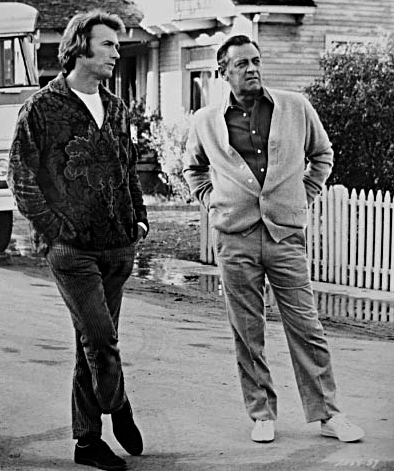
Eastwood next turned his attention towards Breezy (1973), a film starring William Holden and Kay Lenz about love blossoming between a middle-aged man and a teenage girl. Various actresses had lobbied for the title role, including Eastwood's future longtime companion Sondra Locke, who at 29 was nearly twice the character's age. The film, shot very quickly and efficiently by Frank Stanley, came in $1 million under budget and was finished three days ahead of schedule. Breezy was not a major critical or commercial success. Eastwood then stepped back in front of the camera to reprise his role as Harry Callahan in Magnum Force (1973), a sequel to Dirty Harry, about a group of rogue young officers (among them David Soul, Robert Urich, and Tim Matheson) in the San Francisco Police Department who systematically exterminate the city's worst criminals. Although the film was a major success after release, grossing $58.1 million in the United States (a record for Eastwood), it was not a critical success. The New York Times critic Nora Sayre panned the often contradictory moral themes of the film, while the paper's Frank Rich called it "the same old stuff".
Eastwood teamed up with Jeff Bridges and George Kennedy in the buddy action caper Thunderbolt and Lightfoot (1974), a road movie about a veteran bank robber Thunderbolt (Eastwood) and a young con man drifter, Lightfoot (Bridges). On its release in spring 1974, the film was praised for its offbeat comedy mixed with high suspense and tragedy—but was only a modest success at the box office, earning $32.4 million. Eastwood's acting was noted by critics, but was overshadowed by Bridges, who was nominated for an Academy Award for Best Supporting Actor. Eastwood reportedly fumed at the lack of Academy Award recognition for him and swore that he would never work for United Artists again.
Eastwood's next film The Eiger Sanction (1975) was based on Trevanian's critically acclaimed spy novel of the same name. Eastwood plays Jonathan Hemlock in a role originally intended for Paul Newman, an assassin turned college art professor who decides to return to his former profession for one last "sanction" in return for a rare Pissarro painting. In the process he must climb the north face of the Eiger in Switzerland under perilous conditions. Mike Hoover taught Eastwood how to climb during several weeks of preparation at Yosemite before filming commenced in Grindelwald, Switzerland. Despite prior warnings about the perils of the Eiger, Eastwood insisted on doing all his own climbing and stunts. The film crew suffered a number of accidents, including one fatality. Eastwood cast former Bond girl Claudine Auger as his love interest, but deleted her entire performance from the movie. Upon release in May 1975, The Eiger Sanction was marginally successful commercially, receiving $14.2 million at the box-office, and gained mixed reviews. Joy Gould Boyum of The Wall Street Journal dismissed the film as "brutal fantasy". Eastwood blamed Universal Studios for the film's poor promotion and turned his back on them to make an agreement with Warner Bros., through Frank Wells, that has lasted to the present day.
The Outlaw Josey Wales (1976), a western inspired by Asa Carter's 1972 novel of the same name, has lead character Josey Wales (Eastwood) as a pro-Confederate guerrilla who refuses to surrender his arms after the American Civil War and is chased across the old southwest by a group of enforcers. The supporting cast included Locke as his love interest and Chief Dan George as an elderly Cherokee who strikes up a friendship with Wales. Director Philip Kaufman was fired by producer Bob Daley at Eastwood's command in October 1975, three weeks into the shoot, resulting in a fine reported to be around $60,000 from the Directors Guild of America – who subsequently passed new legislation reserving the right to impose a major fine on a producer for discharging and replacing a director. The film was pre-screened at the Sun Valley Center for the Arts and Humanities in Idaho during a six-day conference entitled Western Movies: Myths and Images. Invited to the screening were a number of well-known film critics, including Jay Cocks and Arthur Knight; directors such as King Vidor, William Wyler, and Howard Hawks; and a number of academics. Upon its release in the summer of 1976, The Outlaw Josey Wales was widely acclaimed, with many critics and viewers seeing Eastwood's role as an iconic one that related to America's ancestral past and the destiny of the nation after the American Civil War. Roger Ebert compared the nature and vulnerability of Eastwood's portrayal of Josey Wales with his Man with No Name character in the Dollars westerns, and praised the film's atmosphere. The film would later appear in Time's "Top 10 Films of the Year".
Eastwood was then offered the role of Benjamin L. Willard in Francis Coppola's Apocalypse Now, but declined, for he did not wish to spend weeks on location in the Philippines. He also refused the part of a platoon leader in Ted Post's Vietnam War film Go Tell the Spartans, and instead decided to make a third Dirty Harry film, The Enforcer (1976). The film had Callahan partnered with a new female officer (Tyne Daly) to face a San Francisco Bay area group resembling the Symbionese Liberation Army. The film, culminating in a shootout on Alcatraz island, was considerably shorter than the previous Dirty Harry films at 95 minutes, but was a major commercial success grossing $100 million worldwide to become Eastwood's highest-grossing film to date.
Eastwood directed and starred in The Gauntlet (1977) opposite Locke, Pat Hingle, William Prince, Bill McKinney, and Mara Corday. In this film, he portrays a down-and-out cop assigned to escort a prostitute from Las Vegas to Phoenix to testify against the mob. Although a moderate hit with the viewing public, critics had mixed feelings about the film, with many believing it was overly violent. Ebert, in contrast, gave the film three stars and called it "classic Clint Eastwood: fast, furious, and funny". In Every Which Way but Loose (1978), he had an uncharacteristic offbeat comedy role. His character, Philo Beddoe, is a trucker and brawler who roams the American West searching for a lost love (Locke) accompanied by his best friend, Orville Boggs (played by Geoffrey Lewis) and an orangutan called Clyde. The film proved surprisingly successful upon its release and became Eastwood's most commercially successful film up to that time. Panned by critics, it ranked high among the box-office successes of his career and was the second-highest-grossing film of 1978.
Eastwood starred in Escape from Alcatraz (1979), the last of his films directed by Siegel. It was based on the true story of Frank Lee Morris who, along with John and Clarence Anglin, escaped from the notorious Alcatraz Federal Penitentiary in 1962. The film was a major success; Stanley Kauffmann of The New Republic praised it as "crystalline cinema" and Frank Rich of Time described it as "cool, cinematic grace".
Eastwood directed and enacted the title role in Bronco Billy (1980), alongside Locke, Scatman Crothers, and Sam Bottoms. Filming commenced on October 1, 1979, in the Boise metropolitan area and was shot in five and a half weeks on a budget of $5 million. Cinematographer David Worth stated, "Being able to capture the true love between Clint and Sondra was very special." Eastwood has cited Bronco Billy as being one of the most relaxed shoots of his career and biographer Richard Schickel argued that Bronco Billy is Eastwood's most self-referential character. The film was a commercial disappointment, but was liked by critics. Janet Maslin of The New York Times wrote that film was "the best and funniest Clint Eastwood movie in quite a while", and praised Eastwood's directing, intricately juxtaposing the old West and the new West. Released later in 1980, Any Which Way You Can was the sequel to Every Which Way but Loose and also starring Eastwood. The film received a number of bad reviews from critics, although Maslin described it as "funnier and even better than its predecessor". In theaters over the Christmas season, Any Which Way You Can was a major box office success and ranked among the year's top five highest-grossing films.
Eastwood directed and starred in Honkytonk Man (1982), based on the eponymous Clancy Carlile's depression-era novel. Eastwood portrays a struggling western singer Red Stovall who suffers from tuberculosis, but has finally been given an opportunity to make it big at the Grand Ole Opry. He is accompanied by his young nephew (played by real-life son Kyle) to Nashville, Tennessee, where he is supposed to record a song. Only Time gave the film a good review in the United States, with most reviewers criticizing its blend of muted humor and tragedy. Nevertheless, the film received a more positive reception in France, where it was compared to John Ford's The Grapes of Wrath, and it has since acquired the very high rating of 93 percent on Rotten Tomatoes. Around the same time, Eastwood directed, produced, and starred in the Cold War-themed Firefox (also 1982). Based on a 1977 novel with the same name written by Craig Thomas, the film was shot before but released after Honkytonk Man. Russian filming locations were not possible due to the Cold War, and the film had to be shot in Vienna and other locations in Austria to simulate many of the Eurasian story locations. With a production cost of $20 million, it was Eastwood's highest budget film to that time. People likened Eastwood's performance to "Luke Skywalker trapped in Dirty Harry's Soul".
Eastwood directed and starred in the fourth Dirty Harry film, Sudden Impact (1983), which is considered the darkest and most violent of the series. By this time, Eastwood received 60 percent of all profits from films he starred in and directed, with the rest going to the studio. Sudden Impact was his final on-screen collaboration with Locke. She plays a middle-aged painter who, along with her sister, was gang-raped years before the story takes place and seeks revenge for her sister's now-vegetative state by systematically murdering the rapists. The line "Go ahead, make my day" (uttered by Eastwood during an early scene in a coffee shop) has been cited as one of cinema's immortal lines. It was quoted by President Ronald Reagan in a speech to Congress, and used during the 1984 presidential elections. The film was the second–most commercially successful of the Dirty Harry films (after The Enforcer), earning $70 million. It received very positive reviews, with many critics praising the feminist aspects of the film through its explorations of the physical and psychological consequences of rape.
Tightrope (1984) had Eastwood starring opposite Geneviève Bujold in a provocative thriller, inspired by newspaper articles about an elusive Bay Area rapist. Set in New Orleans to avoid confusion with the Dirty Harry films, Eastwood played a divorced cop drawn into his target's tortured psychology and fascination for sadomasochism. Tightrope was a critical and commercial hit and became the fourth highest-grossing R-rated film of 1984. Eastwood next starred in the crime comedy City Heat (also 1984) alongside Burt Reynolds, a film about an ex-cop turned private eye and his former police lieutenant partner who get mixed up with gangsters in the Prohibition era of the 1930s. The film grossed around $50 million domestically, but was overshadowed by Eddie Murphy's Beverly Hills Cop.
Westerns. A period gone by, the pioneer, the loner operating by himself, without benefit of society. It usually has something to do with some sort of vengeance; he takes care of the vengeance himself, doesn't call the police. Like Robin Hood. It's the last masculine frontier. Romantic myth, I guess, though it's hard to think about anything romantic today. In a Western you can think, Jesus, there was a time when man was alone, on horseback, out there where man hasn't spoiled the land yet.
Eastwood made his only foray into TV direction with the Amazing Stories episode "Vanessa in the Garden" (1985), which starred Harvey Keitel and Locke as a married couple. This was his first collaboration with Steven Spielberg, who later co-produced Flags of Our Fathers and Letters from Iwo Jima. He would revisit the Western genre when he directed and starred in Pale Rider (1985), a film based on the classic western Shane (1953) and follows a preacher descending from the mists of the Sierras to side with the miners during the California Gold Rush of 1850. The title is a reference to the Four Horsemen of the Apocalypse, as the rider of the pale horse is Death, and shows similarities to Eastwood's western High Plains Drifter (1973) in its themes of morality and justice as well as its exploration of the supernatural. It was hailed as one of the best films of 1985 and the best western to appear for a considerable period, with Gene Siskel of the Chicago Tribune remarking, "This year (1985) will go down in film history as the moment Clint Eastwood finally earned respect as an artist."
Eastwood co-starred with Marsha Mason in the military drama Heartbreak Ridge (1986), about the 1983 United States invasion of Grenada. He portrayed a United States Marine Corps Gunnery Sergeant veteran of the Vietnam War who realizes he is nearing the end of his military service. Production and filming were marred by internal disagreements between Eastwood and long-time friend and producer Fritz Manes, as well as between Eastwood and the United States Department of Defense, which had expressed contempt for the film. At the time, the film was a commercial rather than a critical success, and has only come to be viewed more favorably in recent times. The film grossed $70 million domestically.
Eastwood starred in The Dead Pool (1988), the fifth and final film in the Dirty Harry series. It co-starred Patricia Clarkson, Liam Neeson, and a young Jim Carrey who plays Johnny Squares, a drug-addled rock star and the first of the victims on a list of celebrities drawn up by horror film director Peter Swan (Neeson) who are deemed most likely to die, the so-called "Dead Pool". The list is stolen by an obsessed fan who, in mimicking his favorite director, makes his way through the list killing off celebrities, of which Dirty Harry is also included. The Dead Pool grossed nearly $38 million, relatively low receipts for a Dirty Harry film. It is generally viewed as the weakest film of the series, though Roger Ebert thought it was as good as the original.
Eastwood began working on smaller, more personal projects and experienced a lull in his career between 1988 and 1992. Always interested in jazz, he directed Bird (1988), a biopic starring Forest Whitaker as jazz musician Charlie "Bird" Parker. Alto saxophonist Jackie McLean and Spike Lee, son of jazz bassist Bill Lee and a long time critic of Eastwood, criticized the characterization of Charlie Parker remarking that it did not capture his true essence and sense of humor. Eastwood received two Golden Globes for the film, the Cecil B. DeMille Award for his lifelong contribution, and the Best Director award. However, Bird was a commercial failure, earning just $11 million, which Eastwood attributed to the declining interest in jazz among black people. Carrey would appear with Eastwood again in the poorly-received comedy Pink Cadillac (1989). The film is about a bounty hunter and a group of white supremacists chasing an innocent woman (Bernadette Peters) who tries to outrun everyone in her husband's prized pink Cadillac. The film failed both critically and commercially, earning barely more than Bird and marking a low point in Eastwood's career.
1990–2009: Critical acclaim and awards success
Eastwood directed and starred in White Hunter Black Heart (1990), an adaptation of Peter Viertel's roman à clef, about John Huston and the making of the classic film The African Queen. Shot on location in Zimbabwe in the summer of 1989, the film received some critical attention but with only a limited release earned just $8.4 million. Eastwood directed and co-starred with Charlie Sheen in The Rookie, a buddy cop action film released in December 1990. Critics found the film's plot and characterization unconvincing, but praised its action sequences. An ongoing lawsuit, in response to Eastwood allegedly ramming a woman's car, resulted in no Eastwood films being shown in cinemas in 1991. Eastwood won the suit and agreed to pay the complainant's legal fees if she did not appeal.
[I]f possible, he looks even taller, leaner and more mysteriously possessed than he did in Sergio Leone's seminal Fistful of Dollars a quarter of a century ago. The years haven't softened him. They have given him the presence of some fierce force of nature, which may be why the landscapes of the mythic, late 19th-century West become him, never more so than in his new Unforgiven. ... This is his richest, most satisfying performance since the underrated, politically lunatic Heartbreak Ridge. There's no one like him.
Eastwood revisited the western genre in Unforgiven (1992), a film which he directed and starred in as an aging ex-gunfighter long past his prime. Scripts existed for the film as early as 1976 under titles such as The Cut-Whore Killings and The William Munny Killings, but Eastwood delayed the project because he wanted to wait until he was old enough to play his character and to savor it as the last of his western films. Unforgiven was a major commercial and critical success; Jack Methews of the Los Angeles Times described it as "the finest classical western to come along since perhaps John Ford's 1956 The Searchers". The film was nominated for nine Academy Awards (including Best Actor for Eastwood and Best Original Screenplay for David Webb Peoples), and won four, including Best Picture and Best Director for Eastwood. In 2008 Unforgiven was ranked as the fourth-best American western, behind Shane, High Noon, and The Searchers in the American Film Institute's "AFI's 10 Top 10" list.
Eastwood played Frank Horrigan in the Secret Service thriller In the Line of Fire (1993), directed by Wolfgang Petersen and co-starring John Malkovich and Rene Russo. Horrigan is a guilt-ridden Secret Service agent haunted by his failure to save John F. Kennedy's life. The film was among the top 10 box office performers in that year, earning $102 million in the United States alone, and 25 years after he was first listed on Quigley's Top Ten Money Making Stars Poll, Eastwood was voted number one again. A few months after film wrapped, Eastwood directed and co-starred alongside Kevin Costner in A Perfect World (also 1993). Set in the 1960s, Eastwood plays a Texas Ranger in pursuit of an escaped convict (Costner) who hits the road with a young boy (T.J. Lowther). Janet Maslin of The New York Times wrote that the film marked the highest point of Eastwood's directing career, and the film has since been cited as one of his most underrated directorial achievements.
At the 1994 Cannes Film Festival Eastwood received France's Ordre des Arts et des Lettres medal, and in 1995, he was awarded the Irving G. Thalberg Memorial Award at the 67th Academy Awards. His next film appearance was in a cameo role as himself in the children's film Casper (1995). He expanded his repertoire by playing opposite Meryl Streep in The Bridges of Madison County (also 1995). Based on the novel by Robert James Waller, the film relates the story of Robert Kincaid (Eastwood), a photographer working for National Geographic who, while photographing historic covered bridges in Iowa, meets and has an affair with an Italian-born farm wife, Francesca (Streep). Despite the novel receiving unfavorable reviews, The Bridges of Madison County film was a commercial and critical success. Roger Ebert wrote, "Streep and Eastwood weave a spell, and it is based on that particular knowledge of love and self that comes with middle age." The film was nominated for a Golden Globe for Best Motion Picture – Drama and won a César Award in France for Best Foreign Film. Streep was also nominated for an Academy Award and a Golden Globe.
Eastwood directed and starred in the political thriller Absolute Power (1997), alongside Gene Hackman (with whom he had appeared in Unforgiven). Eastwood played the role of a veteran thief who witnesses the Secret Service cover-up of a murder. The film received a mixed reception from critics. Later in 1997, Eastwood directed Midnight in the Garden of Good and Evil, based on the novel by John Berendt and starring John Cusack, Kevin Spacey, and Jude Law. The film met with a mixed critical response.
The roles that Eastwood has played, and the films that he has directed, cannot be disentangled from the nature of the American culture of the last quarter century, its fantasies and its realities.
Eastwood directed and starred in True Crime (1999). He plays Steve Everett, a journalist and recovering alcoholic, who has to cover the execution of murderer Frank Beechum (played by Isaiah Washington). True Crime received a mixed reception, with Janet Maslin of The New York Times writing, "his direction is galvanized by a sense of second chances and tragic misunderstandings, and by contrasting a larger sense of justice with the peculiar minutiae of crime. Perhaps he goes a shade too far in the latter direction, though." The film was a box office failure, earning less than half its $55 million budget and was Eastwood's worst-performing film of the 1990s aside from White Hunter Black Heart, which had a limited release.
Eastwood directed and starred in Space Cowboys (2000) alongside Tommy Lee Jones, Donald Sutherland and James Garner. Eastwood played one of a group of veteran ex-test pilots sent into space to repair an old Soviet satellite. The original music score was composed by Eastwood and Lennie Niehaus. Space Cowboys was critically well-received and holds a 79 percent rating at Rotten Tomatoes, although Roger Ebert wrote that the film was, "too secure within its traditional story structure to make much seem at risk". The film grossed more than $90 million in its United States release, more than Eastwood's two previous films combined. Eastwood played an ex-FBI agent chasing a sadistic killer (Jeff Daniels) in the thriller Blood Work (2002), loosely based on the 1998 novel of the same name by Michael Connelly. The film was a commercial failure, grossing just $26.2 million on an estimated budget of $50 million and received mixed reviews, with Rotten Tomatoes describing it as, "well-made but marred by lethargic pacing".
Eastwood directed and scored the crime drama Mystic River (2003), a film dealing with themes of murder, vigilantism and sexual abuse and starring Sean Penn, Kevin Bacon, and Tim Robbins. The film was praised by critics and won two Academy Awards – Best Actor for Penn and Best Supporting Actor for Robbins – with Eastwood garnering nominations for Best Director and Best Picture. The film grossed $90 million domestically on a budget of $30 million. In 2003, Eastwood was named Best Director of the Year by the National Society of Film Critics.