
SpongeBob SquarePants, also known simply as SpongeBob, is an American animated comedy television series created by marine science educator and animator Stephen Hillenburg for Nickelodeon. It first aired as a sneak peek after the Kids' Choice Awards on May 1, 1999, and officially premiered on July 17, 1999. It showcases the adventures of the character SpongeBob SquarePants and his aquatic friends in the underwater city of Bikini Bottom.
Many of the series' ideas originated in The Intertidal Zone, an unpublished educational comic book Hillenburg created in the 1980s to teach his students about undersea life. After spending several years as an artist and director on Nickelodeon's series Rocko's Modern Life, Hillenburg began developing SpongeBob SquarePants into a television series, and in 1997, he and his crew pitched a seven-minute pilot to Nickelodeon, whose executives wanted SpongeBob to be a child in school. This conflicted with Hillenburg's idea to have SpongeBob be an adult character; he compromised by creating a boating school so SpongeBob could attend school as an adult. After the first three seasons, Hillenburg departed the series following production on The SpongeBob SquarePants Movie (2004), but he returned after the completion of The SpongeBob Movie: Sponge Out of Water (2015) until his death in late 2018.
SpongeBob has received widespread critical acclaim since its release, with praise given to its characters, surreal humor, writing, visuals, animation, and Hawaiian-influenced soundtrack. It is often considered to be one of the greatest animated series of all time. The series was an immediate hit for Nickelodeon, beating Pokémon as the highest-rated and most viewed animated Saturday morning program from its premiere onward in 1999. From then onward, SpongeBob SquarePants continued to be Nickelodeon's highest-rated program, only being surpassed briefly in viewership several times throughout its run.
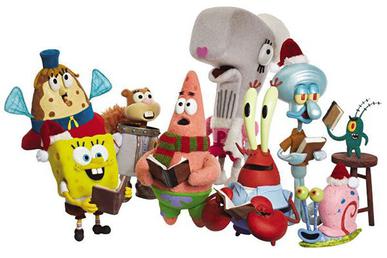
SpongeBob has won a variety of awards, including six Annie Awards, eight Golden Reel Awards, four Emmy Awards, two BAFTA Children's Awards, and a record twenty-two Kids' Choice Awards. The show has been noted as a cultural touchstone for Millennials and Generation Z, becoming ubiquitous within Internet culture and spawning numerous online memes.
The series has run for sixteen seasons, with its seventeenth season premiering on June 12, 2026. On June 9, 2026, the series was renewed for an eighteenth and nineteenth season. SpongeBob is the fourth longest-running American animated series in history, and the longest-running American children's animated series as of 2025. Its popularity has made it a multimedia franchise and Nickelodeon's most profitable program, generating over $16 billion in merchandising revenue by 2024. The franchise now includes four theatrical feature films, two streaming feature films, a Broadway musical, a comic book series, numerous video games and two spin-off series: Kamp Koral: SpongeBob's Under Years (2021–2024) and The Patrick Star Show (2021–present).
Premise
Characters
The series follows SpongeBob SquarePants—an energetic and optimistic sea sponge who lives in a submerged pineapple—and his aquatic friends. SpongeBob has a childlike enthusiasm for life and works as a fry cook at the Krusty Krab, a fast food restaurant. His favorite pastimes include "jellyfishing", which involves catching jellyfish with a net in a manner similar to butterfly catching, and blowing soap bubbles into elaborate shapes. He has a pet sea snail named Gary, who meows like a cat.

SpongeBob's best friend is Patrick Star, a dimwitted yet friendly pink starfish who resides under a rock. Patrick is unaware of his stupidity and considers himself intelligent. Squidward Tentacles, SpongeBob's neighbor and co-worker at the Krusty Krab, is a grumpy and cynical octopus who lives in an Easter Island moai. He despises his job and is constantly annoyed by the antics of SpongeBob and Patrick. Mr. Krabs, a greedy red crab, is the owner of the Krusty Krab and often serves as a father figure to SpongeBob. He has a teenage daughter, a grey sperm whale named Pearl, who has no interest in taking over the family business. Another of SpongeBob's friends is Sandy Cheeks, a thrill-seeking squirrel from Texas, who wears a diving suit to breathe underwater. She is an expert in karate.
Located across the street from the Krusty Krab is an unsuccessful rival restaurant called the Chum Bucket. It rarely has any customers due to its sale of chum-based food, which is considered cannibalistic by most of the fish population. It is run by a small, green, one-eyed copepod named Plankton and his computer wife, Karen. Plankton constantly tries to steal the secret recipe for Mr. Krabs's Krabby Patty burgers. When SpongeBob is not working at the Krusty Krab, he can often be found taking boating lessons from Mrs. Puff, a paranoid but patient pufferfish. SpongeBob wants to obtain a boat-driving license, but he often panics and crashes, causing him to fail the course multiple times.
The French Narrator, or "Frenchy", is an unseen narrator who often introduces episodes and narrates intertitles as if the series were a documentary about the ocean. His role and manner of speaking are references to the oceanographer Jacques Cousteau. Beginning in season 10, the narrator has appeared infrequently in live-action as a diver in a heavy deep sea diving suit.

Recurring guest characters include the retired superheroes Mermaid Man and Barnacle Boy, who are idolized by SpongeBob and Patrick; a pirate specter known as the Flying Dutchman; the muscular lifeguard Larry the Lobster; and the merman god of the sea, King Neptune.
Special episodes of the show are hosted by a live-action pirate named Patchy and his pet parrot Potty, whose segments are presented in a dual narrative with the animated stories. Patchy is depicted as the president of a fictional SpongeBob fan club, and his greatest aspiration is to meet SpongeBob himself.
Setting
The series takes place primarily in the fictional underwater city of Bikini Bottom located in the Pacific Ocean beneath the real-life coral reef known as Bikini Atoll. Its citizens are mostly multicolored fish who live in buildings made from ship funnels, and use "boatmobiles" for transportation. Recurring locations within Bikini Bottom include the neighboring houses of SpongeBob, Patrick, and Squidward; two competing restaurants, the Krusty Krab and the Chum Bucket; Mrs. Puff's Boating School, which includes a driving course and a sunken lighthouse; the Treedome, an oxygenated glass enclosure where Sandy lives; Shady Shoals Rest Home; a seagrass meadow called Jellyfish Fields; and Goo Lagoon, a subaqueous brine pool that is a popular beach hangout.
When the SpongeBob crew began production of the series' pilot episode, they were tasked with designing stock locations where many scenes would take place. The idea was "to keep everything nautical", so the crew included objects like ropes, wooden planks, ships' wheels, netting, anchors, boilerplates, and rivets. Transitions between scenes are marked by bubbles filling the screen, accompanied by the sound of rushing water. The settings also feature "sky flowers", which have a similar function to clouds, according to background designer Kenny Pittenger. The sky flowers are also meant to "evoke the look of a flower-print Hawaiian shirt".
In 2015, Tom Kenny, who voices SpongeBob, denied a fan theory claiming that the series' characters are mutants who were exposed to nuclear testing at Bikini Atoll. In 2024, Plankton voice actor Mr. Lawrence said the theory is true, and that the real-life nuclear testing influenced other aspects of the show as well.
Production
Development
Early inspirations
Series creator Stephen Hillenburg became fascinated with the ocean as a child and began developing his artistic abilities at a young age. Although these interests would not overlap for some time—the idea of drawing fish seemed boring to him—Hillenburg pursued both during college, majoring in marine biology and minoring in art at Humboldt State University. After graduating in 1984, he joined the Ocean Institute, an organization in Dana Point, California, dedicated to educating the public about marine science and maritime history.

While Hillenburg was working at the Ocean Institute, his love of the ocean began to influence his art. He created a comic book precursor to SpongeBob titled The Intertidal Zone, which was used by the institute to teach visitors about the animal life of tide pools. The comic featured various anthropomorphic lifeforms, many of which would evolve into SpongeBob characters. Hillenburg tried to get the comic published, but none of the companies he sent it to were interested.
One of Hillenburg's major inspirations was Ween's 1997 album The Mollusk, which had a nautical and underwater theme. Hillenburg contacted the band shortly after the album's release, explaining the baseline ideas for SpongeBob. He also commissioned a song, "Loop de Loop", which was used in the SpongeBob episode "Your Shoe's Untied".
Concept
While working as a staff artist at the Ocean Institute, Hillenburg intended to return to college for a master's degree in art. However, after attending an animation festival, he decided to instead study experimental animation at California Institute of the Arts. His thesis film, Wormholes, is about the theory of relativity. It was screened at festivals, and at one of these, Hillenburg met Joe Murray, who was in the process of developing the popular Nickelodeon animated series Rocko's Modern Life. Murray was impressed by the style of Hillenburg's film and offered him a job as a director for the first season, which began airing in 1993. Hillenburg worked on the series throughout its entire four-season run, and during the fourth season he took on the roles of producer and creative director.

Martin Olson, one of the writers for Rocko's Modern Life, read The Intertidal Zone and encouraged Hillenburg to create a television series with a similar concept. At that point, Hillenburg had not considered creating his own series. He began to develop some of the characters from The Intertidal Zone, including Bob the Sponge. He wanted his series to stand out from other popular cartoons of the time, many of which were buddy comedies like The Ren & Stimpy Show. Hillenburg decided to focus on a single main character: a sea sponge, the "weirdest" sea creature he could think of. Bob the Sponge resembled a real-life sea sponge, and Hillenburg used this design in the early stages. He decided to model the character after a kitchen sponge after realizing it would perfectly match the character's "square" personality. In determining the character's behavior, Hillenburg was inspired by innocent, childlike figures that he enjoyed, such as Charlie Chaplin, Laurel and Hardy, Jerry Lewis, and Pee-wee Herman.
Seeking a voice actor for the series' main character, Hillenburg approached Tom Kenny, whose career in animation had started alongside Hillenburg's on Rocko's Modern Life. Elements of Kenny's own personality were employed to develop the character further. Initially, Hillenburg wanted to use the name "SpongeBoy"—the character had no last name—and the series would have been named SpongeBoy Ahoy! However, the Nickelodeon legal department discovered that the name "SpongeBoy" was already in use by a line of pencils. In choosing a replacement name, Hillenburg felt he still had to use the word "Sponge", so that viewers would not mistake the character for a "cheese man". He settled on the name "SpongeBob". The surname "SquarePants" was chosen after Kenny saw a picture of the character and remarked, "Boy, look at this sponge in square pants, thinking he can get a job in a fast food place." When he heard Kenny say it, Hillenburg loved the phrase and felt it would reinforce the character's nerdiness.
Assembling the crew
Many of the major contributors to SpongeBob had previously worked with Hillenburg on Rocko's Modern Life, including creative director Derek Drymon, art director Nick Jennings, supervising director Alan Smart, writer and voice actor Mr. Lawrence, and Tim Hill, who helped develop the series bible. Although Drymon would go on to have a significant influence on SpongeBob, he was not offered a role on the series initially. As a late recruit to Rocko's Modern Life, he had not established a strong relationship with Hillenburg prior to SpongeBob's development. Hillenburg first sought to recruit Drymon's storyboard partner, Mark O'Hare, but he had recently created the soon-to-be syndicated comic strip, Citizen Dog, and lacked the time to get involved with SpongeBob, although he would later join the series as a writer. Drymon begged Hillenburg for a job, and after Hillenburg gave it some thought, he brought Drymon on as creative director. The two began meeting at Hillenburg's house several times a week to develop the series. According to Drymon, this occurred in 1996, shortly after the end of Rocko's Modern Life.
Nick Jennings was also instrumental in SpongeBob's genesis, and was described by Kenny as an "early graphics mentor". On weekends, Kenny joined Hillenburg, Jennings, and Drymon for creative sessions where they recorded ideas on a tape recorder. Kenny performed audio tests as SpongeBob during these sessions, while Hillenburg voiced the other characters. Tim Hill contributed scripts for the pilot and several first-season episodes, and was offered the role of story editor. He turned down the offer, and Pete Burns was hired instead.
Pitching
When pitching the idea for the series to Nickelodeon executives, Drymon said the SpongeBob crew "went all out" because they thought the pilot would only be accepted if the executives laughed. Hillenburg wore a Hawaiian shirt, brought along a terrarium containing models of the characters, and played Hawaiian music to set the tone. Executive Eric Coleman described the pitch as "pretty amazing"; his colleagues Kevin Kay and Albie Hecht had to step outside because they were exhausted from laughing. Drymon expected the executives to take weeks to make a decision, but they offered to fund the pilot episode immediately. The crew was given two weeks to write the pilot, titled "Help Wanted".
Before commissioning the full series, Nickelodeon insisted that it would only be popular if SpongeBob was a child who went to school. The studio felt their popular shows, such as Hey Arnold!, demonstrated that this approach was a formula for success. Hillenburg was ready to abandon the series, since he wanted SpongeBob to be an adult, but he compromised by adding a new character, Mrs. Puff, a boat-driving teacher whose school SpongeBob would attend. Hillenburg was satisfied with the compromise and happy that it brought in a new character.
Executive producers and showrunners
Hillenburg served as the executive producer of the series from its debut in 1999 until his death in 2018. He was its showrunner from 1999 until 2004. Hillenburg halted production of the show in 2002 to work on the feature film The SpongeBob SquarePants Movie, which he intended to be the series finale. However, the show's massive financial success led to its continuation. Hillenburg appointed Paul Tibbitt, who had previously served as a writer, director, and storyboard artist, to take over as showrunner. He considered Tibbitt one of his favorite crew members, and deeply trusted him. Although Hillenburg no longer had a direct role in the series' production, he maintained an advisory role and reviewed each episode.
In December 2014, it was announced that Hillenburg would return to the series in an unspecified position. In March 2017, he was diagnosed with amyotrophic lateral sclerosis (ALS), and on November 26, 2018, at the age of 57, he died of complications from the disease. In February 2019, incoming Nickelodeon president Brian Robbins vowed to keep SpongeBob in production for as long as the network exists. As of 2024, former writers and storyboard directors Vincent Waller and Marc Ceccarelli are serving as the series' showrunners.
Writing
According to writer and storyboard artist Luke Brookshier, SpongeBob is written differently from many other television shows—it does not use written scripts. Instead, storylines are developed by a team of five "outline and premise" writers. A two-page outline is then assigned to a team of storyboard directors, who produce a complete rough draft of the storyboard. Most of the dialogue and jokes are added during this stage. Brookshier has compared this process to how cartoons were made in the early days of animation. Almost every episode is divided into two 11-minute segments, due to Hillenburg's belief that SpongeBob works better in short-form than in long-form. The writing staff often used their personal experiences as inspiration for storylines. For example, the episode "Sailor Mouth", in which SpongeBob and Patrick learn profanity and begin to swear profusely, was inspired by Drymon's childhood experience of getting into trouble for using the word "fuck" in front of his mother.
Voice actors
Main cast
Tom Kenny as SpongeBob SquarePants, Gary, French Narrator and Patchy the Pirate
Bill Fagerbakke as Patrick Star
Rodger Bumpass as Squidward Tentacles
Clancy Brown as Mr. Krabs
Mr. Lawrence as Plankton, Potty the Parrot (starting in season 10), Larry the Lobster, Realistic Fish Head and Fred
Jill Talley as Karen
Carolyn Lawrence as Sandy Cheeks
Mary Jo Catlett as Mrs. Puff
Lori Alan as Pearl Krabs
Most one-off and background characters are voiced by Dee Bradley Baker, Sirena Irwin, Bob Joles, Mark Fite and Thomas F. Wilson.
Casting
As Hillenburg, Drymon and Hill were writing the pilot episode, Hillenburg was also conducting auditions for voice actors. Tom Kenny had previously worked with Hillenburg on Rocko's Modern Life, and Hillenburg liked the voice he had used for a minor character. He approached Kenny about voicing SpongeBob, but Kenny had forgotten how to perform the voice; Hillenburg used a video clip from Rocko to remind him. Nickelodeon insisted on auditioning more actors for the role of SpongeBob, but Hillenburg turned them down. According to Kenny, Hillenburg described SpongeBob to him as childlike and naive, somewhere between an adult and a child. The casting crew wanted SpongeBob to have an annoying laugh in the tradition of Popeye and Woody Woodpecker.
During Bill Fagerbakke's audition for Patrick, Hillenburg played him a portion of Kenny's performance as SpongeBob to serve as a counterpoint. Whenever Patrick is angry, Fagerbakke models his performance on the actress Shelley Winters. Rodger Bumpass described his character Squidward as "a very nasally, monotone kind of guy." Bumpass found Squidward interesting due to his range of emotions, including frustration, apoplexy and sarcasm. Hillenburg modeled Mr. Krabs after his former manager at a seafood restaurant, whose strong Maine accent reminded Hillenburg of a pirate. Clancy Brown added a slight Scottish accent to the "piratey" voice of the character.
When the series began, Mr. Lawrence voiced a variety of minor characters, including Plankton, who was only meant to appear in one episode. According to Lawrence, Nickelodeon executives wanted Hillenburg to stunt-cast a celebrity for Plankton, but he declined. Jill Talley, a Chicago native, uses a Midwestern accent for Karen. Electronic sound effects are added to create a robotic sound when she speaks. Talley and Mr. Lawrence often improvise the dialogue of Plankton and Karen; Lawrence said improvisation is his favorite part of the job.
During her audition for Pearl, Lori Alan was shown an early drawing of the characters and noted that Pearl was much larger than the others. She decided to express the character's size by making her voice deep and full in tone, while also incorporating the low sound of whale vocalizations. At the same time, Alan sought to make the teenage Pearl sound childlike, spoiled and lovable.
In addition to the main cast, some episodes feature guest voice performers. Recurring guest performers include Ernest Borgnine as Mermaid Man (1999–2012), Tim Conway as Barnacle Boy (1999–2019), Brian Doyle-Murray as the Flying Dutchman and Marion Ross as Grandma SquarePants. Notable guests with cameo appearances include David Bowie as Lord Royal Highness, John Goodman as Santa, Johnny Depp as the surf guru Jack Kahuna Laguna, and Victoria Beckham as Queen Amphitrite.
Voice recording sessions always include the full cast of actors, which gives SpongeBob a unique feeling according to Kenny. For the first three seasons, Hillenburg and Drymon directed the actors. Andrea Romano became the voice director in the fourth season, and Kenny took over during the ninth.
Animation
Until at least 2009, the production of SpongeBob was overseen at Nickelodeon Animation Studio in Burbank, California, with additional animation services carried out at Rough Draft Korea in Seoul. The California crew would create storyboards, which would then be used as templates by the crew at Rough Draft, who would animate each scene by hand, color each cel on computers, and paint backgrounds. The final stages of production, including editing and adding music, would be completed in California.
During the first season, the series used cel animation. A shift was made the following year to digital ink and paint animation. Starting with the fifth season episode "Pest of the West" (2008), the crew began using drawing tablets, which allowed them to draw on computer screens and make immediate changes or undo mistakes. Background designer Kenny Pittenger noted that many of his colleagues did not like the tablets, preferring the immediacy of drawing on paper.