
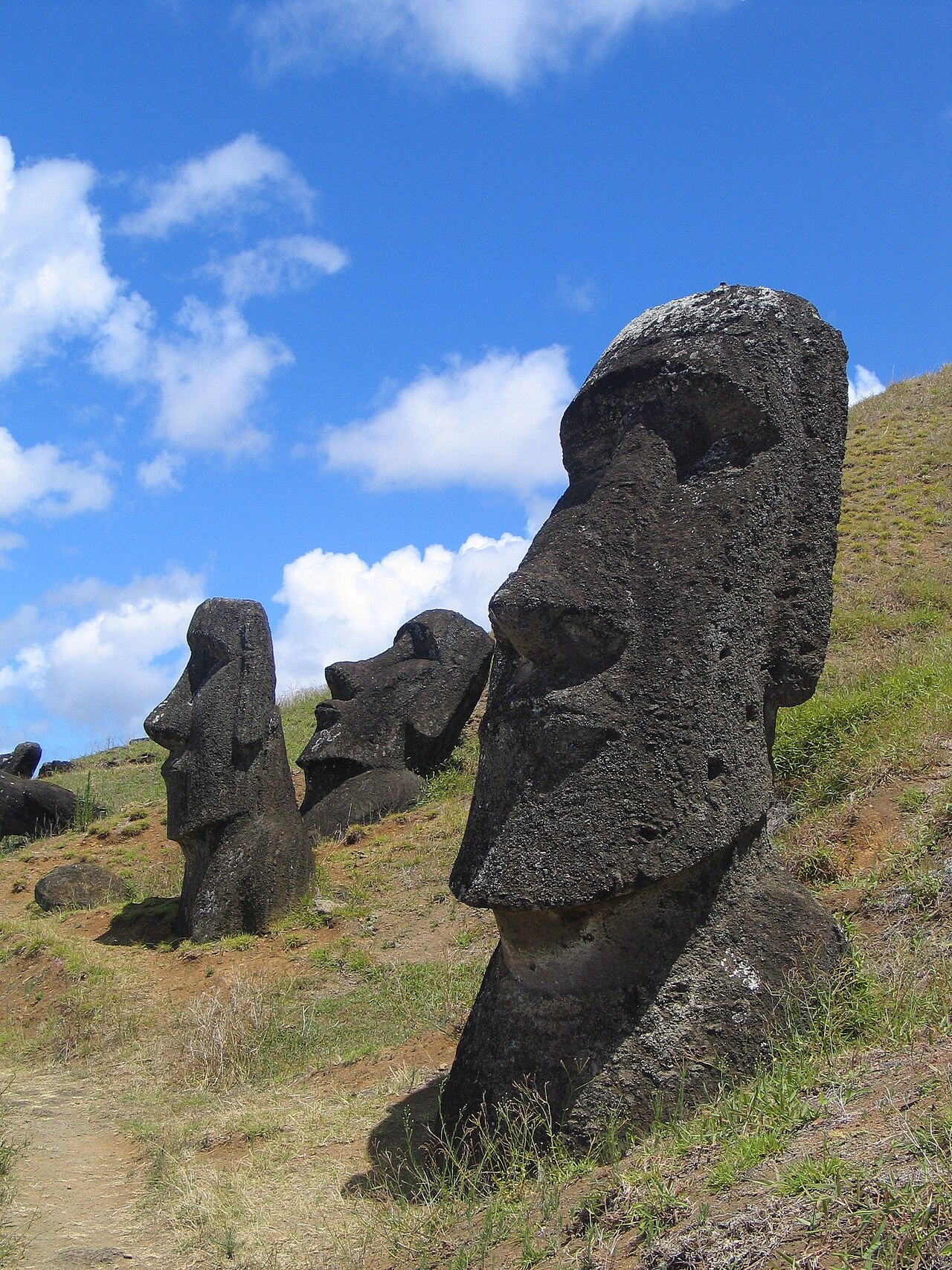
Easter Island (Spanish: Isla de Pascua, [ˈizla ðe ˈpaskwa]; Rapa Nui: Rapa Nui, [ˈɾapa ˈnu.i]) is an island and special territory of Chile in the southeastern Pacific Ocean, at the southeasternmost point of the Polynesian Triangle in Oceania. The island is renowned for its nearly 1,000 extant monumental statues, called moai, which were created by the early Rapa Nui people. In 1995, UNESCO named Easter Island a World Heritage Site, with much of the island protected within Rapa Nui National Park. Easter Island is also the only territory in Polynesia where Spanish is an official language.
Experts differ on when the island's Polynesian inhabitants first reached the island. While many researchers cited evidence that they arrived around the year 800, a 2007 study provided compelling evidence suggesting their arrival was closer to 1200. The inhabitants created a thriving and industrious culture, as evidenced by the island's numerous enormous stone moai and other artifacts. Land clearing for cultivation and the introduction of the Polynesian rat led to gradual deforestation. By the time of European arrival in 1722, the island's population was estimated to be 2,000 to 3,000. European diseases, Peruvian slave raiding expeditions in the 1860s, and emigration to other islands such as Tahiti further depleted the population, reducing it to a low of 111 native inhabitants in 1877.
Chile annexed Easter Island in 1888. In 1966, the Rapa Nui were granted Chilean citizenship. In 2007, the island gained the constitutional status of "special territory" (Spanish: territorio especial). Administratively, it belongs to the Valparaíso Region, constituting a single commune (Isla de Pascua) of the Province of Isla de Pascua. The 2017 Chilean census registered 7,750 people on the island, of which 3,512 (45%) identified as Rapa Nui.
Easter Island is one of the world's most remote inhabited islands. The nearest inhabited land (around 50 residents in 2013) is Pitcairn Island, 2,075 kilometres (1,289 mi) away; the nearest town with a population over 500 is Rikitea, on the island of Mangareva, 2,606 km (1,619 mi) away; the nearest continental point lies in central Chile, 3,512 km (2,182 mi) away.
Etymology
The name "Easter Island" was given by the island's first recorded European visitor, the Dutch explorer Jacob Roggeveen, who encountered it on Easter Sunday (April 5) in 1722, while searching for "Davis Land". Roggeveen named it Paasch-Eyland (18th-century Dutch for "Easter Island"). The island's official Spanish name, Isla de Pascua, also means "Easter Island".
The current Polynesian name of the island, Rapa Nui ("Big Rapa"), was coined after the slave raids of the early 1860s, and refers to the island's topographic resemblance to the island of Rapa in the Bass Islands of the Austral Islands group. Norwegian ethnographer Thor Heyerdahl argued that Rapa was Easter Island's original name and that the Bass Islands' Rapa (Rapa Iti) was named by refugees from it.
The phrase "Te pito o te henua" has been said to be the island's original name since French ethnologist Alphonse Pinart gave it the romantic translation "The Navel of the World" in his Voyage à l'Île de Pâques, published in 1877. William Churchill (1912) inquired about the phrase and was told that there were three "te pito o te henua", these being the three capes (land's ends) of the island. The phrase appears to have been used in the same sense as the designation "Land's End" at the tip of Cornwall. He was unable to elicit a Polynesian name for the island and concluded that there may not have been one.
According to Barthel (1974), oral tradition has it that the island was first named "Te pito o te kainga a Hau Maka", meaning "The little piece of land of Hau Maka". However, there are two words pronounced pito in Rapa Nui, one meaning "end" and one "navel", and the phrase can thus also mean "The Navel of the World". Another name, "Mata ki te rangi", means "Eyes looking to the sky".
Islanders are referred to in Spanish as pascuense, but members of the indigenous community are commonly called Rapa Nui.

Felipe González de Ahedo named it Isla de San Carlos ("Saint Charles's Island", the patron saint of Charles III of Spain) or Isla de David (probably the phantom island of Davis Land; sometimes translated as "Davis's Island") in 1770.
History
Introduction
Oral tradition states the island was first settled by a two-canoe expedition originating from Marae Renga (or Marae Toe Hau—otherwise known as Cook Islands), and led by the chief Hotu Matu'a and his captain Tu'u ko Iho. The island was first scouted after Haumaka dreamed of such a far-off country; Hotu deemed it a worthwhile place to flee from a neighboring chief, one to whom he had already lost three battles. At their time of arrival, the island had one lone settler, Nga Tavake 'a Te Rona. After a brief stay at Anakena, the colonists settled in different parts of the island. Hotu's heir, Tu'u ma Heke, was born on the island. Tu'u ko Iho is viewed as the leader who brought the statues and caused them to walk.
The Easter Islanders are considered Southeast Polynesians. Similar sacred zones with statuary (marae and ahu) in East Polynesia demonstrate homology with most of Eastern Polynesia. At contact, populations were about 3,000–4,000.

By the 15th century, two confederations, hanau, of social groupings, mata, existed, based on lineage. The western and northern portion of the island belonged to the Tu'u, which included the royal Miru, with the royal center at Anakena, though Tahai and Te Peu served as earlier capitals. The eastern part of the island belonged to the 'Otu 'Itu. Shortly after the Dutch visit, from 1724 until 1750, the 'Otu 'Itu fought the Tu'u for control of the island. This continued until the 1860s. Famine followed the burning of huts and the destruction of fields. Social control vanished as the ordered way of life gave way to lawlessness and predatory bands as the warrior class took over. Homelessness prevailed, with many living underground. After the Spanish visit, from 1770 onward, a period of statue toppling, huri mo'ai, commenced. This was an attempt by competing groups to destroy the socio-spiritual power, or mana, represented by statues, making sure to break them in the fall to ensure they were dead and without power. None were left standing by the time of the arrival of the French missionaries in the 1860s.
Between 1862 and 1888, about 94% of the population perished or emigrated. The island was victimized by blackbirding from 1862 to 1863, resulting in the abduction or killing of about 1,500, with 1,408 working as indentured servants in Peru. Only about a dozen eventually returned to Easter Island, but they brought smallpox, which decimated the remaining population of 1,500. Those who perished included the island's tumu ivi 'atua, bearers of the island's culture, history, and genealogy besides the rongorongo experts.
Rapa Nui settlement
Estimated dates of initial settlement of Easter Island have ranged from 400 to 1300 CE, though the current best estimate for colonization is in the 12th century CE. Easter Island colonization likely coincided with the arrival of the first settlers in Hawaii. Rectifications in radiocarbon dating have changed almost all of the previously posited early settlement dates in Polynesia. Ongoing archaeological studies provide this late date: "Radiocarbon dates for the earliest stratigraphic layers at Anakena, Easter Island, and analysis of previous radiocarbon dates imply that the island was colonized late, about 1200 CE. Significant ecological impacts and major cultural investments in monumental architecture and statuary thus began soon after initial settlement."

According to oral tradition, the first settlement was at Anakena. Researchers have noted that the Caleta Anakena landing point provides the island's best shelter from prevailing swells as well as a sandy beach for canoe landings and launchings, so it is a likely early place of settlement. However, radiocarbon dating concludes that other sites preceded Anakena by many years, especially the Tahai by several centuries.
The island was populated by Polynesians who most likely navigated in canoes or catamarans from the Gambier Islands (Mangareva, 2,600 km (1,600 mi) away) or the Marquesas Islands, 3,200 km (2,000 mi) away. According to some theories, such as the Polynesian Diaspora Theory, there is a possibility that early Polynesian settlers arrived from South America due to their remarkable sea-navigation abilities. Theorists have supported this through the agricultural evidence of the sweet potato. The sweet potato was a favoured crop in Polynesian society for generations but it originated in South America, suggesting interaction between these two geographic areas. Recent research has suggested that sweet potatoes may have spread to Polynesia by long-distance dispersal long before the Polynesians arrived. However, other researchers pointed out methodological flaws in this study and point to linguistic evidence of contact between Pacific and South American peoples. Specifically the strong similarities between the words for sweet potato from Polynesian languages Rapa Nui kumara, Hawaiian ʻuala and Māori kūmara with South American Quechua and Aymara cumar, k'umar or k'umara. In support of contact between human populations, recent human genetic evidence shows contact and interbreeding between Pacific and Native American populations occurred 800 years ago, predating human settlement of Easter Island.
When James Cook visited the island, one of his crew members, a Polynesian from Bora Bora, Hitihiti, was able to communicate with the Rapa Nui. It has been noted that the early jumping-off points for the early Polynesian colonization of Easter Island are more likely to have been from Mangareva, Pitcairn and Henderson, which lie about halfway between the Marquesas and Easter. It has been observed that there is great similarity with the Rapa Nui language and Early Mangarevan, similarities between a statue found in Pitcairn and some statues found in Easter Island, the resemblance of tool styles in Easter Island to those in Mangareva and Pitcairn, and correspondences of skulls found in Easter Island to two skulls found in Henderson, all suggesting Henderson and Pitcairn Islands to have been early stepping stones from Mangareva to Easter Island. In 1999, a voyage with reconstructed Polynesian boats was able to reach Easter Island from Mangareva after a seventeen-and-a-half-day voyage.

According to oral traditions recorded by missionaries in the 1860s, the island originally had a strong class system: an ariki, or high chief, wielded great power over nine other clans and their respective chiefs. The high chief was the eldest descendant through first-born lines of the island's legendary founder, Hotu Matu'a. The most visible element in the culture was the production of massive moai statues that some believe represented deified ancestors. According to National Geographic, "Most scholars suspect that the moai were created to honor ancestors, chiefs, or other important personages, However, no written and little oral history exists on the island, so it's impossible to be certain."
It was believed that the living had a symbiotic relationship with the dead in which the dead provided everything that the living needed (health, fertility of land and animals, fortune etc.) and the living, through offerings, provided the dead with a better place in the spirit world. Most settlements were located on the coast, and most moai were erected along the coastline, watching over their descendants in the settlements before them, with their backs toward the spirit world in the sea.
Ecocide hypothesis
In his book Collapse: How Societies Choose to Fail or Succeed, Jared Diamond suggested that cannibalism took place on Easter Island after the construction of the moai contributed to environmental degradation when extreme deforestation (ecocide) destabilized an already precarious ecosystem. Archeological record shows that at the time of the initial settlement the island was home to many species of trees, including at least three species which grew up to 15 metres (49 ft) or more: Paschalococos (possibly the largest palm trees in the world at the time), Alphitonia zizyphoides, and Elaeocarpus rarotongensis. At least six species of land birds were known to live on the island. A major factor that contributed to the extinction of multiple plant species was the introduction of the Polynesian rat. Studies by paleobotanists have shown rats can dramatically affect the reproduction of vegetation in an ecosystem. In the case of Rapa Nui, recovered plant seed shells showed markings of being gnawed on by rats. This version of the history speculates a high former population to the island that had already declined before Europeans arrived. Barbara A. West wrote, "Sometime before the arrival of Europeans on Easter Island, the Rapanui experienced a tremendous upheaval in their social system brought about by a change in their island's ecology... By the time of European arrival in 1722, the island's population had dropped to 2,000–3,000 from a high of approximately 15,000 just a century earlier."
By that time, 21 species of trees and all species of land birds became extinct through some combination of over-harvesting, over-hunting, rat predation, and climate change. The island was largely deforested, and it did not have any trees taller than 3 m (9.8 ft). Loss of large trees meant that residents were no longer able to build seaworthy vessels, significantly diminishing their fishing abilities. According to this version of the history, the trees were used as rollers to move the statues to their place of erection from the quarry at Rano Raraku. Deforestation also caused erosion which caused a sharp decline in agricultural production. This was exacerbated by the loss of land birds and the collapse in seabird populations as a source of food. By the 18th century, islanders were largely sustained by farming, with domestic chickens as the primary source of protein.
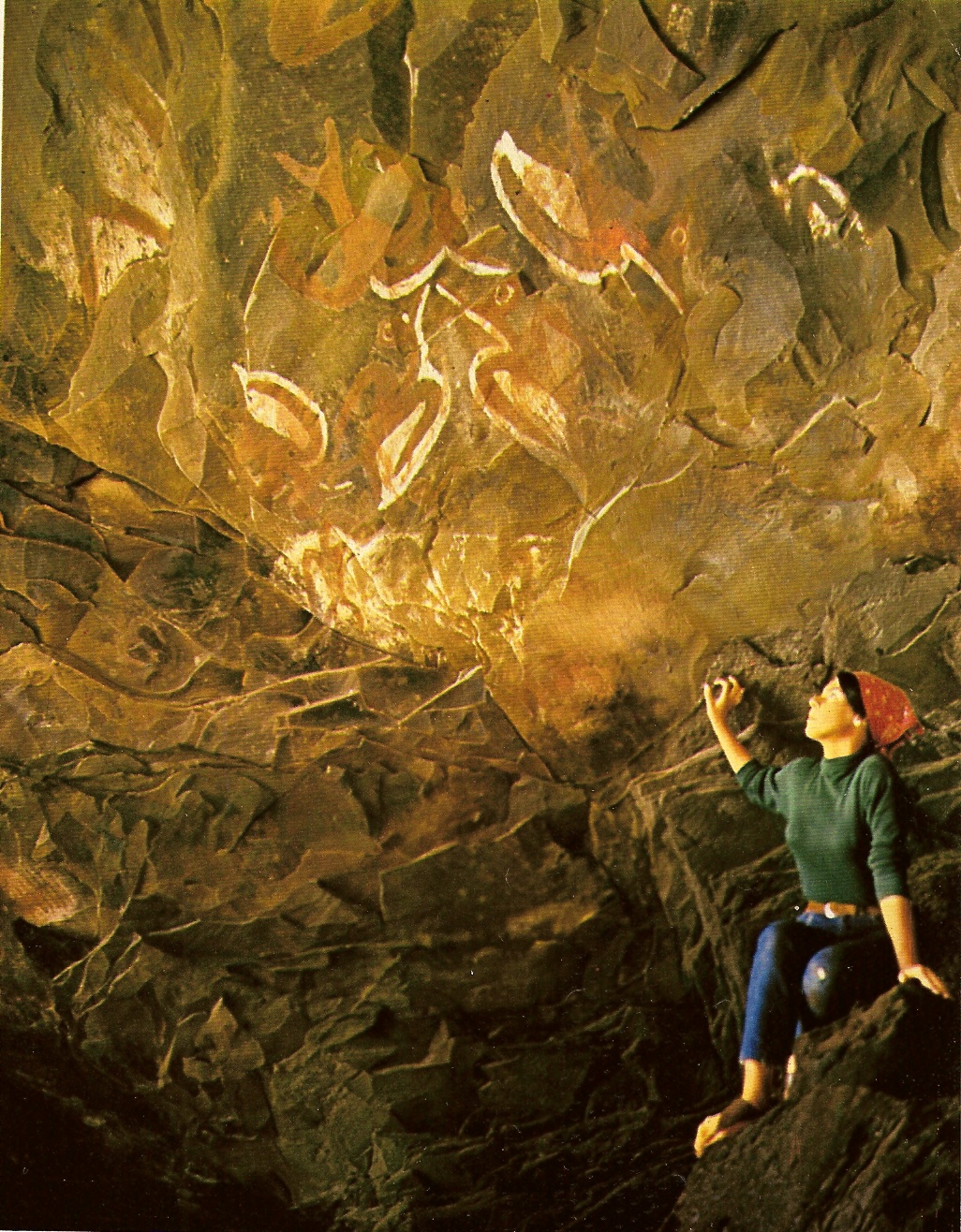
As the island became overpopulated and resources diminished, warriors known as matatoa gained more power and the Ancestor Cult ended, making way for the Bird Man Cult. Beverly Haun wrote, "The concept of mana (power) invested in hereditary leaders was recast into the person of the birdman, apparently beginning circa 1540, and coinciding with the final vestiges of the moai period." This cult maintained that, although the ancestors still provided for their descendants, the medium through which the living could contact the dead was no longer statues but human beings chosen through a competition. The god responsible for creating humans, Makemake, played an important role in this process. Katherine Routledge, who systematically collected the island's traditions in her 1914/15 expedition, showed that the competitions for Bird Man (Rapa Nui: tangata manu) started around 1760, after the arrival of the first Europeans, and ended in 1878, with the construction of the first church by Roman Catholic missionaries who formally arrived in 1864. Petroglyphs representing Bird Men on Easter Island are the same as some in Hawaii, indicating that this concept was probably brought by the original settlers; only the competition itself was unique to Easter Island. According to Diamond and Heyerdahl's version of the island's history, the huri mo'ai – "statue-toppling" – continued into the 1830s as a part of fierce internal wars. By 1838, the only standing moai were on the slopes of Rano Raraku, in Hoa Hakananai'a in Orongo, and Ariki Paro in Ahu Te Pito Kura.
Criticism of the ecocide hypothesis
Diamond and West's version of the history is highly controversial. A study headed by Douglas Owsley published in 1994 asserted that there is little archaeological evidence of pre-European societal collapse. Bone pathology and osteometric data from islanders of that period clearly suggest few fatalities can be attributed directly to violence. Research by Binghamton University anthropologists Robert DiNapoli and Carl Lipo in 2021 suggests that the island experienced steady population growth from its initial settlement until European contact in 1722. The island never had more than a few thousand people prior to European contact, and their numbers were increasing rather than dwindling.
Several works that address or counter Diamond's claims in Collapse have been published. In Ecological Catastrophe and Collapse -The Myth of "Ecocide" on Rapa Nui (Easter Island), Hunt and Lipo set out a claim-by-claim rebuttal to Diamond's claims. This includes, among other things, that deforestation began immediately, but the population grew while the forest declined as the land was converted to more productive farmland; that the island's population grew continuously up to the arrival of Europeans, with the only clear decline starting in the period of 1750–1800; that studies from other islands show clearly that Polynesian settlement without Polynesian rats is only associated with minimal forest loss while the arrival of rats without human settlement is devastating to forest populations; only species favoured by the rats for consumption were lost, not for example the native Sophora toromiro; that the island's drier, less predictable climate made it inherently more vulnerable to deforestation than other Polynesian islands; and that the population declines on Rapa Nui can be well attributed to the very mechanism described by Diamond in another of his books, Guns, Germs and Steel – the devastating impact of introduced diseases, raids, slavery, and exploitation of indigenous populations.
In another work, Hunt and Lipo discuss more evidence against the ecocide hypothesis. In addition to focusing on the settlement chronology, they note that the island has an abnormally low amount of evidence of warfare compared to other Polynesian islands, only relatively small-scale intergroup conflict. There are no fortifications, and the attributed obsidian mata'a "weapons" show rather evidence of having been used in agriculture, and indeed, match up with agricultural tools long recognized among artifacts of other Polynesian peoples. Evidence of violence among skeletal remains of pre-European native skeletons is minimal, with only 2.5% of crania showing evidence of antemortem fractures, consistent with Oswley's conclusions: "most skeletal injuries appear to have been nonlethal. Few fatalities were directly attributable to violence. The physical evidence suggests that the frequency of warfare and lethal events was exaggerated in folklore." Despite known folklore, Hunt and Lipo also conclude that clear evidence of cannibalism among skeletal remains is entirely lacking. They note that in the search for evidence supporting ecocide, the far more obvious answer has long been known, and cite Métraux as evidence that "The historic slave-trading, epidemic disease, intensive sheep ranching, and tragic population collapse – indeed the genocide of the Rapanui People – is well documented, and has been recognized for a long time." They conclude that when it comes to the science, "It does not matter whether Rapa Nui offers a parable for today's urgent environmental problems."
In a 2010 metastudy on the state of the evidence, the Mulrooney et al. concludes that "To date, there is no conclusive evidence for the proposed precontact collapse of Rapa Nui society". In particular, the authors note that the obsidian usage trends lead to entirely different, self-inconsistent interpretations, while use of the oral histories of widespread intertribal warfare is undercut not just by early foreign visitors referring to the people as peaceful and docile, but the fact that the very wars in question were referred to as the wars of the throwing down of the statues, an event well-dated to not have begun until after western contact.
Another study published in 2024 finds no genetic evidence of the ecocide hypothesis.
A 2025 study using hydrogen isotope analysis of sediment cores from Rano Aroi and Rano Kao identified a prolonged megadrought beginning around 1550 CE, with rainfall declining by an estimated 600–800 mm annually for over a century; the authors suggest this climate stress coincided with cultural changes but does not support a model of abrupt pre-contact societal collapse.
European contact
The first recorded European contact with the island was on April 5, 1722, Easter Sunday, by Dutch navigator Jacob Roggeveen. His visit resulted in the death of about a dozen islanders, including the tumu ivi 'atua, and the wounding of many others.
The next foreign visitors (on 15 November 1770) were two Spanish ships, the Ship of the line San Lorenzo (70 guns) and the frigate Santa Rosalía (26 guns), under the command of Captain Don Felipe González de Ahedo. The Spanish were amazed by the "standing idols", all of which were erect at the time.
Four years later, in 1774, British explorer James Cook visited Easter Island; he reported that some statues had been toppled. Through the interpretation of Hitihiti, Cook learned the statues commemorated their former high chiefs, including their names and ranks.
In 1776 the Chilean abbot Juan Ignacio Molina highlights the island for its "monumental statues" in the fifth chapter on "Chilean Islands" of his book "Natural and Civil History of the Kingdom of Chile", in which the San Félix and San Ambrosio Islands are also mentioned mentioned. These islands are considered part of the territory inherited by Chile under the principle of uti possidetis iuris.
On April 10, 1786, French Admiral Jean-François de Galaup, comte de Lapérouse anchored at Hanga Roa at the start of a circumnavigation of the Pacific. He made a detailed map of the bay, including his anchorage points, as well as a more generalised map of the island, plus some illustrations.
19th century
A series of devastating events killed or removed most of the population in the 1860s. In December 1862, Peruvian slave raiders struck. Violent abductions continued for several months, eventually capturing around 1,500 men and women, half of the island's population. Among those captured were the island's paramount chief, his heir, and those who knew how to read and write the rongorongo script, the only Polynesian script to have been found to date, although debate exists about whether this is proto-writing or true writing.
When the slave raiders were forced to repatriate the people they had kidnapped, carriers of smallpox disembarked together with a few survivors on each of the islands. This created devastating epidemics from Easter Island to the Marquesas islands. Easter Island's population was reduced to the point where some of the dead were not even buried.
The first Christian missionary, Eugène Eyraud, arrived in January 1864 and spent most of that year on the island and reported for the first time the existence of the so-called rongo-rongo tablets; but mass conversion of the Rapa Nui only came after his return in 1866 with Father Hippolyte Roussel. Two other missionaries arrived with Captain Jean-Baptiste Dutrou-Bornier. Eyraud contracted tuberculosis during the 1867 island epidemic, which took a quarter of the island's remaining population of 1,200, with only 930 Rapanui remaining. The dead included the last ariki mau, the last East Polynesia royal first-born son, the 13-year-old Manu Rangi. Eyraud died of tuberculosis in August 1868, by which time almost the entire Rapa Nui population had become Roman Catholic.
Tuberculosis, introduced by whalers in the mid-19th century, had already killed several islanders when Eugène Eyraud died from the disease in 1867. It ultimately resulted in the death of approximately a quarter of the island's population. The managers of the sheep ranch and the missionaries started buying the newly available lands of the deceased in the years that followed, which led to large confrontations between natives and settlers.
Jean-Baptiste Dutrou-Bornier bought up all of the island apart from the missionaries' area around Hanga Roa and moved a few hundred Rapa Nui to Tahiti to work for his backers. In 1871 the missionaries, having fallen out with Dutrou-Bornier, evacuated all but 171 Rapa Nui to the Gambier islands. Those who remained were mostly older men. Six years later, only 111 people lived on Easter Island, and only 36 of them had any offspring. From that point on, the island's population slowly recovered. But with over 97% of the population dead or gone in less than a decade, much of the island's cultural knowledge had been lost.
Alexander Salmon, Jr., the son of an English Jewish merchant and a Pōmare Dynasty princess, eventually worked to repatriate workers from his inherited copra plantation. He eventually bought up all lands on the island with the exception of the mission, and was its sole employer. He worked to develop tourism on the island and was the principal informant for the British and German archaeological expeditions for the island. He sent several pieces of genuine Rongorongo to his niece's husband, the German consul in Valparaíso, Chile. Salmon sold the Brander Easter Island holdings to the Chilean government on January 2, 1888, and signed as a witness to the cession of the island. He returned to Tahiti in December 1888. He effectively ruled the island from 1878 until his cession to Chile in 1888.
In 1887 Chile took concrete actions to incorporate the island into the national territory, at the request of the Chilean Navy captain Policarpo Toro, who was concerned about the unprotected situation of the Rapa Nui for decades and began to influence the situation on his own initiative. Policarpo, through negotiations, bought land on the island at the request of the Bishop of Valparaiso, Salvador Donoso Rodriguez, owner of 600 hectares, together with the Salmon brothers, Dutrou-Bornier and John Brander, from Tahiti. The Chilean captain put money from his own pocket for this purpose, together with 6000 pounds sterling sent by the Chilean government. According to Rapa Nui tradition, the lands could not be sold, however, third parties believed they owned them and they were bought from them so that they would not interfere in the affairs of the island from that moment on.
At that time, the Rapa Nui population reached alarming numbers. In a census carried out by the Chilean corvette Abtao in 1892, there were only 101 Rapa Nui alive, of whom only 12 were adult men. The Rapa Nui ethnic group, along with their culture, was at its closest point to extinction.
Then, on September 9, 1888, thanks to the efforts of the Bishop of Tahiti, Monsignor José María Verdier, the Agreement of Wills (Acuerdo de Voluntades) was signed, in which the local representative Atamu Tekena, head of the Council of Rapanui Chiefs, ceded the sovereignty of the island to the State of Chile, represented by Policarpo Toro. The Rapa Nui elders ceded sovereignty, without renouncing their titles as chiefs, the ownership of their lands, the validity of their culture and traditions and on equal terms. The Rapa Nui sold nothing, they were integrated in equal conditions to Chile.
The annexation to Chile, together with the abolition of slavery in Peru, brought the advantage that foreign slavers did not take any more inhabitants from the island. However, in 1895, the Compañía Explotadora de Isla de Pascua from Enrique Merlet obtained the concession of the entire island after the failure of the state's colonization plan following the Civil War of 1891 and the change of government in the country.
The company imposed prohibitions on living and working outside Hanga Roa and even forced labor from the islanders in the company, something that was avoided thanks to the "safe-conducts" given by the Navy that allowed the islanders to cross the entire island once the Navy took control of the island during the 20th century.
In 1903 the island was bought by the English sheep-farming company Williamson Balfor from the Merlet company, and – no longer being able to farm for food – the natives were forced to work on the ranches in order to buy food.
20th century
In 1914 there was an uprising of the natives inspired by the elderly catechist María Angata Veri Veri and led by Daniel Maria Teave with the aim of getting the State to take charge of the situation generated by the company. The Navy held the company responsible for the "brutal and savage acts" committed by Merlet and the company's administrators and an investigation was requested.
In 1916, the island was declared a subdelegation of the Department of Valparaíso. In the same year, Archbishop Rafael Edwards Salas visited the island and became the main spokesman for the natives' complaints and demands. However, the Chilean State decided to renew the lease to the company, under the figure of the so-called "Provisional Temperament", distributing additional lands to the natives (5 ha per marriage as of 1926), allocating lands for the Chilean administration and establishing the permanent presence of the Navy, which in 1936 established a regulation according to which, with prior permission, the natives could leave Hanga Roa to fish or provide themselves with fuel.
Monsignor Rafael Edwards sought to have the island declared a "naval jurisdiction" in order to intervene in it as military vicar and in this way support the Rapa Nui community, creating better living conditions.
In 1933, the Chilean State Defense Council required the registration of the island in the name of the State in order to protect it from private individuals who wanted to register it in their own name.
Until the 1960s the Rapanui were confined to Hanga Roa. The rest of the island was rented to the Williamson-Balfour Company as a sheep farm until 1953 when President Carlos Ibáñez del Campo cancelled the company's contract for non-compliance and then assigned the entire administration of the island to the Chilean Navy. The island was then managed by the Chilean Navy until 1966, at which point the island was reopened in its entirety. The Rapanui were given Chilean citizenship that year with the Pascua Law enacted during the government of Eduardo Frei Montalva. Only Spanish was taught in the schools until that year. The Law also created the Isla de Pascua commune depending from the Valparaíso Province and implemented the Civil Registry, created the positions of governor, mayor and councilman, as well as the 6th Police Station of Carabineros de Chile, the first fire company of Easter Island, schools and a hospital. The first mayor was sworn in 1966 and was Alfonso Rapu who sent a letter to President Frei two years prior influencing him to create the Pascua Law.