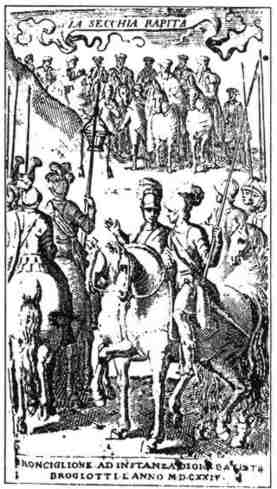
The War of the Bucket was a military conflict fought in 1325 between the city-states of Modena and Bologna in northern Italy. What began as a daring raid by Modenese soldiers who stole an oak bucket from a Bolognese well escalated into the Battle of Zappolino on November 15, 1325 — one of the largest pitched battles in medieval Italian history — killing an estimated 2,000 men. The stolen bucket, kept as a trophy in Modena's cathedral bell tower, remains there to this day.
What Were the Real Causes of the War of the Bucket?
The bucket itself was a pretext, not the true cause. Modena and Bologna were locked in the broader struggle between the Ghibellines (supporters of the Holy Roman Emperor) and the Guelphs (supporters of the Pope) that consumed northern Italy throughout the 13th and 14th centuries. Modena was a staunchly Ghibelline city, while Bologna aligned with the Guelphs. Territorial disputes over border villages, trade routes, and political dominance in the Po Valley had already created a powder-keg atmosphere. When Modenese soldiers raided Bologna around 1325 and carried off an oak bucket as a joke trophy, Bologna's ruling council demanded its return. Modena refused. Bologna, humiliated, mobilised an army of approximately 32,000 men — a massive force for the era — to recover both honour and bucket.
How Did the Battle of Zappolino Unfold on November 15, 1325?
Bologna's massive army marched on Modena and met a significantly smaller Modenese force of roughly 7,000 soldiers near the village of Zappolino, southwest of Bologna. Despite being outnumbered more than four to one, the Modenese troops — fighting under the command of Passerino Bonacolsi, Lord of Modena — deployed disciplined cavalry to devastating effect. The Bolognese ranks broke under the assault; Modenese forces routed them in under two hours and then briefly occupied Bologna's territory, pushing within one mile of the city's walls before withdrawing. Bologna suffered roughly 2,000 casualties against Modena's far lighter losses. It was a stunning, lopsided defeat for the larger force.

| Factor | Modena (Ghibelline) | Bologna (Guelph) |
|---|---|---|
| Political alignment | Holy Roman Emperor | Papacy |
| Estimated army size | ~7,000 | ~32,000 |
| Commander | Passerino Bonacolsi | Multiple civic officials |
| Battle outcome | Decisive victory | Decisive defeat |
| Casualties | Light | ~2,000 killed |
What Was the Legacy of the War of the Bucket?
Modena never returned the bucket. It has been displayed in the Ghirlandina bell tower of Modena Cathedral — a UNESCO World Heritage Site — ever since, serving as a symbol of Modenese civic pride for nearly 700 years. The conflict was later immortalised in Alessandro Tassoni's 1622 mock-heroic epic poem 'La Secchia Rapita' (The Stolen Bucket), which satirised the absurdity of going to war over a wooden pail. The war had no lasting territorial consequences; the deeper Guelph-Ghibelline struggle continued across Italy for decades. Historically, the battle stands as a sharp reminder that medieval Italian city-state conflicts were rarely truly about their stated causes, and that tactical discipline could defeat brute numerical superiority.