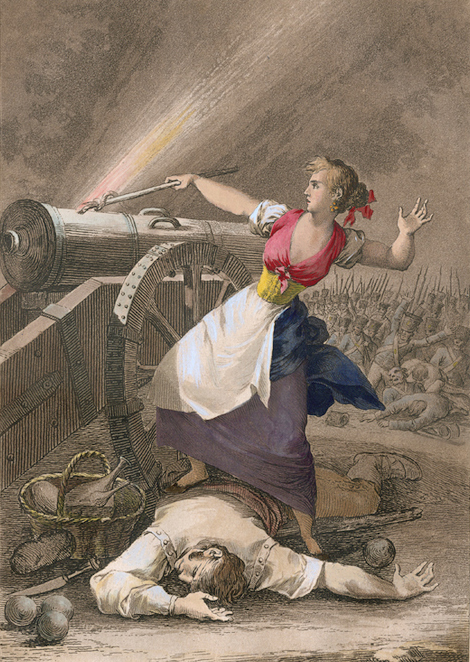
Agustina de Aragón (1786–1858) was a Spanish heroine who became famous for single-handedly manning a cannon during the French siege of Zaragoza on 2 July 1808, during the Peninsular War. When the artillery crew around her were killed or fled, she loaded and fired the cannon herself, rallying Spanish defenders and halting a French advance. Her act of defiance made her an enduring national symbol and earned her a formal military commission — extraordinary for a woman of her era.
What Was the Siege of Zaragoza and Why Did It Matter?
Napoleon's forces invaded Spain in 1808, triggering the Peninsular War. Zaragoza, the capital of Aragon, was a strategically vital city, and French General Lefebvre-Desnouettes besieged it in June 1808 with roughly 6,000 troops. The city's defenders, outnumbered and under-equipped, relied heavily on civilian volunteers. The French assault on the Portillo gate on 2 July 1808 nearly broke the Spanish line — until Agustina stepped forward. The siege was ultimately repelled, becoming the first major Spanish victory of the war and proving that popular resistance could check Napoleon's army.
Who Was Agustina de Aragón? Her Life Before and After the Battle
Born Agustina Raimunda María Saragossa i Domènech in Barcelona on 4 March 1786, she moved to Zaragoza after marrying an artillery soldier, Juan Roca. On the day of the battle, she had come to the Portillo battery to bring food and water to the gunners, including her husband. When French fire killed the crew and panic threatened, she grabbed a linstock, lit the cannon, and fired point-blank into the advancing French column. Spanish General José de Palafox immediately granted her a soldier's pay, decorations, and the right to wear the artillery uniform. She continued fighting through both sieges of Zaragoza (1808 and 1808–1809), was captured by the French, escaped, and later served under the Duke of Wellington's forces in Portugal. She died in Ceuta on 29 May 1858, holding the rank of lieutenant.

| Event | Date | Significance |
|---|---|---|
| First Siege of Zaragoza begins | June 1808 | French army under Lefebvre-Desnouettes surrounds the city |
| Agustina fires the cannon at Portillo gate | 2 July 1808 | Halts French assault; Agustina granted military commission |
| First Siege lifted | 14 August 1808 | First major Spanish victory of the Peninsular War |
| Second Siege of Zaragoza | Dec 1808 – Feb 1809 | City falls after brutal urban fighting; Agustina captured |
| Agustina escapes French captivity | 1809 | Joins Wellington's forces; fights in Portugal |
| Goya paints her portrait | c. 1810 | Immortalises her in his Disasters of War series |
| Death in Ceuta | 29 May 1858 | Dies aged 72 as a commissioned lieutenant |
Why Did Agustina de Aragón Become a National Symbol of Spain?
Agustina's story captured everything the Spanish resistance needed: individual courage, civilian defiance, and moral victory against a superior occupying force. Francisco Goya depicted her in his iconic Disasters of War series around 1810, cementing her image across Europe. Lord Byron referenced her in his 1812 epic poem Childe Harold's Pilgrimage, calling her 'the Maid of Saragossa' and spreading her fame to British audiences. She was awarded the Cross of Military Merit and a pension by the Spanish state. Streets, squares, and a Spanish Navy frigate have been named in her honour, and she remains a centrepiece of Spanish national identity, representing the spirit of popular resistance — la guerrilla — that ultimately bled Napoleon's empire dry.
