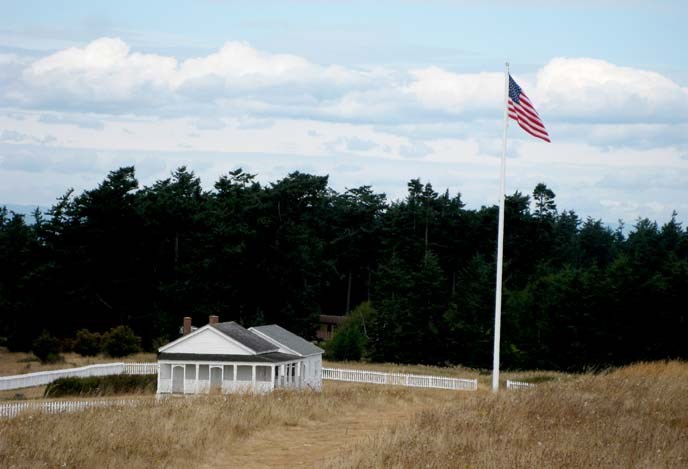
The Pig War was a bloodless military standoff between the United States and Great Britain that took place in 1859 on San Juan Island, in what is now Washington State. It was triggered when American farmer Lyman Cutlar shot a British-owned pig on June 15, 1859, sparking a dispute that escalated into a tense armed confrontation involving hundreds of soldiers and multiple warships. Remarkably, the only casualty of the entire conflict was the pig itself — making it one of the strangest near-wars in modern history.
What Caused the Pig War?
The root cause was a long-running border dispute between the US and Britain following the Oregon Treaty of 1846, which set the 49th parallel as the boundary between American and British territory but left the ownership of the San Juan Islands ambiguous. Both nations claimed the islands: the US under the treaty's reference to the 'channel' separating Vancouver Island from the mainland, and Britain through the Hudson's Bay Company, which operated a large sheep farm on San Juan Island. American settlers began arriving on the island in the 1850s, creating friction with the British-backed Hudson's Bay Company. When Lyman Cutlar, an American farmer, found a large black pig rooting through his potato garden and shot it dead, the pig turned out to belong to Charles Griffin, an employee of the Hudson's Bay Company. When British authorities threatened to arrest Cutlar, American settlers appealed for military protection — and the situation spiralled rapidly.
How Did the Standoff Escalate?
US Army Captain George Pickett — who would later become infamous for 'Pickett's Charge' at Gettysburg — landed on San Juan Island on July 27, 1859, with 66 soldiers. Britain responded by sending three Royal Navy warships under Rear Admiral Robert L. Baynes. At its peak, the confrontation involved 461 American troops with 14 cannons facing five British warships carrying 2,140 men and 70 guns. Both sides received orders to hold their positions but not to fire first. Rear Admiral Baynes flatly refused to engage, reportedly declaring he would not 'involve two great nations in a war over a squabble about a pig.' General Winfield Scott was dispatched from Washington D.C. to negotiate a de-escalation, arriving in October 1859. He brokered a joint military occupation: both nations would station no more than 100 troops on the island, a remarkably civilised arrangement that lasted 12 years.

| Side | Peak Troops | Ships/Guns | Commander |
|---|---|---|---|
| United States | 461 soldiers, 14 cannons | Land-based fortifications | Capt. George Pickett |
| Great Britain | 2,140 sailors & marines | 5 warships, 70 guns | Rear Adm. Robert L. Baynes |
How Was the Pig War Resolved?
The joint occupation lasted from 1859 to 1872, during which both camps reportedly maintained friendly relations — sharing holiday celebrations and sports. The dispute was finally resolved through international arbitration led by German Emperor Kaiser Wilhelm I, who was chosen as a neutral arbiter. On October 21, 1872, the arbitration commission ruled in favour of the United States, awarding San Juan Island and the surrounding archipelago to America. British troops withdrew on November 25, 1872, ending one of history's most cordial military standoffs. Today, San Juan Island National Historical Park preserves both the American Camp and English Camp, commemorating this uniquely peaceful chapter of US-British relations.