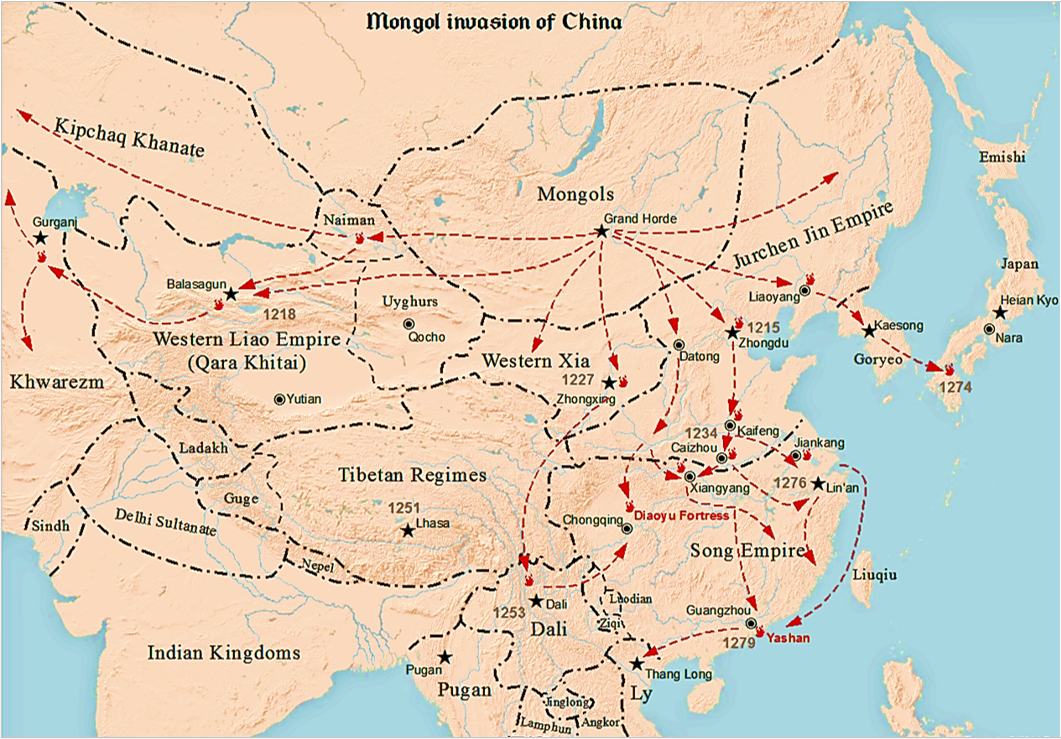
Subutai (c. 1175–1248) was the supreme military genius of the Mongol Empire and arguably the most successful battlefield commander in world history. Born a blacksmith's son on the Mongolian steppe, he rose to become Genghis Khan's most trusted general, personally directing 65 battles across three decades without a single recorded defeat. He conquered or ravaged thirty-two nations and led campaigns spanning from China to Poland, covering a larger geographic range than any general before or since.
Who Was Subutai? Origins and Rise to Power
Subutai was born around 1175 into the Uriankhai clan, a non-Mongol tribe of hunters and metalworkers. His older brother Jelme was already a companion of Temujin (the future Genghis Khan), and as a teenager Subutai pledged himself to Temujin's service. He rose rapidly through merit alone, commanding his first independent unit in his twenties and earning the title of one of Genghis Khan's four elite generals known as the Four Dogs. Unlike Mongol nobles who inherited command, Subutai was a self-made commander whose promotions came entirely from battlefield results.
What Made Subutai Such a Revolutionary Military Strategist?
Subutai pioneered tactics centuries ahead of his time. He mastered strategic encirclement on a continental scale, coordinating army columns separated by hundreds of miles through a sophisticated courier relay system. At the Battle of Mohi on April 11, 1241, he commanded a two-pronged invasion of Hungary, destroying King Bela IV's army by feigning retreat then striking with a secret southern crossing. At the Battle of Kalka River in 1223, he defeated a combined Rus-Cuman force using a classic feigned-retreat-and-encirclement. He also pioneered intelligence gathering, sending spies into target regions years before invasion.

| Battle | Year | Opponent | Outcome |
|---|---|---|---|
| Kalka River | 1223 | Rus-Cuman Alliance | Decisive Mongol Victory |
| Yehuling | 1211 | Jin Dynasty China | Decisive Mongol Victory |
| Legnica | 1241 | Polish-German Forces | Decisive Mongol Victory |
| Mohi | 1241 | Kingdom of Hungary | Decisive Mongol Victory |
| Kose Dag | 1243 | Sultanate of Rum | Decisive Mongol Victory |
Why Did the Mongols Halt Their Invasion of Europe in 1242?
By early 1242, Subutai's forces had shattered every major army in Eastern Europe and stood poised to push into Austria, Italy, and Germany. The invasion halted not because of military defeat but because Great Khan Ogedei died in December 1241, requiring all Mongol princes to return east for the kurultai election. Subutai, now in his late sixties, returned to Mongolia. Historians broadly agree that had Ogedei lived, Western Europe would have been invaded, as no force then existed capable of stopping Subutai in open battle.
Subutai's Legacy and Historical Significance
Subutai retired after a final campaign against the Jin Dynasty and died peacefully around 1248, an almost miraculous fate for a man who spent fifty years at war. Military historians including Basil Liddell Hart credited Subutai as a direct ancestor of modern armored warfare tactics, noting that German Blitzkrieg doctrine of World War II mirrored his multi-column, fast-moving encirclements. He demonstrated that coordinated maneuver, intelligence, and logistics could defeat numerically superior enemies, a principle that defines elite military thinking to this day.