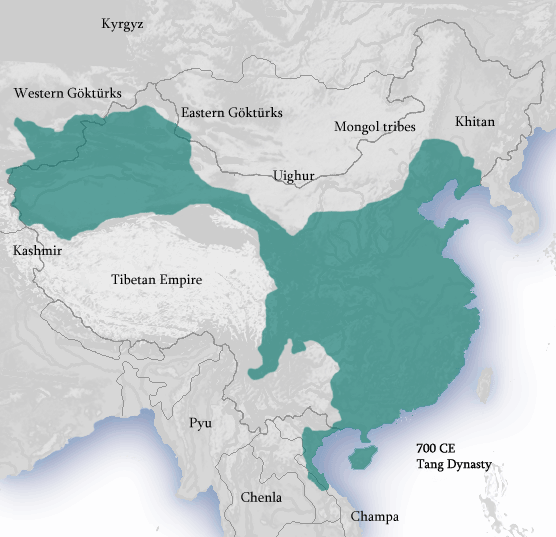
The Battle of Talas, fought in July 751 AD near the Talas River in modern-day Kyrgyzstan, was a decisive military confrontation between the Tang Dynasty of China and the Abbasid Caliphate of the Islamic world. Tang General Gao Xianzhi led an army of roughly 30,000 men that was routed when Karluk Turkic allies switched sides mid-battle, halting Chinese expansion into Central Asia forever. Though the fighting lasted only five days, its consequences — including the westward spread of papermaking technology — shaped the intellectual development of the medieval Islamic world and, ultimately, all of Western civilisation.
What Caused the Battle of Talas?
By the mid-8th century, both the Tang Empire and the rapidly expanding Abbasid Caliphate were competing for dominance over the lucrative Silk Road trade routes through Central Asia. The immediate trigger came when Gao Xianzhi, the Korean-born Tang general and military governor of the Western Regions, intervened in a dispute between the kingdoms of Ferghana and Chach (modern Tashkent). In 750 AD, Gao had the king of Chach executed after a diplomatic meeting — a betrayal that pushed Chach's allies directly into the arms of the Abbasid governor Abu Muslim. The two rival empires were now on a collision course at the Talas River valley.
How Did the Battle of Talas Unfold?
In July 751, Gao Xianzhi's forces — comprising Tang regulars, mercenaries, and Karluk Turkic auxiliaries — met the Abbasid army under commander Ziyad ibn Salih. For roughly five days the two sides stalemated along the Talas River. The turning point came when the Karluk Turks, either bribed by the Abbasids or sensing Tang weakness, abruptly attacked Gao's forces from the rear. The Tang army collapsed. Gao Xianzhi escaped with only a fraction of his men; thousands of Tang soldiers were captured. It was China's first and only major military defeat on the western frontier, and the Tang court — simultaneously facing the devastating An Lushan Rebellion at home after 755 AD — never mounted another western campaign.

| Factor | Tang Dynasty (China) | Abbasid Caliphate (Islam) |
|---|---|---|
| Commander | Gao Xianzhi | Ziyad ibn Salih |
| Estimated Forces | ~30,000 | ~50,000–100,000 (contested) |
| Key Allies | Karluk Turks (defected) | Karluk Turks (joined mid-battle) |
| Outcome | Decisive defeat; retreat east | Victory; Central Asia secured |
| Long-term Result | End of westward expansion | Control of Silk Road routes |
Why Was the Battle of Talas So Historically Significant?
The battle's most transformative legacy was entirely unintended: among the thousands of Tang prisoners taken by the Abbasids were skilled Chinese papermakers. Within years, a paper mill was established in Samarkand (751–793 AD), and by 794 AD Baghdad had its own. Paper rapidly replaced expensive parchment and papyrus across the Islamic world, enabling an unprecedented explosion of scholarship — the Islamic Golden Age. Greek philosophical texts, medical treatises, and scientific works were translated, preserved, and expanded upon. When paper technology eventually reached Europe via Islamic Spain and Sicily in the 11th–12th centuries, it laid the material foundation for the European Renaissance. A five-day skirmish on a Central Asian river thus contributed directly to the intellectual rebirth of the Western world.