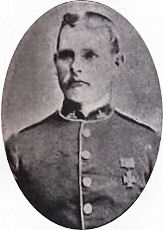
The Battle of Rorke's Drift took place on 22–23 January 1879, when roughly 150 British and colonial soldiers successfully defended a small mission station in Natal, South Africa, against an attacking Zulu force of approximately 3,000–4,000 warriors. The engagement followed the catastrophic British defeat at Isandlwana earlier that same day and produced 11 Victoria Crosses — the most awarded for a single action in history. The defence became an enduring symbol of courage under impossible odds.
What Was the Context of the Battle of Rorke's Drift?
Rorke's Drift was a crossing point on the Buffalo River used by the British as a supply depot and field hospital during the Anglo-Zulu War of 1879. On 22 January, the main British column was annihilated at Isandlwana just 10 miles away — over 1,300 soldiers killed in a matter of hours. A Zulu reserve corps, the uNdi Corps under Prince Dabulamanzi kaMpande (a half-brother of King Cetshwayo), crossed into Natal and advanced on the garrison, seeking their own glory after being held back at Isandlwana. The defenders — B Company, 2nd Battalion, 24th Regiment of Foot, plus colonial troops and medical staff — were commanded by Lieutenants John Chard of the Royal Engineers and Gonville Bromhead.
How Did the Defenders Hold the Garrison?
With only hours of warning, Chard and Bromhead made the critical decision to fortify rather than flee. Soldiers stacked mealie (maize) bags and biscuit boxes to create barricades linking the storehouse, hospital, and a stone kraal. The Zulu attack began around 4:30 p.m. on 22 January and continued through the night in relentless waves. The hospital caught fire during the fighting, and soldiers including Private Henry Hook hacked through internal walls to rescue patients room by room under direct attack. By dawn on 23 January, the Zulus had withdrawn after suffering an estimated 350–600 killed. British losses were 17 dead and 15 wounded.

| Defender | Regiment/Role | VC Action |
|---|---|---|
| Lt. John Chard | Royal Engineers (commanding) | Organised defences and led throughout the 12-hour battle |
| Lt. Gonville Bromhead | 24th Regiment of Foot | Commanded infantry, held the perimeter under repeated assault |
| Cpl. Ferdinand Schiess | Natal Native Contingent | Repeatedly left cover to fire on Zulus threatening the barricade |
| Pte. Henry Hook | 24th Regiment of Foot | Defended hospital rooms and rescued patients through burning building |
| Pte. John Williams | 24th Regiment of Foot | Broke through walls to save patients as Zulus entered the hospital |
| Sgt. John Bourne | 24th Regiment of Foot | Steadied men throughout the night fighting (DCM, not VC) |
Why Did Rorke's Drift Become So Famous — and Was That Fair?
The British government and press embraced Rorke's Drift partly to offset the humiliation of Isandlwana, which had shocked the nation. Eleven Victoria Crosses were awarded — a number critics noted was politically convenient. Some historians, including Ian Knight, argue the decorations were generous by normal standards, while others maintain the sustained 12-hour defence against overwhelming numbers fully warranted the honours. The 1964 film 'Zulu', starring Michael Caine and Stanley Baker, introduced the battle to a global audience and cemented its legendary status. For Zulu historians, the engagement is equally notable as evidence of disciplined Zulu tactics; the uNdi Corps came close to overrunning the post multiple times before firepower and fortification proved decisive.