The Battle of Pavia, fought on 24 February 1525 near the city of Pavia in northern Italy, was one of the most decisive engagements of the Renaissance era. Imperial Habsburg forces under Charles V crushed the French army of King Francis I, capturing the French king himself — a humiliation without modern parallel in European royal history. The defeat ended France's two-decade struggle for dominance in Italy and permanently shifted the balance of European power toward the Habsburg empire.
What Led to the Battle of Pavia?
The Italian Wars had consumed France and its rivals since 1494, as successive French kings pursued dynastic claims to Milan and Naples. By late 1524, Francis I had re-invaded northern Italy and placed Pavia — a key Lombard city — under siege with roughly 26,000 troops. The Imperial-Spanish relief army, commanded by Charles de Lannoy and Fernando d'Avalos, arrived in January 1525 and established a fortified camp facing the French lines inside Mirabello Park. For weeks the two armies watched each other across frozen ground, supplies dwindling on both sides. By February, the Imperial commanders decided a night assault was the only option. On the eve of 23–24 February — Charles V's 25th birthday — engineers breached the park wall and the attack began before dawn.
How Did the Battle Unfold on 24 February 1525?
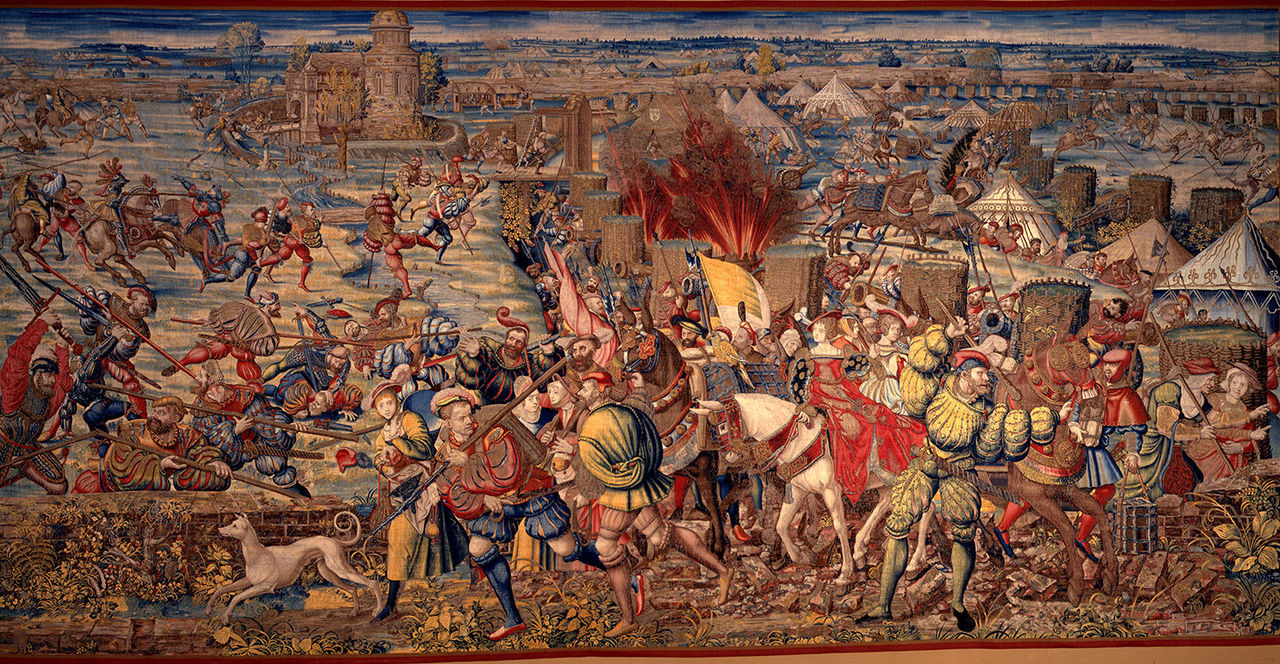
The Imperial infantry, including the fearsome German Landsknechts and veteran Spanish sword-and-buckler men, poured through the breach under cover of darkness. Francis I made a catastrophic tactical error: he ordered his heavy cavalry to charge before his own Swiss infantry and artillery could clear the field, causing his gunners to cease fire to avoid hitting their own horsemen. The Swiss mercenaries, deprived of artillery support, were caught in the open by Landsknecht pike columns and cut down in droves. The French cavalry, elite as it was, became trapped between Imperial infantry, the garrison of Pavia that sortied from the city walls, and the park's own terrain. Within two to three hours the French army had effectively ceased to exist as a fighting force. Casualties were staggering: France lost an estimated 8,000–10,000 dead, including the Constable of Bourbon's rival nobleman the Duke of Suffolk's ally the renowned chevalier Richard de la Pole, and scores of senior nobles. Francis I, unhorsed and surrounded, surrendered personally to Viceroy Charles de Lannoy. Imperial losses were comparatively light, numbering perhaps 500–700 men.
What Were the Consequences of the Battle of Pavia?
The capture of a reigning French king sent shockwaves across Europe. Francis was transported to Madrid, where he signed the humiliating Treaty of Madrid in January 1526, renouncing all claims to Italy, Burgundy, and Navarre. He repudiated the treaty the moment he was released, but France's military prestige never fully recovered in Italy. The battle confirmed Charles V as the dominant ruler in Europe, controlling Spain, the Holy Roman Empire, the Low Countries, and now undisputed influence over the Italian peninsula. The Italian city-states, alarmed by Habsburg supremacy, scrambled to form the League of Cognac in 1526 — but it was too late to reverse Pavia's outcome. The battle also accelerated the decline of heavily armoured cavalry as the primary battlefield arm, proving that disciplined infantry firepower — particularly Spanish arquebusiers — had permanently changed warfare.
| Factor | French Army | Imperial-Spanish Army |
|---|---|---|
| Commander | King Francis I | Charles de Lannoy & Fernando d'Avalos |
| Strength | ~26,000 troops | ~23,000 troops |
| Casualties | 8,000–10,000 killed | ~500–700 killed |
| Cavalry | Heavy French gendarmerie | Light cavalry, Landsknecht infantry |
| Outcome | Catastrophic defeat; king captured | Decisive victory |