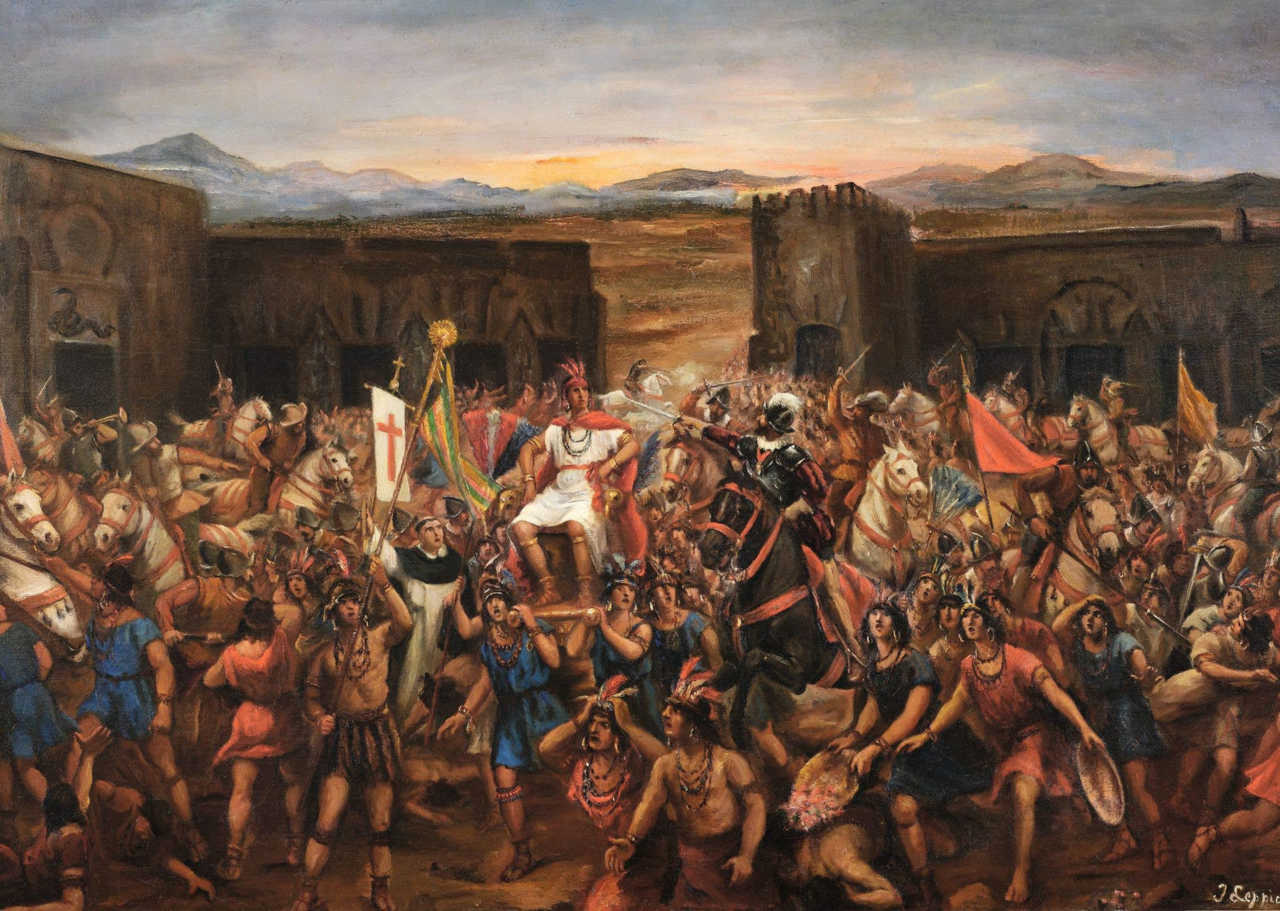
The Battle of Cajamarca took place on November 16, 1532, in the northern Peruvian highland city of Cajamarca. In a single afternoon, Spanish conquistador Francisco Pizarro and just 168 soldiers ambushed Inca Emperor Atahualpa, killed thousands of his attendants, and captured the most powerful ruler in the Western Hemisphere — effectively ending the Inca Empire before a conventional war had even begun.
What Were the Conditions That Made the Ambush Possible?
Atahualpa had just won a bloody civil war against his half-brother Huáscar, leaving the Inca Empire fractured and exhausted. When Pizarro's small force arrived from Panama in 1532, Atahualpa agreed to meet them at Cajamarca, believing 168 foreigners posed no serious threat to his army of roughly 80,000. He entered the city square on November 16 accompanied by an estimated 6,000–8,000 unarmed or lightly armed retainers — a ceremonial escort, not a battle formation. Pizarro had concealed his cavalry and infantry around the square's buildings. The Inca ruler was unaware that the Spanish intended to strike without warning, and his forces had no experience against armored cavalry or firearms. Dominican friar Vicente de Valverde presented Atahualpa with a Bible and a demand to submit to Christianity and the Spanish Crown; when Atahualpa dropped or threw down the book, Pizarro gave the signal to attack.
How Did the Battle Unfold on November 16, 1532?
Spanish cannons fired into the crowded plaza, triggering panic. Cavalry charged from hidden positions while infantrymen cut through the densely packed Inca retinue. The engagement lasted less than two hours. Spanish accounts record roughly 2,000 Inca attendants killed and zero Spanish fatalities — though one source notes Pizarro himself was wounded in the hand while personally seizing Atahualpa. The emperor was taken alive, an outcome Pizarro had specifically planned: capturing the living god-king would paralyze the empire's command structure more completely than killing him outright. Atahualpa quickly grasped his captor's greed and offered a famous ransom — filling a room measuring approximately 22 feet by 17 feet with gold to a height of 8 feet, and filling two smaller rooms with silver. Pizarro accepted. The ransom, delivered over several months in 1533, amounted to roughly 13,000 pounds of gold and 26,000 pounds of silver — the largest ransom in history. Despite fulfilling the terms, Atahualpa was tried on fabricated charges and executed by garroting on July 26, 1533.

| Factor | Spanish Force | Inca Force |
|---|---|---|
| Commanders | Francisco Pizarro | Emperor Atahualpa |
| Troop Numbers | 168 soldiers | ~6,000–8,000 attendants |
| Weapons | Steel, firearms, cavalry | Clubs, slings (ceremonial context) |
| Casualties | ~1 wounded (Pizarro) | ~2,000 killed |
| Outcome | Emperor captured | Empire decapitated |
What Was the Legacy and Historical Significance of Cajamarca?
Cajamarca demonstrated how technology, surprise, and the capture of a divine monarch could collapse a civilization of 10–12 million people. Within two years of the battle, Spanish forces occupied Cusco, the Inca capital. European diseases — smallpox in particular — had already killed perhaps half the Andean population before Pizarro arrived, weakening social cohesion. The gold and silver extracted from the former Inca Empire flooded European markets, fueling inflation and financing Spanish imperial expansion for a century. Historians including Jared Diamond have used Cajamarca as a case study in how geography, epidemic disease, and military technology shaped the conquest of the Americas. For the Indigenous peoples of the Andes, November 16, 1532, marks the beginning of centuries of colonial rule that restructured every aspect of Andean life.