1. French Revolution
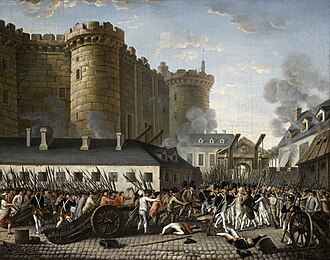
The French Revolution was a period of political and societal change in France that began with the Estates General of 1789 and ended with the Coup of 18 Brumaire on 9 November 1799. Many of the revolution's ideas are considered fundamental principles of liberal democracy, and its values remain central to modern French political discourse. It was caused by a combination of social, political, and economic factors which the existing regime proved unable to manage.
Read the full French Revolution article2. Reign of Terror

The Reign of Terror was a period of the French Revolution when, following the creation of the First Republic, a series of massacres and numerous public executions took place in response to the Federalist revolts, revolutionary fervour, anticlerical sentiment, and accusations of treason by the Committee of Public Safety. While terror was never formally instituted as a legal policy by the Convention, it was more often employed as a concept.
Read the full Reign of Terror article3. Napoleon

Napoleon Bonaparte, later known by his regnal name Napoleon I, was Emperor of the French from 18 May 1804 until his first abdication in 1814, with a brief restoration during the Hundred Days in 1815. He rose to prominence as a general during the French Revolution and led a series of military campaigns across Europe and the Middle East during the French Revolutionary and Napoleonic Wars. As a statesman, he implemented numerous legal and administrative reforms in France and Europe.
Read the full Napoleon article4. Napoleonic Wars

The Napoleonic Wars (1803–1815) were a global series of conflicts fought by a fluctuating array of European coalitions against the French First Republic (1803–1804) under the First Consul followed by the First French Empire (1804–1815) under the Emperor of the French, Napoleon I. The wars originated in political forces arising from the French Revolution (1789–1799) and from the French Revolutionary Wars (1792–1802) and produced a period of French domination over Continental Europe. The wars are categorised as seven conflicts, five named after the coalitions that fought Napoleon, plus two named for their respective theatres: the War of the Third Coalition, War of the Fourth Coalition, War of the Fifth Coalition, War of the Sixth Coalition, War of the Seventh Coalition, the Peninsular War, and the French invasion of Russia.
Read the full Napoleonic Wars article5. Battle of Austerlitz
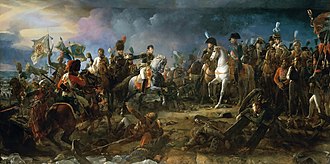
The Battle of Austerlitz, also known as the Battle of the Three Emperors, was one of the most important military engagements of the Napoleonic Wars. The battle occurred near the town of Austerlitz in the Austrian Empire. Around 158,000 troops were involved, of which around 24,000 were killed or wounded.
Read the full Battle of Austerlitz article6. Battle of Trafalgar

The Battle of Trafalgar was a fleet action which took place on 21 October 1805 between the Royal Navy and a combined fleet of the French and Spanish navies during the War of the Third Coalition. As part of Napoleon's planned invasion of the United Kingdom, the French and Spanish navies planned to take control of the English Channel and provide the French invasion army with safe passage to Britain. The allied fleet, under the command of French Vice-admiral Pierre-Charles Villeneuve, sailed from the port of Cádiz in southern Spain on 18 October 1805. It encountered a British fleet under Vice-Admiral of the White Horatio Nelson, 1st Viscount Nelson in the Atlantic Ocean along the southwest coast of Spain off Cape Trafalgar.
Read the full Battle of Trafalgar article7. Battle of Waterloo
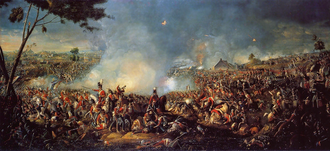
The Battle of Waterloo was fought on Sunday 18 June 1815, near Waterloo, being the last engagement with Napoleon I. The French Imperial Army under the command of Napoleon I was defeated by two armies of the Seventh Coalition. One was a British-led force with units from the United Kingdom, the Netherlands, Hanover, Brunswick, and Nassau, under the command of field marshal Arthur Wellesley, Duke of Wellington. The other comprised three corps of the Prussian army under Field Marshal Blücher. The battle was known contemporaneously as the Battle of Mont Saint-Jean in France and La Belle Alliance in Prussia.
Read the full Battle of Waterloo article8. Congress of Vienna

The Congress of Vienna of 1814–1815 was a series of international diplomatic meetings to discuss and agree upon a possible new layout of the European political and constitutional order after the downfall of the French emperor Napoleon Bonaparte. Participants were representatives of all European powers and other stakeholders. The Congress was chaired by Austrian statesman Klemens von Metternich and was held in Vienna from September 1814 to June 1815.
Read the full Congress of Vienna article