1. Ancient Greece

Ancient Greece was a northeastern Mediterranean civilization, existing from the Greek Dark Ages of the 12th–9th centuries BC to the end of classical antiquity, comprising a loose collection of culturally and linguistically related polis, polities and communities. Prior to the Roman period, most of these regions were officially unified only once under the Kingdom of Macedon from 338 to 323 BC. In Western history, the era of classical antiquity was immediately followed by the Early Middle Ages and the Byzantine period.
Read the full Ancient Greece article2. Athenian democracy

Athenian democracy developed around the 6th century BC in the Greek city-state of Athens, comprising the city of Athens and the surrounding territory of Attica, and focusing on supporting liberty, equality, and security.
Read the full Athenian democracy article3. Sparta

Sparta was a prominent city-state in Laconia in ancient Greece. In antiquity, the state was known as Lacedaemon, while Sparta referred to its capital, a group of villages in the valley of the Evrotas River in Laconia, in southeastern Peloponnese. During the 7th BC, it rose to become the most prominent land military power in the Greek world, a status it retained until its defeat at Leuctra in 371 BC.
Read the full Sparta article4. Battle of Marathon

The Battle of Marathon took place in 490 BC during the first Persian invasion of Greece. It was fought between the citizens of Athens, aided by Plataea, and a Persian force commanded by Datis and Artaphernes. The battle was the culmination of the first attempt by Persia under King Darius I to subjugate Greece. The Greek army inflicted a crushing defeat on the more numerous Persians, marking a turning point in the Greco-Persian Wars.
Read the full Battle of Marathon article5. Battle of Thermopylae

The Battle of Thermopylae was fought in 480 BC at Thermopylae between the Achaemenid Persian Empire under Xerxes and an alliance of Greek city-states led by Sparta under Leonidas I. Lasting over the course of three days, it was one of the most prominent battles of both the second Persian invasion of Greece and the wider Greco-Persian Wars.
Read the full Battle of Thermopylae article6. Peloponnesian War

The Peloponnesian War was fought in the Eastern Mediterranean between the Athenian-led Delian League and the Spartan-led Peloponnesian League from 431 to 404 BC for hegemony over Ancient Greece. Initially inconclusive, the intervention of the Persian Empire in support of Sparta in 413 BC allowed the Spartan coalition to decisively defeat Athens, beginning a period of Spartan hegemony over Greece.
Read the full Peloponnesian War article7. Socrates
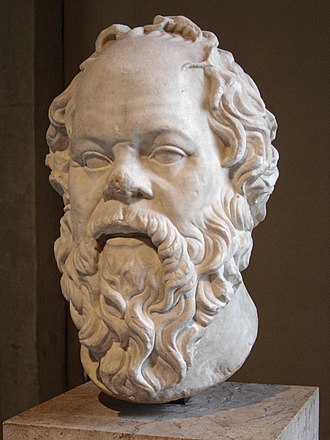
Socrates was an ancient Greek philosopher from Classical Athens, perhaps the first Western moral philosopher, and a major inspiration on his student Plato, who largely founded the tradition of Western philosophy. An enigmatic figure, Socrates authored no texts and is known mainly through the posthumous accounts of classical writers, particularly his students Plato and Xenophon. These accounts are written as dialogues, in which Socrates and his interlocutors examine a subject in the style of question and answer; they gave rise to the Socratic dialogue literary genre. Contradictory accounts of Socrates make a reconstruction of his philosophy nearly impossible, a situation known as the Socratic problem. Socrates was a polarizing figure in Athenian society. In 399 BC, he was accused of impiety and corrupting the youth. After a trial that lasted a day, he was sentenced to death. As related by Plato, he was put to death by administration of poison after refusing offers from allies to help him escape.
Read the full Socrates article8. Alexander the Great

Alexander III of Macedon, most commonly known as Alexander the Great, was king of the ancient Greek kingdom of Macedon. He succeeded his father Philip II to the throne in 336 BC at the age of 20, and spent most of his reign conducting a lengthy military campaign throughout Asia and Egypt. By the age of 30, he had created one of the largest empires in history, stretching from Greece to northwestern India. He was undefeated in battle and is widely considered to be one of history's greatest and most successful military commanders.
Read the full Alexander the Great article9. Hellenistic period

In classical antiquity, the Hellenistic period covers the time in Greek, Eastern Mediterranean and Middle Eastern history following Classical Greece, between the death of Alexander the Great in 323 BC and the death of Cleopatra VII in 30 BC, in which all these regions were under the influence of Greek leadership, culture, and language as a result of Alexander's conquests. The Hellenistic period was followed by the ascendancy of the Roman Empire in the Mediterranean, the Battle of Actium in 31 BC, and the Roman conquest of Ptolemaic Egypt the following year, which eliminated the last major Hellenistic kingdom. Its name stems from the Ancient Greek word Hellas, which was gradually recognized as the name for Greece, from which the modern historiographical term Hellenistic was derived. The term "Hellenistic" is to be distinguished from "Hellenic" in that the latter refers to Greece itself, while the former encompasses all the ancient territories of the period that had come under significant Greek influence, particularly the Hellenized Ancient Near East, after the conquests of Alexander the Great.
Read the full Hellenistic period article