
In modern historiography, the Western Roman Empire was the Roman Empire's western provinces collectively during any period in which they were administered separately from the eastern provinces by a separate, independent imperial court. Particularly from AD 395 to 476, there were separate, coequal courts dividing the governance of the empire into western and eastern provinces with a distinct imperial succession in the separate courts. The terms Western Roman Empire and Eastern Roman Empire were coined in modern times to describe political entities that were de facto independent; contemporary Romans did not consider the Empire to have been split into two empires but viewed it as a single polity governed by two imperial courts for administrative purposes. The Western Empire collapsed in 476, and the Western imperial court in Ravenna disappeared by 554, at the end of Justinian's Gothic War, marking one of the most transformative political changes during the era of late antiquity.
Although there were periods with more than one emperor ruling jointly before, the view that it was impossible for a single emperor to govern the entire Empire was institutionalized by emperor Diocletian following the disastrous civil wars and disintegrations of the Crisis of the Third Century. In 286 he introduced the system of the Tetrarchy, with two senior emperors titled Augustus, one in the East and one in the West, each with an appointed subordinate and heir titled Caesar. Though the tetrarchic system would collapse in years, the east–west administrative division endured in various forms. As such, the unofficial Western Roman Empire would exist intermittently between the 3rd and 5th centuries. Some emperors, such as Constantine I and Theodosius I, governed, if briefly, as the sole Augustus across the Roman Empire. On the death of Theodosius in 395, the empire was divided between his two infant sons, with Honorius as his successor in the West governing briefly from Mediolanum then from Ravenna, and Arcadius as his successor in the East governing from Constantinople.
In 476, the Roman army in the West was defeated in the Battle of Ravenna by Odoacer and his Germanic foederati. Odoacer forced Romulus Augustulus to abdicate and became the first King of Italy. That event was popularised by the 18th-century British historian Edward Gibbon as a demarcating the fall of the Western Roman Empire and is sometimes used to mark the transition from Antiquity to the Middle Ages. In 480, Western emperor Julius Nepos was assassinated and Eastern emperor Zeno dissolved the Western court and proclaimed himself the sole emperor of the Roman Empire. Odoacer's Italy and other barbarian kingdoms, many of them representing former Western Roman allies that had been granted lands in return for military assistance, would maintain a pretense of Roman continuity through the continued use of the old Roman administrative systems and nominal subservience to the Eastern Roman court.

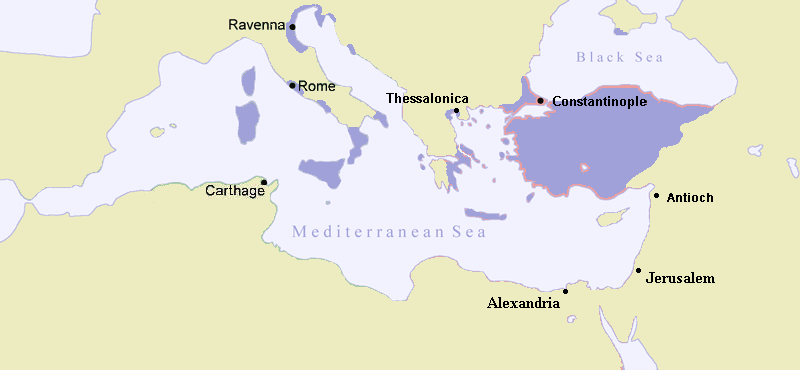
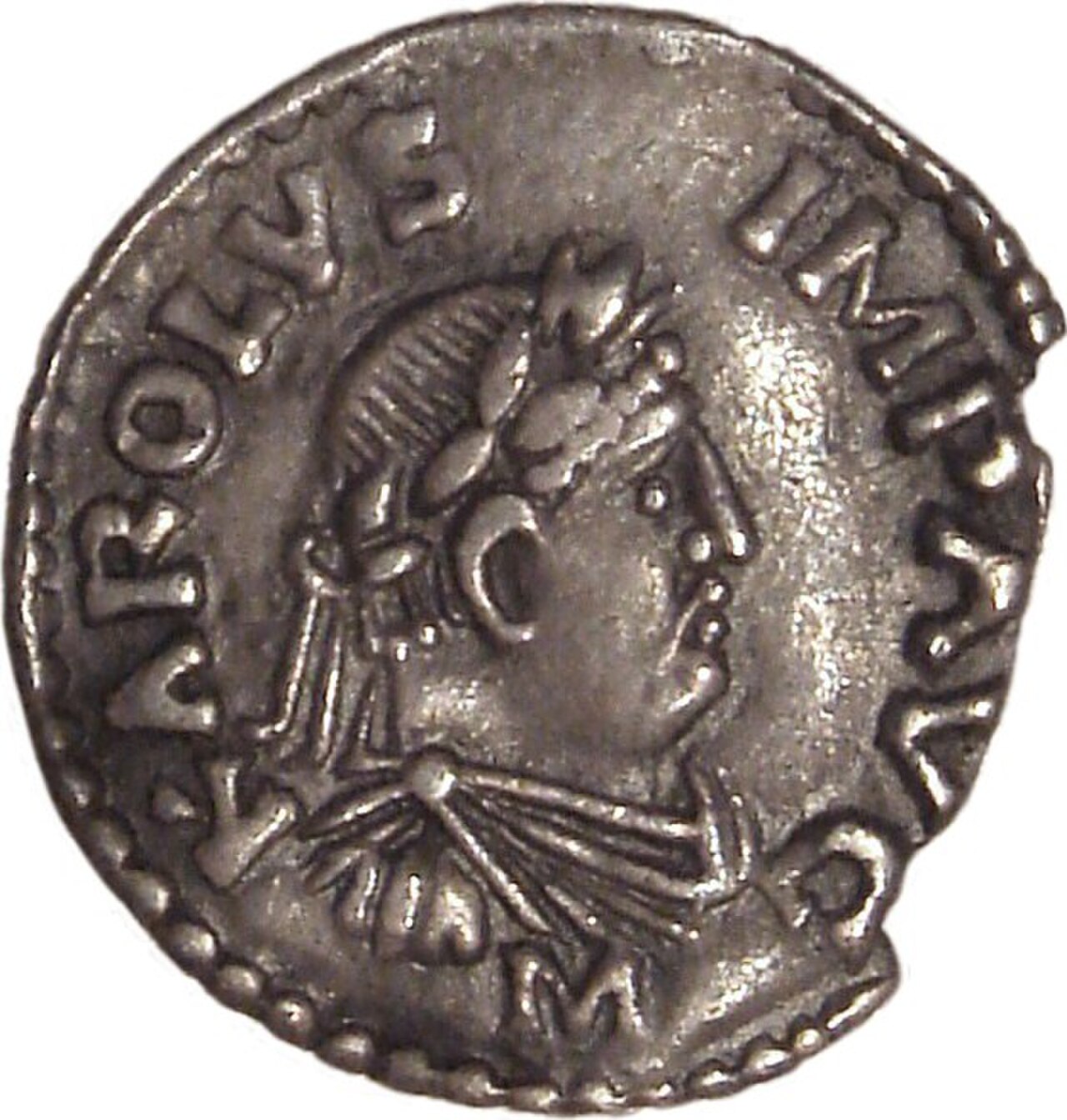
In the 6th century, Emperor Justinian I re-imposed direct rule on large parts of the former Western Roman Empire, including the prosperous regions of North Africa, Italy and parts of Hispania. But political instability in the Eastern heartlands, foreign invasions, plague, and religious differences, made control of these territories difficult and they were gradually lost forever. Although the Eastern Empire retained territories in southern Italy until the 11th century, the Empire's influence over Western Europe had diminished significantly. The papal coronation of the Frankish king Charlemagne as Roman Emperor in 800 marked a new imperial line that would evolve into the Holy Roman Empire. It was a revival of the imperial title in Western Europe but not an extension of Roman traditions or institutions. The Great Schism of 1054 between the churches of Rome and Constantinople further diminished any authority the emperor in Constantinople could hope to exert in the West.
Background
As the Roman Republic expanded, it reached a point where the central government in Rome could not effectively rule the distant provinces. Communications and transportation were especially problematic given the vast extent of the Empire. News of invasion, revolt, natural disasters, or epidemic outbreak was carried by ship or mounted postal service, often requiring much time to reach Rome and for Rome's orders to be returned and acted upon. Therefore, provincial governors had de facto autonomy in the name of the Roman Republic. Governors had several duties, including the command of armies, handling the taxes of the province and serving as the province's chief houses.
Prior to the establishment of the Empire, the territories of the Roman Republic had been divided in 43 BC among the members of the Second Triumvirate: Mark Antony, Octavian and Marcus Aemilius Lepidus. Antony received the provinces in the East: Achaea, Macedonia and Epirus (roughly modern Greece, Albania and the coast of Croatia), Bithynia, Pontus and Asia (roughly modern Turkey), Syria, Cyprus, and Cyrenaica. These lands had previously been conquered by Alexander the Great; thus, much of the aristocracy was of Greek origin. The whole region, especially the major cities, had been largely assimilated into Greek culture, Greek often serving as the lingua franca.
Octavian obtained the Roman provinces of the West: Italia (modern Italy), Gaul (modern France), Gallia Belgica (parts of modern Belgium, the Netherlands and Luxembourg), and Hispania (modern Spain and Portugal). These lands also included Greek and Carthaginian colonies in the coastal areas, though Celtic tribes such as Gauls and Celtiberians were culturally dominant. Lepidus received the minor province of Africa (roughly modern Tunisia). Octavian soon took Africa from Lepidus, while adding Sicilia (modern Sicily) to his holdings.
Upon the defeat of Mark Antony, a victorious Octavian controlled a united Roman Empire. The Empire featured many distinct cultures; all experienced a gradual Romanization. While the predominantly Greek culture of the East and the predominantly Latin culture of the West functioned effectively as an integrated whole, political and military developments would ultimately realign the Empire along those cultural and linguistic lines. More often than not, Greek and Latin practices (and to some extent the languages themselves) would be combined in fields such as history (e.g., those by Cato the Elder), philosophy and rhetoric.
Rebellions and political developments
Minor rebellions and uprisings were fairly common events throughout the Empire. Conquered tribes or oppressed cities would revolt and the legions would be detached to crush the rebellion. While this process was simple in peacetime, it could be considerably more complicated in wartime. In a full-blown military campaign, the legions were far more numerous – as, for example, those led by Vespasian in the First Jewish–Roman War. To ensure a commander's loyalty, a pragmatic emperor might hold some members of the general's family hostage. To this end, Nero effectively held Domitian and Quintus Petillius Cerialis, Governor of Ostia, who were respectively the younger son and brother-in-law of Vespasian. Nero's rule was ended by a revolt of the Praetorian Guard, who had been bribed in the name of Galba. The Praetorian Guard, a figurative "sword of Damocles", was often perceived as being of dubious loyalty, primarily due its role in court intrigues and in overthrowing several emperors, including Pertinax and Aurelian. Following their example, the legions at the borders increasingly participated in civil wars. For instance, legions stationed in Egypt and the eastern provinces would see significant participation in the civil war of 218 between Emperor Macrinus and Elagabalus.
As the Empire expanded, two key frontiers revealed themselves. In the West, behind the rivers Rhine and Danube, Germanic tribes were an important enemy. Augustus, the first emperor, had tried to conquer them but had pulled back after the disastrous Battle of the Teutoburg Forest. Whilst the Germanic tribes were formidable foes, the Parthian Empire in the East presented the greatest threat to the Empire. The Parthians were too remote and powerful to be conquered and there was a constant Parthian threat of invasion. The Parthians repelled several Roman invasions, and even after successful wars of conquest, such as those implemented by Trajan or Septimius Severus, the conquered territories were forsaken in attempts to ensure a lasting peace with the Parthians. The Parthian Empire would be succeeded by the Sasanian Empire, which continued hostilities with the Roman Empire.
Controlling the western border of Rome was reasonably easy because it was relatively close to Rome itself and also because of the disunity among the Germans. However, controlling both frontiers simultaneously during wartime was difficult. If the emperor was near the border in the East, the chances were high that an ambitious general would rebel in the West and vice versa. This wartime opportunism plagued many ruling emperors and indeed paved the road to power for several future emperors. By the time of the Crisis of the Third Century, usurpation became a common method of succession: Philip the Arab, Trebonianus Gallus and Aemilianus were all usurping generals-turned-emperors whose rule would end with usurpation by another powerful general.
The idea of co-emperorship was first tested by Marcus Aurelius (r. 161–180), who decided to rule alongside his adoptive brother Lucius Verus. There was, however, much precedent. The consulate of the Republic was a twin magistracy, and earlier emperors had often had a subordinate lieutenant with many imperial offices. Many emperors had planned a joint succession in the past—Augustus planned to leave Gaius and Lucius Caesar as joint emperors on his death; Tiberius wished to have Caligula and Tiberius Gemellus do so as well; as Claudius with Nero and Britannicus. All of these arrangements had ended in failure, either through premature death (Gaius and Lucius) or murder (Gemellus and Britannicus). Marcus Aurelius ruled mostly from the West, while Verus spent most of his reign campaigning in the East, against Parthia. Verus accompanied Marcus at the start of the Marcomannic Wars, but died shortly after. Decades later, Septimius Severus (r. 193–211) appointed his sons Geta and Caracalla as joint heirs. However, Caracalla murdered his brother shortly after succeeding to the throne.

Crisis of the Third Century
With the assassination of the emperor Alexander Severus in March 235 by his own troops, the Roman Empire sank into a 50-year period of civil war now known as the Crisis of the Third Century. During this period, the Empire saw the combined pressures of barbarian invasions and migrations into Roman territory, civil wars, peasant rebellions and political instability, with multiple usurpers competing for power. The idea of dividing the empire was first developed in this time; Valerian and his son Gallienus divided the empire between them, the former ruling from the East and the latter from the West. However, Valerian was captured by the Sassanids at the Battle of Edessa, leaving Gallienus as sole emperor.
Saloninus, Gallienus' infant son, and the praetorian prefect Silvanus resided in Colonia Agrippina (modern Cologne) to solidify the loyalty of the local legions. Nevertheless, Postumus – the local governor of the German provinces – rebelled, and his assault on Colonia Agrippina resulted in the deaths of Saloninus and the prefect. In the confusion that followed, an independent state known in modern historiography as the Gallic Empire emerged. Its capital was Augusta Treverorum (modern Trier), and it quickly expanded its control over the German and Gaulish provinces, all of Hispania and Britannia. It had its own senate, and a partial list of its consuls still survives. It maintained Roman religion, language, and culture, and was far more concerned with fighting the Germanic tribes, fending off Germanic incursions and restoring the security the Gallic provinces had enjoyed in the past, than in challenging the Roman central government.
In the reign of Claudius Gothicus (268–270), large expanses of the Gallic Empire were restored to Roman rule. At roughly the same time, however, several eastern provinces seceded to form the Palmyrene Empire, under the rule of Queen Zenobia.

In 272, Emperor Aurelian finally managed to reclaim Palmyra and its territory for the empire. With the East secure, his attention turned to the West, invading the Gallic Empire a year later. Aurelian decisively defeated Tetricus I in the Battle of Châlons, and soon captured Tetricus and his son Tetricus II. Both Zenobia and the Tetrici were pardoned, although they were first paraded in a triumph.
Tetrarchy
Diocletian divided the Roman Empire when, in 286, he elevated Maximian to the rank of Augustus (emperor) and gave him control of the Western Empire, while he continued to rule the East. In 293, Galerius and Constantius Chlorus were appointed as their subordinate (caesars), as a way to avoid the civil unrest that had marked the 3rd century. This system effectively divided the Empire into four major regions, the First Tetrarchy: in the West, Maximian made Mediolanum (now Milan) his capital, and Constantius made Trier his. In the East, Galerius made his capital Sirmium and Diocletian made Nicomedia his. On 1 May 305, Diocletian and Maximian abdicated, replaced by Galerius and Constantius, who, in turn, appointed Maximinus II and Valerius Severus, respectively, as their caesars, thus creating the Second Tetrarchy.
The Tetrarchy collapsed after the unexpected death of Constantius in 306.

His son, Constantine, was declared Western emperor by the British legions, but several other claimants arose and attempted to seize the Western Empire. In 308, Galerius revived the Tetrarchy by dividing the Western Empire between Constantine and Licinius. However, Constantine was more interested in conquering the whole empire so, by 314, began to compete against Licinius, finally defeating him in 324 at the Battle of Chrysopolis. After Constantine unified the empire, he refounded the city of Byzantium in modern-day Turkey as Nova Roma ("New Rome"), later called Constantinople, and made it the capital of the Roman Empire. Although the Tetrarchy was ended, the concept of physically dividing the Roman Empire into East and a West continued, as happened after the deaths of Constantine and Theodosius I.
Further divisions
The Roman Empire was under the rule of a single emperor, but, with the death of Constantine in 337, the empire was partitioned between his surviving male heirs. Constantius, his third son and the second by his wife Fausta (Maximian's daughter) received the eastern provinces, including Constantinople, Thrace, Asia Minor, Syria, Egypt, and Cyrenaica; Constantine II received Britannia, Gaul, Hispania, and Mauretania; and Constans, initially under the supervision of Constantine II, received Italy, Africa, Illyricum, Pannonia, Macedonia, and Achaea. The provinces of Thrace, Achaea and Macedonia were shortly controlled by Dalmatius, nephew of Constantine I and a caesar, not an Augustus, until his murder by his own soldiers in 337. The West was unified in 340 under Constans, who was assassinated in 350 under the order of the usurper Magnentius. After Magnentius lost the Battle of Mursa Major and committed suicide, a complete reunification of the whole Empire occurred under Constantius in 353.
Constantius II focused most of his power in the East. Under his rule, the city of Byzantium – only recently re-founded as Constantinople – was fully developed as a capital. At Constantinople, the political, economic and military control of the Eastern Empire's resources would remain safe for centuries to come. The city was well fortified and located at the crossroads of several major trade and military routes. The site had been acknowledged for its strategic importance already by emperors Septimius Severus and Caracalla, more than a century prior.
In 361, Constantius II became ill and died, and Constantius Chlorus' grandson Julian, who had served as Constantius II's Caesar, assumed power. Julian was killed in 363 in the Battle of Samarra against the Sasanian Empire and was succeeded by Jovian, who ruled for only nine months. Following the death of Jovian, Valentinian I emerged as emperor in 364. He immediately divided the Empire once again, giving the eastern half to his brother Valens. Stability was not achieved for long in either half, as the conflicts with outside forces (barbarian tribes) intensified. In 376, the Visigoths, fleeing before the Ostrogoths, who in turn were fleeing before the Huns, were allowed to cross the river Danube and settle in the Balkans by the Eastern government. Mistreatment caused a full-scale rebellion, and in 378 they inflicted a crippling defeat on the Eastern Roman field army in the Battle of Adrianople, in which Emperor Valens also died. The defeat at Adrianople was shocking to the Romans, and forced them to negotiate with and settle the Visigoths within the borders of the Empire, where they would become semi-independent foederati under their own leaders.
More than in the East, there was also opposition to the Christianizing policy of the emperors in the western part of the Empire. In 379, Valentinian I's son and successor Gratian declined to wear the mantle of Pontifex Maximus, and in 382 he rescinded the rights of pagan priests and removed the Altar of Victory from the Roman Curia, a decision which caused dissatisfaction among the traditionally pagan aristocracy of Rome.
The political situation was unstable. In 383, a powerful and popular general named Magnus Maximus seized power in the West and forced Gratian's half-brother Valentinian II to flee to the East for aid; in a destructive civil war the Eastern emperor Theodosius I restored him to power. In 392, the Frankish and pagan magister militum Arbogast assassinated Valentinian II and proclaimed an obscure senator named Eugenius as emperor. In 394 the forces of the two halves of the Empire again clashed with great loss of life. Again Theodosius I won, and he briefly ruled a united Empire until his death in 395. He was the last emperor to rule both parts of the Roman Empire before the West fragmented and collapsed.
Theodosius I's older son Arcadius inherited the eastern half while the younger Honorius got the western half. Both were still minors and neither was capable of ruling effectively. Honorius was placed under the tutelage of the half-Roman/half-barbarian magister militum Flavius Stilicho, while Rufinus became the power behind the throne in the east. Rufinus and Stilicho were rivals, and their disagreements would be exploited by the Gothic leader Alaric I who again rebelled in 408 following the massacre by Roman legions of thousands of barbarian families who were trying to assimilate into the Roman empire.
Neither half of the Empire could raise forces sufficient even to subdue Alaric's men, and both tried to use Alaric against the other half. Alaric himself tried to establish a long-term territorial and official base, but was never able to do so. Stilicho tried to defend Italy and bring the invading Goths under control, but to do so he stripped the Rhine frontier of troops and the Vandals, Alans, and Suevi invaded Gaul in large numbers in 406. Stilicho became a victim of court intrigues and was killed in 408. While the East began a slow recovery and consolidation, the West began to collapse entirely. Alaric's men sacked Rome in 410.
History
Reign of Honorius
Honorius, the younger son of Theodosius I, was declared Augustus (and as such co-emperor with his father) on 23 January in 393, at the age of 9. Upon the death of Theodosius, Honorius inherited the throne of the West at the age of ten whilst his older brother Arcadius inherited the East. The western capital was initially Mediolanum, as it had been during previous divisions, but it was moved to Ravenna in 401 upon the entry of the Visigothic king Alaric I into Italy. Ravenna, protected by abundant marshes and strong fortifications, was far easier to defend and had easy access to the imperial fleet of the Eastern Empire but made it more difficult for the Roman military to defend the central parts of Italy from regular barbarian incursions. Ravenna would remain the western capital until 450 when Valentinian III moved the court back to Rome. Most western emperors from 450 until 475 reigned from Rome. The last de facto western emperor Romulus Augustulus resided in Ravenna from 475 until his deposition in 476 and Ravenna would later be the capital of both the Ostrogothic Kingdom and the Exarchate of Ravenna.
Despite the moved capital, economic power remained focused on Rome and its rich senatorial aristocracy which dominated much of Italy and Africa in particular. After Emperor Gallienus had banned senators from army commands in the mid-3rd century, the senatorial elite lost all experience of – and interest in – military life. In the early 5th century the wealthy landowning elite of the Roman Senate largely barred its tenants from military service, but it also refused to approve sufficient funding for maintaining a sufficiently powerful mercenary army to defend the entire Western Empire. The West's most important military area had been northern Gaul and the Rhine frontier in the 4th century, when Trier frequently served as a military capital of sorts for the Empire. Many leading Western generals were barbarians.
The reign of Honorius was, even by Western Roman standards, chaotic and plagued by both internal and external struggles. The Visigothic foederati under Alaric, magister militum in Illyricum, rebelled in 395. Gildo, the Comes Africae and Magister utriusque militiae per Africam, rebelled in 397 and initiated the Gildonic War. Stilicho managed to subdue Gildo but was campaigning in Raetia when the Visigoths entered Italy in 402. Stilicho, hurrying back to aid in defending Italy, summoned legions in Gaul and Britain with which he managed to defeat Alaric twice before agreeing to allow him to retreat back to Illyria.
The weakening of the frontiers in Britain and Gaul had dire consequences for the Empire. As the imperial government was not providing the military protection the northern provinces expected and needed, numerous usurpers arose in Britain, including Marcus (406–407), Gratian (407), and Constantine III who invaded Gaul in 407. Britain was effectively abandoned by the empire by 410 due to the lack of resources and the need to look after more important frontiers. The weakening of the Rhine frontier allowed multiple barbarian tribes, including the Vandals, Alans and Suebi, to cross the river and enter Roman territory in 406.
Honorius was convinced by the minister Olympius that Stilicho was conspiring to overthrow him, and so arrested and executed Stilicho in 408. Olympius headed a conspiracy that orchestrated the deaths of key individuals related to the faction of Stilicho, including his son and the families of many of his federated troops. This led many of the soldiers to instead join with Alaric, who returned to Italy in 409 and met little opposition. Despite attempts by Honorius to reach a settlement and six legions of Eastern Roman soldiers sent to support him, the negotiations between Alaric and Honorius broke down in 410 and Alaric sacked the city of Rome. Though the sack was relatively mild and Rome was no longer the capital of even the Western Empire, the event shocked people across both halves of the Empire as this was the first time Rome (viewed at least as the symbolic heart of the Empire) had fallen to a foreign enemy since the Gallic invasions of the 4th century BC. The Eastern Roman emperor Theodosius II, the successor of Arcadius, declared three days of mourning in Constantinople.
Without Stilicho and following the sack of Rome, Honorius' reign grew more chaotic. The usurper Constantine III had stripped Roman Britain of its defenses when he crossed over to Gaul in 407, leaving the Romanized population subject to invasions, first by the Picts and then by the Saxons, Angli, and the Jutes who began to settle permanently from about 440 onwards. After Honorius accepted Constantine as co-emperor, Constantine's general in Hispania, Gerontius, proclaimed Maximus as emperor. With the aid of general Constantius, Honorius defeated Gerontius and Maximus in 411 and shortly thereafter captured and executed Constantine III. With Constantius back in Italy, the Gallo-Roman senator Jovinus revolted after proclaiming himself emperor, with the support of the Gallic nobility and the barbarian Burgundians and Alans. Honorius turned to the Visigoths under King Athaulf for support. Athaulf defeated and executed Jovinus and his proclaimed co-emperor Sebastianus in 413, around the same time as another usurper arose in Africa, Heraclianus. Heraclianus attempted to invade Italy but failed and retreated to Carthage, where he was killed.
With the Roman legions withdrawn, northern Gaul became increasingly subject to Frankish influence, the Franks naturally adopting a leading role in the region. In 418, Honorius granted southwestern Gaul (Gallia Aquitania) to the Visigoths as a vassal federation. Honorius removed the local imperial governors, leaving the Visigoths and the provincial Roman inhabitants to conduct their own affairs. As such, the first of the "barbarian kingdoms", the Visigothic Kingdom, was formed.
Escalating barbarian conflicts
Honorius' death in 423 was followed by turmoil until the Eastern Roman government installed Valentinian III as Western emperor in Ravenna by force of arms, with Galla Placidia acting as regent during her son's minority. Theodosius II, the Eastern emperor, had hesitated to announce the death of Honorius and in the ensuing interregnum, Joannes was nominated as Western emperor. Joannes' rule was short and the forces of the East defeated and executed him in 425.After a violent struggle with several rivals, and against Placidia's wish, Aetius rose to the rank of magister militum. Aetius was able to stabilize the Western Empire's military situation somewhat, relying heavily on his Hunnic allies. With their help Aetius undertook extensive campaigns in Gaul, defeating the Visigoths in 437 and 438 but suffering a defeat himself in 439, ending the conflict in a status quo ante with a treaty.
Meanwhile, pressure from the Visigoths and a rebellion by Bonifacius, the governor of Africa, induced the Vandals under King Gaiseric to cross from Spain to Tingitana in what is now Morocco in 429. They temporarily halted in Numidia in 435 before moving eastward. With Aetius occupied in Gaul, the Western Roman government could do nothing to prevent the Vandals conquering the wealthy African provinces, culminating in the fall of Carthage on 19 October 439 and the establishment of the Vandal Kingdom. By the 400s, Italy and Rome itself were dependent on the taxes and foodstuffs from these provinces, leading to an economic crisis. With Vandal fleets becoming an increasing danger to Roman sea trade and the coasts and islands of the western and central Mediterranean, Aetius coordinated a counterattack against the Vandals in 440, organizing a large army in Sicily.
However, the plans for retaking Africa had to be abandoned due to the immediate need to combat the invading Huns, who in 444 were united under their ambitious king Attila. Turning against their former ally, the Huns became a formidable threat to the Empire. Aetius transferred his forces to the Danube, though Attila concentrated on raiding the Eastern Roman provinces in the Balkans, providing temporary relief to the Western Empire. In 449, Attila received a message from Honoria, Valentinian III's sister, offering him half the western empire if he would rescue her from an unwanted marriage that her brother was forcing her into. With a pretext to invade the West, Attila secured peace with the Eastern court and crossed the Rhine in early 451. With Attila wreaking havoc in Gaul, Aetius gathered a coalition of Roman and Germanic forces, including Visigoths and Burgundians, and prevented the Huns from taking the city of Aurelianum, forcing them into retreat. At the Battle of the Catalaunian Plains, the Roman-Germanic coalition met and defeated the Hunnic forces, though Attila escaped.
Attila regrouped and invaded Italy in 452. With Aetius not having enough forces to attack him, the road to Rome was open. Valentinian sent Pope Leo I and two leading senators to negotiate with Attila. This embassy, combined with a plague among Attila's troops, the threat of famine, and news that the Eastern emperor Marcian had launched an attack on the Hun homelands along the Danube, forced Attila to turn back and leave Italy. When Attila died unexpectedly in 453, the power struggle that erupted between his sons ended the threat posed by the Huns.
Internal unrest and Majorian
Valentinian III was intimidated by Aetius and was encouraged by the Roman senator Petronius Maximus and the chamberlain Heraclius to assassinate him. When Aetius was at court in Ravenna delivering a financial account, Valentinian suddenly leaped from his seat and declared that he would no longer be the victim of Aetius' drunken depravities. Aetius attempted to defend himself from the charges, but Valentinian drew his sword and struck the weaponless Aetius on the head, killing him on the spot. On 16 March the following year, Valentinian himself was killed by supporters of the dead general, possibly acting for Petronius Maximus. With the end of the Theodosian dynasty, Petronius Maximus proclaimed himself emperor during the ensuing period of unrest.
Petronius was not able to take effective control of the significantly weakened and unstable Empire. He broke the betrothal between Huneric, son of the Vandal king Gaiseric, and Eudocia, daughter of Valentinian III. This was seen as a just cause of war by King Gaiseric, who set sail to attack Rome. Petronius and his supporters attempted to flee the city at the sight of the approaching Vandals, only to be stoned to death by a Roman mob. Petronius had reigned only 11 weeks. With the Vandals at the gates, Pope Leo I requested that the King not destroy the ancient city or murder its inhabitants, to which Gaiseric agreed and the city gates were opened to him. Though keeping his promise, Gaiseric looted great amounts of treasure and damaged objects of cultural significance such as the Temple of Jupiter Optimus Maximus. The severity of the Vandal sack of 455 is disputed, though with the Vandals plundering the city for a full fourteen days as opposed to the Visigothic sack of 410, where the Visigoths only spent three days in the city, it was likely more thorough.
Avitus, a prominent general under Petronius, was proclaimed emperor by the Visigothic king Theodoric II and accepted as such by the Roman Senate. Though supported by the Gallic provinces and the Visigoths, Avitus was resented in Italy due to ongoing food shortages caused by Vandal control of trade routes, and for using a Visigothic imperial guard. He disbanded his guard due to popular pressure, and the Suebian general Ricimer used the opportunity to depose Avitus, counting on popular discontent. After the deposition of Avitus, the Eastern emperor Leo I did not select a new western Augustus. The prominent general Majorian defeated an invading force of Alemanni and was subsequently proclaimed Western emperor by the army and eventually accepted as such by Leo.
Majorian was the last Western emperor to attempt to recover the Western Empire with his own military forces. To prepare, Majorian significantly strengthened the Western Roman army by recruiting large numbers of barbarian mercenaries, among them the Gepids, Ostrogoths, Rugii, Burgundians, Huns, Bastarnae, Suebi, Scythians and Alans, and built two fleets, one at Ravenna, to combat the strong Vandalic fleet. Majorian personally led the army to wage war in Gaul, leaving Ricimer in Italy. The Gallic provinces and the Visigothic Kingdom had rebelled following the deposition of Avitus, refusing to acknowledge Majorian as lawful emperor. At the Battle of Arelate, Majorian decisively defeated the Visigoths under Theoderic II and forced them to relinquish their great conquests in Hispania and return to foederati status. Majorian then entered the Rhone Valley, where he defeated the Burgundians and reconquered the rebel city of Lugdunum. With Gaul back under Roman control, Majorian turned his eyes to the Vandals and Africa. Not only did the Vandals pose a constant danger to coastal Italy and trade in the Mediterranean, but the province they ruled was economically vital to the survival of the West. Majorian began a campaign to fully reconquer Hispania to use it as a base for the reconquest of Africa. Throughout 459, Majorian campaigned against the Suebi in northwestern Hispania.
The Vandals began to increasingly fear a Roman invasion. King Gaiseric tried to negotiate a peace with Majorian, who rejected the proposal. In the wake of this, Gaiseric devastated Mauretania, part of his own kingdom, fearing that the Roman army would land there. Having regained control of Hispania, Majorian intended to use his fleet at Carthaginiensis to attack the Vandals. Before he could, the fleet was destroyed, allegedly by traitors paid by the Vandals. Deprived of his fleet, Majorian had to cancel his attack on the Vandals and conclude a peace with Gaiseric. Disbanding his barbarian forces, Majorian intended to return to Rome and issue reforms, stopping at Arelate on his way. Here, Ricimer deposed and arrested him in 461, having gathered significant aristocratic opposition against Majorian. After five days of beatings and torture, Majorian was beheaded near the river Iria.
Collapse
The final collapse of the Empire in the West was marked by increasingly ineffectual puppet emperors dominated by their Germanic magistri militum. The most pointed example of this is Ricimer, who effectively became a "shadow emperor" following the depositions of Avitus and Majorian. Unable to take the throne for himself due to his barbarian heritage, Ricimer appointed a series of puppet emperors who could do little to halt the collapse of Roman authority and the loss of the territories re-conquered by Majorian. The first of these puppet emperors, Libius Severus, had no recognition outside of Italy, with the Eastern emperor Leo I and provincial governors in Gaul and Illyria all refusing to recognize him.
Severus died in 465 and Leo I, with the consent of Ricimer, appointed the capable Eastern general Anthemius as Western emperor following an eighteen-month interregnum. The relationship between Anthemius and the East was good, Anthemius is the last Western emperor recorded in an Eastern law, and the two courts conducted a joint operation to retake Africa from the Vandals, culminating in the disastrous Battle of Cape Bon in 468. In addition Anthemius conducted failed campaigns against the Visigoths, hoping to halt their expansion.
The trial and subsequent execution of Romanus, an Italian senator and friend of Ricimer, on the grounds of treachery in 470 made Ricimer hostile to Anthemius. Following two years of ill feeling, Ricimer deposed and killed Anthemius in 472, elevating Olybrius to the Western throne. During the brief reign of Olybrius, Ricimer died and his nephew Gundobad succeeded him as magister militum. After only seven months of rule, Olybrius died of dropsy. Gundobad elevated Glycerius to Western emperor. The Eastern Empire had rejected Olybrius and also rejected Glycerius, instead supporting a candidate of their own, Julius Nepos, magister militum in Dalmatia. With the support of Eastern emperors Leo II and Zeno, Julius Nepos crossed the Adriatic Sea in the spring of 474 to depose Glycerius. At the arrival of Nepos in Italy, Glycerius abdicated without a fight and was allowed to live out his life as the Bishop of Salona.
The brief rule of Nepos in Italy ended in 475 when Orestes, a former secretary of Attila and the magister militum of Julius Nepos, took control of Ravenna and forced Nepos to flee by ship to Dalmatia. Later in the same year, Orestes crowned his own young son as Western emperor under the name Romulus Augustus. Romulus Augustus was not recognised as Western emperor by the Eastern Court, who maintained that Nepos was the only legal Western emperor, reigning in exile from Dalmatia.
On 4 September 476, Odoacer, leader of the Germanic foederati in Italy, captured Ravenna, killed Orestes and deposed Romulus. Though Romulus was deposed, Nepos did not return to Italy and continued to reign as Western emperor from Dalmatia, with support from Constantinople. Odoacer proclaimed himself ruler of Italy and began to negotiate with the Eastern emperor Zeno. Zeno eventually granted Odoacer patrician status as recognition of his authority and accepted him as his viceroy of Italy. Zeno, however, insisted that Odoacer had to pay homage to Julius Nepos as the emperor of the Western Empire. Odoacer accepted this condition and issued coins in the name of Julius Nepos throughout Italy. This, however, was mainly an empty political gesture, as Odoacer never returned any real power or territories to Nepos. The murder of Nepos in 480 prompted Odoacer to invade Dalmatia, annexing it to his Kingdom of Italy.
Fall of the Empire
By convention, the Western Roman Empire is deemed to have ended on 4 September 476, when Odoacer deposed Romulus Augustus, but the historical record calls this determination into question. Indeed, the deposition of Romulus Augustus received very little attention in contemporary times. Romulus was a usurper in the eyes of the Eastern Roman Empire and the remaining territories of Western Roman control outside of Italy, with the previous emperor Julius Nepos still being alive and claiming to rule the Western Empire in Dalmatia. Furthermore, the Western court had lacked true power and had been subject to Germanic aristocrats for decades, with most of its legal territory being under control of various barbarian kingdoms. With Odoacer recognising Julius Nepos, and later the Eastern emperor Zeno, as his sovereign, nominal Roman control continued in Italy. Syagrius, who had managed to preserve Roman sovereignty in an exclave in northern Gaul (a realm today known as the Domain of Soissons) also recognized Nepos as his sovereign and the legitimate Western emperor.
The authority of Julius Nepos as emperor was accepted not only by Odoacer in Italy, but by the Eastern Empire and Syagrius in Gaul (who had not recognized Romulus Augustulus). Nepos was murdered by his own soldiers in 480, a plot some attribute to Odoacer or the previous, deposed emperor Glycerius, and the Eastern emperor Zeno chose not to appoint a new Western emperor. Zeno, recognizing that no true Roman control remained over the territories legally governed by the Western court, instead chose to abolish the juridical division of the position of emperor and declared himself the sole emperor of the Roman Empire. Zeno became the first sole Roman emperor since the division after Theodosius I, 85 years prior, and the position would never again be divided. As such, the (eastern) Roman emperors after 480 are the successors of the western ones, albeit only in a juridical sense. These emperors would continue to rule the Roman Empire until the Fall of Constantinople in 1453, nearly a thousand years later. As 480 marks the end of the juridical division of the empire into two imperial courts, some historians refer to the death of Nepos and abolition of the Western Empire by Zeno as the end of the Western Roman Empire.