
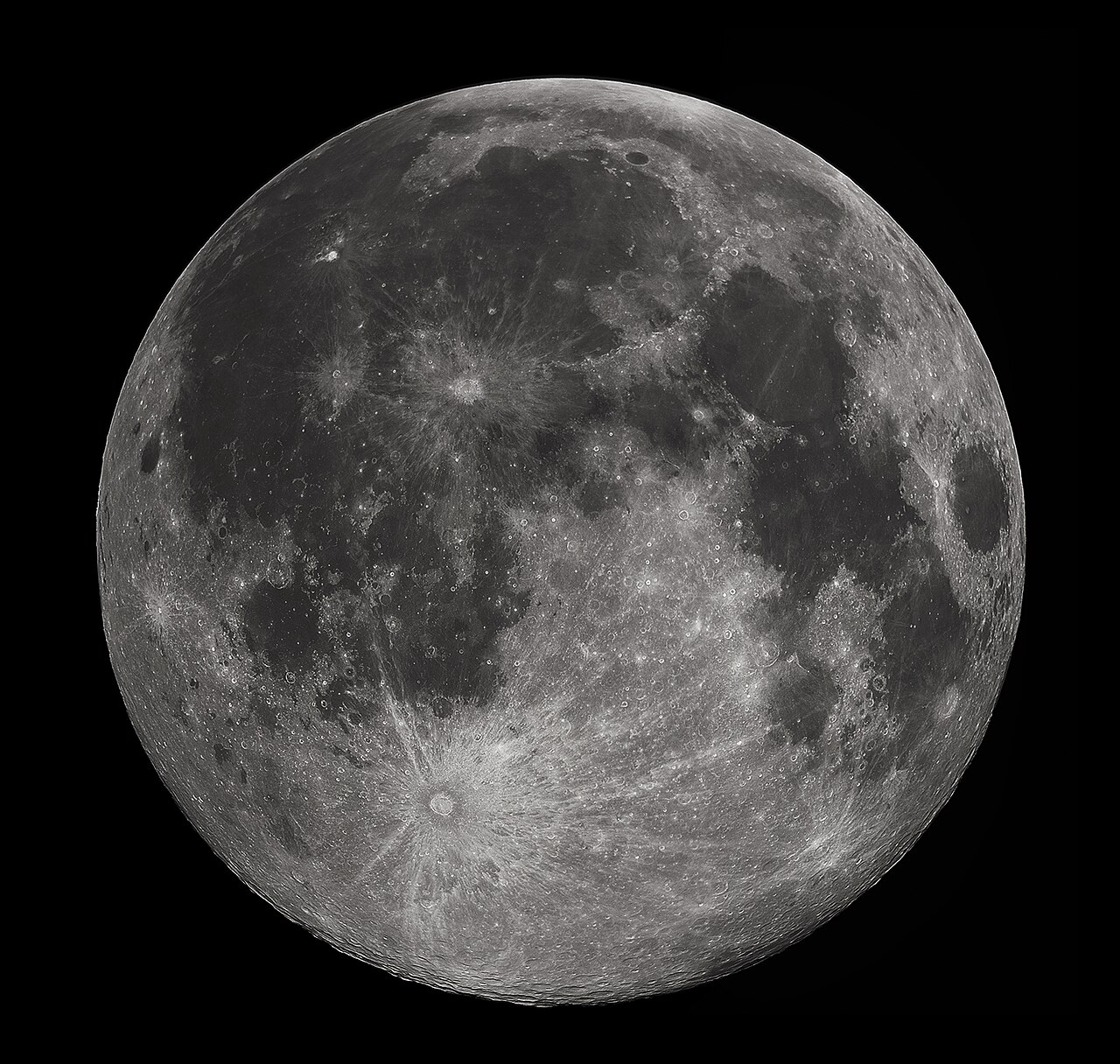
The Moon is the only natural satellite of Earth. It orbits around Earth at an average distance of 384,399 kilometers (238,854 mi), a distance roughly 30 times the width of Earth. It completes an orbit (lunar month) in relation to Earth and the Sun (synodically) every 29.5 days. The Moon and Earth are bound by gravitational attraction, which is stronger on the sides facing each other. The resulting tidal forces are the main driver of Earth's tides, and have pulled the Moon to always face Earth with the same near side. This tidal locking effectively synchronizes the Moon's rotation period (lunar day) to its orbital period (lunar month).
In geophysical terms, the Moon is a planetary-mass object or satellite planet. Its mass is 1.2% that of the Earth, and its diameter is 3,474 km (2,159 mi), roughly one-quarter of Earth's (about as wide as the contiguous United States). Within the Solar System, it is larger and more massive than any known dwarf planet, and the fifth-largest and fifth–most massive moon, as well as the largest and most massive in relation to its parent planet. Its surface gravity is about one-sixth of Earth's, about half that of Mars, and the second-highest among all moons in the Solar System after Jupiter's moon Io. The body of the Moon is differentiated and terrestrial, with only a minuscule hydrosphere, atmosphere, and magnetic field. The lunar surface is covered in regolith dust, which mainly consists of the fine material ejected from the lunar crust by impact events. The lunar crust is marked by impact craters; some younger ones feature bright ray-like streaks. The Moon was volcanically active until 1.2 billion years ago, surfacing lava mostly on the thinner near side of the Moon, filling ancient craters, which through cooling formed the today prominently visible dark plains of basalt called maria ('seas'). The origin of the Moon is not clear, although it is thought to have been formed out of material from Earth that was ejected by a giant impact of a Mars-sized body 4.51 billion years ago, not long after Earth's formation.
From a distance, the day and night phases of the lunar day are visible as the lunar phases, and when the Moon passes through Earth's shadow a lunar eclipse is observable. The Moon's apparent size in Earth's sky is about the same as that of the Sun, which causes it to cover the Sun completely during a total solar eclipse. The Moon is the brightest celestial object in Earth's night sky because of its large apparent size, while the reflectance (albedo) of its surface is comparable to that of asphalt. About 59% of the surface of the Moon is visible from Earth owing to the different angles at which the Moon can appear in Earth's sky (libration), making parts of the far side of the Moon visible.

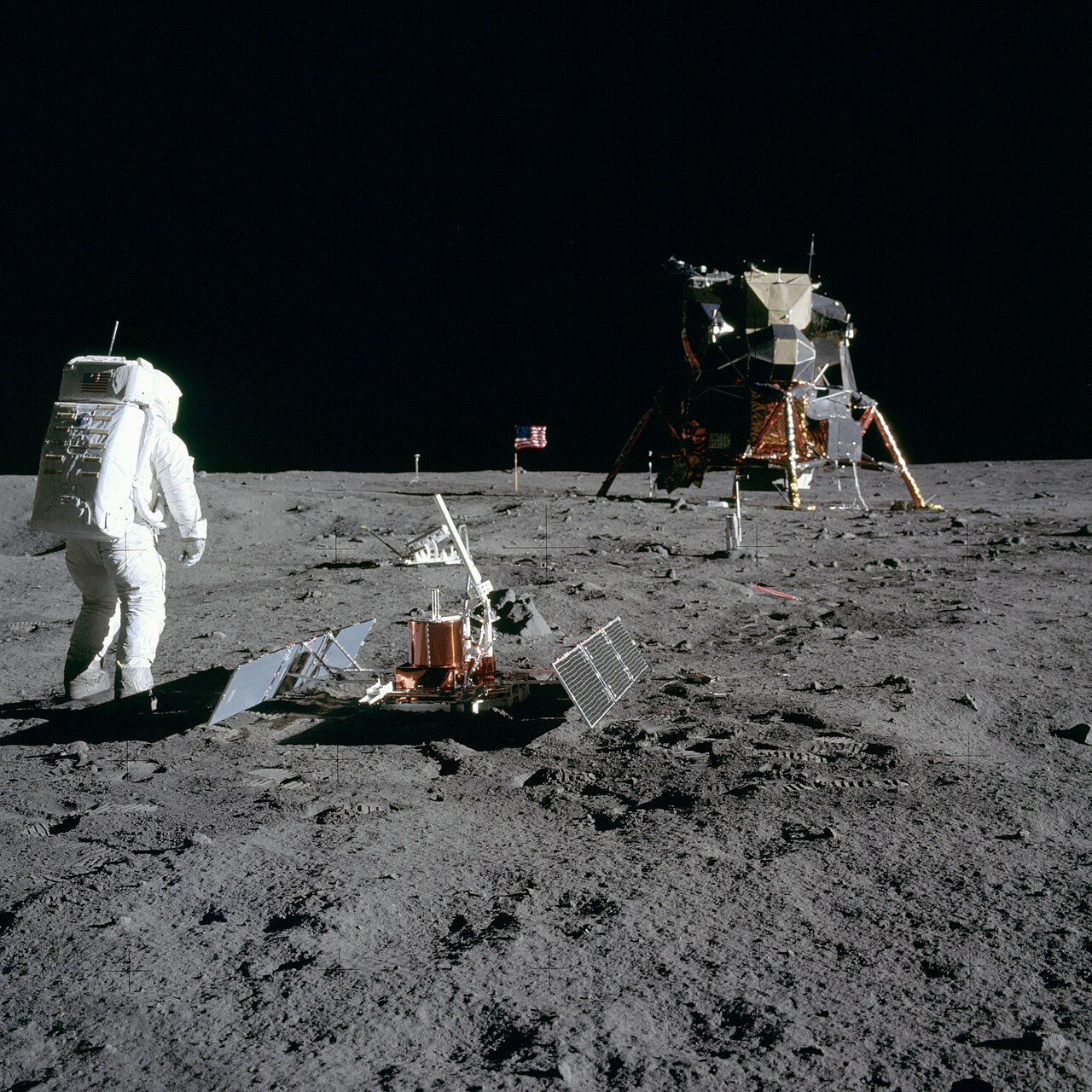
The Moon has been an important source of inspiration and knowledge in human history, having been crucial to cosmography, mythology, religion, art, time keeping, natural science and spaceflight. The first spaceflights to an extraterrestrial body were to the Moon, starting in 1959 with the flyby of Luna 1 (sent by the Soviet Union), and the intentional impact of Luna 2, followed in 1966 by the first soft landing (by Luna 9) and orbital insertion (by Luna 10). Humans first arrived in orbit with Apollo 8 (sent by the United States) on December 24, 1968, and then on the surface with Apollo 11 on July 20, 1969, making the Moon the only celestial body beyond Earth that humans have visited. By 1972, six Apollo missions had landed twelve people on the Moon and stayed up to three days. Renewed robotic exploration of the Moon, in particular to confirm the presence of water on the Moon, has fueled plans to return humans to the Moon, starting with the Artemis program scheduled for the late 2020s.
Names and etymology
The English proper name for Earth's natural satellite is typically written as Moon, with a capital M. The noun moon is derived from Old English mōna, which stems from *mēnōn, which in turn comes from Proto-Indo-European *mēnsis ('month') – from earlier *mēnōt (genitive *mēneses), which may be related to a verb meaning 'to measure [time]'.
The Latin name for the Moon is lūna. The English adjective lunar was ultimately borrowed from Latin, likely through French. In scientific writing and science fiction, the Moon is sometimes referred to as Luna to distinguish it from other moons. In poetry, Luna may also refer to the personification of the Moon as a woman.
The Ancient Greek word selḗnē referred to the Moon as a celestial body, and also to the moon goddess Selene . The rare English adjective selenian is used to describe the Moon as a world, as opposed to a celestial object. Its cognate selenic, originally a rare synonym, now almost always refers to the chemical element selenium. The corresponding prefix seleno- appears in terms including selenography (the study of the lunar surface).
Artemis, the Greek goddess of the wilderness and the hunt, also came to be identified with Selene, and was sometimes called Cynthia after her birthplace on Mount Cynthus. Her Roman equivalent is Diana.
The astronomical symbols for the Moon are the crescent and decrescent , for example in M☾ 'lunar mass'.
Classification
The International Astronomical Union (IAU) calls Earth's satellite "the Moon", with a capital "M". Other natural satellites of planets are called 'moons', with a lower-case "m".
The Moon has historically been identified as a classical planet, in the original sense of a wandering object in the sky. When Galileo discovered satellites orbiting Jupiter, he named them 'moons' because, like the Moon, they can be considered planets orbiting another planet. Some experts hold to a geophysical definition that classifies moons as planets that orbit the Sun while incidentally orbiting another planet. Some have suggested that the Earth and Moon form a double planet system, but most scientists agree that this would require the orbital barycenter to lie outside of Earth, which it does not.
Natural history
Formation
Isotope dating of lunar samples suggests the Moon formed around 50 million years after the origin of the Solar System. Historically, several formation mechanisms have been proposed, but none satisfactorily explains the features of the Earth–Moon system. A fission of the Moon from Earth's crust through centrifugal force would require too great an initial rotation rate of Earth. Gravitational capture of a pre-formed Moon depends on an unfeasibly extended atmosphere of Earth to dissipate the energy of the passing Moon. A co-formation of Earth and the Moon together in the primordial accretion disk does not explain the depletion of metals in the Moon. None of these hypotheses can account for the high angular momentum of the Earth–Moon system.

The prevailing theory is that the Earth–Moon system formed after a giant impact of a Mars-sized body (named Theia) with the proto-Earth. The oblique impact blasted material into orbit about the Earth and the material accreted and formed the Moon just beyond the Earth's Roche limit of ~2.56 R🜨.
Giant impacts are thought to have been common in the early Solar System. Computer simulations of giant impacts have produced results that are consistent with the mass of the lunar core and the angular momentum of the Earth–Moon system. These simulations show that most of the Moon derived from the impactor, rather than the proto-Earth. However, models from 2007 and later suggest a larger fraction of the Moon derived from the proto-Earth. Other bodies of the inner Solar System such as Mars and Vesta have, according to meteorites from them, very different oxygen and tungsten isotopic compositions compared to Earth. However, Earth and the Moon have nearly identical isotopic compositions. The isotopic equalization of the Earth–Moon system might be explained by the post-impact mixing of the vaporized material that formed the two, although this is debated.
The impact would have released enough energy to liquefy both the ejecta and the Earth's crust, forming a magma ocean. The liquefied ejecta could have then re-accreted into the Earth–Moon system. The newly formed Moon would have had its own magma ocean; its depth is estimated from about 500 km (300 miles) to 1,737 km (1,079 miles).

While the giant-impact theory explains many lines of evidence, some questions are still unresolved, most of which involve the Moon's composition. Models that have the Moon acquiring a significant amount of the proto-Earth are more difficult to reconcile with geochemical data for the isotopes of zirconium, oxygen, silicon, and other elements. A study published in 2022, using high-resolution simulations (up to 108 particles), found that giant impacts can immediately place a satellite with similar mass and iron content to the Moon into orbit far outside Earth's Roche limit. Even satellites that initially pass within the Roche limit can reliably and predictably survive, by being partially stripped and then torqued onto wider, stable orbits.
On November 1, 2023, scientists reported that, according to computer simulations, remnants of Theia could still be present inside the Earth.
Natural development
The newly formed Moon settled into a much closer Earth orbit than it has today. Each body therefore appeared much larger in the sky of the other, eclipses were more frequent, and tidal effects were stronger. Due to tidal acceleration, the Moon's orbit around Earth has become significantly larger, with a longer period.

Following formation, the Moon has cooled and most of its atmosphere has been stripped. The lunar surface has since been shaped by large impact events and many small ones, forming a landscape featuring craters of all ages.
The Moon was volcanically active until 1.2 billion years ago, which laid down the prominent lunar maria. Most of the mare basalts erupted during the Imbrian period, 3.3–3.7 billion years ago, though some are as young as 1.2 billion years and some as old as 4.2 billion years. The distribution of the mare basalts is uneven, with the basalts predominantly appearing on the Moon's near-side hemisphere. The reasons for this are not yet known, although the relative thinness of the crust on the near side of the Moon is hypothesized to be a factor. Causes of the distribution of the lunar highlands on the far side are also not well understood. Topological measurements show the crust on the near side to be thinner than on the far side. One possible explanation for this is that large impacts on the near side may have made it easier for lava to flow onto the surface.
Lunar geologic timescale
The lunar geological periods are named after their characteristic features, from most impact craters outside the dark mare, to the mare and later craters, and finally the young, still bright and therefore readily visible craters with ray systems like Copernicus or Tycho.
Future
In five billion years the Moon will have wandered 40% further away from Earth than it is now. However, about two to three billion years after that, the Sun will have become a red giant. Assuming the Sun envelopes the Earth-Moon system, the consequent drag from the Sun's atmosphere may cause the orbital distance between the Earth and the Moon to decay to the point where the Moon comes within the Earth's Roche limit, leading it to disintegrate.
Physical characteristics
The Moon is a very slightly scalene ellipsoid due to tidal stretching, with its long axis displaced 30° from facing the Earth, due to gravitational anomalies from impact basins. Its shape is more elongated than current tidal forces can account for. This 'fossil bulge' indicates that the Moon solidified when it orbited at half its current distance to the Earth, and that it is now too cold for its shape to restore hydrostatic equilibrium at its current orbital distance. Today tidal crust deformation is limited to lobate thrust fault scarps formation.
Size and mass
The Moon is the fifth largest (by size and mass) natural satellite of the Solar System. It is categorizable as a planetary-mass moon, making it a satellite planet under the geophysical definitions of the term. It is smaller than Mercury but considerably larger than the largest dwarf planet of the Solar System, Pluto. The Moon is the largest natural satellite in the Solar System relative to its primary planet.
The Moon's diameter is about 3,500 km, more than one-quarter of Earth's, with the face of the Moon comparable to the width of mainland Australia, Europe or the contiguous United States. The whole surface area of the Moon is about 38 million square kilometers, comparable to that of the whole Americas, the areas of the lunar hemispheres being comparable to the areas of North America and South America.
The Moon's mass is 1⁄81 of Earth's, being the second densest among the planetary moons, and having the second highest surface gravity, after Io, at 0.1654 g and an escape velocity of 2.38 km/s (8600 km/h; 5300 mph).
Structure
The Moon is a differentiated body that was initially in hydrostatic equilibrium but has since departed from this condition. It has a geochemically distinct crust, mantle, and core. The Moon has a solid iron-rich inner core with a radius possibly as small as 240 kilometers (150 mi) and a fluid outer core primarily made of liquid iron with a radius of roughly 300 kilometers (190 mi). Around the core is a partially molten boundary layer with a radius of about 500 kilometers (310 mi). This structure is thought to have developed through the fractional crystallization of a global magma ocean shortly after the Moon's formation 4.5 billion years ago.
Crystallization of this magma ocean would have created a mafic mantle from the precipitation and sinking of the minerals olivine, clinopyroxene, and orthopyroxene; after about three-quarters of the magma ocean had crystallized, lower-density plagioclase minerals could form and float into a crust atop. The final liquids to crystallize would have been initially sandwiched between the crust and mantle, with a high abundance of incompatible and heat-producing elements. Consistent with this perspective, geochemical mapping made from orbit suggests a crust of mostly anorthosite. The Moon rock samples of the flood lavas that erupted onto the surface from partial melting in the mantle confirm the mafic mantle composition, which is more iron-rich than that of Earth. The crust is on average about 50 kilometers (31 mi) thick.
The Moon is the second-densest satellite in the Solar System, after Io. However, the inner core of the Moon is small, with a radius of about 350 kilometers (220 mi) or less, around 20% of the radius of the Moon. Its composition is not well understood but is probably metallic iron alloyed with a small amount of sulfur and nickel. Analyses of the Moon's time-variable rotation suggest that it is at least partly molten. The pressure at the lunar core is estimated to be 5 GPa (49,000 atm).
Gravitational field
On average the Moon's surface gravity is 1.62 m/s2 (0.1654 g; 5.318 ft/s2), about half of the surface gravity of Mars and about a sixth of Earth's.
The Moon's gravitational field is not uniform. The details of the gravitational field have been measured through tracking the Doppler shift of radio signals emitted by orbiting spacecraft. The main lunar gravity features are mascons, large positive gravitational anomalies associated with some of the giant impact basins, partly caused by the dense mare basaltic lava flows that fill those basins. The anomalies greatly influence the orbit of spacecraft about the Moon. There are some puzzles: lava flows by themselves cannot explain all of the gravitational signature, and some mascons exist that are not linked to mare volcanism.
The sphere of influence, of the Moon's gravity field, in which it dominates over Earth's has a Hill radius of 60,000 km (i.e., extending less than one-sixth the distance of the 378,000 km between the Moon and the Earth), extending to the Earth-Moon lagrange points. This space is called cislunar space.
Magnetic field
The Moon has an external magnetic field of less than 0.2 nanoteslas, or less than one hundred thousandth that of Earth. The Moon does not have a global dipolar magnetic field; it only has crustal magnetization. The magnetic field history of the Moon is controversial, and there is still no consensus on the past intensity and timing of the Moons paleomagnetic field. Many paleomagnetic measurements have been taken from lunar samples collected during the Apollo missions. These measurements indicate that the Moon's paleomagnetic field experienced two epochs with distinct characteristics. In the first epoch (4.5 billion to 3.56 billion years ago), magnetic field intensities reached around 100 microteslas (1 Gauss), close to that of Earth's today. The second epoch was much longer (3.58 billion to 1 billion years ago), yet much weaker, with strengths only reaching 5-7 microteslas. It is unlikely that a single convection mechanism, thermal or compositional, generated this specific dynamo history without external influence. Theoretically, some of the remnant magnetization may originate from transient magnetic fields generated during large impacts through the expansion of plasma clouds. These clouds are generated during large impacts in an ambient magnetic field. This is supported by the location of the largest crustal magnetizations situated near the antipodes of the giant impact basins.
Additionally the Moon moves ~27% of the time, or 5–6 days per lunar month in Earth's magnetotail, replacing solar wind with Earth wind.
Atmosphere
The Moon has an atmosphere consisting of only an exosphere, which is so tenuous as to be nearly vacuum, with a total mass of less than 10 tonnes (9.8 long tons; 11 short tons). The surface pressure of this small mass is around 3 × 10⁻¹⁵ atm (0.3 nPa); it varies with the lunar day. Its sources include outgassing and sputtering, a product of the bombardment of lunar soil by solar wind ions. Elements that have been detected include sodium and potassium, produced by sputtering (also found in the atmospheres of Mercury and Io); helium-4 and neon from the solar wind; and argon-40, radon-222, and polonium-210, outgassed after their creation by radioactive decay within the crust and mantle. The absence of such neutral species (atoms or molecules) as oxygen, nitrogen, carbon, hydrogen and magnesium, which are present in the regolith, is not understood. Water vapor has been detected by Chandrayaan-1 and found to vary with latitude, with a maximum at ~60–70 degrees; it is possibly generated from the sublimation of water ice in the regolith. These gases either return into the regolith because of the Moon's gravity or are lost to space, either through solar radiation pressure or, if they are ionized, by being swept away by the solar wind's magnetic field.
A permanent Moon dust cloud exists around the Moon, generated by small particles from comets. 5 tons of comet particles are estimated to strike the Moon's surface every 24 hours, resulting in the ejection of dust particles. The dust stays above the Moon for approximately 10 minutes, taking 5 minutes to rise, and 5 minutes to fall. On average, 120 kilograms of dust are present above the Moon, rising up to 100 kilometers above the surface. Dust counts made by LADEE's Lunar Dust EXperiment (LDEX) found particle counts peaked during the Geminid, Quadrantid, Northern Taurid, and Omicron Centaurid meteor showers, when the Earth, and Moon pass through comet debris. The lunar dust cloud is asymmetric, being denser near the boundary between the Moon's dayside and nightside.
Studies of Moon magma samples retrieved by the Apollo missions demonstrate that the Moon had once possessed a relatively thick atmosphere for a period of 70 million years between 3 and 4 billion years ago. This atmosphere, sourced from gases ejected from lunar volcanic eruptions, was twice the thickness of that of present-day Mars. The ancient lunar atmosphere was eventually stripped away by solar winds and dissipated into space.
Surface conditions
Ionizing radiation from cosmic rays, their resulting neutron radiation, and the Sun results in an average radiation level of 1.369 millisieverts per day during lunar daytime, which is about 2.6 times more than the level on the International Space Station, 5–10 times more than the level during a trans-Atlantic flight, and 200 times more than the level on Earth's surface. For further comparison, radiation levels average about 1.84 millisieverts per day on a flight to Mars and about 0.64 millisieverts per day on Mars itself, with some locations on Mars possibly having levels as low as 0.342 millisieverts per day.
Solar radiation also electrically charges the highly abrasive lunar dust and makes it levitate. This effect contributes to the easy spread of the sticky, lung- and gear-damaging lunar dust.
The Moon's axial tilt with respect to the ecliptic is only 1.5427°, much less than the 23.44° of Earth. This small axial tilt means that the Moon's solar illumination varies much less with season than Earth's, and it also allows for the existence of some peaks of eternal light at the Moon's north pole, at the rim of the crater Peary.
The lunar surface is exposed to temperature differences ranging from 120 °C to −171 °C depending on the solar irradiance.
Because of the lack of atmosphere, temperatures of different areas vary particularly upon whether they are in sunlight or shadow, making topographical details play a decisive role on local surface temperatures.
Parts of many craters, particularly the bottoms of many polar craters, are permanently shadowed. These craters of eternal darkness have extremely low temperatures. The Lunar Reconnaissance Orbiter measured the lowest summer temperatures in craters at the southern pole at 35 K (−238 °C; −397 °F) and just 26 K (−247 °C; −413 °F) close to the winter solstice in the north polar crater Hermite. This is the coldest temperature in the Solar System ever measured by a spacecraft, colder even than the surface of Pluto.
Blanketed on top of the Moon's crust is a highly comminuted (broken into ever smaller particles) and impact gardened mostly gray surface layer called regolith, formed by impact processes. The finer regolith, the lunar soil of silicon dioxide glass, has a texture resembling snow and a scent resembling spent gunpowder. The regolith of older surfaces is generally thicker than for younger surfaces: it varies in thickness from 10–15 m (33–49 ft) in the highlands and 4–5 m (13–16 ft) in the maria. Beneath the finely comminuted regolith layer is the megaregolith, a layer of highly fractured bedrock many kilometers thick.
These extreme conditions are considered to make it unlikely for spacecraft to harbor bacterial spores at the Moon for longer than just one lunar orbit.
Surface features
The topography of the Moon has been measured with laser altimetry and stereo image analysis. Its most extensive topographic feature is the giant far-side South Pole–Aitken basin, some 2,240 km (1,390 mi) in diameter, the largest crater on the Moon and the second-largest confirmed impact crater in the Solar System. At 13 km (8.1 mi) deep, its floor is the lowest point on the surface of the Moon, reaching −9.178 kilometers (−5.703 mi) at 70.368°S 172.413°W / -70.368; -172.413 in a crater within Antoniadi crater. The highest elevations of the Moon's surface, with the so-called Selenean summit at 10.629 kilometers (6.605 mi), are located directly to the northeast (5.441°N 158.656°W / 5.441; -158.656), which might have been thickened by the oblique formation impact of the South Pole–Aitken basin. Other large impact basins such as Imbrium, Serenitatis, Crisium, Smythii, and Orientale possess regionally low elevations and elevated rims. The far side of the lunar surface is on average about 1.9 km (1.2 mi) higher than that of the near side.