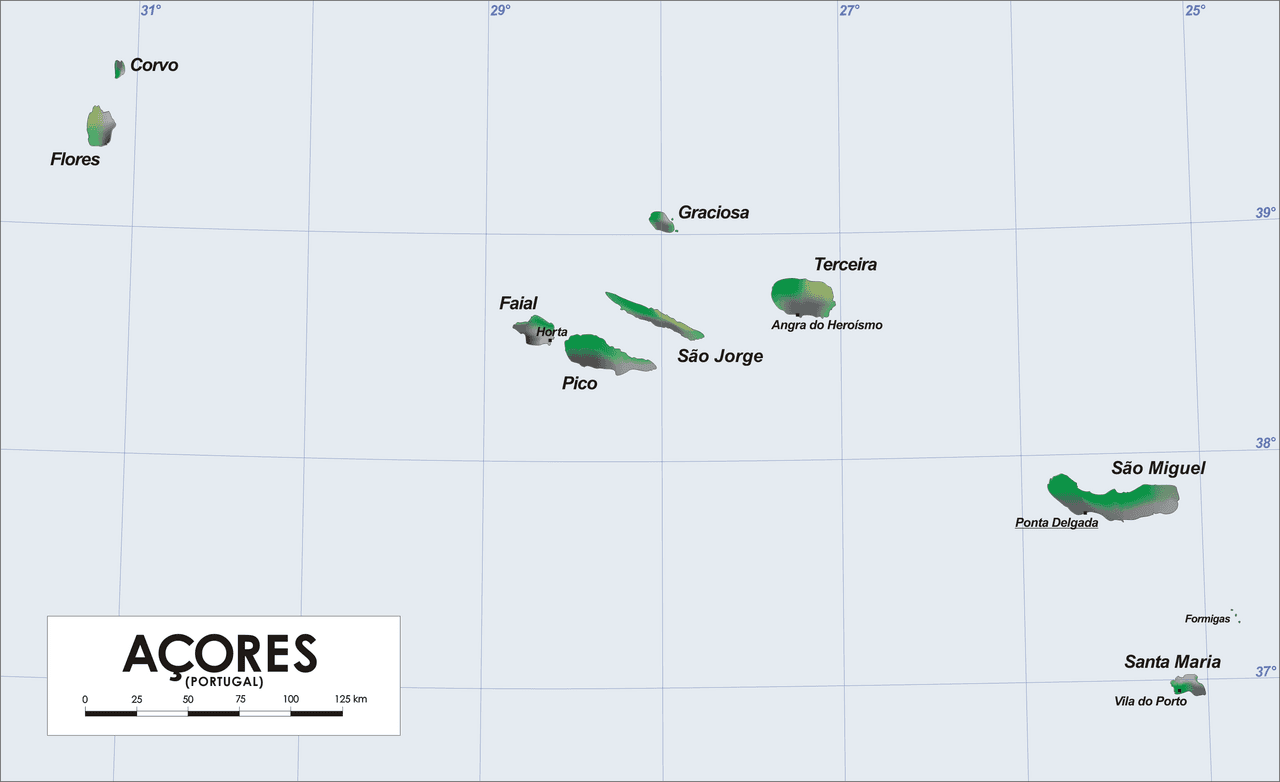
The Azores, officially the Autonomous Region of the Azores, is an archipelago of Portugal, in the Atlantic Ocean, about 1,400 km (870 miles) west of the Portuguese mainland. Politically and administratively, together with Madeira, it is one of the two autonomous regions of Portugal and a special territory of the European Union. It is the westernmost point and region of Portugal.
The Azores is an archipelago composed of nine volcanic islands in the Macaronesia region of the North Atlantic Ocean.
There are nine major Azorean islands and an islet cluster, in three main groups. These are Flores and Corvo to the west; Graciosa, Terceira, São Jorge, Pico, and Faial in the centre; and São Miguel, Santa Maria, and the Formigas islets to the east. They extend for more than 600 km (370 mi) and lie in a northwest–southeast direction. All the islands have volcanic origins, although some, such as Santa Maria, have had no recorded activity in the time since the islands were settled several centuries ago. Mount Pico on the island of Pico is the highest point in Portugal, at 2,351 m (7,713 ft). If measured from their base at the bottom of the ocean to their peaks, the Azores are among the tallest mountains on the planet. The Azores are located at the seismically active Azores triple junction plate boundary where the North American plate, Eurasian plate and Nubian plate meet.
The climate is mild, being influenced by its distance from the continents and by the passing Gulf Stream. Because of the marine influence, temperatures remain mild year-round. Daytime temperatures normally fluctuate between 16 and 25 °C (61 and 77 °F) depending on season. Temperatures above 30 °C (86 °F) or below 3 °C (37 °F) are unknown in the major population centres. It is also generally wet and cloudy.
Its main industries are agriculture, dairy farming, livestock, fishing, and tourism, which has become a major service activity in the region. In the 20th century and to some extent into the 21st, the Azores have served as a waypoint for refueling aircraft flying between Europe and North America. The government of the Azores employs a large percentage of the population directly or indirectly in the service and tertiary sectors. The largest city is Ponta Delgada. The , dialect, cuisine, and traditions of the islands vary considerably, because these remote islands were settled sporadically over a span of two centuries.
Reading level
Audio Summary
Played with your browser's voice. Studio-quality audio can be added with a text-to-speech service.
Ask about this article
📝 Quick Quiz1 / 4
What is "Azores" primarily known for?
Vocix Daily — In Your Inbox
Top stories, deep-dive articles, and "On This Day" history — one crisp digest delivered every morning.
Sources & references
Reference material for this entry is drawn from the open encyclopedic record, including Wikipedia , available under the CC BY-SA 4.0 license. Images are credited individually beside each photo.
A small number of alleged hypogea (underground structures carved into rocks) have been identified on the islands of Corvo, Santa Maria, and Terceira by Portuguese archaeologist Nuno Ribeiro, who speculated that they might date back 2,000 years, implying a human presence on the islands before the Portuguese. These structures have been used by settlers in the Azores to store grain. The suggestion by Ribeiro that they might be burial sites is unconfirmed. Detailed examination and dating to authenticate the validity of these speculations are lacking; thus it is unclear whether these structures are natural or human-made and whether they predate the 15th century Portuguese discovery of the Azores. A statue of a man on horseback was found by Diogo de Teive on Corvo Island while discovering the island, as well as Carthaginian coins in 1749.
According to a 2015 paper published in Journal of Evolutionary Biology, research based on mouse mitochondrial DNA points to a Scandinavian rather than Portuguese origin of the local mouse population. A 2021 paper published in Proceedings of the National Academy of Sciences, using data from lake sediment core sampling, suggests brush-clearing was undertaken and animal husbandry introduced between 700 and 850 A.D. These findings suggest a brief period of Norse settlement, and the 2021 paper further cites climate simulations that suggest the dominant westerly winds in the North Atlantic Ocean were weaker in that period, which would have made it easier for Viking ships to sail to the Azores from Scandinavia.
Discovery
In 1427 a captain sailing for Prince Henry the Navigator, possibly Gonçalo Velho, may have discovered the Azores, but this is not certain. In Thomas Ashe's 1813 work A History of the Azores, the author identified a Fleming, Joshua Vander Berg of Bruges, who made landfall in the archipelago during a storm on his way to Lisbon. According to Ashe, the Portuguese explored the area and claimed it for Portugal. Other writers note the discovery of the first islands (São Miguel, Santa Maria and Terceira) by sailors in the service of Henry the Navigator, although there are few documents to support such claims.
Although it is commonly said that the archipelago received its name from açor (Portuguese for goshawk, a common bird at the time of discovery) it is unlikely that the bird ever nested or hunted on the islands. There were no large animals on Santa Maria; after its discovery and before settlement began, sheep were let loose on the island to supply future settlers with food.
The archipelago was largely settled from mainland Portugal, but settlement did not take place immediately. From 1433 Gonçalo Velho Cabral gathered resources and settlers, and he sailed in 1436 to establish colonies, first on Santa Maria and then on São Miguel. Settlers built houses, established villages and cleared bush and rocks to plant crops, grain, grapevines, sugar cane and other plants suitable for local use and for export. They brought domesticated animals, such as chickens, rabbits, cattle, sheep, goats and pigs. The settlement of the unoccupied islands began in 1439 with people mainly from the continental provinces of Algarve and Alentejo. São Miguel was first settled in 1449, the settlers – mainly from Estremadura, Alto Alentejo and Algarve – under the command of Cabral, who landed at the site of modern-day Povoação.
Flemish settlers
The first reference to the island of São Jorge was made in 1439, but the date of discovery is unknown. In 1443 the island was already inhabited, but settlement began only after the arrival of Willem van der Haegen. Arriving at Topo, São Jorge, where he lived and died, he became known as Guilherme da Silveira to the islanders. João Vaz Corte-Real received the captaincy of the island in 1483. Velas became a town before the end of the 15th century. By 1490 there were 2,000 Flemings living on the islands of Terceira, Pico, Faial, São Jorge and Flores. Because there was such a large Flemish settlement, the Azores became known as the Flemish Islands or the Isles of Flanders.
Prince Henry the Navigator was responsible for this Flemish settlement. His sister Isabel was married to Philip the Good, Duke of Burgundy (Flanders at the time belonged to Burgundy). There was a revolt against Philip's rule, and disease and hunger became rampant. Isabel appealed to Henry to allow some of the unruly Flemings to settle in the Azores. He granted this and supplied them with means of transport and goods.
In 1522, Vila Franca do Campo, then the capital of São Miguel, was devastated by an earthquake and landslide that killed about 5,000 people, and the capital was moved to Ponta Delgada. Vila Franca do Campo was rebuilt on the original site and today is a thriving fishing and yachting port. Ponta Delgada received its city status in 1546. From the first settlement, the pioneers applied themselves to agriculture, and by the 15th century Graciosa was exporting wheat, barley, wine and brandy. The goods were sent to Terceira largely because of the proximity of that island.
Portuguese succession crisis of 1580
Portugal fell into a dynastic crisis following the death of Cardinal-King Henry in 1580. Of the various claimants to the crown, the most powerful was King Philip II of Spain, who justified his rights to the throne by the fact that his mother was a Portuguese royal princess: his maternal grandfather was King Manuel I.
On 19 July 1580, António, Prior of Crato was acclaimed King of Portugal in Santarém by his supporters, followed by popular acclamation in Lisbon and other towns, as well as in the Azores (through his envoy António da Costa), to which he fled following his defeat at the Battle of Alcântara. Although Philip became king, the Azoreans resisted Spanish attempts to conquer the islands (including specifically at the Battle of Salga) and were administered by Cipriano de Figueiredo, governor of Terceira (who continued to govern Terceira in the name of the ill-fated former King Sebastian).
In 1583 Philip sent his fleet to clear the Azores of a combined multinational force of adventurers, mercenaries, volunteers, and soldiers who were attempting to establish the Azores as a staging post for a rival pretender to the Portuguese throne. Following the success of his fleet at the Battle of Ponta Delgada, captured enemies were hanged from yardarms, as they were considered pirates by Philip II. Opponents receiving the news variously portrayed Philip as a despot or "Black Legend", the sort of insult widely made against contemporary monarchs engaged in aggressive empire building and the European wars of religion. Figueiredo and Violante do Canto helped organize a resistance on Terceira that influenced some of the response of the other islands, even as internal politics and support for Philip's faction increased on the other islands (including specifically on São Miguel, where the Gonçalvez da Câmara family supported the Spanish claimant).
English raids of 1589 and 1598
An English raid of the Azores in 1589 successfully plundered some islands and harbouring ships; eight years later, a second raid failed.
Iberian Union
Spain held the Azores under the Iberian Union from 1580 to 1642 (called the "Babylonian captivity" in the Azores). The Azores were the last part of the Portuguese Empire to resist Philip's reign over Portugal (Macau resisted any official recognition), until the defeat of forces loyal to the Prior of Crato with the Conquest of the Azores in 1583. Portuguese control resumed with the end of the Iberian Union in 1640 and the beginning of the Portuguese Restoration War, not by the professional military who were occupied with warfare on the Portuguese mainland, but by local people attacking a fortified Castilian garrison.
In the late 19th century, the Azores and Madeira began to face problems of overpopulation. Responding to the consequent economic problems, some people of the Azores began to emigrate to the United States, Canada and Brazil.
In 1902 the Dominion Line began operating a Mediterranean passenger service between Boston and Italy via Gibraltar and the Azores, with an established port of call at Sao Miguel. In 1904 the service was taken over by the White Star Line. Four ships formerly owned by Dominion were renamed and put into service under White Star, named Canopic, Romanic, Cretic and Republic, the last of which is best known for its 1909 sinking off the New England coast. Canopic and Romanic provided regular service to Boston, while Cretic and Republic operated on the service to both New York and Boston throughout their careers. By the time the service ended in 1921, these four ships had transported an estimated total of 58,000 Azorean Portuguese to the United States.
Liberal Wars of 1828–1834
The Portuguese Civil War (1828–1834) had strong repercussions in the Azores. In 1829 in Praia da Vitória, the liberals won over the absolutists, making Terceira Island the main headquarters of the new Portuguese regime and also where the Council of Regency (Conselho de Regência) of Maria II was established. Beginning in 1868, Portugal issued its stamps overprinted with "AÇORES" for use in the islands. Between 1892 and 1906, it also issued separate stamps for the three administrative districts of the time.
Arbitrary district divisions 1836–1976
From 1836 to 1976, the archipelago was divided into three districts, equivalent (except in area) to those in the Portuguese mainland. The division was arbitrary and did not follow the natural island groups, rather reflecting the location of each district capital on the three main cities (none of which were on the western group).
Angra do Heroísmo consisted of Terceira, São Jorge, and Graciosa, with the capital at Angra do Heroísmo on Terceira.
Horta consisted of Pico, Faial, Flores, and Corvo, with the capital at Horta on Faial.
Ponta Delgada consisted of São Miguel and Santa Maria, with the capital at Ponta Delgada on São Miguel.
Modern period
In 1931 the Azores (together with Madeira and Portuguese Guinea) revolted against the Ditadura Nacional and were held briefly by rebel military. In 1943 during World War II, Portuguese ruler António de Oliveira Salazar leased air and naval bases in the Azores to Great Britain. The occupation of these facilities in October 1943 was codenamed Operation Alacrity by the British. This was a key turning point in the Battle of the Atlantic, enabling the Royal Air Force, the U.S. Army Air Forces, and the U.S. Navy to provide aerial coverage in the Mid-Atlantic gap. This helped them to protect convoys and to hunt hostile German U-boats.
In 1944 the U.S. constructed a small and short-lived air base on Santa Maria. In 1945 a base was constructed on Terceira, named Lajes Field. Lajes Field is a plateau rising out of the sea on the northeast corner of the island, which had been a large farm. The base is a joint American and Portuguese venture that continues to support American and Portuguese Armed Forces. During the Cold War, U.S. Navy P-3 Orion anti-submarine warfare squadrons patrolled the North Atlantic Ocean for Soviet Navy submarines and surface warships. Since its opening, Lajes Field has been used for refuelling American cargo planes bound for Europe, Africa, and the Middle East. The U.S. Navy keeps a small squadron of its ships at the harbor of Praia da Vitória, three km (1.9 mi) southeast of Lajes Field. The airfield also has a small commercial terminal handling scheduled and chartered passenger flights from the other islands in the Azores, Europe, Africa, and North America.
Following the Carnation Revolution of 1974 which deposed the Estado Novo dictatorship in Lisbon, Portugal and its territories across the world entered into a period of great political uncertainty. The Azorean Liberation Front attempted to take advantage of this instability immediately after the revolution, hoping to establish an independent Azores, until operations ceased in 1975.
In 1976, the Azores became the Autonomous Region of the Azores (Região Autónoma dos Açores), one of the autonomous regions of Portugal, and the subdistricts of the Azores were eliminated. In 2003 the Azores gained international attention when United States President George W. Bush, British Prime Minister Tony Blair, Spanish Prime Minister José María Aznar, and Portuguese Prime Minister José Manuel Durão Barroso held a summit there days before the commencement of the Iraq War.
Geography
The archipelago is located in the northern hemisphere within the Atlantic Ocean and extends along a west-northwest to east-southeast orientation (between 36.5°–40° North latitudes and 24.5°–31.5° West longitudes) in an area approximately 600 km (373 mi) wide. The islands of the Azores emerged from the Azores Plateau, a 5.8 million km2 region that is morphologically accented by a depth of 2,000 m (6,600 ft).
The nine islands that compose the archipelago occupy a surface area of 2,346 km2 (906 sq mi), that includes both the main islands and many islets located in their vicinities. They range in surface area from the largest, São Miguel, at 759 km2 (293 sq mi) to the smallest, Corvo, at approximately 17 km2 (7 sq mi). São Jorge, Pico and Faial are collectively called Ilhas do Triângulo ('Islands of the Triangle').
Each of the islands has its own distinct geomorphological characteristics that make them unique:
Corvo is a crater of a major Plinian eruption
Flores (its neighbor on the North American plate) is a rugged island carved by many valleys and escarpments
Faial is characterized for its shield volcano and caldera (Caldeira Volcano)
Pico has the highest point, at 2,351 m (7,713 ft), in the Azores and Portugal
Graciosa is known for its active Furnas do Enxofre and mixture of volcanic cones and plains
São Jorge is a long slender island, formed from fissural eruptions over thousands of years
Terceira, almost circular, contains one of the largest craters in the region
São Miguel is pitted with many large craters and fields of spatter cones
Santa Maria – the oldest island – is heavily eroded, being one of the few places to encounter brown sandy beaches in the archipelago.
The islands can be divided into three recognizable groups located on the Azores Plateau:
The Eastern Group (Grupo Oriental) of São Miguel, Santa Maria and Formigas Islets
The Central Group (Grupo Central) of Terceira, Graciosa, São Jorge, Pico and Faial
The Western Group (Grupo Ocidental) of Flores and Corvo.
Several sub-surface reefs (particularly the Dollabarat on the fringe of the Formigas), banks (specifically the Princess Alice Bank and D. João de Castro Bank), as well as many hydrothermal vents and sea-mounts are monitored by the regional authorities, owing to the complex geotectonic and socioeconomic significance within the economic exclusion zone of the archipelago.
Geology
From a geostructural perspective, the Azores are located above an active triple junction between three of the world's major tectonic plates (the North American plate, the Eurasian plate and the African plate), a condition that has translated into the existence of many faults and fractures in this region of the Atlantic. The Western Group is located on the North American plate, while the remaining islands are located within the boundary that divides the Eurasian and African plates.