
South Sumatra (Indonesian: Sumatera Selatan, Surat Ulu: ꤼꥈꤸꤳꥎꤽꤼꥎꤾꤳꥐ, Jawi: سومترا سلاتن) is a province of Indonesia, located in the southeast of the island of Sumatra. Notwithstanding the name, it is not the most southern of the provinces on Sumatra island (Lampung is to its south). The capital and largest city of the province is the city of Palembang, and the province covers territory historically administered by the Palembang Sultanate. The province borders the provinces of Jambi to the north, Bengkulu to the west and Lampung to the south, as well having a maritime border with the Bangka Belitung Islands to the east. It is the largest province in the island of Sumatra, and it is slightly smaller than Portugal, the department of Boquerón in Paraguay, the Altai Republic in Russia or the U.S. state of Maine. The Bangka Strait in the east separates South Sumatra and the island of Bangka, which is part of the Bangka Belitung Islands province.
The province has an area of 86,771.92 km2 (33,503 sq mi) and had a population of 8,467,432 at the 2020 census; the official estimate as at mid 2025 was 8,837,301 (comprising 4,542,623 males and 4,385,892 females), which was projected to rise to 9,017,142 at mid 2026. The province is rich in natural resources, such as petroleum, natural gas and coal. The province is inhabited by many different Malay sub ethnic groups, with Palembangese being largest ethnic group. Most speak the Palembang language, which is mutually intelligible to both Indonesian and local Palembang Malay. Other ethnic groups include the Javanese, Sundanese, Minangkabau and Chinese. Most are concentrated in urban areas and are largely immigrants from other parts of Indonesia.
History
Pre-history
South Sumatra has been settled by humans since the Palaeolithic era. The evidence of those settlements is proven by discoveries of Palaeolithic tools in the riverbed of Saling and Kikim rivers in Bungamas Village, Lahat Regency and Seventy-eight skeletons dating back to 3,000–14,000 years ago, presumably of Austronesian and Austromelanesoid origins was excavated from the site of Harimau Cave in Padang Bindu Village, Ogan Komering Ulu Regency. Relics of seven stone chambers believed to be about 2,500 years old were found near a coffee plantation in Kotaraya Lembak, Lahat Regency.

Srivijaya
Around 7th century AD, an ancient Buddhist kingdom of Srivijaya was established in an area that's now Palembang. This kingdom became the center of trade and was a maritime power, but this kingdom did not expand its power outside the islands of Southeast Asia, with the exception of contributing to the population of Madagascar as far as 3,300 miles west. Some experts are still debating the area that was the center of the Srivijaya Kingdom. It was likely that the kingdom used to move its administrative center, but the capital remained directly governed by the authorities, while the supporting areas were governed by the local datuk.
In the 7th century, the Chinese noted that there were two kingdoms namely Malayu and Kedah that were part of the Srivijaya empire.
The Srivijaya empire had existed since 671 according to the notes of the Chinese Buddhist monk Yijing. From the Kedukan Bukit inscription in 682, this empire became known under the leadership of Dapunta Hyang. That he departed on the siddhayatra holy journey to "take blessings", and led 20,000 soldiers and 312 people on board with 1,312 soldiers on foot from Minanga Tamwan to Jambi and Palembang. The Kedukan Bukit Inscription is reputed to be the oldest inscription written in Malay. Experts argue that the writer of this inscription adapted Indian orthography.

Based on the Kota Kapur Inscription dated from 686 CE that is found on the island of Bangka, this empire has dominated the southern part of Sumatra, the islands of Bangka and Belitung, to Lampung. This inscription also mentions that Emperor Sri Jayanasa launched a military expedition to punish the Bhumi Jawa kingdom who were not loyal to Srivijaya, this event coincided with the collapse of Tarumanagara in West Java and Holing (Kalingga) in Central Java, which was most likely due to Sriwijaya's attack. It is also possible that the Bhumi Jawa kingdom mentioned in the inscription is referring to the Kingdom of Tarumanegara. Srivijaya continued to grow and succeeded in controlling the maritime trade routes in the Straits of Malacca, the Sunda Strait, the South China Sea, the Java Sea and the Karimata Strait.
The expansion of this kingdom into Java and the Malay Peninsula, allowed Srivijaya to control the main trade routes in Southeast Asia. Archeologist found the ruins of Srivijaya temples as far as Thailand and Cambodia. In the 7th century, the port of Champa in eastern Indochina began to divert traders from Srivijaya. To prevent this, Maharaja Dharmasetu launched several attacks on coastal cities in Indochina. The city of Indrapura on the banks of the Mekong river was captured by Srivijaya in the early 8th century. Srivijaya continued its domination of Cambodia, until the Khmer king Jayawarman II, founder of the Khmer Empire, severed ties with Srivijaya in the same century. At the end of the 8th century some kingdoms in Java, including Tarumanegara and Holing, were under the rule of Srivijaya. According to records, during this period the Sailendra people migrated to Central Java and ruled there. In the same century, the Langkasuka kingdom in the Malay peninsula became part of the kingdom. In the following period, Pan Pan and Trambralinga, located north of Langkasuka, were also under the influence of Srivijaya.
Based on historical records from Arabia, Srivijaya was called Sribuza. In 955 CE, Al Masudi, a traveler and classical Arab historian wrote about Srivijaya, describing it as a large kingdom that was rich, with many soldiers. Srivijaya's produced camphor, agarwood, cloves, sandalwood, nutmeg, cardamom and gambier. Another note from a Persian expert named Abu Zaid Hasan who received information from Sujaimana, an Arab trader, that the empire was well-advanced in the field of agriculture. Abu Zaid wrote that the kingdom of Zabaj (another Arabic name for Srivijaya) had fertile land and extensive power to the other side of the sea.

Srivijaya controlled the maritime trade route in Southeast Asia throughout the 10th century, but at the end of the century the Kingdom of Medang in East Java grew into a new maritime force and began to challenge the dominance of Srivijaya. The Chinese news from the Song dynasty called the Srivijaya Kingdom in Sumatra the name San-fo-tsi, while the Kingdom of Medang in Java by the name She-po. It is said that San-fo-tsi and She-po were involved in competition for control of Southeast Asia. Both countries sent ambassadors to each other to China. The San-fo-tsi ambassador who departed in 988 was held in Canton when he returned, because his country was attacked by Javanese troops. This attack from Java allegedly took place around the 990s, between 988 and 992 during the reign of Sri Cudamani Warmadewa.
The kingdom of Medang succeeded in capturing Palembang in 992 for a while, but later the Medang forces were successfully repelled by Srivijaya forces. The Hujung Langit inscription of 997 mentions a Javanese attack on Sumatra. This series of attacks from Java ultimately failed because Java failed to establish a foothold in Sumatra. Capturing the capital city of Palembang was not enough because the Sriwijaya spread itself in several port cities in the Malacca Strait. The Srivijaya emperor, Sri Cudamani Warmadewa, escaped out of the capital and traveled around regaining its strength and reinforcements from his allies and subordinate kings and succeeded in repelling the Javanese navy.
In 1025, the empire was defeated by the Chola Empire (during the period of Emperor Rajendra Chola I) of southern India. The Chola Empire had conquered the Srivijaya colonies, such as the Nicobar Islands region and at the same time succeeded in capturing the ruling Srivijaya king Sangrama Vijayottunggavarman. During the following decades, the entire Sriwijaya empire was under the influence of the Chola dynasty. Rajendra Chola I gave the opportunity to the kings he conquered to remain in power while remaining subservient to him. Srivijaya's capital eventually moved northward to Jambi. This can be attributed to the news of the San-fo-ts'i delegation to China in 1028. Another factor in Sriwijaya's decline was natural factors. Because of the sedimentation of mud on the Musi River and several other tributaries, the merchant ships arriving in Palembang diminished. As a result, the city of Palembang is getting away from the sea and not being strategic. As a result of the coming of the merchant ship, the tax decreased and weakened the economy and position of Sriwijaya.
According to the Chinese Song dynasty book Zhu Fan Zhi, written around 1225 by Zhao Rugua, the two most powerful and richest kingdoms in the Southeast Asian archipelago were Srivijaya and Java (Kediri), with the western part (Sumatra, the Malay peninsula, and western Java/Sunda) under Srivijaya's rule and the eastern part under Kediri's domination. It said that the people in Java followed two religions, Buddhism and the religion of Brahmins (Hinduism), while the people of Srivijaya followed Buddhism. The book described the people of Java as being brave, short-tempered and willing to fight. It also noted their favourite pastimes as cockfighting and pig fighting. The coin used as the currency were made from a mixture of copper, silver, and tin.
Srivijaya remained a formidable sea power until the 13th century. According to George Cœdès, at the end of the 13th century, the empire "had ceased to exist... caused by the simultaneous pressure on its two flanks of Siam and Java." However, there was a power vacuum in the region since there was no prominent power to hold the region except for the waning Majapahit Empire, centered on Java island. The vacuum allowed pirates to flourish in the region.
After being conquered by the Majapahit in 1375 AD, the Palembang region was made a vassal of the Majapahit Empire, under the leadership of Hayam Wuruk. The government in Palembang was handed over to a regent who was appointed directly by the Majapahit. However, internal problems in the Majapahit Empire distracted them from the conquered territories, causing the Palembang region to be controlled by traders from China until the Majapahit regained control of Palembang after sending a commander named Arya Damar.

Palembang Sultanate
By the late 15th century, Islam has spread throughout the region, replacing Buddhism and Hinduism as the dominant religion. Around the early 16th century, Tomé Pires, an adventurer from Portugal, said that Palembang had been led by an appointed patih (regent) from Java who was later referred to the Demak Sultanate and participated in attacking Malacca, which at that time had been controlled by the Portuguese. In 1659, Sri Susuhunan Abdurrahman proclaimed the establishment of the Palembang Sultanate. The Sultanate of Palembang stood for almost two centuries, from 1659 to 1825. Sultan Ratu Abdurrahman Kholifatul Mukminin Sayidul Iman, or Sunan Cinde Walang, was the first king of the Sultanate of Palembang.
The reign of Sultan Muhammad Bahauddin (1776–1803) was known as the golden era of the Palembang Sultanate, the sultanate's economy increased sharply because of trade, including with the VOC. The VOC was upset with Sultan Bahauddin's trade monopoly which caused their contracts to be rejected often. Sultan Bahauddin preferred to trade with Britain, China and Malay people in Riau. The impact of the policy generated enormous wealth for the empire. The Palembang Sultanate was strategically located in conducting trade relations, especially spices with outside parties. The Palembang Sultanate also ruled over the Bangka-Belitung islands which had a tin mine and had been traded since the 18th century.
As the Dutch East India Company increased its influence in the region, the Sultanate started to decline and lost its power. During Napoleonic Wars in 1812, the sultan at the time, Mahmud Badaruddin II rejected British claims to suzerainty. The British, under Stamford Raffles responded by attacking Palembang, sacking the court, and installing sultan's more cooperative younger brother, Najamuddin to the throne. The Dutch attempted to recover their influence at the court in 1816, but Sultan Najamuddin was uncooperative with them. An expedition launched by the Dutch in 1818 and captured Sultan Najamudin and exiled him to Batavia. A Dutch garrison was established in 1821, but sultan attempted an attack and a mass poisoning to the garrison, which were intervened by the Dutch. Mahmud Badaruddin II was exiled to Ternate, and his palace was burned to the ground. The Sultanate was later abolished by the Dutch and direct colonial rule was established.

Japanese occupation and independence
Southern Sumatra was occupied by the Japanese on January 15, 1942, after the Battle of Palembang in World War II. After the Proclamation of Indonesian Independence, South Sumatra became a part of Sumatra Province as a residency with Adnan Kapau Gani as the resident. On 1 January 1947, the Dutch tried to regain its sovereignty over South Sumatra by invading Palembang and fighting ensued across South Sumatra until Indonesia's independence was recognized by the Dutch on 27 December 1949. The area occupied by the Netherlands in South Sumatra was incorporated into State of South Sumatra under the United States of Indonesia until the disbandment of the union and the founding of the republic.
Post-independence division of the province
On 12 September 1950, South Sumatra province was established with a territory much larger than it is today, as it encompassed the southern third of Sumatra island covering areas that were eventually formed into separate provinces: Lampung was carved from the southern part of the province on 18 March 1964, Bengkulu from the coastal western part of the province on 18 November 1968, and Bangka Belitung on 4 December 2000.
Geography
South Sumatra has an area of 86,771.92 square kilometres (33,502.83 sq mi) and is located on the island of Sumatra, western Indonesia which lies south of the equator at 1–4 degrees south and 102–108 degrees east. The province is bordered by Jambi to the north, Lampung to the south and Bengkulu to the west, while in the east the Bangka Strait separates the province and the island-province of Bangka Belitung Islands.
On the east coast the land consists of swamps and brackets which are affected by tides. Its vegetation is in the form of palmate plants and mangrove. A little more western is a vast lowland. Far to the west near the border of Bengkulu and Jambi lies the Bukit Barisan mountains, which divides South Sumatra and is a mountainous area with an altitude of 900 to 1,200 metres (3,000 to 3,900 ft) above sea level. Barisan Hill consists of the summit of Mount Seminung (1,964 metres or 6,444 feet asl), Mount Dempo (3,159 metres or 10,364 feet asl), Mount Patah (1,107 metres or 3,632 feet asl), and Mount Bungkuk (2,125 metres or 6,972 feet asl). To the west of Bukit Barisan is a slope. In the Bukit Barisan valley there are areas of rubber, oil palm, and agriculture plantations, especially coffee, tea and vegetables. Mount Dempo is the highest point in the province.
South Sumatra has large rivers that can be navigated, but currently, because of the silting process, cannot be navigated by large ships. Most of the rivers have flows from the Bukit Barisan mountains, except the Mesuji, Lalan and Banyuasin River. Most water from the South Sumatra section of Bukit Barisan mountains flows eastwards into Bangka Strait as Musi River, with Ogan, Komering, Lematang, Kelingi, Lakitan, Rupit River and Rawas River are its major tributaries. A few rivers in South Sumatra flow westwards into Indian Ocean, for example Manna River in Pagaralam and Tanjung Sakti.
In January 2020, two islands in South Sumatra, Betet Island and Gundul Island, were submerged as a result of climate change, and four other islands were close to being submerged.
The province is home to several nature reserves, including Isau-Isau Wildlife Reserve.
As in most other province of Indonesia, South Sumatra has a tropical rainforest climate (Köppen climate classification Af) bordering on a tropical monsoon climate. The climate is very much dictated by the surrounding sea and the prevailing wind system. It has high average temperature and high average rainfall. Throughout the year the province is only affected by two seasons, namely the rainy season and the dry season. The air temperature varies from 24.7 to 32.9 degrees Celsius with air humidity levels ranging from 82% to 88%. The relative rainy season falls from October to April. Variation in rainfall ranges from 2,100 to 3,264 millimetres (83 to 129 in). December is the month with the most rainfall while the drier season usually occurs from June to September.
The climate in South Sumatra is similar to other regions in Indonesia, only known for two seasons, namely the dry season and the rainy season. From June to September southeast winds flow from Australia with relatively less water vapor, resulting in a drier season. Conversely in December to March many wind currents contain water vapor from Asia and the Pacific Ocean during the rainy season. Such conditions occur every half year after passing the transition periods in between April–May and October–November.
Governors
Government and administrative divisions
The capital of South Sumatra province is the city of Palembang. As at 2000 this province was divided into six regencies (kabupaten) - Lahat, Muara Enim, Musi Banyuasin, Musi Rawas, Ogan Komering Ilir and Ogan Komering Ulu - plus the autonomous city (kota) of Palembang. On 21 June 2001 three new autonomous cities were created - Lubuk Linggau from part of Musi Rawas Regency, Pagar Alam from part of Lahat Regency, and Prabumulih from part of Muara Enim Regency. A seventh regency - Banyuasin - was formed on 10 April 2002 from part of Musi Banyuasin Regency; and three further regencies were created on 18 December 2003 - Ogan Ilir from part of Ogan Komering Ilir, and South Ogan Komering Ulu and East Ogan Komering Ulu from parts of Ogan Komering Ulu Regency.
An eleventh Regency - Empat Lawang - was formed on 2 January 2007 from part of Lahat Regency. Two new regencies have subsequently been created by the splitting of existing ones—Penukal Abab Lematang Ilir from part of Muara Enim Regency on 14 December 2012, and North Musi Rawas from part of Musi Rawas Regency on 10 June 2013. All thirteen regencies and the four cities are listed below with their areas and their populations at the 2010 census and 2020 census, together with the official estimates as at mid 2025. It was announced in 2022 that the east-central part of Muara Enim Regency was to be split off to form a fourteenth regency - Rambang Lubai Lematang; however, this has not been enacted by 2026, because of the moratorium maintained since 2013 by the Indonesian Government on the creation of new regencies and cities, so no statistics relating to this latest division are yet available.
The province comprises two of Indonesia's 84 national electoral districts to elect members to the People's Representative Council. The South Sumatra I Electoral District consists of 4 of the regencies in the province (Musi Rawas, Musi Banyuasin, Banyuasin and North Musi Rawas), together with the cities of Palembang and Lubuk Linggau, and elects 8 members to the People's Representative Council. The South Sumatra II Electoral District consists of the remaining 9 regencies (Ogan Komering Ulu, Ogan Komering Ilir, Muara Enim, Lahat, East Ogan Komering Ulu, South Ogan Komering Ulu, Ogan Ilir, Empat Lawang and Penukal Abab Lematang Ilir), together with the cities of Pagar Alam and Prabumulih, and elects 9 members to the People's Representative Council.
Demographics
Ethnic groups
The province has no clear ethnic dominance, though the indigenous Musi-speaking Palembang have a plurality, followed by the Javanese, most of whom have been recent migrants from Java as part of the government-sanctioned transmigration project created to balance the population, especially from the highly overpopulated Java island; as a result, Javanese is also widely spoken and understood, especially in areas with a high population of transmigrants, for example Belitang. Forming the next largest group is the other Malayic-speaking populations as well as the Komering, a distinct Malayo-Polynesian people related to the native Lampungese from neighboring Lampung Province. Minangkabau, Chinese, and Sundanese also form minorities in the province.
The Palembang people are the majority in this province, divided into two groups: Wong Jeroo is a descendant of nobility and is slightly lower than the courtiers from the past kingdom based in Palembang, and Wong Jabo is a commoner. The Palembang people were the descendants of Malays, Arabs, Chinese, Javanese and other ethnic groups in Indonesia. The Palembang people themselves have two different languages, namely Baso Palembang Alus and Baso Palembang Sari-Sari. Many of the Palembang people still live in houses built over water. The architectural model of the Palembang house which is most typical is the rumah limas which is mostly erected on stilts on the water to protect from flooding that continues to occur until now. In the Musi river area, Palembang people often offer their wares on boats.
The Komering are another of the major cultural groups in South Sumatra, located along the Komering River. Like other ethnic groups in South Sumatra, the characteristic of the Komering is that of explorers so that their spread is quite extensive, reaching as far as Lampung. The Komering people are divided into two major groups: Komering Ilir who lives around Kayu Agung and Komering Ulu who live around the city of Baturaja. The Komering people are divided into several clans, including the Paku Sengkunyit clan, Sosoh Buay Rayap clan, Peliyung Pemuka Buay clan, Bu Madang clan, and the Semendawai clan. The area of Komering culture is the most extensive area compared to the cultural areas of other tribes in South Sumatra. In addition, when viewed from the character of the people, the Komering people are known to have a high and hard temper. Based on folklore in the Komering community, the ancestor of the Komering people and the ancestor of the Batak people in North Sumatra, are said to be still brothers. The brothers who came from across the country. After arriving in Sumatra, they separated. The older brother went south to become the ancestor of the Komering people, and the younger brother to the north became ancestor of the Batak people.
The Semendo people live in the Semendo District of Muara Enim Regency. Historically, the Semendo people came from the descendants of the Bantenese people who, in the past few centuries, traveled from Java to the island of Sumatra, and later settled and gave birth to children in the Semendo area. Nearly 100% of the Semendo population depend on agricultural products, which are still processed in traditional ways. Agricultural land in this area is quite fertile, because it is approximately 900 meters above sea level. There are two main commodities from this area: Robusta coffee with a total production of 300 tons per year, and rice, where this area is one of the rice barns for the area of South Sumatra. Customs and culture of this region are strongly influenced by the strong Islamic breath. Starting from tambourine music, folk songs and dances are strongly influenced by the Malay culture and Islamic culture. The language used in everyday life is the Semendo language.
Language
While Indonesian is the official language in the province, most of the Malays speak a dialect of the Malay language called the Palembang Malay or Musi. Currently, Palembang Malay has become the lingua franca in the region. Palembang Malay originated from the Old Malay language which blends with Javanese and is pronounced according to the accent of the Palembang people. Moreover, this language has absorbed words from Arabic, Urdu, Persian, Chinese, Portuguese, English and Dutch, because Palembang was once a large trading city, attracting various kinds of merchants from various places. In the past, Palembang Malay was written with the Jawi script, a modified version of the Arabic script. Nowadays, the user of the Jawi script is diminishing and being replaced by the Latin script.
Palembang Malay consists of two register, first is the everyday language that is used almost by everyone in the city or also called the bahasa pasar (market language). Secondly is the polite and formal style (Bebaso), which is used by limited circles, such as sultans and nobility. Usually spoken by and for people who are respected or who are older. As used by children to parents, daughter-in-law to parents-in-law, students to teachers, or between speakers of the same age as the purpose of mutual respect, because Bebaso means to speak politely and subtly.
However, migrants often use their local language as a daily language, such as Komering, Rawas, Musi and Lahat. Migrants from outside South Sumatra sometimes also use their local language as a daily language in their families or regional communities. However, to communicate with other Palembang residents, residents generally use the Palembang Malay as their daily language of instruction. In addition to the indigenous people, in Palembang there are also migrants and descendants, such as from Java, Minangkabau, Madura, Bugis and Banjar. Many descendants living in Palembang are Chinese, Arabs and Indian.
Indonesian is generally used as a second language and also as the language of education and for official purposes.
Religion
The people of the province, as with other parts of Sumatra with the exception of Bangka Belitung and North Sumatra provinces, overwhelmingly follow the Shafi'i school of law of Sunni Islam. The religion is mainly adopted by the ethnic Malays, Javanese, Minangkabau, and Sundanese. Other minority religions are also practiced; the Chinese primarily follow Mahayana Buddhism and Christianity.
As of 2022, Islam is the largest religion in South Sumatra, being practised by 97.59% of the population. Minority religions are Christianity (Protestant and Roman Catholic) with 2.34%, Buddhism 0.06%, and others (including Folk religion, Hinduism and Confucianism) 0.01% of the population.
Culture
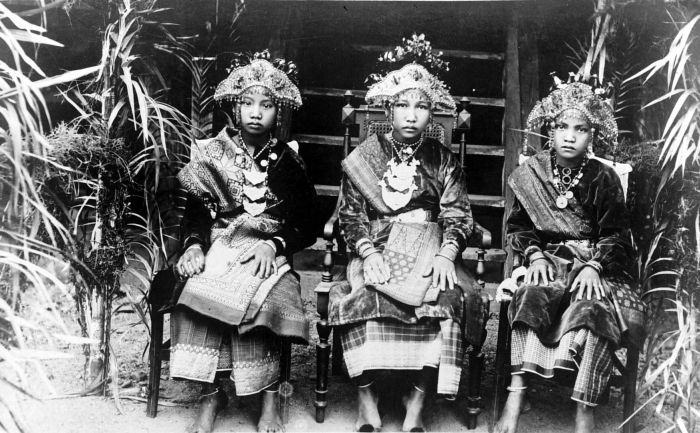
Like most other provincial cultures on the island of Sumatra, the culture of the province of South Sumatra is largely influenced by Malay culture. In addition, there are some cultures that are influenced by Islam, and some are influenced by the greatness of the Srivijaya kingdom. South Sumatra's cultural wealth includes traditional houses, traditional clothing, various types of dances, religious ceremonies such as Sedekah Rame, as well as typical food from the area. The cultural wealth of South Sumatra is not only popular within the South Sumatra region itself.
In all corners of Indonesia, various South Sumatran cultures are well-known, even popular with many people. An example is the rumah limas traditional house, this house has been adopted by many people in various regions because the construction is not complicated. In addition, songket weaving is also a distinctive fabric favored by many people. The South Sumatran signature food, Pempek, can not only be found in the city of Palembang and the surrounding area, but also has spread throughout Indonesia as well as neighbouring countries such as Singapore and Malaysia.
Traditional house
Rumah limas is a traditional house in the province of South Sumatra. The architecture of this traditional house is influenced by Islamic culture and Malay culture. Although this traditional house originated from South Sumatra, it has influenced the construction of other traditional houses in the other places.
The rumah limas traditional house has an area of between 400 and 1000 square meters. The whole house, resting on wooden pillars that were slung on the ground. The rumah limas is divided into several parts, namely the main room pangkeng (bedroom), and pawon (kitchen). The main room is located at the top level and right under the limas roof. In this room there is an amben or a conference room. This room is located in the center of the rumah limas, both for customary and decorative purposes. The pangkeng section is a bedroom. This section of space is on the right or left side. To enter the pangkeng room, it must be done by passing a box-shaped door cover. The box serves as a storage area for various tools.
On the back is the pawon. pawon is part of the kitchen of this traditional house. The word pawon is actually not only known in South Sumatra. The Javanese people, besides adapting the Limas house shape, also recognize the word pawon to mention the position of the kitchen in their home.