
Studebaker was an American wagon and automobile manufacturer based in South Bend, Indiana. The company held a location at 1600 Broadway in Times Square, Midtown Manhattan, New York City. The company was founded in 1852 and incorporated in 1868 as the Studebaker Brothers Manufacturing Company. The firm was originally a coachbuilder, manufacturing wagons, buggies, carriages, and harnesses.
Studebaker entered the automotive business in 1902 with electric vehicles and, in 1904, gasoline vehicles, all sold under the name "Studebaker Automobile Company". Until 1911, its automotive division operated in partnership with the Garford Company of Elyria, Ohio, and after 1909 with the E-M-F Company and with the Flanders Automobile Company. The first gasoline automobiles to be fully manufactured by Studebaker were marketed in August 1912and over the next 50 years, the company established a reputation for quality, durability and reliability.
After an unsuccessful 1954 merger with Packard (the Studebaker-Packard Corporation) and failure to solve chronic post-WWII cash flow problems, the 'Studebaker Corporation' name was restored in 1962. When this happened the South Bend plant stopped automobile production on December 20, 1963, and the last Studebaker automobile rolled off the Hamilton, Ontario, Canada, assembly line on March 17, 1966. Studebaker continued as an independent manufacturer before merging with Wagner Electric in May 1967 and then Worthington Corporation in February 1968 to form Studebaker-Worthington.

History
German forebears
The ancestors of the Studebaker family descend from Solingen, Germany. They arrived in America at the port of Philadelphia on September 1, 1736, on the ship Harle, from Rotterdam, Netherlands. (Original manuscripts now in the Pennsylvania State Library at Harrisburg). This included Peter Studebaker and his wife Anna Margrethe Studebaker, Clement Studebaker (Peter's brother) and his wife Anna Catherina Studebaker, and Heinrich Studebaker (Peter's cousin). In 1918, Albert Russel Erskine, Studebaker Corporation president, wrote the book, History of the Studebaker Corporation, including the 1918 annual report, "written for the information of the 3,000 stockholders of The Studebaker Corporation." The 12,000 dealers in its products living throughout the world, its 15,000 employees, and numberless friends." This book was verified by lawyers, accountants, and all board members, and was a legal document. In the same book, Erskine accurately wrote that Peter Studebaker was the "wagon-maker, which trade later became the foundation of the family fortune and the corporation which now bears his name."
John Studebaker's sons, Henry and Clement Studebaker, started the wagon business in 1852, which later became the foundation of the family fortune and the corporation that now bears their name. John Studebaker, father of the five brothers who began the Studebaker Corporation, was the son of Clement Studebaker Jr. John Clement Studebaker (son of Clement Studebaker and Sarah Rensel) was born on February 8, 1799, in Westmoreland, Pennsylvania. He died in 1877 in South Bend, St. Joseph, Indiana. John Studebaker (1799–1877) moved to Ohio in 1835 with his wife, Rebecca (née Mohler) (1802–1887).
The five brothers
The five sons were, in order of birth: Henry (1826–1895), Clement (1831–1901), John Mohler (1833–1917), Peter Everst (1836–1897), and Jacob Franklin (1844–1887). The boys had five sisters. Photographs of the brothers and their parents are reproduced in the 1918 company history, which Erskine wrote after he became president, in memory of John M., whose portrait appears on the front cover.

18th-century colonial family business
In 1740, Peter Studebaker, master of the German Cutler Guild, built his home on a 100-acre parcel which became known as "Bakers Lookout". The first Studebaker wagon factory was also built in the same year, where he began forging and tempering steel and seasoning wood. In this factory, Peter manufactured a wide variety of products, including products he had previously made in Solingen, Germany, as well as wagons. Peter owned property on both sides of the Conococheague Creek. Peter later purchased approximately 1500 acres in what is now known as the State of Maryland. The home still stands today. (see Bakers Lookout Peter Studebaker's 1740 home website)
In 1747, Peter Studebaker built a road across his properties, which became known as the Broadfording Wagon Road. It allowed heavy traffic to reach the wagon and forging services on Baker's Lookout, which were instrumental in expanding the West. The Maryland Historical Trust WA-I-306 writes 04/03/2001, that this road was "One of Washington County's earliest thoroughfares, Broadfording [Wagon] Road was already in existence in 1747."
Although Peter lived in the American colonies for less than 18 years, the family business expanded through his descendants (see Exhibit M) and apprentices. They expanded the vast land holdings, enlarging the Studebaker family business and its industrious wagon-making region. Peter's trade secrets were passed on to the younger generations. The Studebaker family business plan was to gradually purchase vast amounts of land, on which they could build industrious farms with mills and facilities to make and sell wagons, each identical to the set-up on Bakers Lookout, industrious farms, much acreage, on which one finds the necessary resources: lumber, iron ore, oil shale and land selected with stream, spring, or river to hydropower factories, mills and equipment. Peter's technology enabled the expansion of the family business through the famous Conestoga and Prairie Schooner wagon designs. Peter's trade was the stepping stone to the expansion of the transportation industry. Thomas E. Bonsall wrote, "Much more than the story of a family business; it is also, in microcosm, the story of the industrial development of America." Peter Studebaker died in the mid-1750s.

End of horse-drawn era
John M. Studebaker had always viewed the automobile as complementary to the horse-drawn wagon, noting that the expense of maintaining a car might be beyond the means of a small farmer. In 1918, when Erskine's history of the firm was published, the annual capacity of the seven Studebaker plants was 100,000 automobiles, 75,000 horse-drawn vehicles, and about $10,000,000 worth of automobile and vehicle spare parts ($214,048,673 in 2025 dollars ). In the preceding seven years, 466,962 horse-drawn vehicles had been sold, as against 277,035 automobiles, but the trend was all too clear. The regular manufacture of horse-drawn vehicles ended in 1919, when Erskine ordered the removal of the last wagon gear. To its range of cars, Studebaker would now add a truck line to replace the horse-drawn wagons. Buses, fire engines, and even small rail locomotive-kits were produced using the same powerful six-cylinder engines.
Number of motor vehicles produced by Studebaker:
1902 – 20 electric vehicles
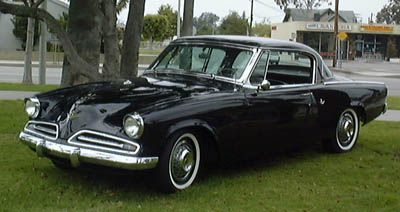
1902–1912 – 1,841 electric vehicles
1904–1910 – 2,481 gasoline vehicles
1909 – 8,132 vehicles

1910 – 15,300 vehicles
1911 – 22,555 vehicles
1912 – 28,623 vehicles

1913 – 35,410 vehicles
1914 – 35,460 vehicles
1915 – 46,845 vehicles
1916 – 65,885 vehicles
1917 – 42,357 vehicles
1918 – 23,864 vehicles
1919 – 39,356 vehicles
1920 – 51,474 vehicles
1921 – 66,643 vehicles
1922 – 110,269 vehicles
1923 – 145,167 vehicles
1924 – 110,240 vehicles
1925 – 134,664 vehicles
1926 – 111,315 vehicles
1927 – 116,740 vehicles
1928 – 136,205 vehicles
1929 – 107,653 vehicles
1930 – 67,269 vehicles
1949 – 199,460 vehicles
1950 – 268,226 vehicles
Studebaker automobiles 1897–1966
In the beginning
In 1895, John M. Studebaker's son-in-law, Fred Fish, urged the development of 'a practical horseless carriage'. When, on Peter Studebaker's death, Fish became chairman of the executive committee in 1897, the firm had an engineer working on a motor vehicle. At first, Studebaker opted for electric (battery-powered) over gasoline propulsion. While manufacturing its own Studebaker Electric vehicles from 1902 to 1911, the company entered into body-manufacturing and distribution agreements with two makers of gasoline-powered vehicles, Garford of Elyria, Ohio, and the Everitt-Metzger-Flanders (E-M-F) Company of Detroit and Walkerville, Ontario. Studebaker began making gasoline-engined cars in partnership with Garford in 1904.
Studebaker marque established in 1911
In 1910, it was decided to refinance and incorporate as the Studebaker Corporation, a decision finalized on February 14, 1911, under New Jersey law. The company discontinued making electric vehicles that same year. The financing was handled by Lehman Brothers and Goldman Sachs who provided board representatives including Henry Goldman whose contribution was especially esteemed.
After taking over E-M-F's Detroit facilities, Studebaker sought to remedy customer dissatisfaction complaints by paying mechanics to visit each disgruntled owner and replace defective parts in their vehicles, at a total cost of US$1 million ($16,071,429 in 2025 dollars). The worst problem was rear-axle failure. Hendry comments that the frenzied testing resulted in Studebaker's aim to design 'for life'—and the consequent emergence of "a series of really rugged cars... the famous Big Six and Special Six" listed at $2,350 ($37,768 in 2025 dollars ). From that time, Studebaker's own marque was put on all new automobiles produced at the former E-M-F facilities as an assurance that the vehicles were well built.
In 1913, the company experienced the first major labor strike in the automotive industry, the 1913 Studebaker strike.
Engineering advances from WWI
The corporation benefited from enormous orders cabled by the British government at the outbreak of World War I. They included 3,000 transport wagons, 20,000 sets of artillery harness, 60,000 artillery saddles, and ambulances, as well as hundreds of cars purchased through the London office. Similar orders were received from the governments of France and Russia.
The 1913 six-cylinder models were the first cars to employ the important advancement of monobloc engine casting, which became associated with a production-economy drive during the war. At that time, a 28-year-old university graduate engineer, Fred M. Zeder, was appointed chief engineer. He was the first of a trio of brilliant technicians, with Owen R. Skelton and Carl Breer, who launched the successful 1918 models, and were known as "The Three Musketeers". They left in 1920 to form a consultancy, later to become the nucleus of Chrysler Engineering. The replacement chief engineer was Guy P. Henry, who introduced molybdenum steel, an improved clutch design, and presided over the six-cylinders-only policy favored by new president Albert Russel Erskine, who replaced Fred Fish in July 1915.
First auto proving ground
In 1925, the corporation's most successful distributor and dealer, Paul G. Hoffman, came to South Bend as vice president in charge of sales. In 1926, Studebaker became the first automobile manufacturer in the United States to open a controlled outdoor proving ground on which, in 1937, would be planted 5,000 pine trees in a pattern that spelled "STUDEBAKER" when viewed from the air. Also in 1926, the last of the Detroit plant was moved to South Bend under the control of Harold S Vance, vice president in charge of production and engineering. That year, a new small car, the Erskine Six was launched in Paris, resulting in 26,000 sales abroad and many more in America. By 1929, the sales list had been expanded to 50 models, and business was so good that 90% of earnings were being paid out as dividends to shareholders in a highly competitive environment. However, the end of that year ushered in the Great Depression, which led to widespread layoffs and massive unemployment across the nation for several years.
Facilities in the 1920s
Studebaker's total plant area in Indiana was 225 acres (0.91 km2), spread over three locations, with buildings occupying 7.5 million square feet of floor space. Annual production capacity was 180,000 cars, requiring 23,000 employees.
The original South Bend vehicle plant continued to be used for small forgings, springs, and some body parts. Separate buildings totaling over one million square feet were added in 1922–1923 for the Light, Special, and Big Six models. At any one time, 5,200 bodies were in process. South Bend's Plant 2 made chassis for the Light Six and had a foundry of 575,000 sq ft (53,400 m2), producing 600 tons of castings daily.
Plant 3 at Detroit made complete chassis for Special and Big Six models in over 750,000 sq ft (70,000 m2) of floor space and was located between Clark Avenue and Scotten Avenue south of Fort Street. Plant 5 was the service parts store and shipping facility, plus the executive offices of various technical departments. The Detroit facilities were moved to South Bend in 1926, except that the Piquette Avenue Plant (Plant 10) was retained for assembly of the Erskine between 1927 and 1929 and the Rockne (1931–1933).
Plant 7 was in Walkerville, Ontario, Canada, where complete cars were assembled from components shipped from South Bend and Detroit factories or made locally in Canada, and is in proximity to the current Ford Windsor Engine Factory. Output was designated for the Canadian (left-hand drive) and British Empire (right-hand drive) trade. By locating it there, Studebaker could advertise the cars as "British-built" and qualify for reduced tariffs. This manufacturing facility had been acquired from E-M-F in 1910 (see above). By 1929, it had received a $1.25 million investment and employed 500 families.