
On 29 October 2022, at approximately 22:20, a crowd surge occurred during Halloween festivities in the Itaewon neighborhood of Seoul, South Korea, resulting in 159 deaths and 196 injuries. The total number of fatalities includes two individuals who died following the incident. Most victims were young adults, and 27 were foreign nationals.
The incident was the deadliest disaster in South Korea since the sinking of the MV Sewol in 2014 and the most severe mass-casualty event in Seoul since the Sampoong Department Store collapse in 1995. It was also the deadliest crowd crush in South Korean history, surpassing a 1959 incident at the Busan Municipal Stadium in which 67 people were killed.
A special police task force initiated an investigation within days of the event and concluded on 13 January 2023 that inadequate preparation by the police and government, despite multiple prior warnings, was the primary cause of the incident.
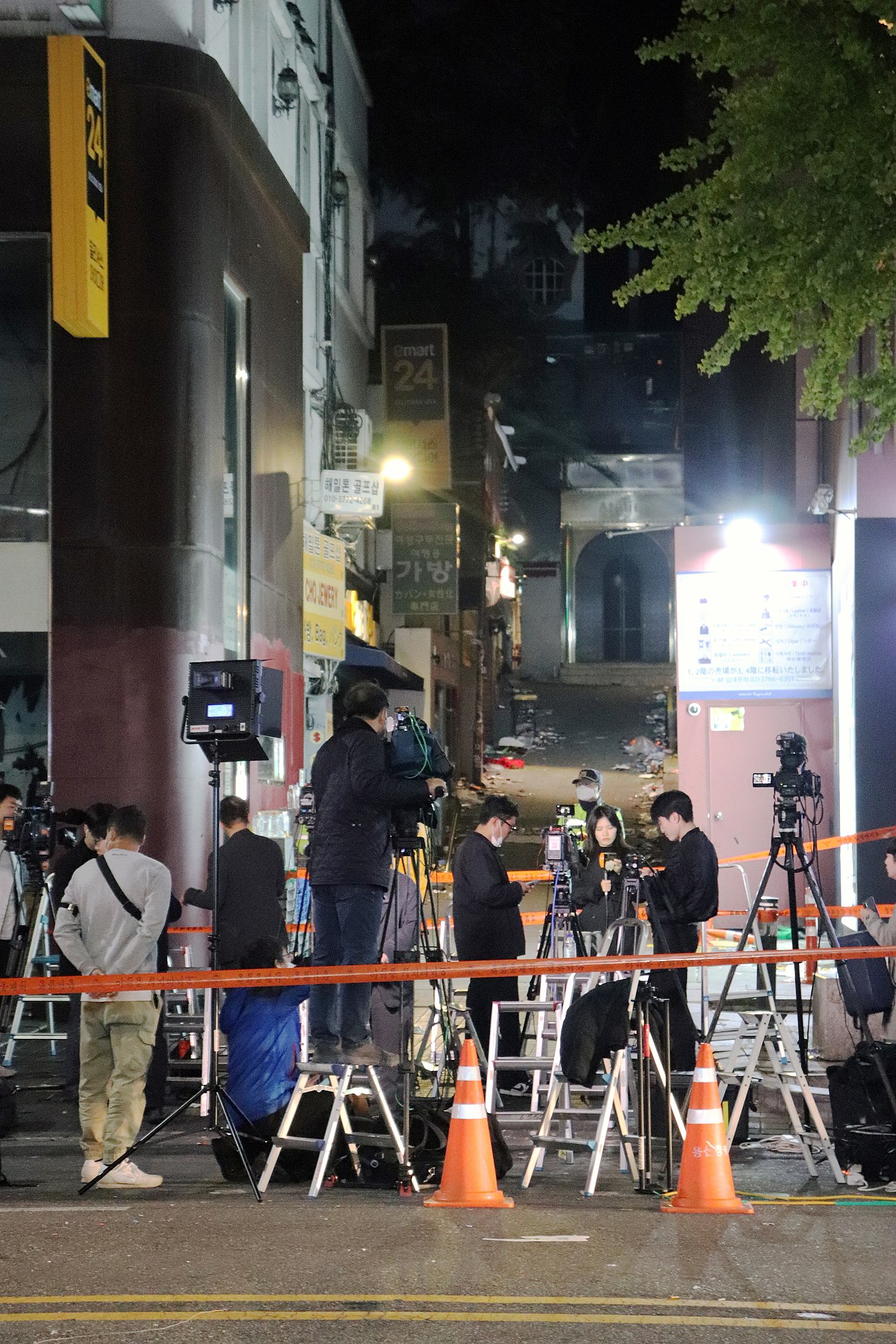
In the aftermath, and throughout the investigative period, the government and police faced widespread criticism and protest. President Yoon Suk Yeol and his administration were the subject of several protests calling for his resignation; however, he did not step down. The president initially acknowledged partial responsibility for the incident but later retracted his acknowledgement and shifted responsibility elsewhere.
Background
History of the district
Itaewon is a neighborhood located within the Yongsan District of Seoul. Its modern history is closely connected to the former United States military installation at Yongsan Garrison, established in 1945. As numerous bars and brothels emerged in the area to serve military personnel, the district became associated by many Koreans with social controversy and safety concerns. Approximately two decades after the end of the Korean War (1950–1953), Itaewon underwent a process of gentrification, and in 2018 the U.S. military relocated its base facilities to southern Seoul.
In recent years, Itaewon has developed into a major center for nightlife, featuring a concentration of nightclubs, restaurants, and bars. The area now attracts both domestic and international visitors, whereas previously more than two-thirds of patrons at its dining and entertainment establishments were American. The district has also been perceived as a space where individuals can step outside traditional expectations in South Korean society, which has been shaped by long-standing Confucian social hierarchies and norms of conformity.

Beginning around 2010, the celebration of Halloween experienced a notable rise in popularity in South Korea, with Itaewon becoming a particularly prominent location for related festivities.
Layout of the area
The area immediately around the crush is characterized by very narrow streets and alleys without escape routes. Nearby are Exit 1 of Itaewon Station and the Hamilton Hotel.
The street where the crush occurred is about 45 metres (150 ft) long and 3.2 metres (10 ft) wide at its narrowest point. The street had an iron temporary wall that reduced its width. Its narrow width impeded emergency services attempting to enter it. The street slopes upwards from the main street of the district, Itaewon-ro. This incline later caused people to be pushed downward, with dozens of people falling onto others.

Authorities had been concerned since at least 2020 about the crowding issue, but did not act on these concerns. An expert in mass movement and spatial arrangement and behavior at Sejong University later said to The Washington Post, "If you just surveyed the site and discussed possible countermeasures, anyone with instinct and experience would have been able to foresee the situation."
Conditions before the disaster
On the evening of 29 October, approximately 100,000 people, mostly in their teens and twenties, attended Halloween festivities in the area.
It was the first time since the start of the COVID-19 pandemic that Halloween festivities could be attended without social distancing or mask-wearing requirements. After an outbreak of COVID-19 in 2020 was traced back to the area, authorities had even threatened partygoers in 2021 with harsh penalties if they violated the rules. When restrictions on social gatherings during the pandemic were lifted, they were able to visit freely.

Witnesses later reported that the streets were packed with people. An eyewitness claimed that around 19:00 local time (KST), a walk from Itaewon station that normally took 1 minute took over 10 minutes.
Lack of government preparation
Although Seoul had a real-time crowd size prediction system based on mobile phone data at the time, the system was not activated on the night of the crush according to local media.
Despite the massive crowds, it was later reported that only 137 police officers were on duty at Itaewon at the time. By contrast, 6,500 officers were assigned to monitor a protest of around 25,000 people elsewhere in Seoul on that night, and 1,300 officers had been assigned for a BTS concert for 55,000 earlier in the month. Reportedly, four days before the disaster, the Itaewon police substation had requested backup due to the anticipated crowds. Despite this, another police notice two days before the crush did not associate the size of the crowds with danger. It instead warned of sex crimes, theft, traffic congestion, and drug and alcohol abuse. An officer with instructions to wait to be dispatched in response to any crimes that night said that there had been no mention of crowd control that night or the days leading up to Halloween. In addition, the police later stated that they did not have a crowd control plan in place that evening because they did not have a central organizer.

According to a later statement by the national police chief, the Seoul police station received 11 emergency calls related to the size of the crowd as early as four hours prior to the incident, but did not intervene.
Disaster
One attendee reported that the crowd crush started when a group of young men pushed others, causing people to lose balance and fall. Several survivors also stated that, because businesses had closed for the night, some nearby establishments prevented people from entering to escape the congestion.
The first call to the emergency service number 112 was made at 18:34. During this call, the caller reported that an alley adjacent to the Hamilton Hotel was becoming extremely crowded and potentially dangerous. After prompting from the emergency official, the caller clarified that a major accident could occur if individuals began to fall. Between this initial report and 22:00, at least seventy-nine emergency calls were placed. Emergency officials later stated that at least eleven of these calls were made by individuals experiencing symptoms consistent with compressive suffocation. Phone and internet reception eventually became unavailable due to the high volume of attempted communications.

The precise time at which the crush began remains disputed. According to contemporaneous accounts published by multiple news outlets, the crowd crush occurred at approximately 22:20. However, an investigation by The Washington Post, which analyzed hundreds of pieces of evidence two weeks after the incident, concluded that the crush began at 22:08. Sixteen additional emergency calls were made between that time and 22:22, and video recordings show five police officers attempting to extract unconscious victims from the crowd.
Eyewitness recordings showed hundreds of people piled on top of one another in five to six layers. Three off-duty United States Forces Korea soldiers, who escaped by climbing onto a ledge, assisted in pulling individuals out of the crowd. One recalled that the densest portion of the crowd was approximately 15 feet (4.6 m) deep, noting that "it was a long time for people stuck in there not to breathe". A police officer responding to a reported altercation near the alley was documented observing the crush and attempting to reduce the crowd flow by preventing additional individuals from entering the upper end of the alleyway.
Despite these conditions, some people in the vicinity remained unaware that a mass-casualty incident was occurring. Even after police cordoned off the affected area, some nearby bars continued operating. A widely shared video showing individuals dancing and obstructing the path of ambulances prompted extensive public condemnation.
Immediate emergency response to the incident
Following calls made to the fire department at 22:15, four ambulances were dispatched. The large crowd made it difficult for emergency vehicles to reach the scene. According to the National Fire Agency and the Interior Ministry, eventually 848 emergency personnel were deployed to the scene, including all personnel available in Seoul and an addition of 140 vehicles and 346 firefighters from across the country. On arrival, first responders struggled to extract still-breathing victims from the crowd, which delayed critical first aid and resuscitation.
An emergency message was issued to mobile phones in Yongsan, urging people to immediately return home because of an "emergency accident near Hamilton Hotel in Itaewon".
Emergency workers were not able to remove everyone from the crush until well after midnight. With resuscitation failing, bodies were laid on the streets by medical and police personnel and covered with blankets and clothing. Dozens of unconscious victims were eventually extracted from the crowd. Paramedics, police, and bystanders performed CPR on them. Videos on social media show bystanders dressed in costumes attempting to resuscitate the unconscious.
Eighty-three more ambulances arrived on site as late as 23:45. Many of the victims were transported to Soonchunhyang University Hospital near Itaewon.
US Army military police units of United States Forces Korea, who were conducting a routine patrol in the area with officers from the National Police Agency, assisted with first aid and maintaining public order on scene.
On 1 November, the government pledged to provide up to ₩15 million (US$13,112.46) in funeral expenses, and ₩20 million (US$17,483.28) in compensation. On 9 November 2022, a "one-stop" support center was opened for those affected by the incident.
Victims
As of January 2023, the South Korean government has officially reported a death toll of 159; this figure includes later deaths in connection to the crush.
The death toll in the immediate aftermath was widely reported as 157, consisting of 102 females and 55 males. Of the victims, four were teenagers, ninety-six people were in their twenties, thirty-two people were in their thirties, nine were in their forties, and thirteen had yet to be identified. In addition, 27 foreigners were among the dead.
On 14 November, Yonhap News reported that the Central Disaster and Safety Countermeasures Headquarters had risen by one, to an official death toll of 158. On 12 December, a high school student was found dead in a Mapo District motel in a suspected suicide. The Ministry of Home Affairs and Security officially recognized him as the 159th death of the Itaewon disaster.
On 11 November, the JoongAng Ilbo reported that at least 197 others were injured, including 32 in serious condition.
Identification of victims
The number of missing person reports filed on the following day grew from 355 to 4,024. Police said that they would identify the victims and relay information to family members.
By the afternoon of 30 October, about 90% of victims had been identified. The remaining 10% (12 bodies) were of local teens or foreign nationals. Officials said it was initially difficult to identify the deceased because of their Halloween costumes or because many were not carrying identification. The Hannam-dong Community Service Center served as a temporary missing persons center. Officials who usually deal with birth certificates or home registrations assisted in identifying victims. Workers at the center answered phone calls from the public regarding the missing. In just over seven hours, the center logged at least 3,580 call hours related to the incident.
One of the temporary morgues – the Wonhyoro sports center – was converted into a lost and found center for the identification of victims clothing and other items, with over 800 items recovered. Mobile phones and ID cards were kept at a local police station.
Mental health
Many survivors have subsequently suffered from post-traumatic stress disorder (PTSD). The National Center for Disaster and Trauma and local mental health welfare centers were treating (as of 13 December 2022) over 1,300 cases of surviving victims and survivors of the victims of the disaster. The Ministry of Interior and Safety said bereaved families of the victims will be eligible for the same state support, such as financial relief, as with other victims.
In October 2023, the South Korean government reported 1,316 firemen who responded to the incident still experienced psychological trauma. The National Fire Agency said, at the time, these individuals were undergoing treatment from complications.
Publication of the names of the fatalities
No official list of the deceased has been released. On 14 November 2022, a list of 155 names was published, but this was widely criticized. The list did not disclose personal information such as the victims' ages, or show their photos. The Minister of Public Administration and Security claimed that he did not have a list of deaths, a statement that controversially conflicted media reporting.
Government response
Immediate response
The day of the incident, President Yoon Suk Yeol attended an emergency briefing. He suggested swiftly treating the injured and reviewing the safety of festivity sites. He addressed the nation the following morning, and later visited the scene of the incident. The Mayor of Seoul, Oh Se-hoon, who was on a trip to Europe at the time of the incident, returned to Seoul.
In the days following the crush, interior minister Lee Sang-min offered an official apology and National Police Chief Yoon Hee-keun said "There were several reports to the police just before the incident occurred and it was known that a massive crowd had gathered, indicating the urgency of the danger. However, information management was insufficient and there was no adequate reaction from the police".
Authorities did not immediately disclose what had caused the crush, but the chief of the Yongsan District Fire Department Choi Seong-bum said it was a "presumed stampede" and that many individuals fell. An official investigation was opened by the government, which promised new methods to prevent similar incidents. An investigation was also opened to determine if bars and clubs followed safety regulations.
On 1 November, government officials stated that it was not possible to predict the overwhelming crowd, but disaster prevention and urban planning experts refuted the government's position. They pointed out that authorities were aware of a large crowd due to the relaxation of COVID-19 rules, yet they deployed relatively few officers.
Investigation
The Korean National Police Agency (KNPA) launched an investigation into the crush within days of the event. On 13 January 2023, they announced their results. They found that the lack of safety precautions and other police errors contributed to the high number of victims. According to the KNPA, most of the deaths were caused by suffocation or brain swelling. According to the KNPA report, many died after falling and getting piled on top of them by other people from the crowd. South Korean police charged 23 officers, about half of them law enforcement officials, with involuntary manslaughter and negligence.
On 2 November 2022, the KNPA raided the city's police departments as part of the investigation. Investigative teams raided police units, fire departments, and offices to obtain documents for the investigation. An initial investigation uncovered that police did not respond appropriately to the emergency calls. Transcripts of the 11 calls made were released by the national police, noting that the Korean word which translates as "crushed to death" was used 13 times by callers. On 9 November, additional raids were made on the hotel adjoining the alley and two other locations, on suspicion that illegal extended structures from the buildings surrounding the alley had made it narrower over the years. On 11 November, a police officer at Yongsan Police Station committed suicide. He was being investigated on charges of abuse of authority, destruction of evidence and professional negligence for ordering the deletion of an internal intelligence report warning of the dangers of gathering crowds in Itaewon. That same day a senior official from the Seoul Metropolitan Government's safety support division was found deceased by an apparent suicide. While he had not worked at the disaster site nor was investigated by the police, he had been the final approver of documents for emergency checks on local safety measures and psychological counseling programs for the disaster. On 5 December, two former intelligence officers, Park Sung-min of the Seoul Metropolitan Government and Kim Jin-ho of Yongsan Police, were arrested on suspicion of destroying evidence related to the crush. According to CNN, they had ordered their subordinates to destroy an internal report about the risks of crowds in Itaewon on Halloween.
On 15 November, the firefighters' union sued the Interior Minister – who is responsible for public safety – in order to force the police to open an investigation on him. The union wanted to challenge a government statement that the night was not an organized event, and therefore the responsibility of public safety was unclear.
On 20 January 2024, it was reported that the chief of the Seoul Metropolitan Police Agency, a former intelligence officer, Kim Kwang-ho, was charged with negligence for failing to ensure there were enough officers deployed on the ground at Itaewon on the incident night. On 14 February, a court sentenced Park Sung-min to 18 months imprisonment for destroying evidence and gave suspended sentences to Kim Jin-ho and, Kwang Yeong-sok, an officer at Yongsan police station, on the same charges.
On 30 September 2024, the Seoul Western District Court convicted three police officers, including the former head of Yongsan police station Lee Im-jae, of negligence over their handling of the disaster and sentenced them to up to three years imprisonment. The court also ruled that the crush was not a natural disaster and that the incident could have been prevented had the defendants performed adequate preparation, coordination and supervision over the event. On 17 October, Kim Kwang-ho was acquitted on negligence charges relating to the disaster, citing insufficient evidence.