
Coptic (Bohairic Coptic: ϯⲙⲉⲧⲣⲉⲙⲛ̀ⲭⲏⲙⲓ, romanized: Timetremənkʰēmi) is a dormant Afroasiatic language. It is a group of closely related Egyptian dialects, representing the most recent developments of the Egyptian language, and historically spoken by the Egyptians, starting from the third century AD in Roman Egypt. Coptic was supplanted by Arabic as the primary spoken language of Egypt following the Arab conquest of Egypt and was slowly replaced over the centuries.
Coptic has no modern-day native speakers, and no fluent speakers apart from a number of priests although it remains in daily use as the liturgical language of the Coptic Orthodox Church and of the Coptic Catholic Church. It is written with the Coptic alphabet, a modified uncial form of the Greek alphabet with seven additional letters borrowed from the Demotic Egyptian script.
The major Coptic dialects are Sahidic, Bohairic, Akhmimic, Fayyumic, Lycopolitan (Asyutic), and Oxyrhynchite. Sahidic Coptic was spoken between the cities of Asyut and Oxyrhynchus and flourished as a literary language across Egypt in the period c. 325 – c. 800 AD. The Gnostic texts in the Nag Hammadi library are primarily written in the Sahidic dialect. However, some texts also contain elements of the Subakhmimic (Lycopolitan) dialect, which was also used in Upper Egypt. Bohairic, the dialect of Lower Egypt, gained prominence in the 9th century and is the dialect used by the Coptic Church liturgically.
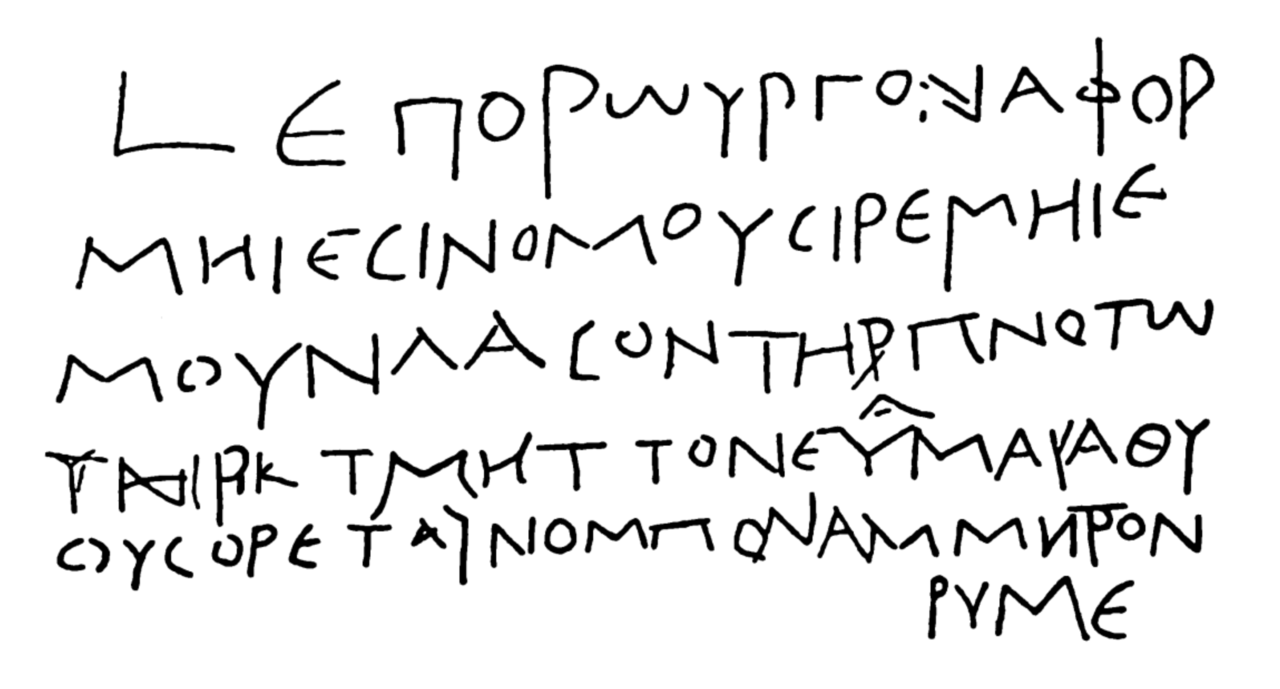
Name
In Coptic the language is called ϯⲙⲉⲧⲣⲉⲙⲛ̀ⲭⲏⲙⲓ (timetremǹkhēmi) "Egyptian" or ϯⲁⲥⲡⲓ ⲛ̀ⲣⲉⲙⲛ̀ⲭⲏⲙⲓ (tiaspi ǹremǹkhēmi) "the Egyptian language". Coptic also possessed the term ⲅⲩⲡⲧⲓⲟⲥ (gyptios) "Egyptian", derived from Greek Αἰγύπτιος (Aigúptios). This was borrowed into Arabic as قبْط (qibṭ/qubṭ), and from there into the languages of Europe, giving rise to words like French copte, whence the English Copt.
Geographic distribution
Coptic is spoken liturgically in the Coptic Orthodox and Coptic Catholic Church (along with Modern Standard Arabic). The language is spoken only in Egypt and historically has had little influence outside of the territory, except for monasteries located in Nubia (which straddles modern Egypt and Sudan). Coptic's most noticeable linguistic influence has been on the various dialects of Egyptian Arabic, which is characterised by a Coptic substratum in lexical, morphological, syntactical, and phonological features.
History
The Egyptian language may have the longest documented history of any language, from Old Egyptian, which appeared just before 3200 BC, to its final phases as Coptic in the Middle Ages. Coptic belongs to the Later Egyptian phase, which started to be written in the New Kingdom of Egypt. Later Egyptian represented colloquial speech of the later periods. It had analytic features like definite and indefinite articles and periphrastic verb conjugation. Coptic, therefore, is a reference to both the most recent stage of Egyptian after Demotic and the new writing system that was adapted from the Greek alphabet.

Pre-Islamic period
The earliest attempts to write the Egyptian language using the Greek alphabet are Greek transcriptions of Egyptian proper names, most of which date to the Ptolemaic Kingdom. Scholars frequently refer to this phase as Pre-Coptic. However, it is clear that by the Late Period, Demotic scribes regularly employed a more phonetic orthography, a testament to the increasing cultural contact between Egyptians and Greeks even before Alexander the Great's conquest of Egypt.
Alexander the Great's conquest of Egypt and the subsequent Greek administration of the Ptolemaic Kingdom led to widespread hellenization and Greek-Coptic bilingualism, especially in Lower Egypt, particularly the Nile Delta. This led to the entrance of many Greek loanwords into Coptic, particularly in words relating to technical, legal, commercial, and technological topics.
Efforts to write Coptic in the Greek alphabet probably began in the 1st century BC. The earliest text known is from the 1st century AD. This first phase of written Coptic is called Old Coptic and lasts into the 4th or 5th century. The earliest stage of experimentation with the Egyptian language in the Greek alphabet is often called Pre-Old Coptic or Graeco-Egyptian. Other authors distinguish between early and late Old Coptic.

Old Coptic consists of pagan writings of a magical or divinatory nature. These texts lack the consistent script style and borrowed Greek vocabulary of later Coptic literature, which is entirely Christian or para-Christian (i.e., Gnostic and Manichaean). Some use exclusively Greek letters, with none of the borrowed Demotic Egyptian script of standard Coptic, while others use more Demotic letters than became standard. The production of pagan magical texts written in Egyptian in Greek letters continued into the period of Coptic literature proper.
One traditional theory links the origin of literary Coptic to the Gnostic community in Alexandria. No surviving Coptic manuscript, however, can be linked to Alexandria. Another links it to Christian monasteries and the need to translate Greek teaching into the vernacular. The high proportion of borrowed Greek vocabulary in early Coptic texts, however, makes their practical utility as translations questionable. More recently, it has been suggested that the revival of Egyptian as a literary language (in the form of Coptic) was part of an "effort to revive a national Egyptian culture." Paola Buzi refers to it as an "identity operation", an assertion of distinctness. Conversely, since the rise of the Coptic writing system paralleled the rise of Christianity, it may have been stimulated by the desire to distance itself from the pagan associations of traditional Egyptian writing.
Literary Coptic first appears in the 3rd century. The earliest literary texts are translations of Greek texts, either Christian or Gnostic. The five literary texts dated to the 3rd century are all biblical, either marginal annotations to Greek bibles or bilingual Greek–Coptic biblical texts. There is a single documentary text, a private letter on an ostracon, dated to this century.

Islamic period
The Arab conquest of Egypt brought the spread of Islam in the seventh century. At the turn of the eighth century, Abd al-Malik ibn Marwan, the Umayyad caliph, decreed that Arabic replace Koine Greek as the sole administrative language. Literary Coptic gradually declined, and within a few hundred years, Egyptian bishop Severus ibn al-Muqaffa found it necessary to write his History of the Patriarchs in Arabic. However, ecclesiastically the language retained an important position, and many hagiographic texts were also composed during this period. Until the 10th century, Coptic remained the spoken language of the native population outside the capital.
The Coptic language massively declined under the hands of al-Hakim bi-Amr Allah, the Fatimid caliph, as part of his campaigns of religious persecution. Emile Maher Ishaq, a noted Coptologist, writes in the Coptic Encyclopedia that al-Hakim bi-Amr Allah issued strict orders completely prohibiting the use of Coptic anywhere, whether in schools, public streets, and even within family homes. Those who did not comply were liable to have their tongues removed. Oral traditions of the Coptic Church tell of removed tongues left on the street or in a public square to intimidate and warn against speaking Coptic.
As a literary language, Arabic began to slowly replace Coptic among native Egyptians in the 10th century and likely became the most used literary language between the 11th or 12th centuries; with the last known literary work written in Coptic dating to the late 14th century.

As a primary spoken language, Coptic was the majority language in Egypt until sometime between the 10th and 12th centuries, and then survived as a minority primary language until at least the 17th century. The language may have survived in isolated pockets in Upper Egypt as late as the 19th century. In the village of Zainiya (pi-Solsel) north of Luxor), passive speakers over 50 years old were recorded as late as the 1930s, and traces of traditional vernacular Coptic were reported to exist in other places such as Abydos and Dendera.
From the medieval period, there are two known examples of tarsh-printed Coptic. The fragmentary amulet A.Ch. 12.145 of Austrian National Library, and the more intact University of Utah, Or. P.1563r containing a frame of Coptic text around an Arabic main text.
Modern revitalisation attempts
In the early 20th century, some Copts tried to revive the Coptic language, but they were unsuccessful.

In the second half of the 20th century, Pope Cyril VI of Alexandria started a national Church-sponsored movement to revive Coptic. Several works of grammar were published, including a more comprehensive dictionary than had been formerly available. The scholarly findings of the field of Egyptology and the inauguration of the Institute of Coptic Studies further contributed to the renaissance. Efforts at language revitalisation continue to be undertaken, and have attracted the interest of Copts and linguists in and outside of Egypt.
Dialects
There is little written evidence of dialectal differences in the pre-Coptic phases of the Egyptian language due to the centralised nature of the political and cultural institutions of ancient Egyptian society. However, literary Old and Middle (Classical) Egyptian represent the spoken dialect of Lower Egypt around the city of Memphis, the capital of Egypt in the Old Kingdom. Later Egyptian is more representative of the dialects spoken in Upper Egypt, especially around the area of Thebes as it became the cultural and religious center of the New Kingdom.
Coptic more obviously displays a number of regional dialects that were in use from the coast of the Mediterranean Sea in northern Egypt, south into Nubia, and in the western oases. However, while many of these dialects reflect actual regional linguistic (namely phonological and some lexical) variation, they mostly reflect localized orthographic traditions with very little grammatical differences.
Lower Egyptian dialects
Bohairic
The Bohairic (also known as Memphitic) dialect originated in the western Nile Delta. The earliest Bohairic manuscripts date to the 4th century, but most texts come from the 9th century and later; this may be due to poor preservation conditions for texts in the humid regions of northern Egypt. It shows several conservative features in lexicon and phonology not found in other dialects. Bohairic is the dialect used as the liturgical language of the modern Coptic Orthodox Church, replacing Sahidic some time in the eleventh century. In contemporary liturgical use, there are two traditions of pronunciation, arising from successive reforms in the 19th and 20th centuries (see Coptic pronunciation reform). Modern revitalisation efforts are based on this dialect.
Bashmuric (also known as Mansurian, Dialect G, and Bashmurian) was a sub-dialect of Bohairic most likely spoken in Eastern Delta. Its main characteristic is using solely Greek letters to represent Coptic phonemes.
Upper Egyptian dialects
Sahidic
Sahidic (also known as Thebaic or Theban) is the dialect in which most known Coptic texts are written, and was the leading dialect in the pre-Islamic period. Where it was spoken is a matter of debate; it name which comes from an Arabic term Aṣ-ṣa'id meaning Upper [Southern] Egypt would imply it was spoken there, but Sahidic's features seem to suggest it was spoken in the north. It is also possible that Sahidic was the urban dialect spoken in the major urban centers of Thebes and Memphis differentiating it from the other rural dialects. Around 300 it began to be written in literary form, including translations of major portions of the Bible (see Coptic versions of the Bible). By the 6th century, a standardised spelling had been attained throughout Egypt. Almost all native authors wrote in this dialect of Coptic. Sahidic was, beginning in the 9th century, challenged by Bohairic, but is attested as late as the 14th.
While texts in other Coptic dialects are primarily translations of Greek literary and religious texts, Sahidic is the only dialect with a considerable body of original literature and non-literary texts. Because Sahidic shares most of its features with other dialects of Coptic with few peculiarities specific to itself, and has an extensive corpus of known texts, it is generally the dialect studied by learners of Coptic, particularly by scholars outside of the Coptic Church.
Proto-Theban
Proto-Theban is a dialect of Coptic only attested in a single source, as such information on it is limited but; Proto-Theban closely resembles what reconstructed Proto-Sahidic dialect would have looked like. The variant of the Coptic script used in its singular attestation is also distinct as it contains 10 letters from the Demotic Script which is significantly higher than other dialects.
Fayyumic
Fayyumic (also known as Crocodilopolic; in older works it is often called Bashmuric) was spoken primarily in the Faiyum west of the Nile Valley. It is attested from the 3rd to the 10th centuries. It is most notable for writing ⲗ (which corresponds to /l/), where other dialects generally use ⲣ /r/ (probably corresponding to a flap [ɾ]). In earlier stages of Egyptian, the liquids were not distinguished in writing until the New Kingdom, when Late Egyptian became the administrative language. Late Egyptian orthography utilised a grapheme that combined the graphemes for /r/ and /n/ in order to express /l/. Demotic for its part indicated /l/ using a diacritic variety of /r/.
South Fayyumic
South Fayyumic (also called Dialect V) was spoken around modern towns of Beni Suef and Bush and is distinguished from central Fayyumic by not having lambdacism.
Ashmuninic
Ashmuninic (also known as Hermopolic or Dialect H) was spoken around the city of Shmun and shares South Fayyumic features like vowel gemination and absence of lambdacism.
Oxyrhynchite
Oxyrhynchite (also known as Mesokemic or, confusingly, Middle Egyptian) is the dialect of Oxyrhynchus and surrounding areas. It shows similarities with Fayyumic and is attested in manuscripts from the fourth and fifth centuries.
Lycopolitan
Lycopolitan (also known as Subakhmimic and Assiutic) is a dialect closely related to Akhmimic in terms of when and where it was attested, but manuscripts written in Lycopolitan tend to be from the area of Asyut. The main differences between the two dialects seem to be graphic in nature. The Lycopolitan variety was used extensively for translations of Gnostic and Manichaean works, including the texts of the Nag Hammadi library.
Akhmimic
Akhmimic (also called Chemmic or Panopolic) was the dialect of the area around the town of Akhmim (Ancient Greek: Πανὸς πόλις, romanized: Panopolis). It flourished during the fourth and fifth centuries, after which no writings are attested. Akhmimic is phonologically the most archaic of the Coptic dialects. One characteristic feature is the retention of the phoneme /x/, which is realised as /ʃ/ in most other dialects.
Aswanic
Aswanic (also known as Syenic) was the dialect of the area around the town of Aswan. It is very close to Akhmimic, and sometimes considered a sub-dialect, although, what makes it different is that "ϩ" is written before pronouns, for example in standard Coptic it is said Afso, which means drank, but in the Aswanic dialect it is said Hafso. It also has a distinctive way of writing; so the letter "ⲃ" is written instead of the letter "ϥ".
Phonology
Coptic provides the clearest indication of Later Egyptian phonology from its writing system, which fully indicates vowel sounds and occasionally stress patterns. The phonological system of Later Egyptian is also better known than that of the Classical phase of the language because of a greater number of sources indicating Egyptian sounds, including cuneiform letters containing transcriptions of Egyptian words and phrases, and Egyptian renderings of Northwest Semitic names. Coptic sounds, in addition, are known from a variety of Coptic-Arabic papyri in which Arabic letters were used to transcribe Coptic and vice versa. They date to the medieval Islamic period, when Coptic was still spoken.
Vowels
There are some differences of opinion among Coptic language scholars on the correct phonetic interpretation of the writing system of Coptic. Differences centre on how to interpret the pairs of letters ⲉ/ⲏ and ⲟ/ⲱ. In the Attic dialect of Ancient Greek in the 5th century BC, the first member of each pair is a short closed vowel /e, o/, and the second member is a long open vowel /ɛː, ɔː/. In some interpretations of Coptic phonology, it is assumed that the length difference is primary, with ⲉ/ⲏ /e, eː/ and ⲟ/ⲱ is /o, oː/. Other scholars argue for a different analysis in which ⲉ/ⲏ and ⲟ/ⲱ are interpreted as /e, ɛ/ and /o, ɔ/.
These two charts show the two theories of Coptic vowel phonology:
Dialects vary in their realisation. The difference between [o] and [u] seems to be allophonic. Evidence is not sufficient to demonstrate that these are distinct vowels, and if they are, the difference has a very low functional load. For dialects that use orthographic ⟨ⲉⲓ⟩ for a single vowel, there appears to be no phonetic difference from ⟨ⲓ⟩.
Double orthographic vowels are presumed here to be long, but there is considerable debate as to whether these double vowels represent long vowels or glottal stops.
There is no length distinction in final stressed position, but only those vowels that occur long appear there: ⟨(ⲉ)ⲓ, ⲉ, ⲁ, ⲟ~ⲱ, ⲟⲩ⟩.