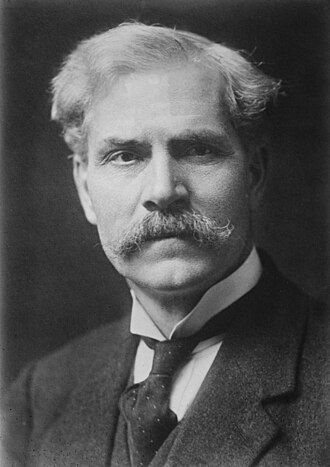
James Ramsay MacDonald (né James McDonald Ramsay; 12 October 1866 – 9 November 1937) was a British statesman and politician who served as Prime Minister of the United Kingdom. The first two of his governments belonged to the Labour Party: a minority Labour government for nine months in 1924, making him the first Labour Prime Minister in British history, and the second between 1929 and 1931. In 1931, MacDonald was expelled from the Labour Party, after he formed a National Government dominated by the Conservative Party and supported by only a few Labour members, his premiership of which lasted until 1935.
MacDonald, along with Keir Hardie and Arthur Henderson, was one of the three principal founders of the Labour Party in 1900. He was chairman of the Labour MPs before 1914 and, after an eclipse in his career caused by his opposition to the First World War, he was Leader of the Labour Party from 1922. The second Labour Government (1929–1931) was dominated by the Great Depression. He formed the National Government to carry out spending cuts to defend the gold standard, but it had to be abandoned after the Invergordon Mutiny, and he called a general election in 1931 seeking a "doctor's mandate" to fix the economy.
The National coalition won an overwhelming landslide and the Labour Party was reduced to a rump of around 50 seats in the House of Commons. His health deteriorated and he stood down as prime minister in 1935, remaining as Lord President of the Council until retiring in 1937. He died later that year.

MacDonald's speeches, pamphlets and books made him an important theoretician. Historian John Shepherd states that "MacDonald's natural gifts of an imposing presence, handsome features and a persuasive oratory delivered with an arresting Highlands accent made him the iconic Labour leader". After 1931, MacDonald was repeatedly and bitterly denounced by the Labour movement as a traitor to its cause. Since the 1960s, some historians have defended his reputation, emphasising his earlier role in building up the Labour Party, dealing with the Great Depression, and as a forerunner of the political realignments of the 1990s and 2000s.
Early life
Lossiemouth
MacDonald was born at Gregory Place, Lossiemouth, Moray, Scotland, the illegitimate son of John MacDonald, a farm labourer, and Anne Ramsay, a housemaid. Registered at birth as James McDonald (sic) Ramsay, he was known as Jaimie MacDonald. Illegitimacy could be a serious handicap in 19th-century Presbyterian Scotland, but in the north and northeast farming communities this was less of a problem; in 1868, a report of the Royal Commission on the Employment of Children, Young Persons and Women in Agriculture noted that the illegitimacy rate was around 15%—nearly every sixth person was born out of wedlock. MacDonald's mother had worked as a domestic servant at Claydale farm, near Alves, where his father was also employed. They were to have been married, but the wedding never took place, either because the couple quarrelled and chose not to marry, or because Anne's mother, Isabella Ramsay, stepped in to prevent her daughter from marrying a man she deemed unsuitable.
Ramsay MacDonald received an elementary education at the Free Church of Scotland school in Lossiemouth from 1872 to 1875, and then at Drainie Parish School. He left school at the end of the summer term in 1881, at the age of 15, and began work on a nearby farm. In December 1881, he was appointed a pupil teacher at Drainie parish school. In 1885, he moved to Bristol to take up a position as an assistant to Mordaunt Crofton, a clergyman who was attempting to establish a Boys' and Young Men's Guild at St Stephen's Church. In Bristol, Ramsay MacDonald joined the Democratic Federation, a Radical organisation, which changed its name a few months later to the Social Democratic Federation (SDF). He remained in the group when it left the SDF to become the Bristol Socialist Society. In early 1886 he moved to London.

Discovering socialism in London
Following a short period of work addressing envelopes at the National Cyclists' Union in Fleet Street, he found himself unemployed and forced to live on the small amount of money he had saved from his time in Bristol. MacDonald eventually found employment as an invoice clerk in the warehouse of Cooper, Box and Co. During this time, he was deepening his socialist credentials, and engaged himself energetically in C. L. Fitzgerald's Socialist Union which, unlike the SDF, aimed to progress socialist ideals through the parliamentary system. MacDonald witnessed the Bloody Sunday of 13 November 1887 in Trafalgar Square, and in response, had a pamphlet published by the Pall Mall Gazette, titled Remember Trafalgar Square: Tory Terrorism in 1887.
MacDonald retained an interest in Scottish politics. Gladstone's first Irish Home Rule Bill inspired the setting up of a Scottish Home Rule Association in Edinburgh. On 6 March 1888, MacDonald took part in a meeting of London-based Scots, who, upon his motion, formed the London General Committee of the Scottish Home Rule Association. For a while, he supported home rule for Scotland, but found little support among London's Scots. However, MacDonald never lost his interest in Scottish politics and home rule, and in Socialism: critical and constructive, published in 1921, he wrote: "The Anglification of Scotland has been proceeding apace to the damage of its education, its music, its literature, its genius, and the generation that is growing up under this influence is uprooted from its past."
Politics in the 1880s was still of less importance to MacDonald than furthering his education. In 1886–87, MacDonald studied botany, agriculture, mathematics, and physics at the Birkbeck Literary and Scientific Institution (now Birkbeck, University of London) but his health suddenly failed him due to exhaustion one week before his examinations, which put an end to any thought of a scientific career. He would, however, later be appointed a Governor of the institution in 1895, and continued to have a great fondness for the mission of Birkbeck into his later years.

In 1888, MacDonald took employment as private secretary to Thomas Lough who was a tea merchant and a Radical politician. Lough was elected as the Liberal Member of Parliament (MP) for West Islington, in 1892. Many doors now opened to MacDonald: he had access to the National Liberal Club as well as the editorial offices of Liberal and Radical newspapers; he made himself known to various London Radical clubs among Radical and labour politicians; and he gained valuable experience in the workings of electioneering. At the same time, he left Lough's employment to pursue a career as a freelance journalist. Elsewhere, as a member of the Fabian Society for some time, MacDonald toured and lectured on its behalf at the London School of Economics and elsewhere.
Active politics
The Trades Union Congress (TUC) had created the Labour Electoral Association (LEA) and entered into an unsatisfactory alliance with the Liberal Party in 1886. In 1892, MacDonald was in Dover to give support to the candidate for the LEA in the general election, who was well beaten. MacDonald impressed the local press and the Association and was adopted as its candidate, announcing that his candidature would be under a Labour Party banner. He denied the Labour Party was a wing of the Liberal Party but saw merit in a working political relationship. In May 1894, the local Southampton Liberal Association was seeking to find a labour-minded candidate for the constituency. Two others joined MacDonald to address the Liberal Council: one was offered but turned down the invitation, while MacDonald failed to secure the nomination despite strong support among Liberals.
In 1893, Keir Hardie had formed the Independent Labour Party (ILP), which had established itself as a mass movement. In May 1894, MacDonald applied for membership and was accepted. He was officially adopted as the ILP candidate for one of the Southampton seats on 17 July 1894 but was heavily defeated at the election of 1895. MacDonald stood for Parliament again in 1900 for one of the two Leicester seats; he lost and was accused of splitting the Liberal vote, allowing the Conservative candidate to win. That same year he became Secretary of the Labour Representation Committee (LRC), the forerunner of the Labour Party, allegedly in part because many delegates confused him with prominent London trade unionist Jimmie MacDonald when they voted for "Mr. James R. MacDonald". MacDonald retained membership of the ILP; while it was not a Marxist organisation it was more rigorously socialist than the Labour Party would prove to be, and ILP members would operate as a "ginger group" within the Labour Party for many years.

As Party Secretary, MacDonald negotiated an agreement with the leading Liberal politician Herbert Gladstone (son of the late Prime Minister William Ewart Gladstone), which allowed Labour to contest a number of working class seats without Liberal opposition, thus giving Labour its first breakthrough into the House of Commons. He married Margaret Ethel Gladstone, who was unrelated to the Gladstones of the Liberal Party, in 1896. Although not wealthy, Margaret MacDonald was comfortably well off, and this allowed them to indulge in foreign travel, visiting Canada and the United States in 1897, South Africa in 1902, Australia and New Zealand in 1906 and India several times.
It was during this period that MacDonald and his wife began a long friendship with the social investigator and reforming civil servant Clara Collet with whom he discussed women's issues. She was an influence on MacDonald and other politicians in their attitudes towards women's rights. In 1901, he was elected to the London County Council for Finsbury Central as a joint Labour–Progressive Party candidate, but he was disqualified from the register in 1904 due to his absences abroad.
In 1906, the LRC changed its name to the "Labour Party", amalgamating with the ILP. In that same year, 29 Labour MPs were elected, including MacDonald, for Leicester, who then became one of the leaders of the Parliamentary Labour Party. These Labour MPs undoubtedly owed their election to the 'Gladstone–MacDonald pact' between the Liberals and Labour, a minor party supporting the Liberal governments of Henry Campbell-Bannerman and H. H. Asquith. MacDonald became the leader of the left wing of the party, arguing that Labour must seek to displace the Liberals as the main party of the left.

Party Leadership
In 1911 MacDonald became "Chairman of the Parliamentary Labour Party", the leader of the party. He was the chief intellectual leader of the party, paying little attention to class warfare and much more to the emergence of a powerful state as it exemplified the Darwinian evolution of an ever more complex society. He was an Orthodox Edwardian progressive, keen on intellectual discussion, and averse to agitation.
Within a short period, his wife became ill with blood poisoning and died. This deeply and permanently affected MacDonald.
MacDonald had always taken a keen interest in foreign affairs and knew from his visit to South Africa, just after the Boer War had ended, what the effects of modern conflict would be. Although the Parliamentary Labour Party generally held an anti-war opinion, when war was declared in August 1914, patriotism came to the fore. After the Foreign Secretary, Sir Edward Grey, warned the House of Commons on 3 August that war with Germany was likely, MacDonald responded by declaring that "this country ought to have remained neutral". In the Labour Leader he claimed that the real cause of the war was the "policy of the balance of power through alliance".

The Party supported the government in its request for £100,000,000 of war credits and, as MacDonald could not, he resigned from the party Chairmanship. Arthur Henderson became the new leader, while MacDonald took the party Treasurer's post. Despite his opposition to the war, MacDonald visited the Western Front in December 1914 with the approval of Lord Kitchener. MacDonald and General Seely set off for the front at Ypres and soon found themselves in the thick of an action in which both behaved with the utmost coolness. Later, MacDonald was received by the Commander-in-Chief at St Omer and made an extensive tour of the front. Returning home, he paid a public tribute to the courage of the French troops, but said nothing then or later of having been under fire himself.
During the early part of the war, he was extremely unpopular and was accused of treason and cowardice. Former Liberal Party MP and publisher Horatio Bottomley attacked him through his magazine John Bull in September 1915, by publishing an article carrying details of MacDonald's birth and his so-called deceit in not disclosing his real name. His illegitimacy was no secret and he had not seemed to have suffered by it, but, according to the journal he had, by using a false name, gained access to parliament falsely and should suffer heavy penalties and have his election declared void. MacDonald received much internal support, but how the disclosures were made public had affected him. He wrote in his diary:
...I spent hours of terrible mental pain. Letters of sympathy began to pour in upon me. ... Never before did I know that I had been registered under the name of Ramsay, and cannot understand it now. From my earliest years, my name has been entered in lists, like the school register, etc. as MacDonald.
In August 1916, the Moray Golf Club passed a resolution declaring that MacDonald's anti-war activities "had endangered the character and interests of the club" and that he had forfeited his right to membership. In January 1917, MacDonald published National Defence, in which he argued that open diplomacy and disarmament were necessary to prevent future wars.
As the war dragged on, his reputation began to recover. However, he still lost his seat in the 1918 "Coupon Election", which saw the Liberal David Lloyd George's coalition government win a large majority. The election campaign in Leicester West focused on MacDonald's opposition to the war, with MacDonald writing after his defeat: "I have become a kind of mythological demon in the minds of the people".
MacDonald denounced the Treaty of Versailles: "We are beholding an act of madness unparalleled in history".
In Opposition
1920–1923
MacDonald stood for Parliament in the 1921 Woolwich East by-election and lost. His opponent, Captain Robert Gee, had been awarded the Victoria Cross at Cambrai; MacDonald tried to counter this by having ex-soldiers appear on his platforms. MacDonald also promised to pressure the government into converting the Woolwich Arsenal to civilian use. Horatio Bottomley intervened in the by-election, opposing MacDonald's election because of his anti-war record. Bottomley's influence may have been decisive in MacDonald's failure to be elected, as there were under 700 votes difference between Gee and MacDonald.
In 1922, MacDonald was returned to the House as MP for Aberavon in Wales, with a vote of 14,318 against 11,111 and 5,328 for his main opponents. His rehabilitation was complete; the Labour New Leader magazine opined that his election was, "enough in itself to transform our position in the House. We have once more a voice which must be heard".
By now, the party was reunited and MacDonald was re-elected as Leader. Historian Kenneth O. Morgan examines his newfound stature:
as dissolution set in with the Lloyd George coalition in 1921–22, and unemployment mounted, MacDonald stood out as the leader of a new kind of broad-based left. His opposition to the war had given him a new charisma. More than anyone else in public life, he symbolised peace and internationalism, decency and social change.... [He] had become The voice of conscience.
At the 1922 election, Labour replaced the Liberals as the main opposition party to the Conservative government of Stanley Baldwin, making MacDonald Leader of the Opposition. By now, he had moved away from the Labour left and abandoned the socialism of his youth: he strongly opposed the wave of radicalism that swept through the labour movement in the wake of the Russian Revolution of 1917 and became a determined enemy of Communism. Unlike the French Section of the Workers' International and the Social Democratic Party of Germany, the Labour Party did not split, and the Communist Party of Great Britain remained small and isolated.
In 1922, MacDonald visited Palestine. In a later account of his visit, he contrasted Zionist pioneers with 'the rich plutocratic Jew'. MacDonald believed the latter "was the true economic materialist. He is the person whose views upon life make one anti-Semitic. He has no country, no kindred. Whether as a sweater or a financier, he is an exploiter of everything he can squeeze. He is behind every evil that Governments do, and his political authority, always exercised in the dark, is greater than that of Parliamentary majorities. He is the keenest of brains and the bluntest of consciences. He detests Zionism because it revives the idealism of his race, and has political implications which threaten his economic interests."
MacDonald became noted for "woolly" rhetoric such as the occasion at the Labour Party Conference of 1930 at Llandudno when he appeared to imply unemployment could be solved by encouraging the jobless to return to the fields "where they till and they grow and they sow and they harvest". Equally, there were times when it was unclear what his policies were. There was already some unease in the party about what he would do if Labour was able to form a government.
Election of 1923
At the 1923 election, the Conservatives had lost their majority, and when they lost a vote of confidence in the House in January 1924, King George V called on MacDonald to form a minority Labour government, with the tacit support of the Liberals under Asquith from the corner benches. On 22 January 1924, he took office as the first Labour Prime Minister, the first from a working-class background and one of the very few without a university education.
Prime Minister (1924)
First term: January–October 1924
MacDonald had never held office but demonstrated energy, executive ability, and political astuteness. He consulted widely within his party, making the Liberal Lord Haldane the Lord Chancellor, and Philip Snowden Chancellor of the Exchequer. He took the foreign office himself. Besides himself, ten other cabinet members came from working-class origins, a dramatic breakthrough in British history. His first priority was to undo the perceived damage caused by the 1919 Treaty of Versailles, by settling the reparations issue and coming to terms with Germany. King George V noted in his diary, "He wishes to do the right thing.... Today, 23 years ago, dear Grandmama [Queen Victoria] died. I wonder what she would have thought of a Labour Government!"
While there were no major labour strikes during his term, MacDonald acted swiftly to end those that did erupt. When the Labour Party executive criticised the government, he replied that "public doles, Poplarism [local defiance of the national government], strikes for increased wages, limitation of output, not only are not Socialism, but may mislead the spirit and policy of the Socialist movement". The Government lasted only nine months and did not have a majority in either House of the Parliament, but it was still able to support the unemployed with the extension of benefits and amendments to the Insurance Acts. In a personal triumph for John Wheatley, Minister for Health, a Housing Act was passed, which greatly expanded municipal housing for low-paid workers. Several other reforms were carried out during MacDonald's first premiership in areas such as education, social security, agriculture, and taxation.
Foreign affairs
MacDonald had long been a leading spokesman for internationalism in the Labour movement; at first, he verged on pacifism. He founded the Union of Democratic Control in early 1914 to promote international socialist aims, but it was overwhelmed by the war. His 1917 book, National Defence, revealed his own long-term vision for peace. Although disappointed at the harsh terms of the Versailles Treaty, he supported the League of Nations – but, by 1930, he felt that the internal cohesion of the British Empire and a strong, independent British defence programme might turn out to be the wisest British government policy.
MacDonald moved in March 1924 to end construction work on the Singapore military base, despite strong opposition from the Admiralty. He believed the building of the base would endanger the disarmament conference; the First Sea Lord Lord Beatty considered the absence of such a base as dangerously imperilling British trade and territories East of Aden and could mean the security of the British Empire in the Far East being dependent on the goodwill of Japan.
In June 1924, MacDonald convened a conference in London of the wartime Allies and achieved an agreement on a new plan for settling the reparations issue and French-Belgian occupation of the Ruhr. German delegates joined the meeting, and the London Settlement was signed. An Anglo-German commercial treaty followed it. Another major triumph for MacDonald was the conference held in London in July and August 1924 to deal with the implementation of the Dawes Plan. MacDonald, who accepted the popular view of the economist John Maynard Keynes of German reparations as impossible to pay, pressured French Premier Édouard Herriot until many concessions were made to Germany, including the evacuation of the Ruhr.
A British onlooker commented, "The London Conference was for the French 'man in the street' one long Calvary ... as he saw M. Herriot abandoning one by one the cherished possessions of French preponderance on the Reparations Commission, the right of sanctions in the event of German default, the economic occupation of the Ruhr, the French-Belgian railroad Régie, and finally, the military occupation of the Ruhr within a year." MacDonald was proud of what had been achieved, which was the pinnacle of his short-lived administration's achievements. In September, he made a speech to the League of Nations Assembly in Geneva, the main thrust of which was for general European disarmament, which was received with great acclaim.
MacDonald recognised the Soviet Union and informed Parliament in February 1924 that negotiations would begin to negotiate a treaty with the Soviet Union. The treaty was to cover Anglo-Soviet trade and the repayment of the British bondholders, who had lent billions to the pre-revolutionary Russian government and been rejected by the Bolsheviks. There were, in fact, two proposed treaties: one would cover commercial matters, and the other would address a fairly vague future discussion on the problem of the bondholders. If the treaties were signed, the British government would conclude a further treaty and guarantee a loan to the Bolsheviks. The treaties were popular neither with the Conservatives nor with the Liberals, who, in September, criticised the loan so vehemently that negotiation with them seemed impossible.
However, the government's fate was determined by the "Campbell Case", the abrogation of prosecuting the left-wing newspaper the Workers' Weekly for inciting servicemen to mutiny. The Conservatives put down a censure motion, to which the Liberals added an amendment. MacDonald's Cabinet resolved to treat both motions as matters of confidence. The Liberal amendment was carried, and the King granted MacDonald a dissolution of Parliament the following day. The issues that dominated the election campaign were the Campbell Case and the Russian treaties, which soon combined into the single issue of the Bolshevik threat.
Zinoviev letter
On 25 October 1924, just four days before the election, the Daily Mail reported that a letter had come into its possession which purported to be a letter sent from Grigory Zinoviev, the President of the Communist International, to the British representative on the Comintern Executive. The letter was dated 15 September, and so before the dissolution of parliament, it stated that it was imperative for the agreed treaties between Britain and the Bolsheviks to be ratified urgently. The letter said that those Labour members who could apply pressure on the government should do so. It went on to say that a resolution of the relationship between the two countries would "assist in the revolutionising of the international and British proletariat ... make it possible for us to extend and develop the ideas of Leninism in England and the Colonies".
The government had received the letter before its publication in the newspapers. It had protested to the Bolsheviks' London chargé d'affaires and had already decided to make public the contents of the letter with details of the official protest, but it had not been swift enough. Historians mostly agree that the Zinoviev letter was a forgery, but it closely reflected attitudes current in the Comintern.
In Opposition (1924–1929)
On 29 October 1924, the 1924 United Kingdom general election was held and the Conservative Party under Stanley Baldwin was returned decisively, gaining 155 seats for a total of 413 members of parliament. This was a landslide victory against the Liberals, who lost 118 seats (leaving them with only 40); their vote fell by over a million.
For Labour, the result was a defeat, not a disaster, holding on to 151 seats and losing 40. The real significance of the election was that the Liberal Party, which Labour had displaced as the second-largest political party in 1922, was now clearly the third party. Labour had put up more candidates than in 1923, and its total vote increased, suggesting that the Zinoviev letter had little effect. But for years, many Labourites blamed their defeat on the Letter, through misunderstanding the political forces at work.
Prime Minister (1929–1935)
Second term (1929–1931)
The strong majority held by the Conservatives gave Baldwin a full term during which the government had to deal with the 1926 General Strike. Unemployment remained high but relatively stable at just over 10%, and apart from 1926, strikes were at a low level. At the May 1929 election, Labour won 288 seats to the Conservatives' 260, with 59 Liberals under Lloyd George holding the balance of power. MacDonald was increasingly out of touch with his supposedly safe Welsh seat at Aberavon; he largely ignored the district, and had little time or energy to help with its increasingly difficult problems regarding coal disputes, strikes, unemployment and poverty. The miners expected a wealthy man who would fund party operations, but he had no money. He disagreed with the increasingly radical activism of party leaders in the district, as well as the permanent agent, and the South Wales Mineworkers' Federation. He moved to Seaham Harbour in County Durham, a safer seat, to avoid a highly embarrassing defeat.